Audit Ready AI Agent Lifecycle: 180 Day Roadmap for Regulated Firms
Audit Ready AI Agent Lifecycle: 180 Day Roadmap for Regulated Firms

The AI agent lifecycle is the governance sequence that spans discovery, authorization, runtime oversight, recertification, and retirement, and its purpose is to produce continuous, reconstructible telemetry and tamper-evident evidence. Regulators including FINRA and IOSCO now expect firms to prove this, not merely assert it. Compliance leaders who close this loop, using an agentless evidence layer like Aetherpulse, turn oversight into a defensible, auditable record rather than a promise.
TL;DR:
- Regularly update and verify the agent inventory, including owner, scope, dependencies, and third-party links to identify shadow deployments and concentration risks.
- Establish pre-deployment action budgets and signed agent cards to limit risky actions, ensuring that irreversible transactions have human approval and vendor contracts specify audit rights.
- Implement full-chain telemetry capturing every tool call, data fetch, and decision point during operation to create regulator-readable, tamper-evident records of agent behavior.
- Conduct continuous recertification and change management to track model updates, scope extensions, and ensure provenance remains retrievable after agent retirement.
- Use cryptographically signed, reproducible evidence packs, including inventory, telemetry, and approval logs, to streamline audits and meet regulatory transparency requirements.
Table of Contents
- What the AI agent lifecycle covers, stage by stage
- Stage 1: Building the agent inventory and identity graph
- Stage 2: Pre-deployment authorization and action budgets
- Stage 3: Runtime governance and full-chain telemetry
- Stage 4: Recertification, change management, and retirement
- What a defensible evidence pack actually contains
- Presenting the lifecycle to auditors and supervisors
- A 30/90/180 day roadmap for governance leaders
- Why static validation cannot keep up with agentic risk
- See how Aetherpulse closes the evidence gap
- Sources
What the AI agent lifecycle covers, stage by stage
Compliance programs tend to treat AI oversight as a single checkpoint at deployment. That approach fails against agentic systems, because an agent's risk profile shifts every time it acquires a new tool, a new data connection, or a new autonomous action. The AI agent lifecycle breaks governance into five stages, each producing its own audit trail:
- Discovery and inventory — cataloging every agent, its owner, and its permissions
- Pre-deployment authorization — setting action budgets and approval gates before go-live
- Runtime governance — capturing full-chain telemetry while the agent operates
- Recertification and change management — revalidating agents as models, tools, or scope shift
- Retirement and records retention — preserving provenance after an agent is decommissioned
Each stage maps to a specific supervisory expectation. IOSCO's supervisory toolkit names inventory, continuous testing, and audit trails as core focus areas for capital markets oversight. The connecting concept across all five stages is the autonomy footprint: the total scope of financial actions an agent or a linked group of agents can take without human intervention. Mapping that footprint against potential loss exposure gives you the financial blast radius, the number that tells a risk committee how much damage a single misbehaving agent could actually cause.
Stage 1: Building the agent inventory and identity graph
You cannot govern what you have not found. Shadow AI deployments, spun up by business units without central review, are the most common gap examiners flag first. An accurate inventory is the regulatory floor: FINRA's 2026 oversight analysis makes clear that once a system can take action, it falls under books-and-records obligations, and you cannot preserve records for an agent nobody logged.
Each entry in your inventory needs to capture:
- A unique agent ID and stated business purpose
- The named owner and accountable business unit
- Scope of permitted actions and data access rights
- Upstream and downstream dependencies, including other agents it triggers
- Third-party model or platform links, with vendor contract references
- Current action permissions and any standing approvals
Plotting these attributes as an identity graph, rather than a flat spreadsheet, surfaces concentration risk that a list hides. If four separate agents route through the same underlying model or share a data pipeline, a single upstream failure can cascade across all four at once. Reviewing agent types by materiality, using a compliance classification framework, helps prioritize which nodes in that graph deserve tighter scrutiny first.
Pro Tip: Run the identity graph exercise before you write a single policy document. Policies written against an incomplete inventory almost always miss the highest-risk agent in the building.
Stage 2: Pre-deployment authorization and action budgets
Nothing goes live without an authorization record an auditor can read months later. That record centers on the agent card, a document specifying the agent's purpose, its allowed tool set, and its action budget, the bounded set of operations it can execute without additional sign-off. Framing frameworks describe these artifacts, alongside kill switches and audit-trail design, as the mechanism that makes nondeterministic agents regulator-readable.
Before an agent touches live data or client accounts, your pre-deployment checklist should confirm:
- The agent card is signed off by both the business owner and a compliance reviewer
- The action budget excludes irreversible transactions unless a human approval gate sits in front of them
- Vendor contracts for third-party agent features specify auditability rights, data access limits, and reversibility clauses
- Scenario-based testing and red-team exercises ran in an environment segregated from production
- Approved tool sets match the agent's stated purpose, with no unused permissions left active
IBM's governance guidance frames this as preventive control: bounding the safe action space and sanitizing inputs before an agent ever runs live, because action budgets and safe action space constraints materially reduce blast-radius exposure. A security assessment framework for evaluating external agent platforms is worth applying here too, since most action-budget failures trace back to a vendor feature nobody diligenced.
Stage 3: Runtime governance and full-chain telemetry
Deployment approval is a snapshot. What happens in the weeks after go-live is where most agent risk actually materializes, and it is where static model risk management breaks down. Practitioner guidance is blunt about this shift: agentic systems demand runtime governance that captures intermediate tool calls, data fetches, and decision pathways, not just a validated model card filed away at launch.
Full-chain telemetry, to be useful in an examination, needs to record:
- Every intermediate tool call and API request the agent made
- Data fetches, including which fields or records were accessed
- Prompts, screens, or context windows the agent operated on
- Confidence scores or thresholds tied to each decision point
- Delegation chains, when one agent invokes or hands off to another
- Precise timestamps that allow event-by-event reconstruction
Runtime governance envelopes, checkpoints that evaluate an action deterministically before it executes, convert an otherwise unpredictable agent into a sequence of loggable, regulator-readable events. This is the practical answer to a question every examiner eventually asks: how do you know what the agent actually did, not just what it was told to do?
FINRA's position is that agent outputs alone do not satisfy supervisory obligations under rules like 3110 and 3120. The intermediate telemetry itself must be preserved as a record. One useful framing for a risk committee: treat telemetry as books-and-records, on the same retention footing as trade confirmations or client correspondence, not as disposable debug logs. Firms that delete this data after thirty days for storage-cost reasons are, in effect, deleting supervisory records. AI agent logging built for retention, rather than for engineering convenience, is the difference between a defensible file and a gap an examiner will find.
Stage 4: Recertification, change management, and retirement
Agents drift. A model update, a new tool integration, or a quiet scope extension can invalidate the authorization an agent originally received, and none of those changes announce themselves. Recertification closes that gap on a defined cadence, triggered by drift thresholds, configuration changes, or new permissions, not left to whenever someone remembers.
A workable recertification program runs on three artifacts:
- A versioned agent card that logs every material change against the original authorization
- Independent challenge notes from a reviewer outside the team that built or owns the agent
- A documented rollback plan that can be executed if the recertified version underperforms
The FCA's Mills Review reinforces this point directly, urging firms to move from point-in-time validation to continuous monitoring with records that can reconstruct a decision long after it was made. Retirement is not deletion. When an agent is decommissioned, its provenance, approval history, and telemetry archive need to remain retrievable for the full retention period your regulator sets, because an examiner can still ask about a decision an agent made two years before it was switched off.
What a defensible evidence pack actually contains
An audit-ready evidence pack is not a compliance memo summarizing what an agent is supposed to do. It is a reconstructible record of what it actually did, built from five components:
- An agent identity snapshot, pulled from the inventory, showing owner, purpose, and permissions at the time in question
- The runtime telemetry slice covering the specific decision or period under review
- Decision provenance showing the reasoning chain and tool calls behind a given output
- Action approval records, tying each executed decision back to its authorization
- Escalation logs and change history covering any human override or recertification event
Tamper-evidence is what separates a genuine evidence pack from a set of exported logs a regulator has no reason to trust. Cryptographic signing, an HMAC-SHA256 approach is one practical standard, lets an examiner verify that a record has not been altered since it was generated. When evidence is tamper-evident and cryptographically signed, auditors can validate integrity and provenance without needing access to the underlying production data itself, which matters enormously for firms trying to preserve data sovereignty during a review.
Pro Tip: Build your evidence pack template around reproducible subsets from day one. If you can only produce a full data dump under pressure during an actual exam, you have not built an evidence pack, you have built a fire drill.
Presenting the lifecycle to auditors and supervisors
Examiners rarely ask abstract questions about your AI governance philosophy. They ask for specific documents, and the strength of your response depends entirely on whether you can produce them in the room. A workable examination packet includes:
- The current inventory export, filtered to agents relevant to the exam's scope
- A one-week telemetry slice covering the agent or decision under review
- The agent card in effect at the time, plus any recertification history
- The change log showing every material update since deployment
- Human-oversight logs identifying who reviewed or overrode agent decisions, and when
Map each item explicitly to the regulatory requirement it satisfies. The telemetry slice answers supervision obligations under FINRA-style rules. The change log and agent card answer books-and-records retention. The human-oversight logs answer the meaningful-human-control expectation that the Mills Review and IOSCO both emphasize. A supervisor-facing evidence checklist built around these exact categories turns an open-ended examination request into a structured, fifteen-minute handover rather than a two-week scramble.
A 30/90/180 day roadmap for governance leaders
Turning this framework into a working program does not happen in one sprint. A phased rollout, tied to realistic internal capacity, gets you further than a single ambitious mandate that stalls in month two.
- Within 30 days: complete the agent inventory using a structured discovery workflow, identify your highest-impact agents by autonomy footprint, and set interim action budgets on anything touching client funds or irreversible transactions.
- Within 90 days: stand up runtime telemetry capture for your priority agent tier, run red-team scenarios against them, and revise third-party vendor contracts to include audit and reversibility clauses.
- Within 180 days: launch a recertification schedule tied to drift and change triggers, integrate evidence-pack generation into your existing audit workflow, and train human reviewers on escalation protocols and override authority.
Sequencing matters more than speed here. A firm that inventories everything but governs nothing for six months is in a weaker position than one that tightly governs its five riskiest agents from week one.
Why static validation cannot keep up with agentic risk
Traditional model risk management assumes a model's behavior is fixed once validated. Agentic systems break that assumption constantly, chaining tools, delegating to other agents, and making decisions no single validation test anticipated. Continuous, reconstructible telemetry is what actually closes that gap, not a better validation checklist.
I would go further: evidence should be treated as a first-class regulatory record, generated automatically, not reconstructed under duress during an exam. Firms that build this discipline early are not just reducing enforcement risk. They are building an operating advantage over competitors still explaining gaps to supervisors. Use the checklist above as your baseline, then tighten it against your own governance operating model as your agent population grows.
— Eleye
See how Aetherpulse closes the evidence gap
Building full-chain telemetry, tamper-evident signing, and an identity graph in-house typically means months of engineering work and a governance tool invasive enough to touch production systems. Aetherpulse gets you audit-ready evidence without either cost: it connects through metadata only, never touching customer data, and generates cryptographically signed evidence packs mapped directly to the inventory, action-budget, and telemetry requirements covered above.
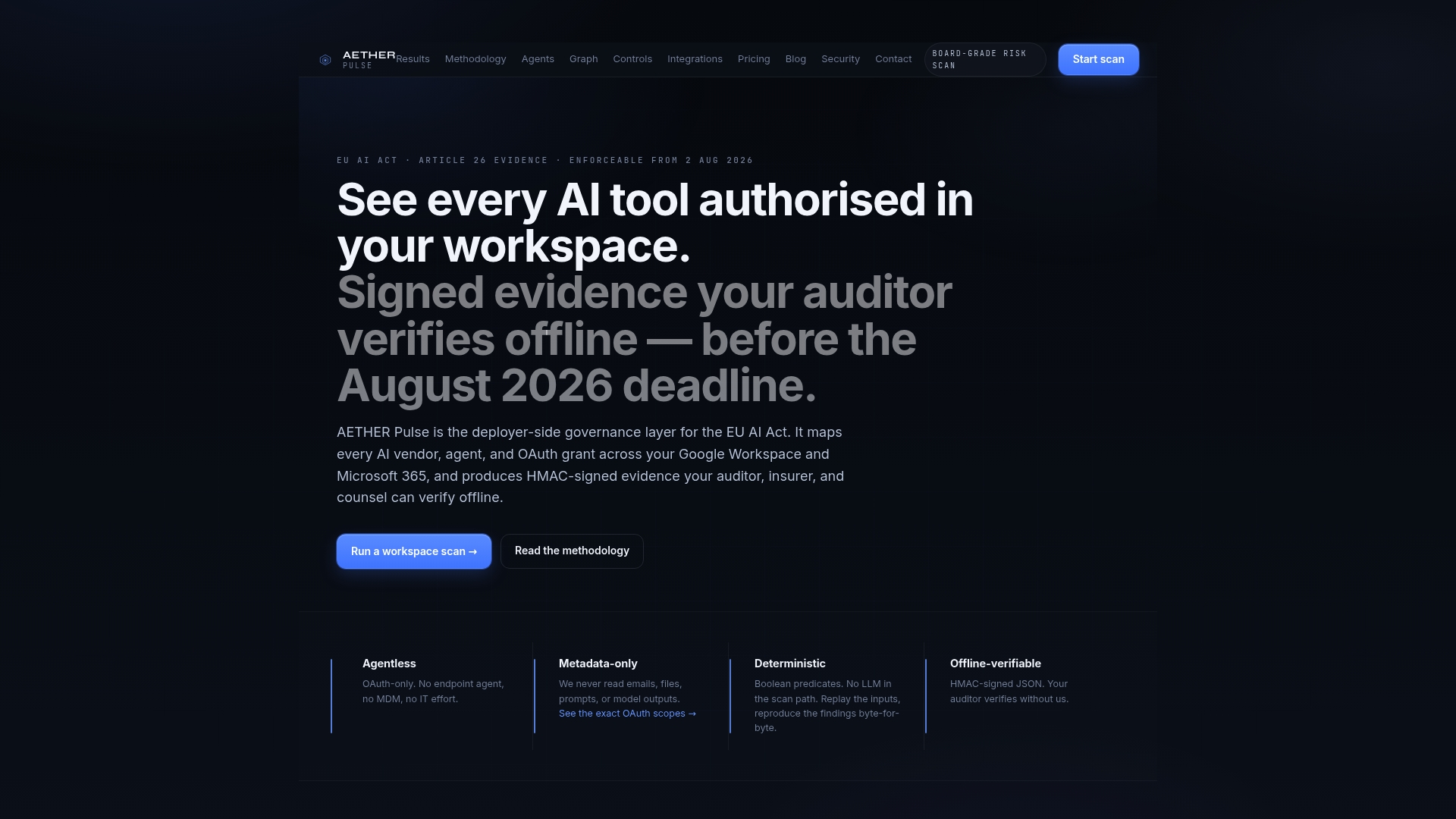
The platform builds your agent inventory and identity graph automatically, surfaces financial blast-radius concentration across your agent population, and produces reproducible evidence subsets ready for regulator handover, all without inserting an agent into your production stack. For firms managing FCA SYSC, EU AI Act Article 26, or Consumer Duty obligations, that agentless design preserves data sovereignty while still giving auditors exactly what they need to verify. Visit Aetherpulse to request a demo and see how your current agent inventory would translate into an audit-ready evidence pack.
This article is general information, not a substitute for advice from a qualified financial advisor. Consult a qualified financial professional about your own circumstances before acting on anything here.
Sources
- FINRA's 2026 oversight report signals a supervisory reckoning for autonomous AI — Stoel Rives / SW Law
- The FCA's Mills Review charts AI's path through retail financial services — Freshfields
- AI takes the wheel: lessons for the age of autonomy — Dentons
- Supervisory toolkit for AI use in capital markets — IOSCO
- Governing agentic AI in financial institutions — IBM white paper
Recommended
Working on Article 26 readiness, deployer-side governance evidence, or AI agent risk at a regulated firm? We'd value 15 minutes of your perspective.
Start a conversation