AI Governance Deployment Models Compared for Enterprises
AI Governance Deployment Models Compared for Enterprises

The choice of AI governance deployment model determines how effectively your organization controls AI risk, satisfies regulators, and produces defensible audit evidence. Three organizational models dominate enterprise practice: centralized, federated, and hybrid. Beneath those sit three infrastructure models that govern where data physically resides: on-premises, air-gapped, and sovereign cloud. The table below maps all six across the dimensions that matter most to compliance and risk functions.
| Model | Organizational structure | Control and ownership | Scalability | Regulatory compliance alignment | Operational complexity | Audit and monitoring |
|---|---|---|---|---|---|---|
| Centralized | Single governing body, top-down | Unified, central ownership | Limited at scale | Strong; uniform policy enforcement | Low to moderate | Straightforward; single audit trail |
| Federated | Domain-led, distributed teams | Distributed, local ownership | High; domain-specific | Variable; depends on coordination | Moderate to high | Complex; multiple audit streams |
| Hybrid | Central standards, federated execution | Shared; central policy, local adaptation | High | Strong with proper design | High | Requires reconciliation across layers |
| On-premises | Enterprise-owned infrastructure | Full customer control | Constrained by hardware | Strong for data residency requirements | High | Customer-owned logs and tooling |
| Air-gapped | Isolated from external networks | Complete isolation | Very constrained | Highest for classified or critical workloads | Very high | Fully internal; no vendor visibility |
| Sovereign cloud | Regionally compliant cloud | Shared with cloud provider | High | Strong for data residency and GDPR/AI Act | Moderate | Provider-assisted with customer oversight |
Key strengths and challenges at a glance:
- Centralized: Strong compliance uniformity; risks bottlenecks and reduced domain agility
- Federated: Domain expertise and speed; risks inconsistent oversight and audit gaps
- Hybrid: Compliance flexibility and depth; managing two policy stacks increases operational burden
- On-premises: Full data control; high capital and operational cost
- Air-gapped: Maximum isolation; model updates and policy changes require out-of-band channels
- Sovereign cloud: Regional compliance with managed infrastructure; residency guarantees vary by provider
Table of Contents
- 1. How does the centralized AI governance model work?
- 2. How does the federated AI governance model distribute control?
- 3. What makes the hybrid AI governance model the enterprise default?
- 4. Which infrastructure deployment model fits your compliance posture?
- 5. How should enterprises select the right AI governance deployment model?
- 6. Advanced considerations for governance integration and regulatory alignment
- 7. How US enterprises are implementing AI governance deployment models
- 8. How do you measure whether your AI governance model is working?
- Aetherpulse: governance evidence for regulated AI deployments
- Key Takeaways
1. How does the centralized AI governance model work?
The centralized model places all governance authority in a single body, typically an AI risk committee or Chief AI Officer function, that sets policy, approves deployments, and owns the audit record. Every business unit operates under standards issued from that center. Control is unified, which means policy drift across teams is structurally prevented rather than managed reactively.
The compliance advantages are real. A single policy stack produces a coherent audit trail, which satisfies the documentation expectations embedded in frameworks like the NIST AI Risk Management Framework and ISO/IEC 42001. Regulators reviewing AI decision-making can trace accountability to a named function with clear authority.
The structural weakness is throughput. When every AI deployment requires central sign-off, the governing body becomes a bottleneck, particularly in large enterprises running dozens of concurrent AI projects. Domain teams in fast-moving areas like trading or underwriting often find centralized review cycles misaligned with their deployment cadence.
Centralized model profile:
- Strengths: Uniform policy enforcement, clear accountability, simplified audit trail, strong compliance posture for high-risk AI systems
- Challenges: Approval bottlenecks at scale, reduced responsiveness to domain-specific risk contexts, risk of stakeholder disengagement if governance feels disconnected from operations
- US regulatory fit: Well-aligned with FTC guidelines on algorithmic accountability and sector-specific mandates requiring documented oversight chains
2. How does the federated AI governance model distribute control?
Federated governance assigns ownership of AI systems to the business units or domains that operate them, under a broad framework of enterprise-wide standards. A financial services firm running this model might have separate governance functions for retail banking, wealth management, and trading, each with local AI risk owners accountable for their own deployments.

The scalability advantage is significant. Domain teams apply governance with contextual knowledge that a central body cannot replicate. A credit risk team understands model drift in lending decisions differently than a central AI committee does, and federated structures let that expertise drive oversight. Effective AI governance frameworks recognize this by pairing centralized standards with federated execution rather than forcing all decisions through one channel.
The audit challenge is the inverse of centralized governance's strength. Multiple audit streams, each maintained by different domain teams with different tooling and documentation standards, create reconciliation work at the enterprise level. When a regulator requests a consolidated view of AI risk exposure, federated organizations often discover their audit evidence is fragmented across systems that were never designed to interoperate.
Federated model profile:
- Strengths: Domain expertise applied directly to oversight, faster deployment cycles, higher stakeholder ownership of governance outcomes
- Challenges: Inconsistent policy application across domains, audit fragmentation, risk of governance gaps where domain boundaries are unclear
- Mitigation: Centralized access controls and a shared risk taxonomy reduce the coordination overhead without eliminating domain autonomy
3. What makes the hybrid AI governance model the enterprise default?
Hybrid governance combines a central policy authority with federated execution at the domain level. The center defines risk tiers, documentation standards, approval thresholds, and audit requirements. Domain teams apply those standards to their specific AI systems, with authority to adapt within defined parameters. Hybrid deployment models score higher on enterprise readiness than either pure centralized or pure self-hosted approaches, specifically because of superior compliance flexibility and data residency control.
The operational complexity is real and often underestimated. Hybrid governance requires reconciling separate vendor and customer audit logs, which introduces hidden overhead in compliance reporting cycles. When a central policy update propagates to domain teams, version control across the policy stack becomes a governance problem in its own right. Enterprises that deploy hyperscaler-native governance tools face an additional constraint: those tools couple audit evidence tightly to proprietary cloud architecture, which complicates multi-cloud or hybrid audits.
Despite the complexity, regulated enterprises in the US consistently select hybrid because it is the only model that simultaneously satisfies enterprise-wide compliance mandates and domain-level operational requirements. A bank subject to both OCC model risk management guidance and state-level consumer protection rules needs the central policy authority to handle the former and domain flexibility to address the latter.
Hybrid model profile:
- Strengths: Compliance flexibility, defense-in-depth governance, enterprise scalability, supports both uniform standards and contextual adaptation
- Challenges: Dual policy stack management, audit log reconciliation, risk of policy version drift between central and domain layers
- US regulatory fit: Strongest alignment with layered compliance environments spanning federal and state requirements
4. Which infrastructure deployment model fits your compliance posture?
Infrastructure deployment models determine where the AI data plane physically resides and who holds the keys. That decision cascades directly into data residency compliance, audit log ownership, and the scope of any Business Associate Agreement or regulatory certification. EU AI Act Annex III high-risk categories often mandate customer VPC or on-premises deployment, and US equivalents in healthcare and defense carry similar constraints.
| Infrastructure model | Data-plane location | Key custody | Audit log retention | Regulatory fit |
|---|---|---|---|---|
| On-premises | Customer data center | Customer-only | Buyer-set | HIPAA, FedRAMP, classified workloads |
| Air-gapped | Isolated customer perimeter | Customer-only | Fully internal | Classified, critical infrastructure |
| Sovereign cloud | Regionally compliant cloud | Shared or customer BYO | Provider-assisted | GDPR, EU AI Act, data residency mandates |
On-premises deployment runs the entire stack inside customer-owned infrastructure. No inference traffic leaves the customer network boundary. The tradeoff is operating burden: the customer owns patching, capacity planning, and model update logistics. ISO/IEC 42001's Plan-Do-Check-Act governance loop applies inside the customer perimeter exactly as it does inside a vendor's environment.
Air-gapped deployment removes the network bridge to any external system entirely. Model updates and policy bundles arrive through controlled out-of-band channels. This is the correct posture for classified workloads or critical infrastructure environments where no inference traffic can transit a third-party network. It is not automatically safer than on-premises for all threat models; it trades network exposure for update latency and operational rigidity.
Sovereign cloud deployment keeps data within a defined geographic and legal boundary while retaining managed infrastructure benefits. Providers like AWS European Sovereign Cloud (a German-incorporated entity, physically separate from standard AWS regions) address CLOUD Act extraterritoriality concerns for EU customers. For US enterprises processing data subject to state privacy laws or sector-specific residency requirements, sovereign cloud offers a middle path between full on-premises control and standard multi-tenant SaaS exposure.
Infrastructure model selection factors:
- Residency requirements: does applicable law prohibit data leaving a specific jurisdiction?
- Key custody: does your compliance posture require customer-managed encryption keys?
- Audit log ownership: does your regulator require logs retained under your own SLO?
- Operating capacity: does your team have the infrastructure function to run self-hosted workloads?
5. How should enterprises select the right AI governance deployment model?
Model selection starts with compliance constraints, not organizational preference. Three conditions trigger an automatic move away from shared-infrastructure models: HIPAA-eligible data, FedRAMP requirements, or EU AI Act Annex III high-risk classification. Each of these creates specific evidence requirements that shared-tenancy architectures cannot satisfy without compromise.
Beyond compliance thresholds, the decision turns on four practical factors:
- Risk posture: High-risk AI systems, those making consequential decisions in credit, employment, or healthcare, require governance models with clear accountability chains and documented human-in-the-loop controls. Centralized or hybrid models provide this more reliably than pure federated structures.
- Organizational capacity: Federated and hybrid models require domain teams with genuine governance competence. Deploying federated governance into business units that lack AI risk expertise produces the appearance of distributed ownership without the substance.
- Audit expectations: If your regulator expects a consolidated, tamper-evident audit record, centralized or hybrid models with a unified evidence layer are structurally better suited than federated architectures with fragmented logs.
- Scalability horizon: Organizations planning to expand AI deployment across many domains should design for hybrid from the outset rather than retrofitting governance after centralized structures become bottlenecks.
Pro Tip: Inventory your current AI use cases and classify them by risk tier before selecting a governance model. A portfolio dominated by high-risk, regulated AI systems points toward centralized or hybrid with strong central oversight. A portfolio of lower-risk, domain-specific tools may tolerate more federated autonomy.
Scenarios where model fit is clearest: a federally regulated bank with a large model inventory benefits from hybrid governance with on-premises or sovereign cloud infrastructure. A mid-size enterprise with a single cloud provider and no high-risk AI classifications may find a centralized governance model on a customer VPC sufficient. The OECD Due Diligence Guidance for Responsible AI provides a structured due diligence framework that maps directly onto these selection criteria, covering impact identification, mitigation, and tracking across the AI lifecycle.
6. Advanced considerations for governance integration and regulatory alignment
C-suite sponsorship is the single most reliable predictor of governance program effectiveness. Without top-level sponsorship, governance frameworks become siloed, disconnected from strategy, and ineffective for actual risk reduction. The governance function needs authority to enforce policy, not just advise on it. Cross-functional governance committees, with representation from legal, compliance, privacy, security, and AI practitioners, provide the coordination mechanism that prevents policy from fragmenting across organizational boundaries.
Shadow AI is a structural risk in any governance model that lacks centralized access controls. When teams deploy AI tools outside formal oversight, the organization accumulates ungoverned risk exposure that audit functions cannot see. Centralized access controls, with role-based permissions governing who can deploy, modify, or retire AI systems, are the primary mitigation. This applies regardless of whether the organizational governance model is centralized, federated, or hybrid.
The regulatory timeline is tightening. EU AI Act high-risk obligations under Articles 6–15 become enforceable August 2, 2026, with penalties reaching 7% of global annual turnover. US enterprises processing EU-resident data in Annex III categories, which include employment-related AI, critical infrastructure management, and essential financial services, face these obligations directly. The NIST AI Risk Management Framework's Map and Govern functions provide a common vocabulary for aligning governance programs with both US and EU requirements. ISO/IEC 42001, a management-system standard governing AI policies and procedures via Plan-Do-Check-Act methodology, applies across all deployment shapes and provides the supplier and resource control families that procurement teams need.
Continuous monitoring and evidence generation are not optional features of a mature governance program. They are the operational mechanism by which governance produces defensible audit artifacts. For enterprises in regulated financial services, the finance tech stack increasingly needs to account for AI agent governance as a first-class infrastructure concern, not an afterthought bolted onto existing model risk management processes.
7. How US enterprises are implementing AI governance deployment models
Centralized model in practice: Large US financial institutions subject to OCC SR 11-7 model risk management guidance have historically favored centralized governance structures. A major retail bank, for example, routes all model approvals through a Model Risk Management function that owns the validation record, the audit trail, and the sign-off authority. When the OCC or Federal Reserve examines model risk, the bank presents a single, consolidated evidence package. The centralized structure makes that package producible; a federated structure would require assembling it from distributed sources under examination pressure.
Federated model in practice: Technology-forward enterprises with diverse AI portfolios across multiple business lines often operate federated governance by necessity. A large US technology company running AI systems across advertising, cloud services, and hardware products cannot practically route every deployment decision through a single committee. Domain teams own their AI systems under enterprise-wide principles, with central functions providing the risk taxonomy and documentation standards. The FTC's guidance on algorithmic accountability creates pressure to document decision-making chains, which federated organizations address through domain-level documentation requirements rather than central review.
Hybrid model in practice: US healthcare systems operating under HIPAA face a governance challenge that hybrid models address directly. Clinical AI tools, such as diagnostic decision support, require rigorous central oversight given their high-risk classification. Administrative AI tools, such as scheduling or billing optimization, can operate under lighter domain-level governance. A hybrid structure lets the central governance function concentrate its oversight capacity on the high-risk clinical systems while domain teams manage the administrative tools within defined parameters. The Responsible AI Pattern Catalogue from ACM Computing Surveys identifies multi-level governance patterns, spanning industry, organization, and team levels, that map directly onto this hybrid structure.
8. How do you measure whether your AI governance model is working?
Governance effectiveness is measurable, but the metrics need to be specific to the model in use. Generic "governance maturity" scores obscure the operational realities that actually determine whether oversight is functioning.
For centralized models:
- Time from AI deployment request to governance approval (cycle time)
- Percentage of production AI systems with complete, current documentation
- Number of policy exceptions granted and their documented rationale
- Audit finding rate per regulatory examination
For federated models:
- Consistency of risk classification across domains for equivalent AI system types
- Coverage rate: percentage of AI systems formally registered in the governance inventory
- Cross-domain audit reconciliation time when enterprise-level reporting is required
- Incident rate attributable to ungoverned or shadow AI deployments
For hybrid models:
- Policy version alignment between central standards and domain-level implementations
- Audit log completeness across both central and domain layers
- Time to produce a consolidated evidence package for a specific AI system on regulator request
- Rate of policy drift detection and remediation
Infrastructure-level metrics apply across all organizational models:
- Data residency compliance rate: percentage of AI workloads confirmed within required geographic boundaries
- Key custody verification: confirmation that encryption key ownership matches contractual and regulatory requirements
- Audit log retention compliance: percentage of logs retained under the organization's own SLO rather than vendor defaults
The IBM enterprise AI governance research notes that many CEOs say governance for generative AI must be integrated in the design phase rather than retrofitted after deployment. That integration intent needs to translate into measurable checkpoints at each lifecycle stage, not just a design-phase declaration.
Aetherpulse: governance evidence for regulated AI deployments
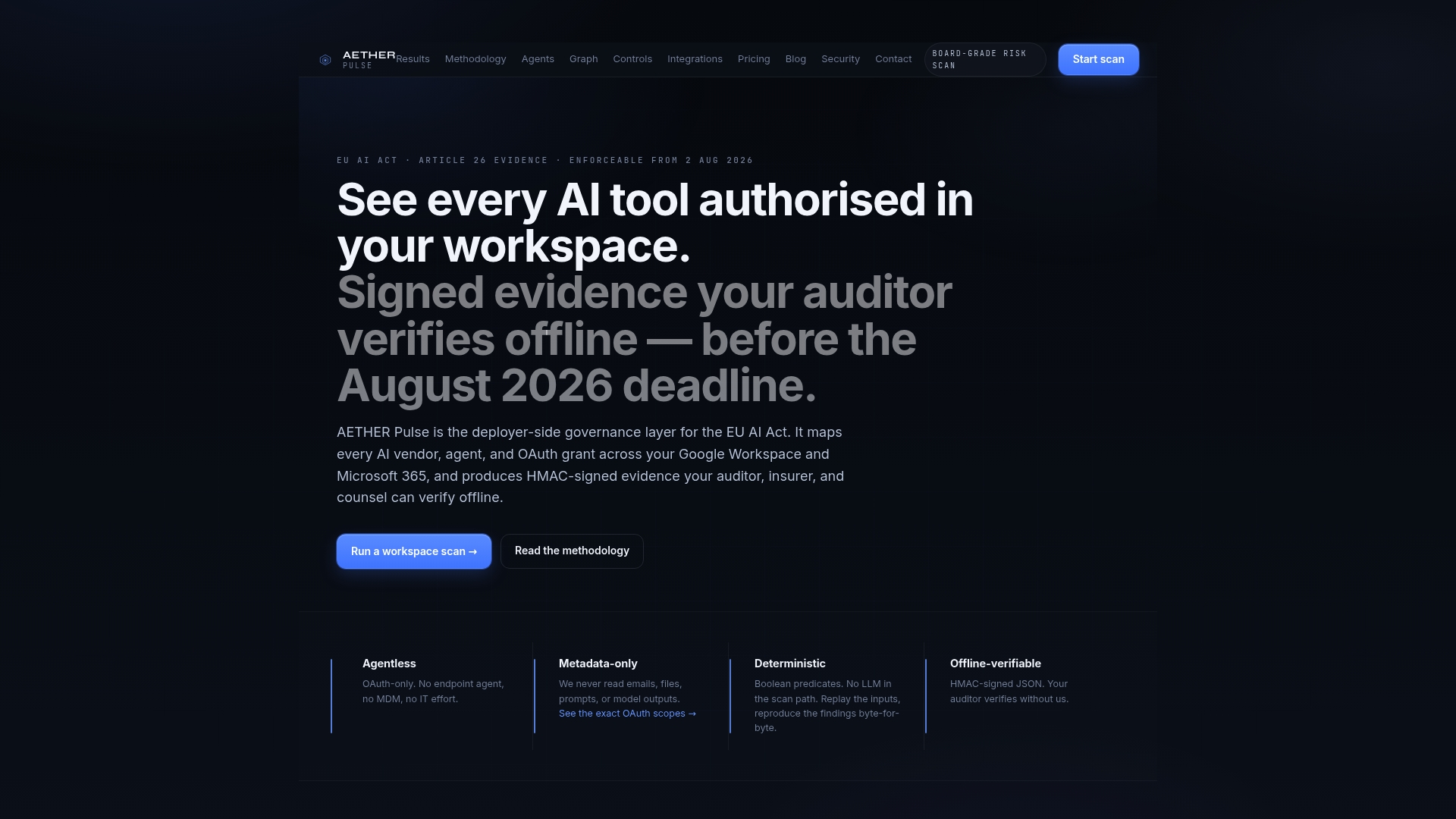
For regulated financial services firms, the gap between having a governance model and producing defensible evidence of that governance is where regulatory exposure lives. Aetherpulse addresses this directly. The platform connects through OAuth metadata only, touching no customer data, and produces tamper-evident, cryptographically signed (HMAC-SHA256) evidence packs that compliance functions can present to auditors and regulators on demand.
Aetherpulse builds an inventory and identity graph of an organization's AI agents, surfaces risk concentration including financial blast-radius exposure, and generates deterministic, provenance-tracked evidence aligned to EU AI Act Article 26, FCA Consumer Duty, SYSC requirements, and the ICO's developing code of practice on AI and automated decision-making. It deploys without inserting itself into production systems, which means no disruption to existing governance structures regardless of whether your organization runs a centralized, federated, or hybrid model.
Explore Aetherpulse to see how the evidence layer integrates with your existing governance architecture.
Key Takeaways
Hybrid AI governance, paired with the right infrastructure deployment model, delivers the strongest compliance posture for US enterprises operating under layered federal and state regulatory requirements.
| Point | Details |
|---|---|
| Hybrid leads on enterprise readiness | Hybrid governance scores highest on compliance flexibility, data residency, and governance depth across organizational models. |
| Infrastructure model drives audit ownership | On-premises and air-gapped deployments place full audit log retention under the customer's own SLO, not the vendor's. |
| C-suite sponsorship is structurally required | Without executive authority behind governance, frameworks become siloed and disconnected from risk reduction. |
| EU AI Act enforcement arrives August 2, 2026 | High-risk AI obligations under Articles 6–15 carry penalties up to 7% of global annual turnover for non-compliant enterprises. |
| Shadow AI is a governance model failure | Ungoverned AI deployments outside formal oversight accumulate risk that audit functions cannot see without centralized access controls. |
Recommended
Working on Article 26 readiness, deployer-side governance evidence, or AI agent risk at a regulated firm? We'd value 15 minutes of your perspective.
Start a conversation