AI Governance Without Data Access: A Compliance Guide
AI Governance Without Data Access: A Compliance Guide

AI governance without data access is the practice of controlling AI system behavior and demonstrating regulatory compliance without ever viewing, storing, or processing sensitive customer data. For compliance and risk management professionals in regulated financial services, this distinction is not theoretical. Regulators under the EU AI Act Article 26, the FCA's Consumer Duty, and GDPR data minimization requirements now expect firms to show documented oversight of automated decision-making. The challenge is doing that without creating new data exposure risks in the process. Cryptographic methods, including zero-access architectures and zero-knowledge proofs, make this possible today.
What is AI governance without data access?
AI governance without data access is defined as a governance model where oversight, audit evidence, and compliance attestation are produced through mathematical guarantees rather than direct inspection of raw data. The industry term for the underlying technical approach is "privacy-preserving AI governance." Both phrases describe the same goal: proving that an AI system behaved correctly without exposing the data it processed.
Traditional governance models require compliance teams to pull logs, review transaction records, and inspect model inputs and outputs. Each of those steps creates a new data handling event, a new liability, and a new attack surface. Privacy-preserving AI governance eliminates that chain entirely. Cryptographic proofs replace raw logs. Attestations replace screenshots. Audit evidence becomes verifiable without being readable.

This matters specifically in financial services because the data involved is not abstract. It is credit scores, account balances, biometric identifiers, and behavioral patterns. Any governance process that requires touching that data to prove compliance is self-defeating. The goal is oversight without exposure.
How do zero-access AI architectures enable governance without exposing data?
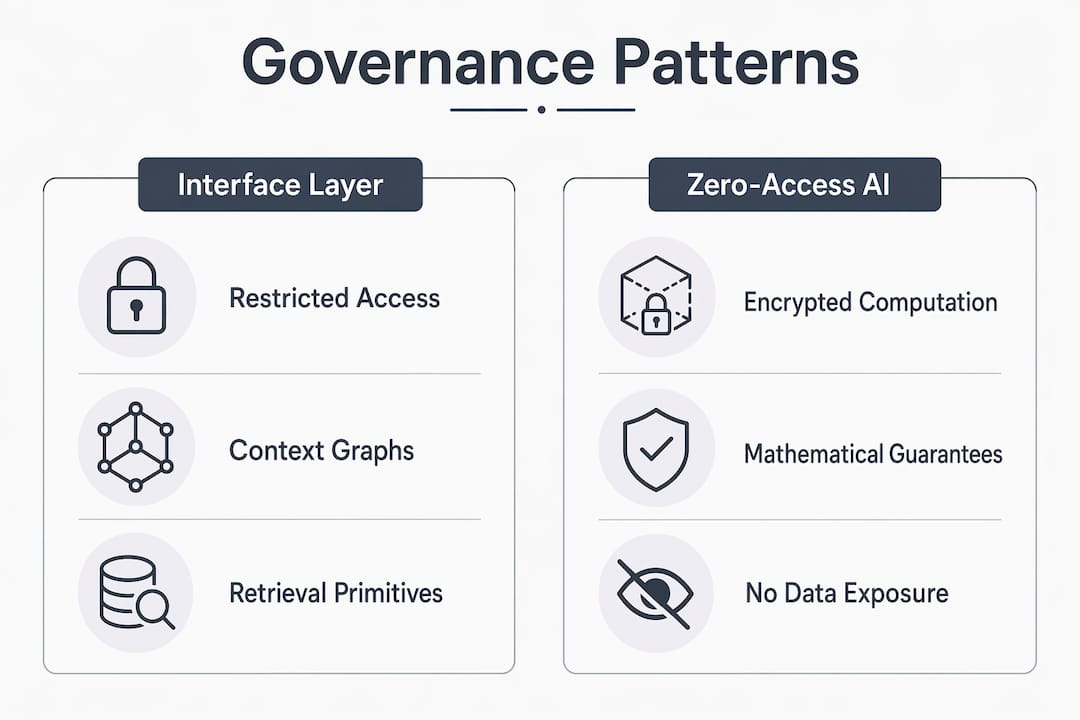
Zero-access AI architectures allow AI models to compute on encrypted ciphertext without decrypting the underlying data at any stage. The model receives encrypted inputs, processes them, and returns encrypted outputs. No plaintext is exposed, not in GPU memory, not in cloud processing pipelines, and not in inference logs.
The technical foundation is fully homomorphic encryption (FHE). FHE permits encrypted computation where computations on ciphertext produce results that match what plaintext computation would yield. The decryption keys never leave the client. The server running the model has no decryption capability built into its binary. This means a vendor operating the AI system cannot access your customer data even if compelled to do so.
For compliance professionals, the practical output of a zero-access architecture is a short cryptographic attestation. That attestation proves the model ran, confirms the inputs were within scope, and records the output hash. It is auditable, tamper-evident, and contains no customer data. Regulators and internal audit functions can verify the attestation without seeing a single record.
Key characteristics of a production-grade zero-access AI architecture include:
- Encrypted input and output at every inference call, with no plaintext intermediary state
- Cryptographic attestations generated per inference, signed and time-stamped
- Server-side binary that excludes decryption code by design, not by policy
- Client-held decryption keys that never transit the network
- Audit records that reference proof hashes, not raw data fields
Pro Tip: When evaluating vendor claims of zero-access AI, ask for the server binary's decryption capability documentation. A genuine zero-access architecture cannot decrypt client data at the server level. If the vendor cannot produce that documentation, the claim is a policy commitment, not a mathematical guarantee.
Policy-based access controls can be revoked, misconfigured, or overridden. Mathematical guarantees cannot. Relying solely on policy is insufficient for true data protection in regulated environments. Zero-access architectures move the guarantee from the trust layer to the cryptographic layer.
How do zero-knowledge proofs attest AI compliance without sharing logs?
Zero-knowledge proofs (ZKPs) are cryptographic constructs that allow one party to prove a statement is true to another party without revealing any information beyond the truth of that statement. In AI governance, ZK-SNARKs and ZK-STARKs prove compliance predicates, such as "this AI agent did not access data outside its authorized scope" or "this model's output fell within the approved decision range," without exposing the underlying logs or behavioral data.
This is a direct answer to a problem that traditional log-based audits cannot solve. A conventional audit requires a compliance officer to review raw interaction logs. Those logs contain personal information. Retaining them creates GDPR liability. Sharing them with external auditors creates further exposure. ZK proofs provide compliance attestation without storing sensitive behavioral logs, reducing liabilities under both GDPR and the EU AI Act simultaneously.
The current state of ZKP technology in AI governance is important to understand accurately. ZK proofs for AI agent compliance focus on post-hoc assertions over structured logs, because proving entire model computation inside ZK circuits remains infeasible at scale today. The practical application is proving what the agent did, not proving how the model computed it. That distinction matters for scoping your compliance program.
Real-world applications in regulated banking environments include:
- Proving API scope compliance: the agent only called authorized endpoints
- Proving data access restrictions: no customer record outside the transaction scope was queried
- Proving policy adherence: the agent's decisions fell within pre-approved parameters
- Proving output integrity: the response was not modified between model output and delivery
Compared to traditional log-based audits, ZKP-based attestation produces a verifiable proof that a regulator can check mathematically. The auditor becomes a verifier of cryptographic proofs rather than a reviewer of raw data. This shift in audit paradigm is fundamental. It removes the auditor's need to hold or inspect sensitive data, which itself reduces the audit process's regulatory footprint.
Architectural patterns for governing AI without data access in practice
The most practical governance architecture restricts the AI agent to an interface role. AI agents deployed as interface layers convert natural language queries into structured operations, such as SQL, without storing or copying the underlying data. The agent generates code. A separate, governed data layer executes it. The agent never holds the result set.
Context graphs and retrieval primitives enforce this separation at the architectural level. The AI model receives a context graph describing what data it may reference, not the data itself. Retrieval primitives define the exact operations the model may invoke. Untagged data is dropped at the retrieval boundary before it reaches the model. This is tool binding: the AI's capabilities are constrained by architecture, not by instruction.
The governance benefit of segregating AI decision logic from data custody is significant. If the AI layer is compromised, the attacker gains access to a model and a context graph. They do not gain access to customer records. The blast radius of an AI-layer breach is contained by design.
| Architecture pattern | Data exposure at AI layer | Audit evidence type | Regulatory fit |
|---|---|---|---|
| Direct data access model | Full plaintext exposure | Raw logs (GDPR risk) | Low |
| Policy-restricted access | Partial, policy-dependent | Access logs (mutable) | Moderate |
| Interface layer with tool binding | None. Agent sees queries only | Structured attestations | High |
| Zero-access with FHE | None. Ciphertext only | Cryptographic proofs | Highest |
Pro Tip: When designing your AI governance architecture, map the blast radius before deployment. Identify which systems the AI agent can reach, what data those systems hold, and what the maximum exposure would be if the agent's credentials were compromised. Architecture that limits the agent to code generation rather than data custody reduces that blast radius to near zero.
The primary challenge with interface-layer architectures is latency. Adding a retrieval boundary and a context graph lookup adds processing time. For real-time decisioning in payments or credit, that overhead requires careful engineering. The mitigation is pre-computed context graphs refreshed on a schedule, rather than built per-query.
What are the benefits and limitations of AI governance without customer data access?
The privacy benefits of data-access-free governance are direct and measurable. Eliminating insider threat risk is the most significant. If compliance officers, auditors, and governance tools never touch customer data, the insider threat surface for that data disappears entirely. There is no privileged access to misuse.
Retention of raw AI interaction logs creates legal and privacy risks that cryptographic audit evidence eliminates. Log data frequently contains personal information that GDPR restricts. Hashed and proof-based records minimize data retention impact while preserving full auditability. This is a direct alignment with GDPR's data minimization principle and the EU AI Act's transparency requirements.
Cryptographic anchors like Merkle roots and STARK proofs create immutable, verifiable audit records that withstand tampering. The primary risk in AI auditing is mutable logs. A compliance program built on mutable logs is vulnerable to both accidental corruption and deliberate manipulation. Cryptographic anchors remove that vulnerability entirely.
The limitations are real and should be part of your risk assessment:
- FHE computation is significantly slower than plaintext computation. Real-time inference at scale requires purpose-built hardware or careful scope limitation.
- ZKP generation has computational cost. Proof generation time must be factored into SLA commitments for regulated processes.
- Regulatory acceptance of cryptographic proofs as audit evidence is still developing. The EU AI Act and FCA frameworks support the principle, but specific proof formats are not yet standardized.
- Implementation complexity is high. Building a zero-access architecture requires cryptographic engineering expertise that most financial services firms do not hold in-house.
The trajectory is clear. Regulatory frameworks are moving toward requiring mathematical guarantees, not policy commitments. Firms that build familiarity with these architectures now will be positioned ahead of the compliance curve when standards solidify.
Key Takeaways
AI governance without data access is the only approach that provides mathematical, rather than policy-based, guarantees of privacy for regulated AI systems in financial services.
| Point | Details |
|---|---|
| Zero-access architecture | AI models compute on encrypted ciphertext, producing cryptographic attestations with no plaintext exposure. |
| Zero-knowledge proofs | ZK-SNARKs and ZK-STARKs prove compliance predicates without retaining or sharing sensitive behavioral logs. |
| Interface layer design | Restricting AI agents to code generation with tool binding eliminates data custody at the AI layer. |
| Audit paradigm shift | Auditors verify cryptographic proofs rather than inspect raw data, reducing the audit process's own regulatory footprint. |
| Limitation awareness | FHE and ZKP carry computational overhead and regulatory acceptance is still developing. Plan for both. |
The uncomfortable truth about AI governance in financial services
The compliance profession has spent decades building governance frameworks on a foundation of access controls and policy documents. The assumption was that if you restrict who can see data and write down the rules, you have governance. AI agents break that assumption completely.
An AI agent operating under a policy-based access control is still an agent that can see plaintext data. If the policy is misconfigured, if the credentials are compromised, or if the model behaves unexpectedly, the data is exposed. The policy did not prevent anything. It just described what should have happened.
What I find most striking, having worked through the implications of these cryptographic architectures, is how much the financial services sector underestimates the gap between "we have a policy" and "we have a guarantee." Regulators are beginning to close that gap for them. The EU AI Act's Article 26 obligations and the ICO's developing code of practice on automated decision-making are both moving toward requiring demonstrable, verifiable oversight. A policy document does not demonstrate anything. A cryptographic proof does.
The firms that will handle the next wave of AI regulation well are not the ones with the most detailed governance policies. They are the ones that have already moved their oversight mechanisms from the trust layer to the cryptographic layer. That transition takes time and engineering investment. Starting now, even at the architecture review stage, puts you ahead of the majority of the market.
— Eleye
How Aetherpulse supports AI governance for regulated firms
Compliance and risk management professionals who need to demonstrate AI oversight without touching customer data have a direct path forward with Aetherpulse.
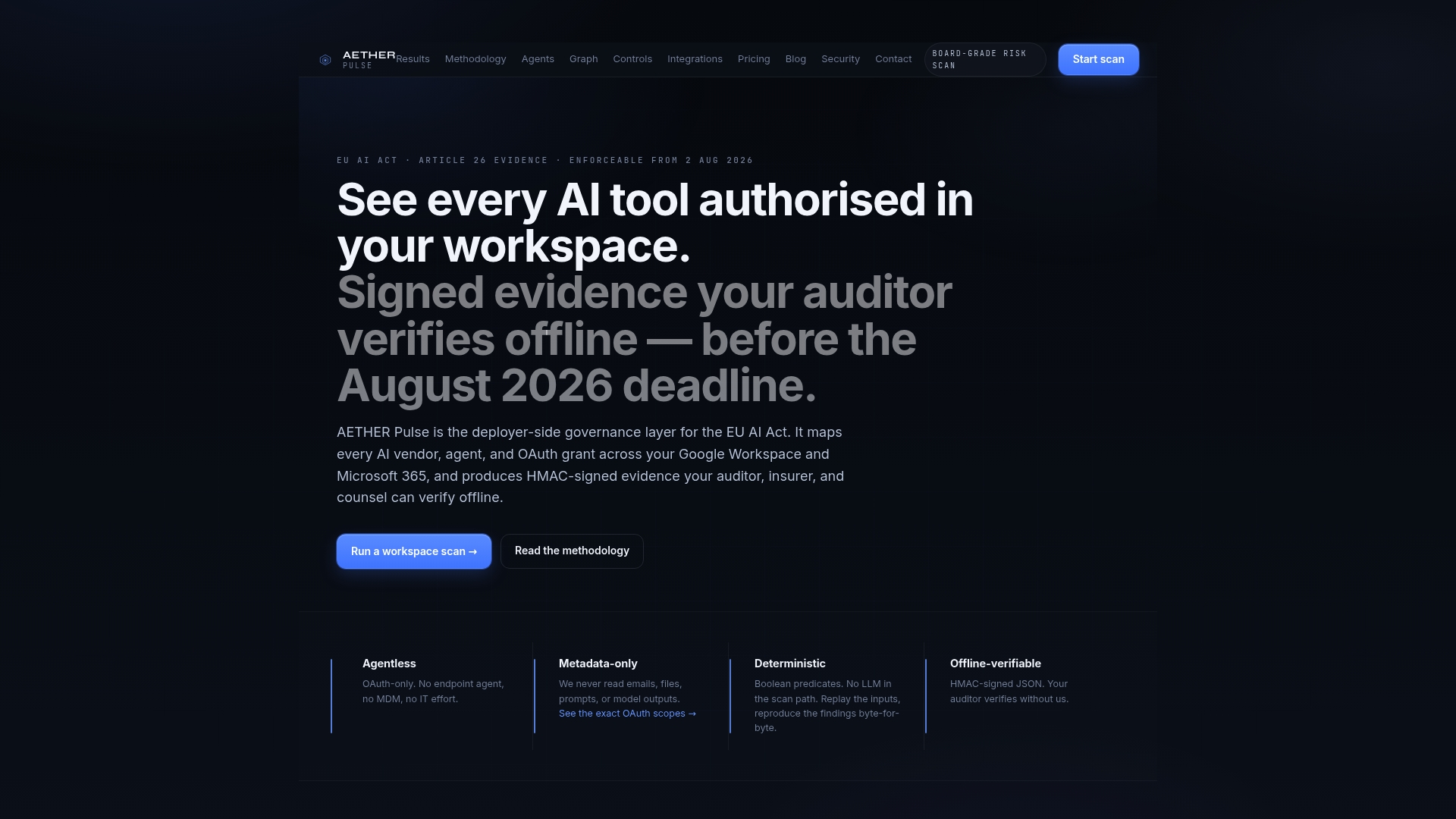
Aetherpulse connects via OAuth metadata only, building an inventory and identity graph of your organization's AI agents without accessing any customer records. It produces tamper-evident, HMAC-SHA256 signed evidence packs that satisfy auditors, regulators, and internal risk functions under the EU AI Act Article 26, FCA Consumer Duty, and SYSC requirements. The platform surfaces risk concentration and financial blast-radius exposure on demand. For firms that need audit-ready AI governance without the data liability, Aetherpulse is built for exactly that regulatory environment.
FAQ
What is AI governance without data access?
AI governance without data access is the practice of overseeing AI system behavior and producing compliance evidence through cryptographic methods rather than direct inspection of sensitive data. It uses zero-access architectures, zero-knowledge proofs, and tamper-evident audit records to satisfy regulators without exposing customer information.
How do zero-knowledge proofs support AI compliance in financial services?
Zero-knowledge proofs allow compliance teams to prove that an AI agent followed authorized data access policies and decision parameters without revealing the underlying logs or customer records. ZK-SNARKs and ZK-STARKs generate verifiable attestations that regulators can check mathematically.
Is fully homomorphic encryption practical for financial services AI today?
FHE is production-viable for specific, scoped use cases but carries significant computational overhead compared to plaintext inference. Real-time, high-volume decisioning at scale requires purpose-built hardware. Firms should scope FHE to high-risk, lower-frequency processes while broader performance improvements continue to develop.
What does the EU AI Act require for AI governance in regulated firms?
EU AI Act Article 26 requires deployers of high-risk AI systems to implement human oversight, maintain logs, and demonstrate that automated decisions can be reviewed and corrected. Privacy-preserving governance architectures satisfy these requirements while aligning with GDPR data minimization obligations.
How does Aetherpulse implement AI governance without accessing customer data?
Aetherpulse connects through OAuth metadata only, never touching customer records or production data. It builds an AI agent inventory and generates HMAC-SHA256 signed evidence packs that provide tamper-evident audit trails for regulators and internal risk functions across FCA and EU AI Act frameworks.
Recommended
Working on Article 26 readiness, deployer-side governance evidence, or AI agent risk at a regulated firm? We'd value 15 minutes of your perspective.
Start a conversation