90 Days to Audit Ready AI Risk Concentration for Regulated Finance
90 Days to Audit Ready AI Risk Concentration for Regulated Finance

AI risk concentration is the buildup of shared dependencies among an organization's autonomous AI agents, where a single foundation model, cloud provider, or data feed sits behind so many automated decisions that its failure creates a wide blast radius. For regulated financial firms, this means one thing operationally: you must inventory every agent, map what it depends on, and produce audit-ready evidence showing you understand your exposure before a regulator asks.
TL;DR:
- Most firms discover shadow AI and unmonitored dependencies for months during initial inventories, highlighting the need for comprehensive discovery processes.
- Dependency mapping should identify all agents, underlying models, data feeds, and cloud regions to calculate blast radius and establish materiality thresholds.
- Regulators expect verifiable, tamper-evident documentation of agent inventories, dependency maps, audit logs, vendor change notifications, and remediation records.
- Runtime controls such as pre-execution evaluation, automatic circuit breakers, and escalation protocols are essential for limiting concentration exposure during live operations.
- Quarterly re-scans and monthly failover tests are recommended to detect model changes early and prevent systemic risks from shared dependencies.
Table of Contents
- What AI Risk Concentration Means in Regulated Finance
- Why Concentration Matters to Auditors, Boards, and Regulators
- How to Detect and Map AI Risk Concentration
- Governance and Runtime Controls That Cut Concentration Exposure
- What Audit-Ready Evidence Actually Looks Like
- What Risk Leaders Should Do in the Next 90 Days
- Get Audit-Ready Without Touching Production Data
- Sources
- FAQ
What AI Risk Concentration Means in Regulated Finance
AI risk concentration, in this context, has nothing to do with how many AI companies dominate the global market. It's about how many of your deployed agents rely on the same underlying dependency, and what happens operationally if that dependency fails, drifts, or gets compromised. This is enterprise agent concentration, not industry concentration, and mixing up the two leads compliance teams to answer the wrong regulatory questions entirely.
Three examples show how this plays out inside a typical regulated firm:
- A loan underwriting agent and a fraud detection agent both call the same third-party foundation model API. A vendor outage or a silent model update degrades both functions simultaneously.
- Twelve customer service and back-office automations all route through one Apps Script or workflow platform tied to a single OAuth grant, so one compromised credential exposes every downstream action.
- A payments' reconciliation agent and a sanctions screening agent both pull from the same data feed vendor, meaning a data quality failure propagates into two critical, correlated control functions at once.
Regulators care because correlated agent failures behave like correlated financial exposures. The Bank of England has flagged how shared model providers can cause many firms to misjudge risk at the same moment, turning an isolated technical fault into a systemic resilience question.
Why Concentration Matters to Auditors, Boards, and Regulators
Auditors don't ask "is your AI accurate?" anymore. They ask "can you show me what this agent depends on, and what happens if that dependency breaks?" Concentration risk sits at the center of that question because it determines how far a single failure travels through your control environment.
Three specific concerns show up repeatedly in audit and supervisory conversations:
- Provenance gaps: can you prove which model version made a given decision, and when?
- Correlated errors: do multiple "independent" controls actually share the same point of failure?
- Vendor opacity: can your third-party AI providers even tell you what changed in their model last quarter?
A pattern regulators keep flagging: the FSB has identified third-party dependency and provider concentration as vulnerabilities that could amplify stress across the financial system, not just within one firm. IOSCO's supervisory toolkit goes further, calling for lifecycle governance and stronger third-party due diligence specifically because outsourced AI functions tend to hide concentration until something breaks. The U.S. Treasury's report on AI in financial services documents the same pattern from the industry side: firms flagged foundation model and vendor dependency as a top concern, and recommended phased rollouts and circuit breakers as a direct response.
How to Detect and Map AI Risk Concentration
Mapping concentration risk is a discovery exercise before it's a documentation exercise. You cannot evidence what you haven't found, and most firms discover during their first inventory pass that shadow AI, automated in a spreadsheet macro or an unreviewed Apps Script, has been running unmonitored for months.
- Discover every agent. Pull OAuth grants, API keys, and service accounts across your environment. Anything with standing authorization to act, not just to read, counts as an agent for this purpose.
- Build a metadata inventory. Record each agent's owner, purpose, authorized action types, and the systems it can touch. This should not require reading customer data, only the metadata describing what the agent is permitted to do.
- Construct an identity graph. Link each agent identifier to its underlying model version, cloud region, and data feed. This graph becomes the artifact auditors query to trace an exposure path in minutes instead of weeks.
- Map dependencies layer by layer. Foundation model, cloud infrastructure, data vendor, and downstream application each represent a separate concentration layer, and the BIS notes that concentration at the chips and cloud layer creates migration friction that makes vendor lock-in worse over time.
- Calculate blast radius. A workable formula multiplies the agent's authorized monetary exposure (daily settlement value, account limits it can touch) by a probability weight for its likely failure modes. A small agent controlling payment releases can carry a higher blast radius than a large agent that only drafts internal reports.
- Set materiality thresholds. Not every shared dependency needs board attention. Flag concentration only where blast radius crosses a threshold your risk committee has pre-approved.
Auditors will typically expect three deliverables from this exercise: a signed dependency map, a sample set of per-action logs showing disposition (approved, blocked, escalated), and a prioritized remediation list ranked by blast radius rather than by how easy each fix is.
Pro Tip: Don't rank remediation by ease of fix. Rank it by blast radius first, then by ease of fix within each tier. Otherwise you'll spend a quarter closing low-risk items while the concentrated exposure sits untouched.
Governance and Runtime Controls That Cut Concentration Exposure
The three lines of defense model still applies to agentic AI; it just needs new owners. The first line is the business unit deploying the agent; the second line is risk and compliance setting the rules the agent must operate within; the third line is internal audit testing whether those rules actually held under live conditions.
Runtime controls do the heaviest lifting because they intervene before an action executes, not after damage is done:
- Pre-execution evaluation checks a proposed agent action against policy before it fires.
- A disposition engine logs whether each action was approved, blocked, or escalated, and why.
- Circuit breakers halt an agent automatically once it crosses a defined loss or volume threshold.
- Escalation service level agreements set a maximum time before a human reviewer must respond to a flagged action.
The Monetary Authority of Singapore's SAFR framework describes exactly this kind of runtime governance layer, pairing pre-execution evaluation with immutable audit logs written at the moment of decision, not reconstructed afterward.
On the vendor side, third-party risk management needs four contractual teeth: transparency into model changes, advance notification before a material update ships, a documented fallback arrangement if the vendor fails, and the right to test that fallback under realistic conditions. Our guide on AI model change management walks through how to structure those change notification clauses for bank vendor contracts.
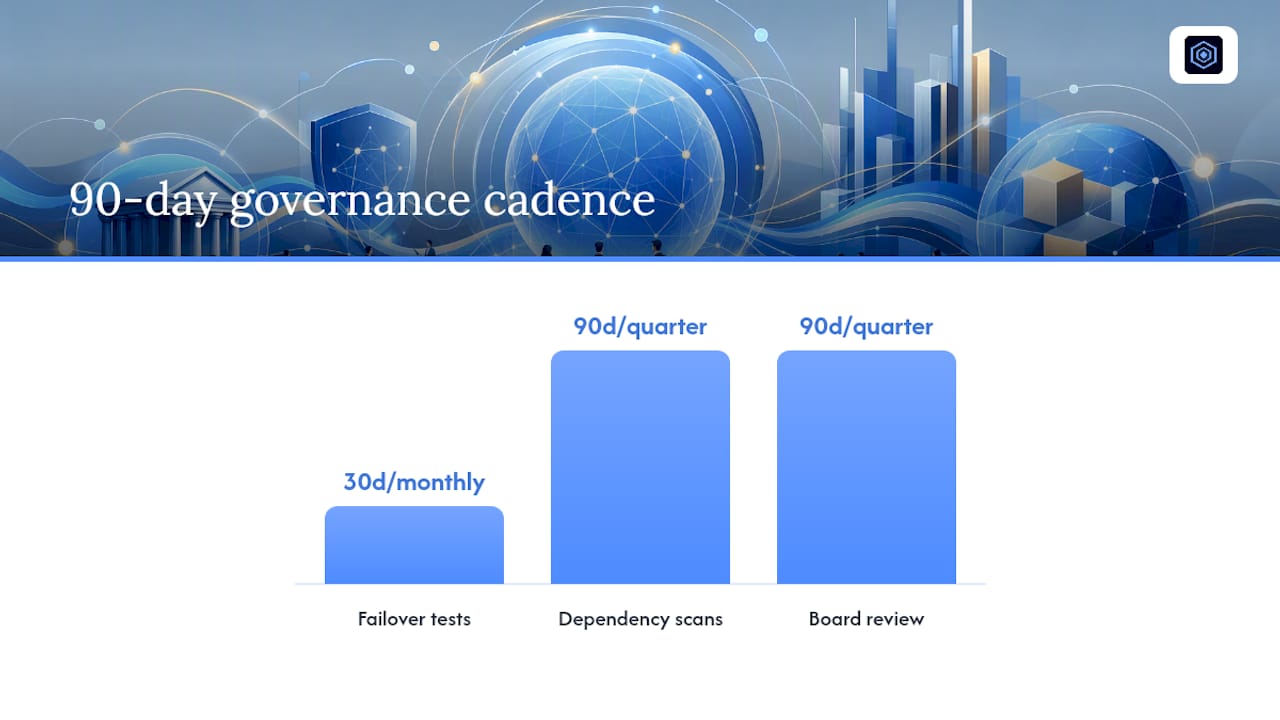
Pro Tip: Schedule dependency re-scans quarterly, not annually. Vendors change model versions far more often than most contracts require them to disclose it.
Build a reporting cadence around this: monthly failover tests for your most concentrated agents, quarterly dependency re-scans across the full inventory, and a standing item on the board risk committee agenda tied to blast-radius trend, not just incident count.
What Audit-Ready Evidence Actually Looks Like
An evidence pack that satisfies an examiner has specific, non-negotiable properties. It isn't enough to have the right documents; those documents have to be provably unaltered and independently checkable.
The core items auditors and regulators want to see:
- A current agent inventory with owners and authorized action types
- A dependency map showing shared foundation models, cloud regions, and data vendors
- Per-action audit logs with disposition (approved, blocked, escalated) for a representative sample
- Vendor due diligence artifacts, including change notification history
- Incident and remediation logs tied back to specific concentration findings
Every one of these items needs to be tamper-evident, time-stamped, and provenance-tracked, meaning an examiner can verify offline that nothing was altered after the fact, typically through cryptographic signatures rather than a screenshot or exported spreadsheet. IOSCO's toolkit explicitly calls for firms to maintain contractual access rights so supervisors can pull this data, and vendor system information, on request rather than waiting on a bespoke report.
Package evidence as a self-contained pack per audit cycle: full artifacts retained internally, a sample extract prepared for the specific examiner request, and a chain-of-custody note showing who generated the pack and when. Our governance reporting metrics guide has templates for structuring the board-facing summary version of this same pack.
What Risk Leaders Should Do in the Next 90 Days
Start with discovery, not policy. Every firm we've studied that struggled with an AI-related audit finding had a governance framework on paper before it had an actual agent inventory. Get the inventory and identity graph built first; the policy gaps become obvious once you can see what you're governing.
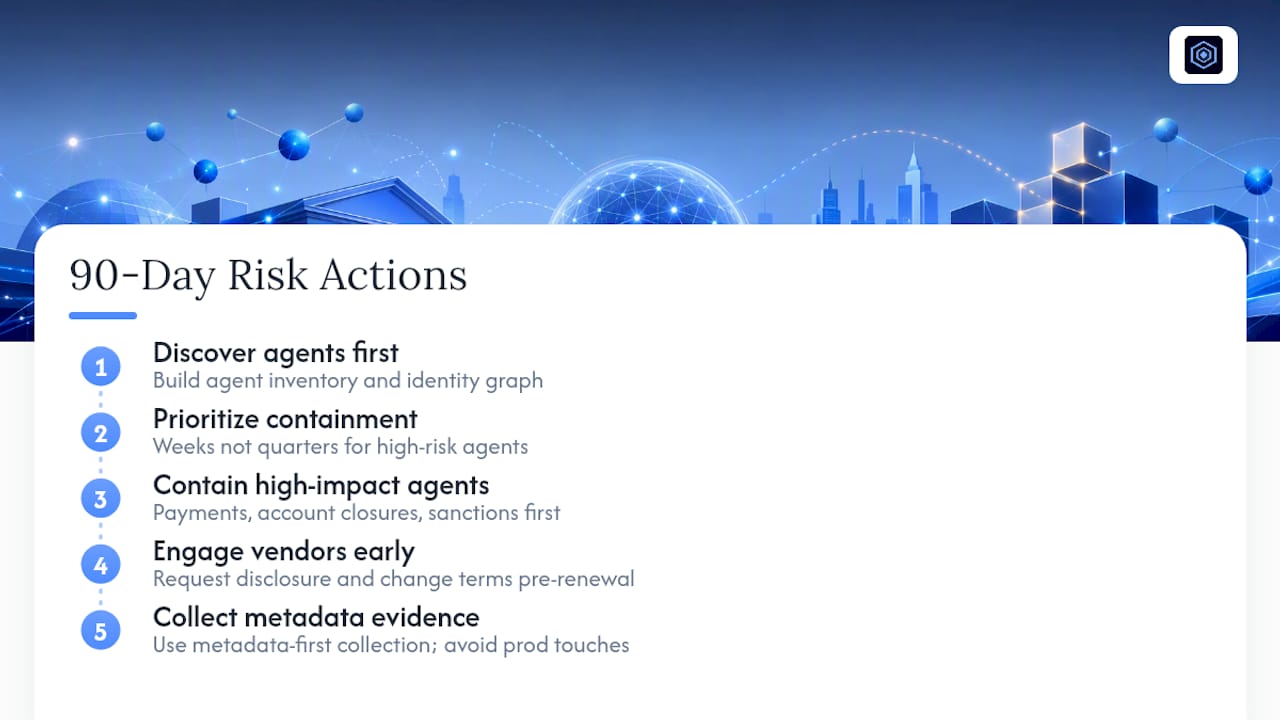
Set a short containment window, weeks not quarters, for any agent whose blast radius touches payments, account closures, or sanctions screening. Everything else can wait for the next remediation cycle. Push your vendors for disclosure now, before a regulator makes you ask; most third-party AI providers will negotiate change notification terms if you ask before renewal, not after an incident.
Metadata-first evidence collection works because it's the only approach that's both fast to deploy and defensible offline; agent-based tooling that touches production data invites its own security review before it solves your compliance one.
— Eleye
Get Audit-Ready Without Touching Production Data
Most AI governance tooling forces a tradeoff you shouldn't have to make: deep visibility or production safety, but not both. This tradeoff can be resolved by connecting through metadata only, without endpoint agents or access to customer data, allowing an agent inventory, identity graph, and blast-radius mapping as described here without adding a new attack surface to your production environment.
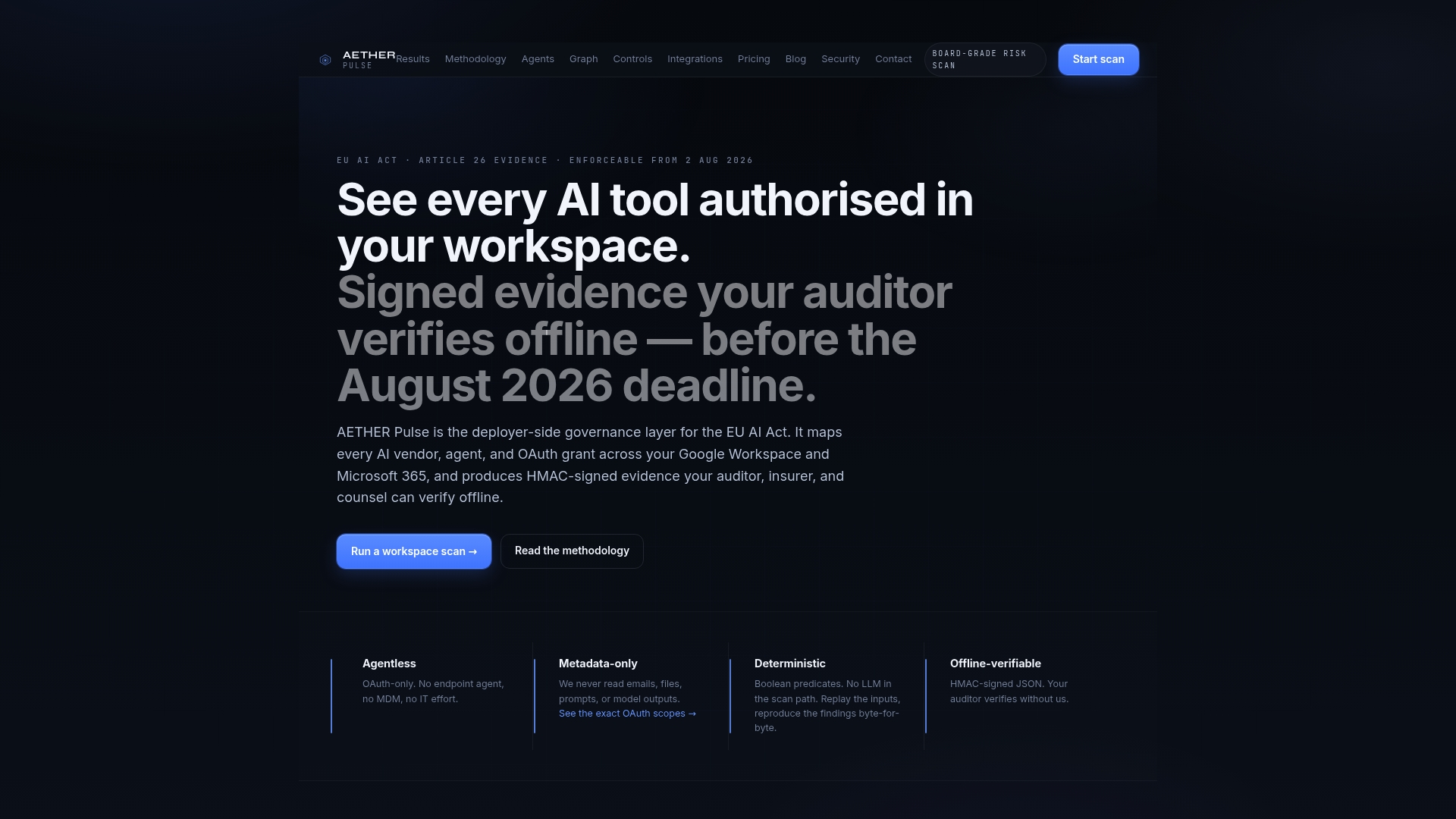
Evidence packs can be tamper-evident and cryptographically signed (HMAC-SHA256) to support the audit cycle described above: inventory, dependency map, per-action disposition logs, and vendor due diligence artifacts, all verifiable offline by an examiner. Such evidence packs align with expectations from EU AI Act Article 26, FCA SYSC, Consumer Duty, and ICO frameworks.
If you're heading into an Article 26 readiness review or need to show a board committee your concentration exposure this quarter, start with the Article 26 readiness audit or explore Free, Pro, and Enterprise plans to see how fast the agent inventory can be running in your environment. Review the security architecture first if your procurement team needs that detail before a demo call.
Sources
- Financial Stability in Focus: Artificial intelligence in the financial system | Bank of England
- Uses, Opportunities, and Risks of Artificial Intelligence in Financial Services | U.S. Department of the Treasury
- The AI adventure: how artificial intelligence may shape the economy and the financial system | FSB
- Supervisory toolkit for AI use in capital markets | IOSCO
FAQ
What Is AI Risk Concentration in Financial Services?
It's the buildup of shared dependencies, a foundation model, vendor, or data feed, across multiple deployed AI agents within one firm, so that a single failure creates a wide blast radius. It is distinct from market-level AI concentration, which concerns industry dominance rather than an individual firm's operational exposure.
How Do You Calculate Blast Radius for an AI Agent?
Blast radius couples an agent's authorized monetary exposure, such as daily settlement value or account limits it can touch, with a probability weight for its likely failure modes. A small agent with payment authority can carry a higher blast radius than a larger agent limited to internal reporting.
What Evidence Do Regulators Expect for AI Agent Oversight?
Examiners typically want a current agent inventory, a dependency map, per-action audit logs showing disposition, vendor due diligence records, and incident remediation logs. IOSCO's supervisory toolkit calls for these to be accessible on request and verifiable independently, not just summarized in a report.
Can Aetherpulse Access Our Customer Data During Setup?
No. Aetherpulse connects through OAuth metadata only, meaning it can build an agent inventory and evidence pack without ever touching customer or production data. Plan details are available on the Aetherpulse site, with pricing and audit services listed on the pricing page.
How Often Should We Re-Scan for New Concentration Risk?
Quarterly dependency re-scans catch most vendor model updates before they surface as an incident, since providers change model versions far more often than most contracts require disclosure. Pair that cadence with monthly failover tests on your highest blast-radius agents.
Recommended
Working on Article 26 readiness, deployer-side governance evidence, or AI agent risk at a regulated firm? We'd value 15 minutes of your perspective.
Start a conversation