Make Your Banking AI Governance Audit Ready in 90 Days for Risk Leaders
Make Your Banking AI Governance Audit Ready in 90 Days for Risk Leaders

Banking AI governance is the set of institution-wide controls, documentation, and evidence needed to deploy artificial intelligence safely, fairly, and defensibly under regulatory scrutiny. Its objective is proportionate oversight: material AI use cases get rigorous controls, low-risk ones get lighter ones, but every use case is inventoried and accountable to a named executive. The single immediate priority for any bank without a mature program is building that inventory and assigning senior ownership before the next exam cycle arrives.
TL;DR:
- Building a comprehensive AI inventory with clear ownership and materiality levels is the foundational step for effective banking AI governance.
- High-risk use cases such as credit decisioning and agentic AI require strict approval gates, detailed documentation, and ongoing validation of explainability and bias.
- Evidence readiness involves maintaining immutable logs, documenting change histories, and providing regular performance, bias, and drift monitoring reports for regulators.
- Governance roles must be clearly assigned across board, first-line, risk, and audit functions to prevent oversight gaps and ensure accountability.
- Implementing phased, automated controls within 90 days and continuously testing AI resilience helps banks meet evolving regulatory expectations efficiently.
Table of Contents
- What Does Banking AI Governance Actually Cover?
- What Are the Material Risks AI Governance Must Control?
- Which AI Use Cases Demand the Strictest Governance?
- What Do Regulators and Supervisors Actually Expect?
- What Are the Core Components of a Governance Framework?
- How Do You Actually Implement This Program?
- What Evidence Do Regulators Want to See?
- Who Owns What: Roles and Decision Rights
- Your 90-Day and 12-Month Action Plan
- How Should Ethics and Fairness Be Built Into the Framework?
- How Should You Communicate AI Governance to Stakeholders?
- How Do You Stress Test AI Systems for Resilience?
- How Do You Train Staff on AI Governance?
- Why Late-Stage Compliance Keeps Failing Banks
- How AETHER Pulse Delivers Audit-Ready AI Governance
- Where to Read the Primary Guidance
- Sources
- FAQ
What Does Banking AI Governance Actually Cover?
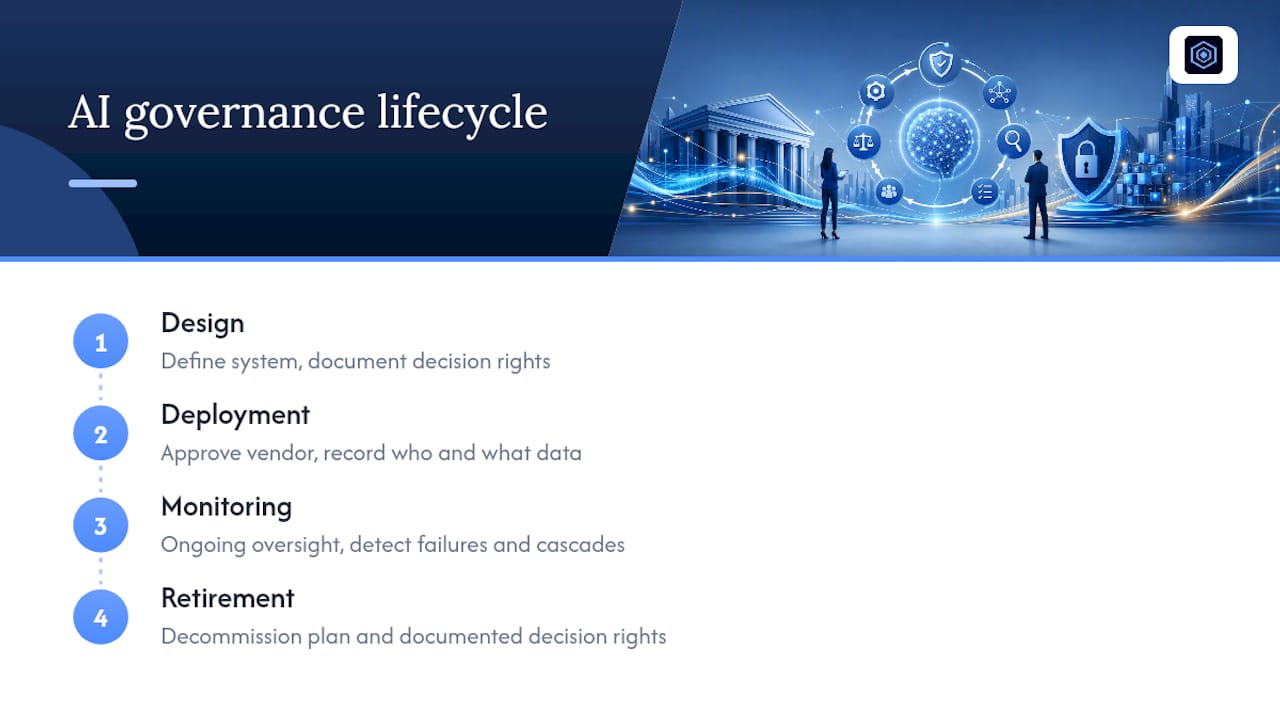
AI governance in banking is not a rebrand of model risk management. It is a lifecycle discipline that governs a system from design through deployment, monitoring, and eventual retirement, with documented decision rights at each stage.
Traditional model risk management, built around SR 11-7 style validation, assumed a relatively static model with a known statistical profile. AI governance extends that logic to systems that learn, adapt, or generate novel outputs, which means it also absorbs pieces of vendor management (who built the model, what data trained it) and operational resilience (what happens when it fails or acts unexpectedly).
Scope matters here. A working banking AI governance program covers traditional machine learning (credit scoring, fraud detection), generative AI (customer service copilots, document summarization), and increasingly, agentic AI, systems that take multi-step actions with limited human review at each step. Agentic systems raise the stakes because a single flawed instruction can cascade into dozens of downstream actions before anyone notices. Governance frameworks written only for static ML models will miss this entirely.
What Are the Material Risks AI Governance Must Control?
Every governance control exists to counter a specific failure mode. Mapping risk to control is the difference between a compliance checklist and a program that actually reduces exposure.
- Bias and fairness: a credit model trained on historical approval data can encode past discriminatory patterns into pricing or underwriting decisions, even when protected attributes are excluded.
- Privacy and data protection: generative tools trained or fine-tuned on customer data can leak sensitive information through outputs or logs.
- Model degradation and hallucination: performance drifts as economic conditions shift, and generative systems can produce fabricated but confident-sounding answers to customers.
- Operational, cyber, and concentration risk: heavy reliance on a small number of third-party AI vendors creates single points of failure across the sector, not just within one bank.
- Conduct and reputational exposure: an AI-driven decision a customer cannot appeal or understand becomes a conduct issue fast.
Deloitte's governance research found that banks with stronger governance maturity deployed AI more broadly and captured more commercial value from it, which suggests these risk categories are not a brake on adoption so much as the precondition for scaling it safely.
Which AI Use Cases Demand the Strictest Governance?
Not every deployment carries the same governance burden. Materiality should track directly to customer and financial impact, not to how novel the technology feels.
- Credit and underwriting decisioning: requires explainability sufficient to support adverse action notices and a documented customer recourse path.
- Fraud and anti-money-laundering monitoring: needs ongoing performance tracking and active management of false-positive rates, which drive both cost and customer friction.
- Generative AI in customer service: demands output safety controls, clear disclosure that a customer is interacting with AI, and full interaction logging.
- Trading and portfolio analytics: needs formal model validation and governance over any automated action the system is permitted to take without human sign-off.
- Agentic automation: introduces orchestration risk across multiple connected systems and requires a tested rollback plan before deployment, not after an incident.
Each use case above maps to a distinct evidence requirement, a theme the AI model change management process should formalize rather than leave to ad hoc review.
What Do Regulators and Supervisors Actually Expect?
Supervisory expectations in 2026 converge on a small number of practical themes, even across jurisdictions with different formal rulebooks. Benchmarking against them beats waiting for a single unified standard that may never arrive.
The Financial Stability Board's consultation report lays out 12 nonbinding sound practices spanning the full AI lifecycle, with recurring emphasis on board oversight, maintained inventories, human oversight calibrated to risk, data governance, and third-party risk management. Treat these 12 practices as a checklist to self-assess against, not just background reading.
Singapore's MAS, through Project MindForge, recommends a risk-based, proportionate lifecycle approach anchored by an AI inventory that captures materiality and change history for every use case. The NAIC has built out an AI Systems Evaluation Tool and companion Model Bulletins that give examiners a structured basis to request governance, testing, and vendor exhibits during exams.
The practical implication: build a proportionate control set now, so the evidence exists before an examiner asks for it, rather than assembling it retroactively under deadline pressure.
What Are the Core Components of a Governance Framework?
A defensible framework rests on five interlocking components, not a single policy document that sits unused after board approval.
- Board and senior management ownership. The board should receive periodic reporting on AI risk exposure, and one senior executive should own the program end to end, with clear escalation authority.
- A living AI inventory. Every use case needs a documented owner, purpose, materiality tier, data lineage, and change history, ideally updated automatically from deployment pipelines rather than by manual survey. The AI model inventory management process is where most programs either succeed or quietly stall.
- Risk tiering with approval gates. High-materiality use cases, anything touching credit decisions, pricing, or large transaction volumes, should require a formal approval gate before deployment; low-risk internal tools can move faster.
- Data governance, validation, explainability, and human oversight. Oversight should be meaningful rather than performative: define specific points where a human can actually understand and intervene in a decision, rather than rubber-stamping every output.
- Third-party due diligence and exit planning. Contracts with AI vendors need transparency clauses and a documented exit path, since vendor concentration and limited transparency are now explicit supervisory concerns.
An operating model built around these five components is far easier to defend under exam than a framework assembled after deployment.
How Do You Actually Implement This Program?
Sequencing matters more than perfection. A phased rollout that produces evidence early beats a comprehensive plan that ships nothing for a year.
- Run a rapid maturity assessment. Identify what AI is already in production, informally or otherwise, and build a prioritized inventory starting with the highest-materiality use cases.
- Design proportional controls. Set approval gates, service-level agreements for review turnaround, and materiality thresholds that determine which controls apply where.
- Validate before deployment. Run explainability checks, bias testing, and insert contractual clauses covering vendor transparency and data rights before anything goes live.
- Monitor in production. Track performance drift, bias metrics, and set alert thresholds with a defined escalation path when a model breaches them.
- Manage change and decommissioning. Every model update needs a change log, and every retired model needs a documented decommissioning record, not a silent removal.
Industry commentary consistently finds that governance bolted on after deployment causes more rework and more supervisory friction than governance designed in from the start.
Pro Tip: Do not wait for a perfect inventory before starting risk tiering. Tier what you know today, flag unknowns as a distinct category, and update tiers as visibility improves. A partial inventory with honest gaps beats a stalled project waiting for completeness.
What Evidence Do Regulators Want to See?
Governance that cannot produce evidence on demand is indistinguishable, to an examiner, from no governance at all. The evidence bar is specific and largely predictable.
Your inventory should capture, at minimum, the use case owner, business purpose, materiality tier, data lineage, and a full change log. Monitoring should track performance metrics, bias indicators, and drift signals on a defined cadence, with more frequent review for high-materiality use cases and less frequent review for lower-risk ones as a common practice. Logs need to be immutable and time-stamped so they hold up as exam evidence rather than being disputed as after-the-fact reconstruction.
An immutable, time-stamped evidence pack that ties inventory entries to monitored metrics shortens exam cycles considerably, since examiners spend less time reconciling claims against source data. Practical evidence packages should include:
- The current inventory snapshot with materiality tiers.
- Monitoring dashboards or reports covering the exam period.
- Validation records and sign-offs for each material use case.
- Vendor due diligence files and contract clauses on AI transparency.
Templates for governance reporting metrics can shortcut the design of this reporting cadence.
Who Owns What: Roles and Decision Rights
Clear decision rights prevent the most common governance failure: everyone assumes someone else is watching the model.
- Board and senior management should receive AI risk reporting quarterly at minimum, with immediate escalation for material incidents.
- First line (business units) own the outcomes of the AI systems they deploy and are accountable for day-to-day performance.
- Second line (risk and compliance) sets policy, reviews approval gates, and challenges first-line risk assessments.
- Third line (internal audit) independently tests whether the first two lines are actually doing what policy says.
- A standing AI governance committee, cutting across risk, compliance, technology, and business leadership, should hold approval authority for high-materiality use cases and own incident escalation.
Your 90-Day and 12-Month Action Plan
Momentum matters as much as design quality. Executives want to see visible progress within one quarter, not a framework document that arrives a year later.
- Immediately: name an executive sponsor, launch the inventory build, and triage existing use cases to flag the highest-risk ones for interim controls.
- Within 90 days: complete vendor mapping for all third-party AI tools, establish baseline monitoring metrics, and fix the most glaring short-term gaps, missing disclosures, unreviewed high-risk models, undocumented data sources.
- Within 6 to 12 months: automate inventory updates from deployment pipelines, formalize the reporting cadence to the board, and build a repeatable audit-evidence process rather than a one-off exam scramble.
A structured maturity model helps translate this timeline into milestones you can actually report against internally.
How Should Ethics and Fairness Be Built Into the Framework?
Ethical principles only matter operationally if they translate into testable controls, not into a values statement filed away after the board meeting.
Fairness testing needs to run at multiple points: pre-deployment on training data, at launch on initial outputs, and continuously in production as the customer population and economic environment shift. A model that passed a fairness audit at launch can drift into disparate impact eighteen months later without anyone re-testing it. Build fairness metrics into the same monitoring cadence used for accuracy and drift, not as a separate annual exercise.

Ethical principles also need to be use-case specific rather than generic. A fairness threshold appropriate for a marketing recommendation engine is not appropriate for a credit-pricing model, where disparate impact carries direct legal exposure. Materiality tiering should therefore drive not just how much oversight a use case gets, but which fairness tests apply and how frequently they run.
Explainability is the operational bridge between ethics and evidence. A model that cannot explain a specific adverse decision to the customer it affected fails the fairness test regardless of its aggregate statistical performance. Banks that treat explainability as a design requirement, not a retrofit, avoid the costly rework of adding interpretability tooling to a model already in production.
Finally, ethical governance needs an owner distinct from technical model validation. Fairness and ethics review should sit with second-line risk and compliance, informed by technical testing but not subordinate to it, so that a statistically valid model that produces an ethically indefensible outcome still gets stopped.
How Should You Communicate AI Governance to Stakeholders?
Transparency obligations run in at least three directions: to customers, to regulators, and internally across the bank, and each needs different content and cadence.
Customer-facing disclosure should be plain language: when a customer is interacting with an AI system, what decision it is making, and how to request human review. Burying this in a lengthy terms-of-service document does not satisfy the spirit of disclosure expectations embedded in frameworks like the FSB's sound practices, and it invites conduct risk if a customer later claims they were not informed.
Regulatory communication works best as continuous evidence rather than periodic self-reporting. Supervisors increasingly expect banks to produce documentation on demand rather than wait for the next scheduled exam, which means your evidence pipeline should be exam-ready at any point in the year, not assembled reactively.
Internal communication is often the weakest link. Business units deploying AI tools frequently do not know what governance policy requires of them, and risk teams frequently do not know what business units have actually deployed. A regular cross-functional forum, ideally the same governance committee that holds approval authority, closes this gap by forcing both sides to report into a shared inventory and shared metrics.
Board reporting deserves its own format: concise, risk-focused, and tied to the inventory rather than a narrative summary. Boards need to see materiality distribution, incident counts, and trend lines on bias and drift metrics, not a qualitative assurance that "governance is working."
How Do You Stress Test AI Systems for Resilience?
Standard model validation was not designed for systems that can act autonomously, which means AI stress testing needs its own scenario library.
Start with scenario planning that assumes model failure, not just model underperformance: what happens if a fraud model stops flagging a new pattern of attack, or a customer service AI gives systematically wrong information for a week before anyone notices? Building these scenarios into a formal test plan surfaces gaps in monitoring alerting long before a real incident does.
Agentic systems need an added layer of stress testing focused on dependency mapping. Practitioners increasingly build an identity graph for each agent, tracing what systems and data it can touch, then run scenario-based tests estimating the potential financial exposure, sometimes called blast-radius, if that agent acts on a flawed instruction. A single agent with write access to multiple downstream systems can turn one bad decision into a much larger operational event.

Resilience testing should also cover third-party concentration. If your fraud detection, credit scoring, and customer service tools all depend on the same underlying AI vendor, a single vendor outage or model update becomes a sector-wide event, not an isolated one. Include vendor-failure scenarios in your stress test calendar alongside your standard business continuity exercises.
Run these tests on a defined schedule, not only after an incident prompts one. Annual stress testing for high-materiality use cases, with more frequent testing after any significant model change, gives the board and examiners a documented resilience record rather than an assumption of resilience.
How Do You Train Staff on AI Governance?
A governance framework only works if the people deploying AI understand what it requires of them, which means training needs to reach far beyond the risk and compliance function.
Business unit staff deploying or requesting AI tools need practical training: how to submit a use case to the inventory, what materiality tiering means for their approval timeline, and who to contact when a model behaves unexpectedly. Generic "AI awareness" training that never touches the actual inventory or approval process produces compliance in name only.
Risk and compliance staff need deeper technical grounding, enough to meaningfully challenge a model validation report rather than rubber-stamp it. This often means partnering with data science teams to build shared vocabulary around drift, bias metrics, and explainability techniques, so second-line review is substantive rather than procedural.
Board members and senior executives need a different kind of training: enough fluency in AI risk concepts to ask sharp questions during quarterly reporting, without requiring technical depth. A board that cannot distinguish a materiality-tier-one credit model from a low-risk internal chatbot cannot exercise meaningful oversight, regardless of how good the underlying reporting is.
Training needs a refresh cycle, not a one-time onboarding module. AI capabilities and regulatory expectations are moving quickly enough that a training program built in 2024 is likely outdated by 2026. Tie refresher training to major framework updates or significant regulatory developments, and track completion the same way you track other mandatory compliance training.
Why Late-Stage Compliance Keeps Failing Banks
The pattern repeats across the sector: governance gets bolted onto AI systems after deployment, usually after an incident or an examiner's question forces the issue. That sequence is expensive, and it is avoidable.
Embedding AI governance into existing enterprise risk management and model risk functions, rather than standing up a parallel structure, accelerates safe adoption rather than slowing it down. The banks getting more value from AI are not the ones with the loosest controls. They are the ones that built oversight into the design phase, so scaling a new use case is a matter of following an established playbook, not negotiating exceptions.
The uncomfortable truth is that most institutions still treat AI governance as a project rather than a permanent operating capability, staffed and funded like one. That mismatch, not any particular regulation, is the real source of most audit findings.
— Eleye
How AETHER Pulse Delivers Audit-Ready AI Governance
Most governance tooling on the market requires installing agents inside production systems or granting access to customer data, which is exactly the friction that slows deployment and adds its own risk surface. Aetherpulse takes a different route: it connects through metadata only, via OAuth, touching no customer data, and builds an inventory and identity graph of your organization's AI agents without inserting itself into production.
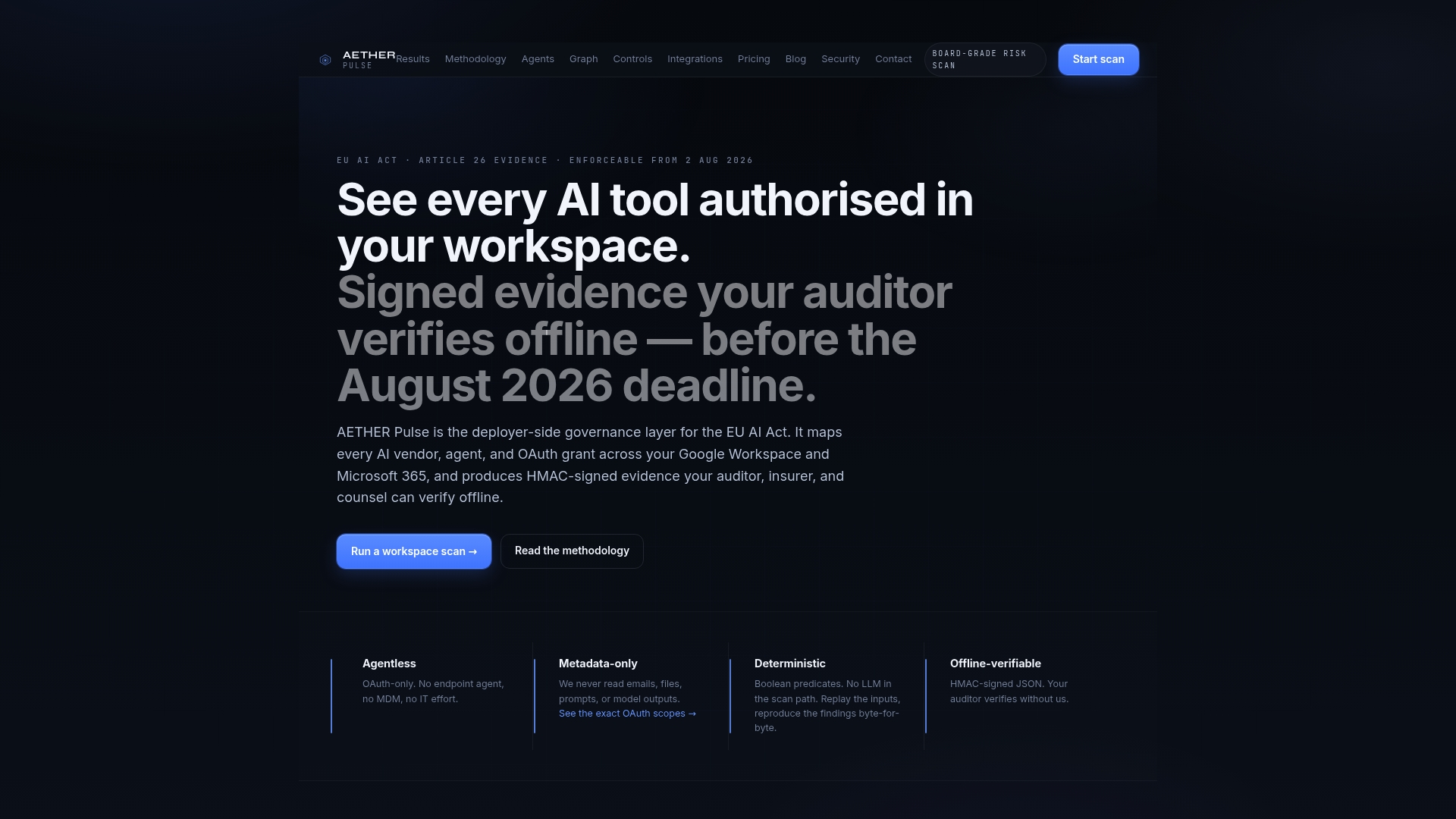
That inventory feeds directly into the evidence regulators and auditors expect, mapped to frameworks including EU AI Act Article 26, the Data (Use and Access) Act, FCA SYSC and Consumer Duty, and the ICO's developing code on automated decision-making. Every output is a tamper-evident, cryptographically signed evidence pack (HMAC-SHA256) that auditors can verify independently, offline, rather than taking your word for it.
Aetherpulse offers Free, Pro, and Enterprise plans, along with a dedicated Article 26 readiness audit for firms preparing specifically for that provision. If your team is still assembling inventory evidence manually before every exam, see what a metadata-only governance layer looks like and book a demo to check whether it fits your current stack.
Where to Read the Primary Guidance
For direct access to the frameworks referenced throughout this guide: the FSB's sound practices consultation report, MAS's AI Risk Management Executive Handbook, the NAIC's AI resources and evaluation tools, and Deloitte's trustworthy AI governance index. For a broader operational view of automation risk, see this risk management automation guide.
Sources
- Sound Practices for Financial Institutions' Responsible AI Adoption: Consultation Report
- AI Risk Management Executive Handbook (Project MindForge)
- Insurance Topics | Artificial Intelligence | NAIC
- Banking on trust: Trustworthy AI governance index and findings
FAQ
What Is AI Governance in Banking?
It is the set of institution-wide controls, documentation, and evidence banks use to manage AI systems safely across their full lifecycle, from design through retirement, calibrated to each use case's materiality.
What Is the First Step in Building an AI Governance Program?
Build a complete inventory of existing AI use cases and assign a named executive sponsor with accountability for the program, since neither controls nor reporting can function without this baseline.
How Does Agentic AI Change Governance Requirements?
Agentic systems act across multiple connected systems with limited human review at each step, which requires dependency mapping, an identity graph for each agent, and blast-radius stress testing beyond standard model validation.
What Does Aetherpulse Cost?
Aetherpulse offers Free, Pro, and Enterprise plans, along with a separate Article 26 readiness audit service; current pricing details are available directly on the Aetherpulse site.
How Often Should AI Systems Be Monitored for Bias and Drift?
High-materiality use cases typically warrant monthly monitoring for performance, bias, and drift metrics, while lower-risk use cases can follow a quarterly cadence, adjusted based on how quickly the underlying data or market conditions change.
Recommended
Working on Article 26 readiness, deployer-side governance evidence, or AI agent risk at a regulated firm? We'd value 15 minutes of your perspective.
Start a conversation