5 Audit Ready Steps to Black Box Oversight for Regulated Firms
5 Audit Ready Steps to Black Box Oversight for Regulated Firms

Black box oversight is the set of governance controls that let a regulated organization demonstrate control over an AI system whose internal logic it cannot fully inspect. The first action for any risk or compliance team is to create an inventory entry for each AI system that records provenance and names an accountable oversight owner. That single step, anchored to the NIST AI Risk Management Framework, converts an abstract compliance obligation into audit-ready evidence.
TL;DR:
- Clear inventory records must include provenance, owner, and model version, with continuous updates for effective auditability and risk management.
- Conduct measurable TEVV activities regularly, focusing on accuracy, fairness, and robustness, with a fixed schedule aligned with model updates.
- Assign specific human oversight roles, establish monitoring processes, and record intervention details using tamper-evident cryptographic markers.
- Prepare audit-ready evidence such as versioned TEVV reports, oversight logs, and vendor attestations to facilitate faster reviews and compliance verification.
- Use metadata-only, cryptographically signed evidence layers that do not require access to production data for verification and regulatory reporting.
Table of Contents
- What "black box" means in regulated settings
- Why black box systems matter to risk, compliance and governance
- Authoritative frameworks and standards to anchor oversight
- Practical steps to build black box oversight an audit will accept
- Preparing and packaging audit-ready oversight evidence
- A concise governance checklist for compliance teams
- Lessons from implementing oversight in regulated environments
- How an agentless evidence layer supports black box oversight
- Sources
- FAQ
What "black box" means in regulated settings
For a compliance team, a black box is any AI system whose decision logic cannot be traced, reconstructed, or explained to a level that satisfies an auditor or regulator. Opacity comes from several sources at once, and rarely from a single cause.
- Model architecture: deep neural networks and large foundation models encode decisions across millions of parameters with no single readable rule.
- Vendor access limits: third-party AI providers often restrict visibility into training data, weights, or update schedules.
- Pipeline complexity: outputs pass through pre-processing, retrieval, and post-processing steps that each add their own opacity.
Post-hoc explainers can approximate why a model produced a given output, but they describe correlations, not the model's actual reasoning, which creates a risk of false assurance if a firm treats an explanation as proof of control.
Why black box systems matter to risk, compliance and governance
Opacity becomes a governance problem the moment an AI system touches credit decisions, claims handling, fraud detection, or customer communications, because these are exactly the use cases regulators scrutinize most closely. When a firm cannot show how a decision was reached, it cannot demonstrate compliance with fair-treatment, non-discrimination, or consumer-protection rules, regardless of how accurate the model is.
- Regulatory expectation: supervisors increasingly ask firms to evidence oversight of automated decisions, not just describe policy intentions.
- Operational risk: an unexplainable adverse decision (a denied loan, a flagged transaction) can trigger complaints, litigation, or regulatory inquiry with no internal record to respond to it.
- Concentration risk: multiple business lines relying on the same opaque model or vendor create a single point of failure across the firm.
Opacity compounds when oversight is passive. NIST's Generative AI Profile recommends moving from passive monitoring to active inventory management with provenance markers, precisely because passive oversight tends to surface problems only after a decision has already caused harm.
Authoritative frameworks and standards to anchor oversight
The NIST AI RMF gives risk teams a structure that maps cleanly onto the tasks auditors expect to see evidence for. Its four functions translate directly into operational work.
- MAP: identify and inventory AI systems, their intended use, and their risk context.
- GOVERN: assign accountable owners, escalation paths, and policy authority for each system.
- MEASURE: run TEVV (test, evaluation, validation, verification) activities against defined metrics.
- MANAGE: treat identified risks, document mitigations, and track residual exposure.
Foundation models complicate this mapping because a single vendor model can sit underneath many internal applications with different risk profiles. The Generative AI Profile extends the base framework with guidance specific to these systems, including recording data provenance through signatures, versioning, and watermarking, and naming explicit human oversight roles in the inventory itself rather than leaving oversight implicit.
Each function produces an artifact an auditor can request: an inventory record, a governance charter entry, a TEVV report, a risk treatment log. Framework adoption matters less as a compliance label than as a source of the underlying evidence.

Practical steps to build black box oversight an audit will accept
Turning framework functions into evidence requires a defined sequence rather than parallel, ad hoc effort.
- Build the inventory and provenance baseline. Capture the system owner, model version, training data provenance, access mode (internal build, vendor API, embedded third-party model), and intended use case for every AI system in scope. A model inventory is the foundation every later control depends on.
- Design TEVV around measurable criteria. Define accuracy, fairness, and robustness metrics, set a sampling approach, schedule red-team exercises or benchmark tests, and fix a validation cadence tied to model updates.
- Establish monitoring and human oversight roles. Name who monitors outputs, under what conditions they intervene, and how a decision hands back to a human reviewer when confidence thresholds are breached.
- Log deterministically. Record decision inputs, feature provenance, and model version at the moment of each decision, using cryptographic markers where feasible to make the record tamper-evident.
- Map risk concentration. Aggregate exposure across agents and shared models to produce a blast-radius view, since a single vendor model feeding multiple business lines often hides the firm's largest single point of failure.
Pro Tip: Treat the inventory as a living record tied to change management, not a one-time spreadsheet: an inventory entry that is not updated at every model version change stops being audit evidence.
Preparing and packaging audit-ready oversight evidence
Auditors and regulators generally ask for a defined set of artifacts, and firms that assemble these in advance move through review far faster than those reconstructing evidence after a request arrives.
- Inventory snapshots taken at fixed intervals, showing the state of every AI system and its ownership at that point in time.
- TEVV reports with versioned datasets, test seeds, and results, so tests can be reproduced independently.
- Monitoring logs and intervention records, showing when a human reviewer stepped in and why.
- Vendor attestations, where a third-party model cannot be inspected directly.
Tamper-evident packaging matters because a record an auditor cannot verify offline carries little weight. Practitioner guidance from Stanford points out that black-box oversight needs technical and governance controls working together, not an explainability tool standing in for a verifiable record.
When a vendor limits visibility into its model, firms still have options: negotiate SLA-level reporting commitments, request formal attestations covering training data and update practices, and commission independent tests of the vendor's outputs where direct inspection is not possible. None of these substitutes for an internal record showing the firm knew about and managed the risk.
A concise governance checklist for compliance teams
A short, owned checklist keeps oversight from drifting into a documentation exercise nobody maintains.
- Inventory completeness, owned by the model risk team, reviewed quarterly.
- TEVV currency, owned by validation, reviewed at every model version change.
- Human oversight assignment, owned by the business line, reviewed semi-annually.
- Evidence packaging, owned by compliance, reviewed before each audit cycle.
| Checklist item | Owner | Green | Amber | Red |
|---|---|---|---|---|
| Inventory completeness | Model risk team | All systems logged with provenance | Some systems missing owner | No central inventory exists |
| TEVV currency | Validation team | Tests current with latest version | Tests lag one version | No recent TEVV on file |
| Oversight assignment | Business line | Named owner, defined thresholds | Owner named, no thresholds | No named owner |
Reporting upward works best as a status summary against this table rather than a narrative, since a CRO or board audit committee needs to see gaps at a glance, and external auditors respond well to the same structure because it mirrors how they score control maturity.
Lessons from implementing oversight in regulated environments
The hardest trade-off in this work is access versus auditability: the tooling that sees the most also carries the most deployment risk and the longest security review. Firms consistently over-invest in explainability dashboards and under-invest in the basics, an inventory nobody has finished, oversight roles nobody has assigned, and blast-radius mapping nobody has attempted. Metadata-only, tamper-evident evidence collection tends to close audit gaps faster than deeper technical access does, precisely because it avoids the review cycle that comes with touching production systems.
— Eleye
How an agentless evidence layer supports black box oversight
AETHER Pulse builds the inventory, provenance, and evidence layer this article describes without connecting to production data or customer records. It ingests through OAuth metadata only, builds an identity graph of an organization's AI agents, and surfaces risk concentration, including financial blast-radius exposure, across shared models and vendors.
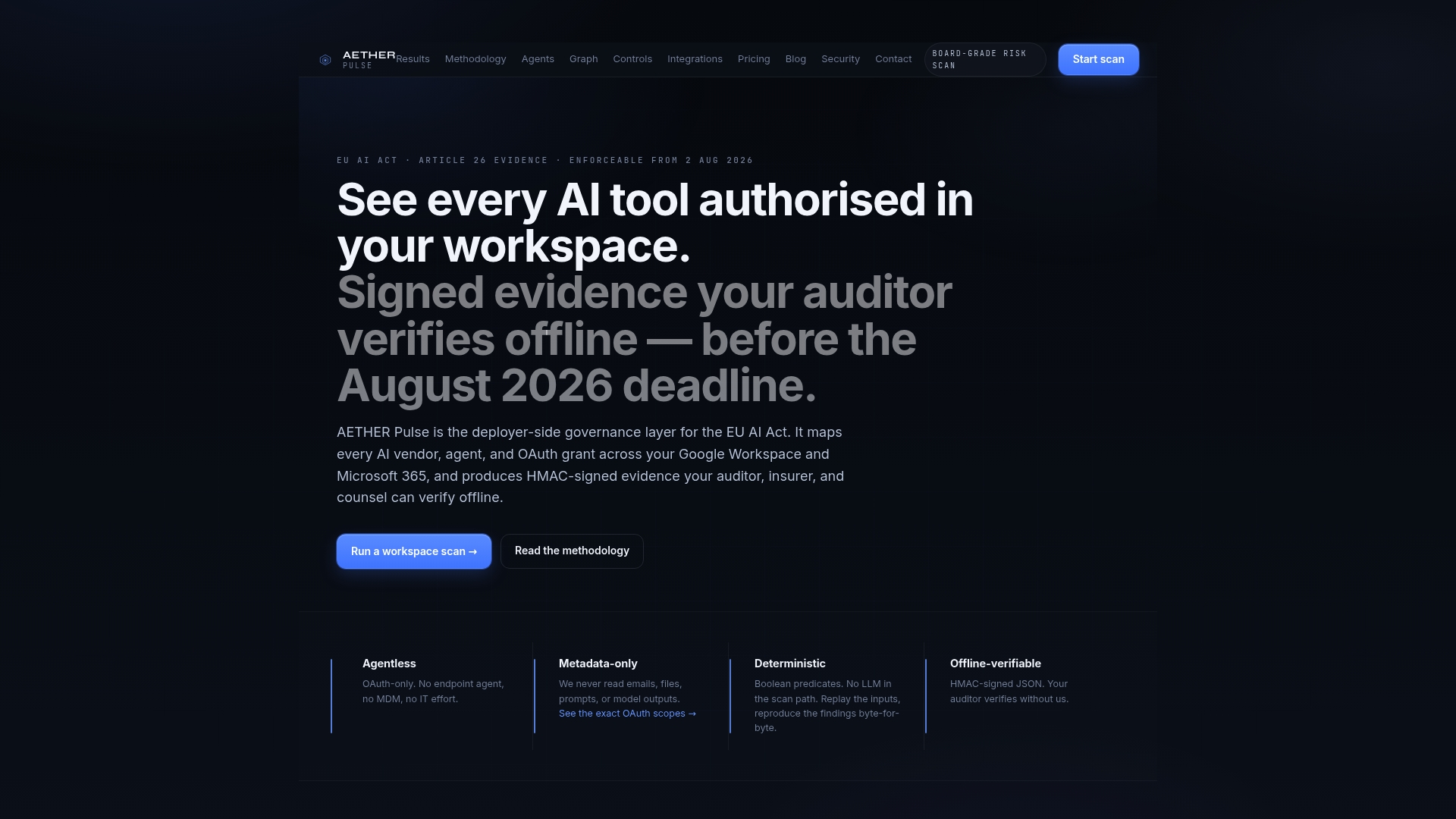
Every evidence pack it generates is deterministic and cryptographically signed with HMAC-SHA256, so an auditor or regulator can verify it independently rather than taking a vendor's word for it. For firms working toward EU AI Act Article 26 obligations, FCA SYSC and Consumer Duty requirements, or ICO expectations on automated decision-making, that verifiability shortens the distance between "we have a policy" and "we can prove it." Compliance teams can start with the Free, Pro, or Enterprise plans or review Design Partner and Production engagement options, including the Article 26 readiness audit, to see how metadata-only evidence collection fits an existing audit calendar.
Sources
Start with the NIST AI RMF and its Generative AI Profile, then review Palo Alto Networks' framework explainer and OmniPulse's AI strategy guidance for implementation context.
- Artificial Intelligence Risk Management Framework (AI RMF 1.0)
FAQ
What does a black box approach mean?
A black box approach means using an AI system whose internal decision process cannot be directly inspected or fully explained, even by the team that deployed it. Compliance teams manage this through inventory, provenance records, and testing rather than by trying to open the model itself.
What does the term "black box" mean?
The term describes any system where inputs and outputs are observable but the internal logic connecting them is not, a definition used across AI ethics glossaries and technical literature alike. In AI, this usually refers to complex models like deep neural networks whose parameters are too numerous to interpret directly.
Who is AETHER Pulse built for?
AETHER Pulse is built for risk, compliance, and governance teams at regulated financial services firms in the UK and EU that need to demonstrate oversight of AI agents. It works through metadata only, without accessing production data, to produce audit-ready evidence packs.
Does explainability solve the black box problem?
Explainability tools help interpret specific outputs, but they approximate a model's reasoning rather than reveal it directly, so they do not fully solve the oversight problem on their own. Regulated firms pair explainability with governance controls such as documented change management and TEVV to build a defensible record.
Recommended
Working on Article 26 readiness, deployer-side governance evidence, or AI agent risk at a regulated firm? We'd value 15 minutes of your perspective.
Start a conversation