Boards: Four Part AI Risk Briefing With Audit Ready Evidence
Boards: Four Part AI Risk Briefing With Audit Ready Evidence

The board should require one repeatable, evidence-first briefing regularly, covering an AI inventory, prioritized active risks with business impact, compliance and regulatory posture, and remediation items with decisions requested. This structure satisfies fiduciary duty because it forces management to show ownership, traceability, and clear decision rights rather than raw activity logs. Frameworks from the NACD and NIST AI RMF, paired with tools like AETHER Pulse, give directors a defensible way to demand this evidence without managing operations themselves.
TL;DR:
- An AI inventory should be current and verified through independent technical discovery to ensure no shadow AI tools have been adopted outside governance.
- The risk register must prioritize high-impact risks with clear financial or regulatory exposure, not just activity logs, and include recent movement and control testing evidence.
- Human override points require documented, tested escalation paths with signed decision records, not just control existence, to meet oversight standards.
- AI risk reporting should focus on exceptions, trend analysis over multiple quarters, and translate technical metrics into business consequences to enable board action.
- Internal and third-party audits must provide detailed scope and independent verification to effectively identify and remediate governance gaps before regulators do.
Table of Contents
- What Should a Board Briefing on AI Risk Include?
- How Do You Turn AI Activity Into Metrics a Board Can Act On?
- Who Should Be Able to Stop an AI Action, and How Is That Reported?
- Where Does AI Risk Fit Inside Enterprise Risk Management?
- How Should Human-in-the-Loop Controls Show Up in Board Reporting?
- What Regulatory Signals Should Boards Track on AI?
- Why Shadow AI Is the Blind Spot Most Boards Miss
- Which AI Risks Deserve the Board's Attention First?
- What Does Good AI Risk Reporting to a Board Look Like in Practice?
- How Do You Get a Board to Actually Engage With AI Risk?
- What AI Risk Trends Should Boards Prepare For Next?
- How Should Third-Party AI Audits Fit Into Board Reporting?
- How Boards Can Get Comfort Without Doing Management's Work
- How AETHER Pulse Gives Boards Audit-Ready AI Evidence
- Sources
- FAQ
What Should a Board Briefing on AI Risk Include?
A board briefing on AI risk works best as a four-part package, delivered on a fixed cadence, with management held to a standard of evidence rather than assurance by assertion. Directors who accept a verbal summary instead of an artifact are, in practice, waiving their own oversight duty.
The four parts, in order:
- AI inventory. A current list of every AI system and agent in production, who owns it, and what data it touches. The artifact is a signed inventory report; its significance is that you cannot govern what you cannot count.
- Prioritized active risks. The handful of risks with the highest business impact this quarter, ranked, not a comprehensive log of every model event. The artifact is a risk register with financial or regulatory exposure attached to each entry.
- Compliance and regulatory posture. Where the organization stands against relevant obligations, including gaps. The artifact is a compliance status report mapped to specific regulatory clauses, not a general "we are compliant" statement.
- Remediation and decisions requested. What management is fixing, by when, and what the board is being asked to approve or fund. The artifact is a remediation tracker with named owners and dates.
Cadence should track deployment velocity. A firm running a handful of static models can brief the board quarterly. A firm deploying agentic AI that takes autonomous actions, initiating payments, adjusting customer terms, executing trades, needs more frequent reporting to the risk committee, with periodic rollups to the full board. The NACD recommends exactly this kind of tiered rhythm: regular briefings tied to an inventory, not ad hoc updates when something breaks.
Before the meeting, directors can reasonably demand:
- A current AI inventory dated recently before the meeting.
- A risk register showing movement (new, closed, escalated) since the last briefing.
- Evidence that at least one control or human checkpoint actually fired during the period.
- A remediation tracker with overdue items flagged in red.
How Do You Turn AI Activity Into Metrics a Board Can Act On?
Raw activity counts (queries processed, models retrained, tickets closed) tell a board almost nothing about risk. What matters is consequence: what could this activity cost the firm, how fast would you know, and how fast could you stop it.
Five metrics do most of the work:
- Financial blast radius. The maximum dollar exposure if the riskiest AI agent in production made a bad decision at scale, not just its average behavior.
- Time-to-detect. How long between an anomalous AI action and someone noticing it.
- Time-to-respond. How long between detection and a human intervening or reversing the action.
- Policy coverage versus usage. The percentage of active AI agents actually covered by a written policy, compared against the percentage in real use. A gap here is a governance failure, not a paperwork lag.
- Escalation rate. How often automated decisions get kicked to a human reviewer, and whether that rate is rising or falling as systems mature.
One number worth tracking closely: the gap between policy coverage and actual usage is often the single most revealing metric on the dashboard, because it exposes shadow deployments that never went through governance review.
Present these on one page, trend lines over four to six quarters, not a snapshot. A dashboard that shows exposure trending down while time-to-detect also drops tells a coherent story; one that shows exposure climbing with no change in detection speed is a flashing warning sign. Detailed metric templates, including how to structure them for different committee audiences, are available in AETHER Pulse's governance reporting guide.
Who Should Be Able to Stop an AI Action, and How Is That Reported?
Every high-risk AI system needs a named human who can halt it, and the board needs to know that person's title, not just that "controls exist." Shared-accountability models, where a business owner and a risk or compliance officer must jointly sign off before a system goes live or before a threshold action executes, work better than single-owner models because they force a second, independent judgment on anything material.
Directors should ask, at minimum:
- Who can pause this system right now, without waiting for a committee meeting?
- What triggers an automatic escalation, and who receives it first?
- What evidence exists that the escalation path was tested in the last twelve months, not just documented?
- If two owners disagree on risk tolerance, who breaks the tie?
Escalation paths should specify what evidence arrives at each step: an automated alert, a human acknowledgment timestamp, and a signed decision record showing what was decided and why. Harvard Law School's Forum on Corporate Governance frames this as part of the board's core oversight duty, distinct from operating the controls itself.
Pro Tip: Treat any question management cannot answer in the room, such as "who approved this specific automated action last month," as a formal finding requiring remediation, not an oversight to revisit informally next quarter.
Where Does AI Risk Fit Inside Enterprise Risk Management?
AI risk belongs inside existing enterprise risk management (ERM) categories, not in a separate silo that only the technology committee sees. Most firms route day-to-day oversight through the risk or audit committee, with escalation to the full board when exposure crosses a predefined financial or regulatory threshold, or when a new high-risk use case launches.
Mapping AI risks into ERM economic terms means translating "the model made an error" into "this model carries $X in potential exposure if it misclassifies transactions at current volume." PwC advises treating AI oversight as part of strategic transformation, tied to capital allocation, not as an isolated IT concern.
Practical committee actions include:
- Amending the risk committee charter to explicitly name AI and algorithmic decision-making as a covered risk category.
- Requiring the AI inventory as a standing agenda item, not a special report.
- Setting a dollar or usage threshold above which any new AI deployment triggers automatic committee review.
- Aligning AI reporting cadence with existing ERM reporting cycles so it doesn't become a parallel process.
Real-world examples of how firms structure this committee ownership appear in AETHER Pulse's governance operating model guide.
How Should Human-in-the-Loop Controls Show Up in Board Reporting?
Human-in-the-loop (HITL) design should be risk-based, not uniform. Reviewing every single AI output with a human checkpoint creates a bottleneck that collapses under volume, while reviewing none defeats the purpose of oversight entirely. The workable pattern is triage: low-risk outputs get spot-checked on a sampling basis, while high-risk outputs, anything touching payments, customer terms, or regulatory filings, follow a structured review with recorded sign-off, according to research on HITL governance design.
What belongs in the board package is not raw telemetry but process evidence that the checkpoints actually ran:
- Signed decision records showing who reviewed a high-risk action and what they decided.
- Tamper-evident evidence packs proving the review happened at the time claimed, not reconstructed after the fact.
- Periodic red-team or adversarial test reports showing the controls hold under stress.
A related risk deserves board attention: human over-trust, where reviewers rubber-stamp AI outputs because volume trains complacency. Decoupling who generates an output from who verifies it reduces this, since a fresh reviewer without authorship bias catches more errors. Chain-of-command controls for autonomous agents are covered in more depth in this analysis of agentic AI compliance risk.
Pro Tip: Ask specifically whether reviewers ever reject a high-risk AI recommendation. A verification process with a zero-rejection rate over several quarters is not evidence of a well-behaved system. It usually means the humans have stopped actually checking.
What Regulatory Signals Should Boards Track on AI?
Boards do not need to become regulatory experts, but they need enough awareness to know when to call counsel. Three reference points matter most right now. The NIST AI Risk Management Framework offers a functions-based structure, govern, identify, protect, detect, respond, recover, that boards can use to judge whether management's program is actually complete or has gaps dressed up as coverage. The White House Executive Order on AI signaled that government expectations for trustworthy, secure AI are rising, which tends to precede more formal disclosure requirements. The SEC has increased scrutiny of AI-related disclosures and claims, meaning boards should expect outside statements about AI capability to be tested against internal evidence.
These signals shape two practical expectations: first, that boards should be able to produce process evidence on demand, not just policy documents; second, that incident reporting for AI failures should follow a defined path with timestamps, similar to how firms already handle cybersecurity incidents.
Request outside counsel or a third-party attestation when:
- A new AI use case could plausibly trigger a regulatory filing or disclosure obligation.
- An internal audit finds a traceability gap, an inability to show which data drove a specific automated decision.
- The firm is entering a new jurisdiction with different AI-specific rules.
Why Shadow AI Is the Blind Spot Most Boards Miss
Most boards assume the AI inventory management shows them is complete. It rarely is. Employees and business units routinely adopt AI tools, browser extensions, automation scripts, third-party APIs plugged into existing software, without going through a formal procurement or governance review. This is shadow AI, and it is usually larger than the sanctioned inventory.
Discovery works best through metadata review rather than manual surveys, since asking business units to self-report what AI tools they use tends to undercount significantly. Metadata-based discovery, connecting through OAuth grants and API logs rather than scanning content, can surface unsanctioned agents without touching customer data, which matters for regulated firms that cannot simply install invasive monitoring software across every department.
A credible AI inventory answers three questions for every entry: what does this system do, who approved it, and what data can it access. If any entry has no clear answer to the second question, that is not a paperwork gap. It is a governance failure waiting to surface during an audit or a regulatory exam. Boards should ask management directly whether the current inventory was built from self-reported lists or from independent technical discovery. The answer changes how much confidence the board should place in it.
Which AI Risks Deserve the Board's Attention First?
Not every AI risk deserves equal board time, and treating them all the same dilutes attention from the ones that could actually hurt the firm. Five categories carry the highest potential impact for regulated financial services firms.
Agentic actions top the list: AI agents that take autonomous steps, initiating transactions, adjusting terms, sending communications, without a human in the approval chain for each action. These carry the highest financial blast radius because errors can compound at machine speed before anyone notices.
Data lineage risk covers whether the firm can trace what data trained or informed a given model output. Without lineage, a firm cannot answer basic regulatory questions about why a decision was made.
Bias and fairness risk applies wherever AI touches customer-facing decisions, credit, pricing, claims, and carries both reputational and legal exposure.
Cybersecurity risk is amplified by AI agents that hold broad system access, since a compromised agent can act at scale faster than a compromised human account.
Financial exposure ties all of the above together: the dollar figure at stake if any of these risks materializes at the agent's current scale of operation.
Ranking these by business impact rather than technical novelty keeps board time focused on what could actually damage the firm this year, not on whatever AI topic is generating the most headlines.
What Does Good AI Risk Reporting to a Board Look Like in Practice?
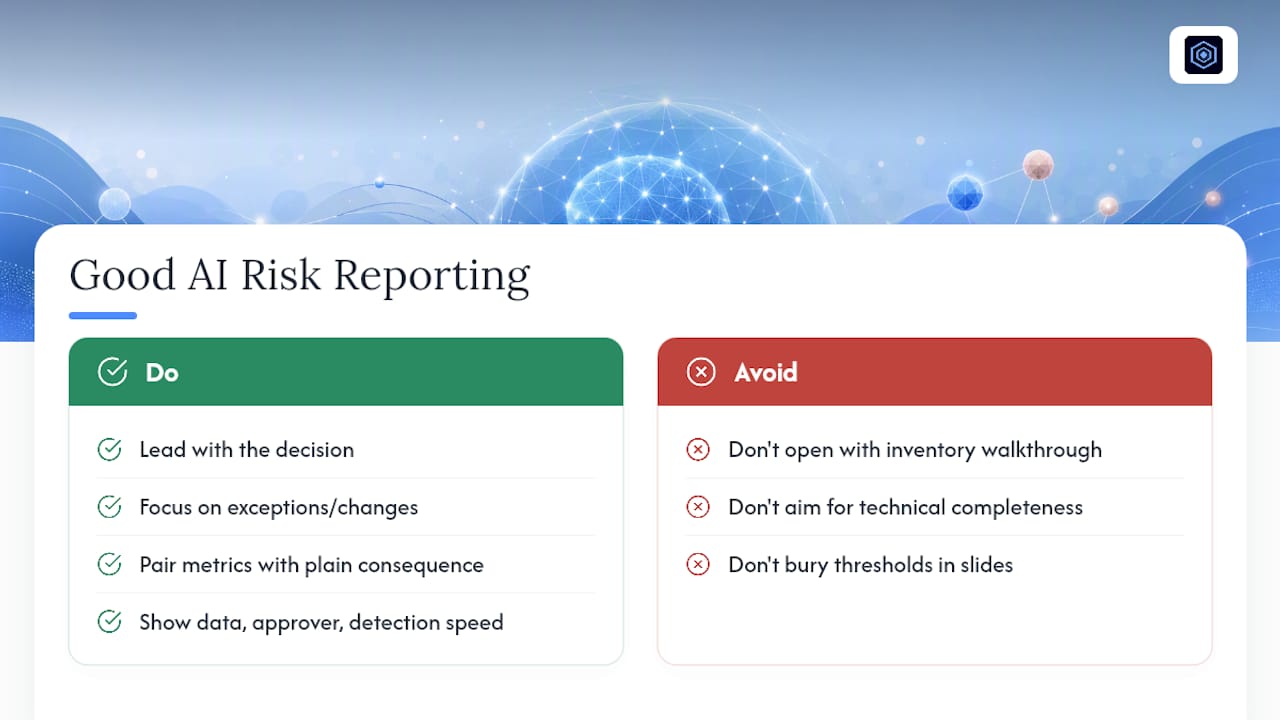
The clearest examples of effective AI risk reporting share one trait: they lead with a decision the board needs to make, not a status update. A risk committee that opens with "here is the one system we recommend pausing pending review, and here is why" gets more useful board engagement than one that opens with a 40-slide inventory walkthrough.
Firms that report well tend to structure the briefing around exceptions, not comprehensiveness. Instead of listing every AI system's status, management flags what changed since last quarter: new deployments, closed risks, and anything that crossed a predefined threshold. This keeps the briefing short enough that directors actually read it before the meeting rather than skimming it during the meeting.
Another pattern worth adopting: pairing every risk metric with a plain-language consequence statement. A time-to-detect figure means little on its own. Stated as "if this agent misfires, it currently takes us longer to notice than the exposure window our insurance policy assumes," it becomes a decision-relevant fact. Practitioner guidance on presenting AI risk to boards recommends anchoring every report to three questions directors actually care about: what data was involved, who approved the action, and how fast the firm caught it. Reports built around those three questions consistently generate better board discussion than reports built around technical completeness.
How Do You Get a Board to Actually Engage With AI Risk?
Directors tune out AI briefings that read like engineering documentation, and they tune out ones that oversimplify to the point of being useless. The middle ground is storytelling anchored in consequence: start with what could go wrong in dollar or regulatory terms, then show the evidence that it either did not happen or was caught quickly.
A few habits separate briefings that land from ones that get skimmed. Open with the single most important change since last quarter, not a recap of everything. Use one visual per major point rather than dense tables that require squinting. Translate every technical term into its business consequence in the same sentence, so "model drift" becomes "the pricing model is now less accurate than when we approved it, which increases the risk of mispricing."
Directors also engage more when management admits uncertainty explicitly rather than projecting false confidence. A line like "we do not yet have full visibility into how this agent makes edge-case decisions, and here is our plan to close that gap by next quarter" builds more trust than a claim of complete control that later proves false. PwC's guidance on board oversight of AI transformation frames this kind of monitoring and honest reporting as core to treating AI as a strategic issue rather than a purely technical one.
What AI Risk Trends Should Boards Prepare For Next?
Agentic AI, systems that act rather than just recommend, is moving from pilot to production across financial services faster than governance structures are adapting to it. Boards that still treat AI oversight as a once-a-year technology briefing will find themselves behind firms that have shifted to monthly or even continuous reporting on their highest-risk agents.
Regulatory attention is also compounding rather than plateauing. Expect more specificity from regulators about what counts as adequate human oversight, not just a general requirement to have some oversight in place. Firms that can already produce timestamped, signed evidence of review will adapt faster than firms still relying on manual sign-off sheets or verbal assurances.
A third trend worth watching: third-party and vendor AI risk is becoming harder to separate from internal risk, since many firms now run AI capabilities embedded in vendor software rather than built in-house. Boards should expect vendor risk assessments to increasingly require the same inventory and evidence standards applied to internal systems.
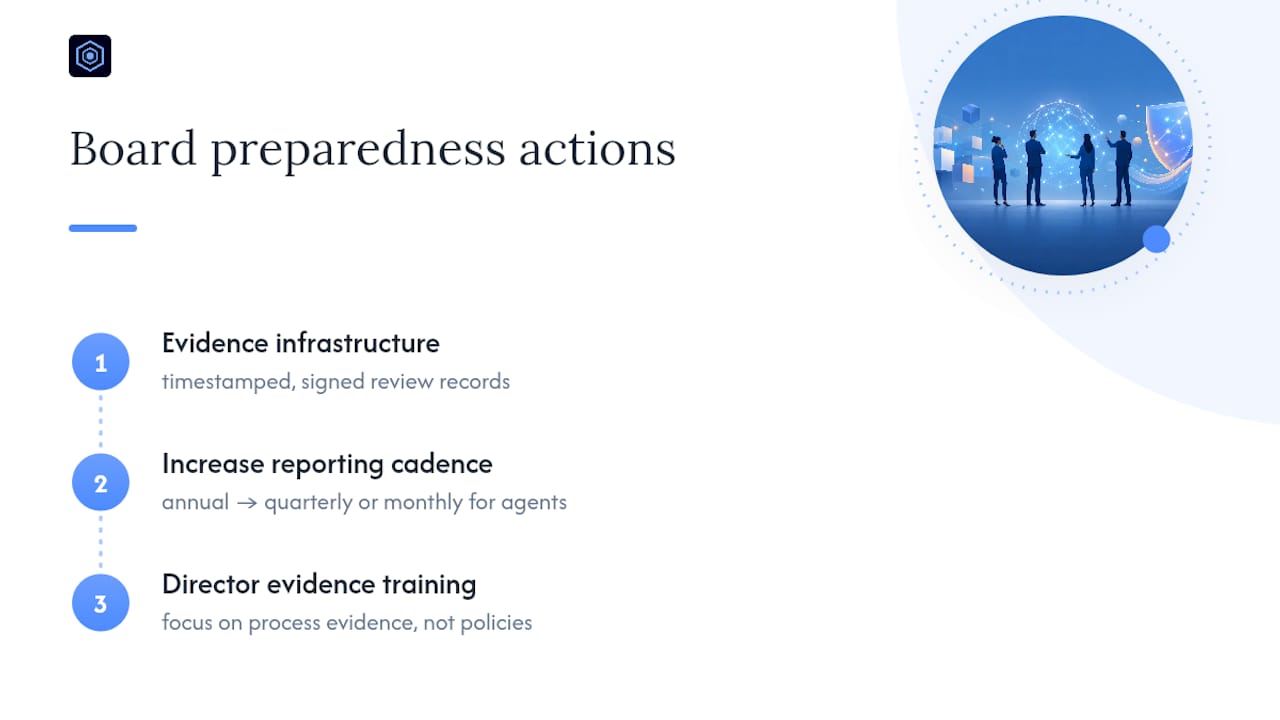
Boards that prepare well are doing three things now: building the evidence infrastructure before a regulator asks for it, moving from annual to quarterly (or monthly for agentic use cases) reporting cadence, and training directors to ask about process evidence rather than accepting policy documents as proof of control.
How Should Third-Party AI Audits Fit Into Board Reporting?
Third-party AI risk assessments add credibility that internal self-reporting cannot match on its own, but only when the board knows exactly what was tested and what was not. A vendor audit that reviewed model accuracy but never touched human oversight controls tells the board nothing about whether a human could actually stop a bad decision in time.
The board package should specify the scope of any third-party assessment in plain terms: what systems were tested, what was excluded, and whether the assessor had independent access or relied on management's own documentation. An audit built entirely from documents management provided carries less weight than one built from independent technical verification.
Third-party findings work best when folded directly into the remediation tracker, not presented as a separate report that never connects to the quarterly briefing. If an external audit flags a gap, the board should expect to see that gap tracked with the same rigor, owner, and deadline as any internally identified risk. Firms just starting this process can use a structured gap assessment, like the one outlined in AETHER Pulse's compliance gap assessment guide, to establish a baseline before bringing in outside assessors.
How Boards Can Get Comfort Without Doing Management's Work
The most common board mistake on AI risk is not asking too little. It's accepting reassurance instead of evidence. A committee that lets "we have controls in place" pass without a signed record has quietly outsourced its oversight duty back to the people it is supposed to be overseeing.
The fix is not more technical training for directors. It's insisting on artifacts, joint sign-off on high-risk systems, and treating any unanswered question as a finding rather than a follow-up item. That posture keeps the board's noses in without its fingers ever touching the controls themselves.
— Eleye
How AETHER Pulse Gives Boards Audit-Ready AI Evidence
Most of the evidence this briefing template calls for, signed decision records, tamper-evident review logs, an accurate inventory that catches shadow AI, can be produced by AI governance tools that connect through metadata only, via OAuth grants, to build a live inventory and identity graph of every AI agent in production, then generate cryptographically signed evidence packs that map directly onto the four-part board briefing: inventory, prioritized risks, compliance posture, and remediation.
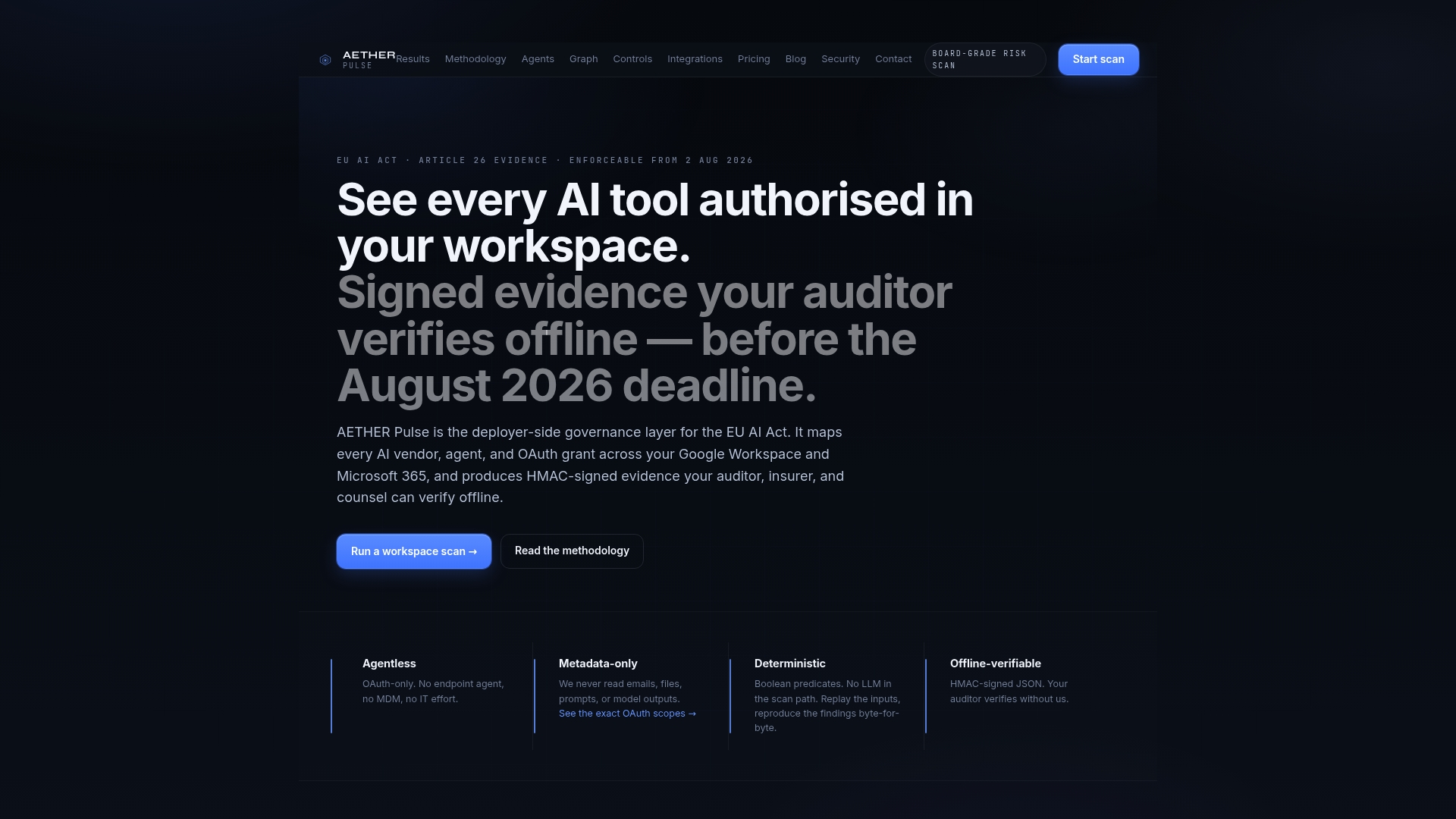
Because AETHER Pulse never inserts itself into production systems or accesses sensitive customer data, it fits the "Noses In, Fingers Out" model this article has argued for: governance visibility without operational interference. It's built around the same reference points boards already track, EU AI Act Article 26, FCA SYSC and Consumer Duty, the ICO's developing code on automated decision-making, so the evidence you bring to the next board meeting maps directly to what regulators will ask about. If your firm needs a defensible answer to "show us the evidence" rather than another policy document, request a demo or an evidence-pack sample from AETHER Pulse before your next quarterly briefing.
Sources
- Director Essentials: Implementing AI Governance — NACD
- Board oversight of AI — Harvard Law School Forum on Corporate Governance
- Board oversight of AI transformation — PwC
- Airc
FAQ
How Often Should a Board Receive AI Risk Reports?
Quarterly is standard for most firms, but firms running agentic AI that takes autonomous actions should move to monthly risk committee reporting with quarterly rollups to the full board.
What Is the Difference Between an AI Inventory and Shadow AI Discovery?
An AI inventory lists sanctioned, known systems, while shadow AI discovery uncovers unsanctioned tools employees adopted without formal review, usually through metadata analysis rather than self-reporting.
Who Should Own AI Risk on the Board?
Most firms route day-to-day AI oversight through the risk or audit committee, escalating to the full board when exposure crosses a predefined financial or regulatory threshold.
What Counts as Process Evidence for AI Governance?
Process evidence means signed decision records, tamper-evident logs, and test reports proving controls actually ran, as opposed to raw activity logs or policy documents alone. Tools like AETHER Pulse generate this evidence automatically through metadata connections.
What Should Boards Do When Management Can't Answer a Traceability Question?
Treat any unanswered question about data lineage or decision approval as a formal finding that drives next-quarter remediation, not as something to revisit informally.
Recommended
Working on Article 26 readiness, deployer-side governance evidence, or AI agent risk at a regulated firm? We'd value 15 minutes of your perspective.
Start a conversation