Build Audit Ready Deterministic Controls for AI in Regulated Finance
Build Audit Ready Deterministic Controls for AI in Regulated Finance

Deterministic controls for AI are the tamper-evident, cryptographically signed, provenance-tracked records that let a governance team prove, not assert, how an AI agent behaved. They convert oversight from a narrative into evidence a regulator or auditor can independently verify. The controls that matter fall into three groups: agent inventory, provenance capture, and signed evidence packaging, each covered in detail below.
TL;DR:
- Deterministic controls rely on cryptographically signed, provenance-tracked records near the source of AI decisions, not on the internal architecture of models.
- Regulatory guidance mandates detailed agent inventories, data provenance, signed evidence, and long-term retention for auditability and oversight.
- Building a compliant system requires a 90-day phased approach, starting with inventory, metadata schema, and signed evidence collection, then expanding coverage.
- Proper evidence packages include signed decision records, provenance chains, agent catalogs, and change logs, emphasizing traceability over volume.
- Common failures involve relying on downstream logs, unsigned tooling, missing provenance data, or neglecting vendor concentration risks, reducing audit reliability.
Table of Contents
- What deterministic controls for AI actually cover
- Why auditors and supervisors care about this now
- The building blocks of a defensible evidence layer
- A 90-day path to audit-ready deterministic controls
- What a defensible audit packet looks like
- Where deterministic control programs go wrong
- The gap between governance theater and governance evidence
- How AETHER Pulse turns these controls into working evidence
- Where to go for the primary regulatory guidance
- Sources
- FAQ
What deterministic controls for AI actually cover
Deterministic controls, in the governance sense used throughout this article, refer to evidence and oversight mechanisms, not to a model's internal architecture. This is a distinction risk and compliance leaders need to hold firmly: the term does not describe rule-based or non-probabilistic AI systems that always return the same output for a given input. It describes the audit trail wrapped around whatever AI agent your firm has deployed, probabilistic or otherwise.
In regulated finance, that scope typically includes agents used for credit decisioning support, transaction monitoring, customer service automation, and document review. Each of these generates decisions or recommendations that a supervisor will eventually ask you to explain.
Deterministic evidence differs from an ordinary application log in three ways. It is captured near the source rather than aggregated downstream, since authoritative logging guidance notes that summarized or aggregated records commonly miss the forensic context needed to reconstruct an incident. It carries provenance metadata describing data origin, model version, and transformation history. And it is cryptographically anchored so tampering after the fact is detectable rather than merely discouraged.

Why auditors and supervisors care about this now
Supervisory guidance did not wait for AI agents to mature before setting expectations. The Federal Reserve's SR 26-2 guidance requires model inventories, clearly assigned roles and responsibilities, documentation, and vendor oversight, all of which apply directly to agentic AI deployments. The FDIC's revised model risk guidance reinforces the same expectations, stressing that vendor and third-party models must be validated and monitored, not taken on faith.
The OCC's 2026 bulletin makes an important point explicit: generative and agentic AI is novel, but the governance fundamentals, inventory, documentation, monitoring, still apply. Examiners are not inventing a new framework; they are asking whether firms can produce the same categories of evidence they already owe for traditional models.
The Financial Stability Board adds a systemic dimension, identifying third-party concentration and limited model explainability as drivers of financial stability risk. Provenance tracking and concentration mapping therefore serve two audiences at once: the individual examiner and the broader supervisory concern about correlated exposure across firms relying on the same few vendors.

The building blocks of a defensible evidence layer
A deterministic control program rests on five components that work together rather than in isolation.
- Agent inventory and identity graph: every AI agent gets a unique identifier, tracked version history, and a documented access mode, consistent with the inventory practices supervisory guidance expects.
- Metadata and provenance capture: data sources, transformations, and prompt or model metadata are recorded at the point of use, not reconstructed later from memory or ticket notes.
- Tamper-evident logging with cryptographic signatures: signing each record with HMAC-SHA256 and attaching a trusted timestamp means alteration after the fact is detectable, since signing alone does not establish event time without a timestamp authority.
- Evidence packaging and retention: packets are assembled on demand and retained for a defined period, echoing CISA's Secure by Design recommendation that baseline logs be retained long enough to support forensic review.
- Control hygiene for the audit tooling itself: collectors and evidence-pack builders are signed and checksum-validated, because an audit trail is only as trustworthy as the tool that assembled it.
Pro Tip: Treat your evidence pipeline as a system requiring its own change control; an unsigned collector undermines every signature it produces downstream.
A 90-day path to audit-ready deterministic controls
Building this capability does not require a multi-year program. A phased approach keeps friction low while producing usable evidence early.
- Inventory and classify. Catalog every deployed AI agent and rank each by materiality and risk concentration before building anything else.
- Define a minimum viable metadata schema. Start with agent ID, model version, data source, decision type, and timestamp; expand once the pilot proves the schema captures what examiners ask for.
- Deploy agentless metadata collection. Connect via read-only, metadata-only taps rather than embedding agents in production systems, which shortens deployment time and avoids touching customer data.
- Establish signing and packaging procedures. Every record gets an HMAC-SHA256 signature and a trusted timestamp before it leaves the collection layer.
- Build offline verification workflows. Auditors should be able to check signatures and provenance chains without needing live access to production systems.
- Pilot with internal audit, then iterate. Run a focused pilot on one agent category, validate the evidence packet with internal audit, and expand coverage in subsequent sprints, a sequence covered in more detail in this 90-day audit-readiness roadmap.
Pro Tip: Run the first pilot on the agent category with the highest risk concentration, not the easiest one to instrument; that is where examiners will look first.
What a defensible audit packet looks like
Auditors and examiners are not looking for a narrative memo. They want artifacts they can independently check.
- Signed event records showing each agent decision or action with its cryptographic signature intact.
- Provenance chains linking each output back to its data source, model version, and transformation steps.
- Inventory exports demonstrating a complete and current agent catalog.
- Risk-concentration reports showing dependency mapping across vendors and models.
- Change logs documenting model updates, retraining events, and configuration changes.
Non-repudiation matters here: a valid HMAC-SHA256 signature paired with a trusted timestamp proves a record was not altered after the fact, which is the property examiners actually test when they ask for evidence rather than assurances. For agents built on vendor black boxes, documented attestations, contractual logging rights, and compensating controls fill the gap when direct instrumentation is not possible. Guidance on how internal audit assesses this kind of evidence without duplicating technical validation is covered in this audit-ready AI model change management guide.
Where deterministic control programs go wrong
Most failures trace back to a handful of recurring mistakes rather than exotic technical gaps.
- Relying on aggregated or downstream logs instead of records captured near the source, which loses the forensic detail examiners need.
- Leaving audit tooling itself unsigned, so the collectors and parsers that build the evidence pack become the weakest link.
- Inconsistent or missing provenance fields, which breaks the chain an auditor needs to trace a decision back to its inputs.
- Ignoring vendor concentration risk, a gap the Financial Stability Board flags as a systemic concern, not just an operational one.
Third-party concentration and limited model explainability are identified as key drivers of financial stability risk. This means provenance and concentration mapping function as both a firm-level control and a signal supervisors watch at the sector level.
The gap between governance theater and governance evidence
Most firms can produce a policy document describing AI oversight. Far fewer can produce a signed, timestamped record proving that oversight was applied to a specific agent decision on a specific date. That gap is where examiner findings tend to concentrate, because a policy answers what a firm intends to do while evidence answers what actually happened.
The industry's instinct has been to add more dashboards and more logging volume, treating quantity as a proxy for rigor. Supervisory guidance from the Federal Reserve, FDIC, and OCC does not ask for more data; it asks for traceable, reproducible records tied to a documented inventory. A firm with a smaller but cryptographically verifiable evidence base will fare better in an exam than one with terabytes of unsigned logs nobody can prove weren't altered. The discipline that matters is provenance and integrity, not volume.
**
How AETHER Pulse turns these controls into working evidence
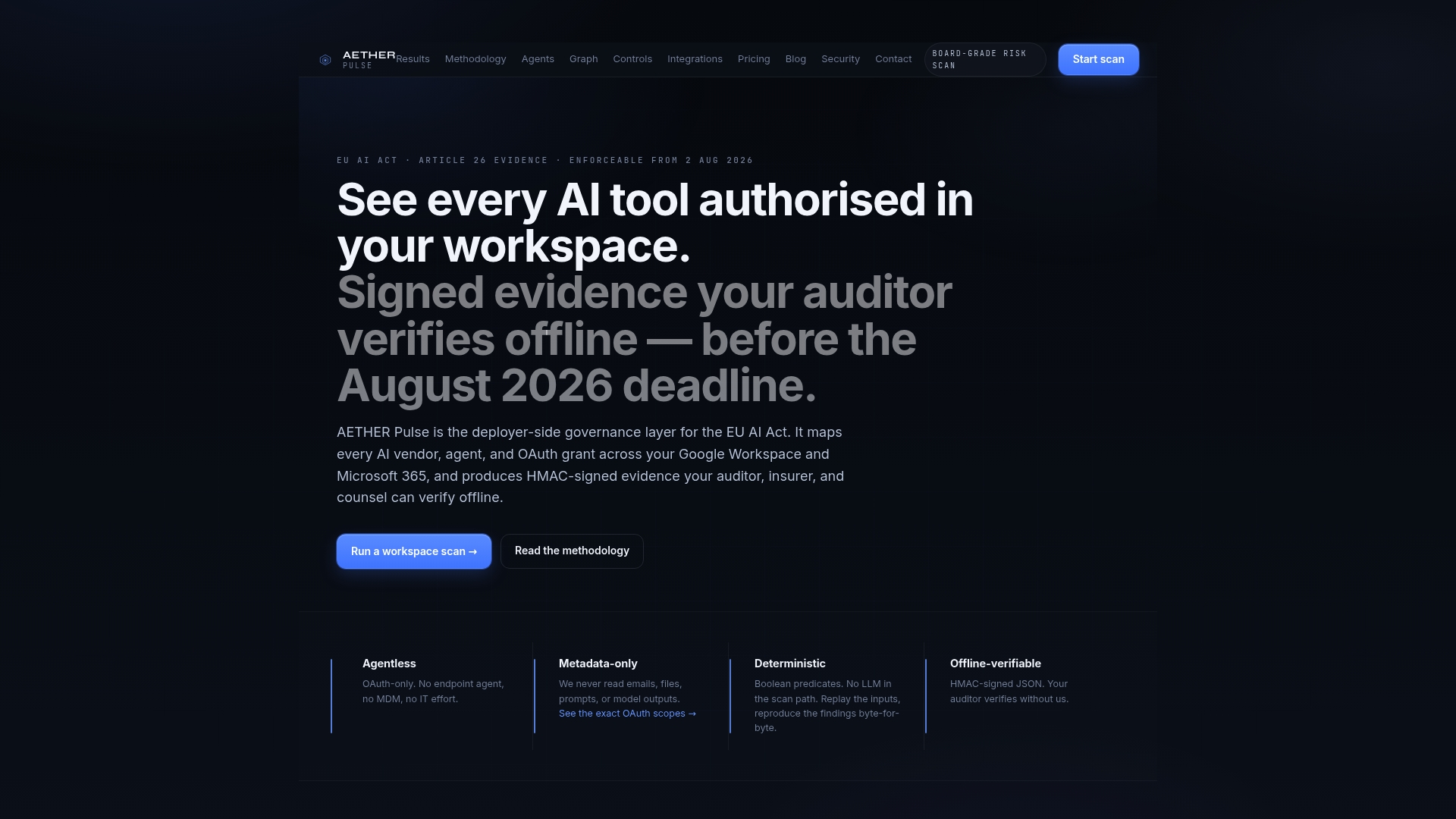
There are platforms built around the governance gap described above: read-only, metadata-only layers for regulated financial services firms that do not touch customer data and require no endpoint agents. Such solutions map directly onto the checklist covered earlier.
- Agent inventory and identity graph, built automatically from metadata rather than manual spreadsheets.
- HMAC-SHA256 signed evidence packs, generated on demand for audit and regulatory review.
- Risk-concentration reporting, surfacing vendor and model dependencies before an examiner asks about them.
Firms preparing for EU AI Act Article 26 obligations can start with the Article 26 readiness audit, while teams wanting a broader look at plans, including Free, Pro, and Enterprise tiers, can review options at Aetherpulse.
Where to go for the primary regulatory guidance
For teams building citations into internal policy, the primary sources behind this article are worth keeping on hand: SR 26-2 and FDIC guidance set model risk expectations, the OCC 2026 bulletin extends them to agentic AI, and the FSB's financial stability report frames the systemic view. Additional advisory perspectives are available through Byram Advisory Group's insights.
This article is general information, not a substitute for advice from a qualified financial advisor. Consult a qualified financial professional about your own circumstances before acting on anything here.
Sources
- Supervisory Guidance on Model Risk Management (SR 26-2)
- FDIC model risk management revised guidance
- OCC model risk management bulletin (2026)
- The Financial Stability Implications of Artificial Intelligence
- CISA logging reference architecture
FAQ
What is the difference between deterministic controls and deterministic AI models?
Deterministic controls, as used in AI governance, refer to tamper-evident, cryptographically signed evidence and audit trails around an AI agent's behavior. They are unrelated to deterministic AI architectures, which describe models that always produce the same output for a given input.
How does cryptographic signing prove an audit record was not altered?
An HMAC-SHA256 signature attached to a record allows anyone verifying it to detect whether the content changed after signing, which is the basis of non-repudiation. Pairing the signature with a trusted timestamp is necessary because signing alone does not establish when an event actually occurred.
Why does vendor concentration matter for AI governance?
Heavy reliance on a small number of AI vendors or models creates correlated exposure across the industry, a concern the Financial Stability Board has flagged as a driver of systemic risk. Mapping these dependencies helps a firm address both its own risk exposure and the broader concentration regulators monitor.
Can AETHER Pulse generate audit-ready evidence without accessing customer data?
Yes, AETHER Pulse connects through metadata only, building an agent inventory and producing HMAC-SHA256 signed evidence packs without touching underlying customer data. This agentless design is intended to shorten deployment while still meeting the documentation and traceability expectations described in supervisory guidance.
Recommended
Working on Article 26 readiness, deployer-side governance evidence, or AI agent risk at a regulated firm? We'd value 15 minutes of your perspective.
Start a conversation