ISO 42001: Close AI Audit Evidence Gaps for Compliance Leaders
ISO 42001: Close AI Audit Evidence Gaps for Compliance Leaders

ISO/IEC 42001 is the international management-system standard that defines how an organization governs AI across its lifecycle. It certifies a management system, not a model, and it runs on the PDCA cycle. Certification is voluntary, but a documented Statement of Applicability (SoA) and clean evidence make you audit-ready and procurement-ready. We at AETHER Pulse build the evidence layer that supports it.
TL;DR:
- Draft the Statement of Applicability early: justify every excluded Annex A control with a risk rationale, and link selected controls to the risks they address.
- Stage 2 auditors test operating history through monitoring logs, incident registers, internal audit reports, and management review minutes; policies without records are insufficient.
- Start with AI systems carrying regulatory or customer exposure, then expand scope at the first surveillance audit rather than committing to systems you barely govern.
- Set review cadence by risk, checking high exposure systems monthly and lower risk systems quarterly or annually, and reassess after material changes.
- ISO/IEC 42001 can structure compliance work, but certification is voluntary and does not grant a presumption of conformity with the EU AI Act.
Table of Contents
- What ISO/IEC 42001 covers and who should use it
- Key clauses and required elements: Clauses 4–10 and Annex A
- What auditors look for: Stage 1, Stage 2 and realistic timelines
- Practical implementation roadmap and common pitfalls
- How ISO 42001 maps to the EU AI Act, NIST AI RMF and ISO 27001
- How agentless, metadata-only evidence layers close ISO 42001 evidence gaps
- Roles and responsibilities in ISO 42001 AI management systems
- Integration of AI risk assessment methods within ISO 42001
- Continuous monitoring and improvement practices specific to AI governance
- Data privacy and security controls mandated by ISO 42001
- Impact of ISO 42001 on organizational culture and AI ethics policies
- Why we would prioritize ISO 42001 now, and when to wait
- How we help you reach ISO 42001 evidence readiness faster
- FAQ
- Sources
What ISO/IEC 42001 covers and who should use it
An AI management system (AIMS) is the set of policies, roles, controls and records that govern how your organization develops, provides or uses AI. ISO/IEC 42001:2023 specifies requirements for establishing, implementing, maintaining and continually improving that system, and it applies across industries and organization sizes. The ISO overview describes it as a management system standard built on the Plan-Do-Check-Act (PDCA) methodology, focused on governance and processes rather than the technical details of specific AI models.
That last point shapes everything that follows. An auditor will not test your model's accuracy. They will test whether you decided who owns AI risk, wrote down how you assess it, and kept proof that the process runs.
Typical triggers for adoption include:
- Scaling from a few pilots to AI embedded in core business processes.
- Enterprise customers asking for evidence of AI governance in procurement questionnaires.
- Regulators or external auditors expecting demonstrable oversight of automated decision-making.
- A need to consolidate scattered AI policies into one auditable system.
- Organizations that develop, provide or use AI systems, including those that only consume third-party AI tools.
PDCA matters because it forces a loop: plan the controls, operate them, check the results, then correct. Auditors look for that loop, not a one-time policy document.
Key clauses and required elements: Clauses 4–10 and Annex A
Treat the clause structure as a work breakdown. Each clause gives you an owner, a deliverable and a body of evidence.
- Context and scope: Define the organization's context, interested parties and the AIMS boundary. A well-defined scope names the AI systems, business units, locations and lifecycle stages included, and states plainly what is excluded and why.
- Leadership: Top management sets the AI policy and objectives, assigns roles and demonstrates commitment. A policy signed but never reviewed may not withstand an operational audit.
- Planning and support: Document AI risk assessment and treatment, set measurable objectives, and show competence, awareness, resources and controlled documented information.
- Operation: Run the controls across the AI lifecycle, including impact assessment and change control.
- Performance and improvement: Monitor, measure, run internal audits and management reviews, and track corrective actions.
ISO's explainer lists the substantive content: leadership, AI policy and objectives, risk management, data governance, lifecycle controls, transparency, performance evaluation and continual improvement. For a clause-by-clause translation into tasks, the Cloud Security Alliance's requirements article is a practical companion.
Annex A holds reference controls, not a mandatory checklist. The SoA is the document that records which controls apply, which do not, and the risk-based reason for each. Attempting to implement every Annex A control by default wastes budget and produces weaker justification than a tight, defensible SoA.
Pro Tip: Draft the SoA early and treat it as a living register. Every exclusion needs a written risk rationale an auditor can read in under a minute.
For teams building deterministic controls in regulated finance, our guide on audit-ready deterministic controls shows how those controls translate into clause-level evidence.
What auditors look for: Stage 1, Stage 2 and realistic timelines
Certification is carried out by independent certification bodies, and the audit runs in two stages.
- Documentation review: The auditor checks that your AIMS exists on paper: scope, AI policy, risk methodology, SoA and the planned arrangements for internal audit and management review. Gaps found here are cheap to fix.
- Operational effectiveness: The auditor tests whether the system actually operates. They sample records and interview owners.
- Evidence auditors commonly request: approved policies and objectives, the SoA with justifications, AI system inventories, monitoring logs, incident registers, completed internal audit reports, management review minutes and control mappings.
- Surveillance: Certification is not a one-time event. Expect periodic surveillance audits that re-test the same loop.
The most common pitfall is requesting an audit before the system has operating history. Auditors need evidence of performance, monitoring and improvement, and a fresh policy set with no records behind it fails that test.
Evidence collection and operating history are common sources of delay in a certification program.
The internal build phase, covering policy design, internal audits and management reviews, tends to be where projects stall. Teams that collect evidence continuously from the start avoid the scramble. Our piece on AI logging for audit evidence explains how to capture it without touching customer data.
Practical implementation roadmap and common pitfalls
Plan the work in clear steps, each with one accountable owner.
- Secure stakeholder buy-in: The executive sponsor, usually the chief risk or compliance officer, confirms budget, scope intent and decision rights.
- Run a gap analysis: The AIMS lead compares current practice against the standard's requirements and inventories every AI system in use, including shadow AI adopted outside IT.
- Design policies and controls: Risk, legal and engineering draft the AI policy, risk methodology, impact assessment process and SoA.
- Collect monitoring evidence: Control owners run the controls and capture records as they go. This step creates the operating history auditors need.
- Hold internal audits and management reviews: An independent internal auditor tests the system; top management reviews results and signs off corrective actions.
- Complete the external audit and remediate: The AIMS lead coordinates the audit and closure of nonconformities.
These activities are planning estimates, not published figures, and they overlap in practice.
Four pitfalls recur. An overbroad scope commits you to evidencing systems you barely govern. A missing operating history makes Stage 2 fail on timing alone. A thin SoA leaves exclusions unjustified. Weak coordination between legal, security, data science and business owners leaves orphaned controls.
Pro Tip: Narrow the first certification scope to the AI systems that carry real regulatory or customer exposure, then widen it at the first surveillance cycle.
A structured walkthrough of audit-ready risk work is available in this AI risk assessment post, and our agentless governance plan shows one way to sequence the same effort in regulated finance.
How ISO 42001 maps to the EU AI Act, NIST AI RMF and ISO 27001
Keep three relationships clear:
- EU AI Act: ISO/IEC 42001 is voluntary and does not grant a presumption of conformity with the EU AI Act. Organizations often use it as a structured first step to build compliance processes. For the legal obligations themselves, this EU AI Act explainer covers who must comply and what is required.
- NIST AI RMF: The two complement each other. ISO 42001 supplies the management system, meaning policy, roles and process. The NIST framework supplies risk-management vocabulary and technical practice. Our guide to mapping NIST to regulator-ready evidence shows how one evidence set can serve both.
- ISO 27001: Both standards share a management-system structure and the PDCA approach, so risk assessment methods, internal audit programs, document control and SoA-style artifacts can be reused when building an AIMS.
How agentless, metadata-only evidence layers close ISO 42001 evidence gaps
Evidence is where most AIMS programs lose time, and it is the problem we built AETHER Pulse to solve. We connect through OAuth metadata only, so we touch no customer data and install nothing in production systems.
- We build an inventory and identity graph of your AI agents, giving you the system register that Clause 4 scoping and the SoA depend on.
- We surface risk concentration, including financial blast-radius exposure, so risk treatment decisions rest on observed activity.
- We generate tamper-evident evidence packs signed with HMAC-SHA256, with provenance tracking, which auditors can verify offline.
- We package records for management review and external audits, giving Stage 2 testers dated, deterministic proof of operation.
Roles and responsibilities in ISO 42001 AI management systems
The standard assigns accountability rather than prescribing job titles. What matters is that every responsibility has a named owner and that the assignment is documented.
Top management owns the AI policy, objectives, resourcing and management review. Under Clause 5 this cannot be delegated away: auditors interview executives to confirm they understand and direct the system.
The AIMS lead, often a head of AI governance or a compliance manager, runs the system day to day. They maintain scope, the SoA and the document set, coordinate the internal audit schedule and track corrective actions.
Risk and compliance functions own the risk assessment methodology, impact assessments and the link to regulatory obligations such as the EU AI Act, FCA expectations or ICO guidance.
AI system owners are the business or product leaders accountable for a specific AI system through its lifecycle. They approve deployment, accept residual risk and respond to incidents.
Engineering and data teams operate technical controls: data quality checks, access management, logging, change control and monitoring.
Internal audit must be independent of the people who built the controls. A common nonconformity is the AIMS lead auditing their own work.
All staff carry an awareness duty under Clause 7. They must know the AI policy and how to report concerns.
A simple responsibility matrix, listing each clause, control and record against an accountable owner, is one of the most persuasive artifacts you can show an auditor.
Integration of AI risk assessment methods within ISO 42001
ISO 42001 requires you to assess and treat AI risk but does not mandate a single method. That flexibility is useful, and it is also where weak programs hide. Pick a method, document it and apply it consistently.
Start by defining criteria: the likelihood and impact scales, the risk appetite and the thresholds that trigger treatment. Then run two distinct assessments. An organizational AI risk assessment looks at risks to the business, such as regulatory exposure, operational dependency and reputational harm. An AI system impact assessment looks outward at effects on individuals and groups, covering fairness, transparency, safety and privacy.

Existing methods plug in cleanly. If you already follow the NIST AI RMF, its map and measure activities can feed your risk register, and your ISO 27001 risk process can supply the scoring approach and treatment workflow. The management system adds the requirement that results are recorded, linked to controls and reviewed.
Risk treatment decisions flow into the SoA. Each selected Annex A control should trace back to a risk it addresses, and each exclusion to a risk judged acceptable or absent. That traceability, risk to control to evidence, is what auditors follow.
Concentration risk deserves explicit attention. A single agent or integration with broad permissions across many workflows can carry far more exposure than its inventory entry suggests. Reassess risk whenever a system changes materially, a new model is adopted or a use case expands, not only on an annual cycle.
Continuous monitoring and improvement practices specific to AI governance
The performance and improvement requirements turn a static document set into a living system. For AI, monitoring has features that classic IT governance lacks, because AI behavior can drift without any code change.
Define what you monitor and who looks at it. Useful categories include:
- Inventory change: new agents, new integrations and new permissions appearing outside the approval process.
- Performance and outcome signals: error rates, complaint volumes, override rates by human reviewers.
- Control operation: whether approvals, reviews and access recertifications happened on schedule.
- Incidents and near misses, logged in a register with root cause and corrective action.
Set review cadences that match risk. High-exposure systems justify monthly review, while low-risk systems can sit on a quarterly or annual rhythm. Record each review, because an unrecorded review is invisible to an auditor.
Internal audits should sample the monitoring itself, asking whether the signals are the right ones and whether anyone acted on them. Management review then takes the aggregated picture: audit findings, incident trends, changes in risk and regulation, and resource needs. Its minutes should record decisions, owners and deadlines.
Continual improvement means nonconformities and lessons learned change the system. Show the chain: finding, root cause, corrective action, verification of effectiveness. Auditors give far more credit to a modest problem that was caught and fixed than to a perfect record with no evidence of checking.
Data privacy and security controls mandated by ISO 42001
ISO 42001 does not replace privacy or security law, and it does not contain a standalone privacy regime. It requires you to manage data and security risk within the AI lifecycle and to show that controls match the risks you identified.
Data governance sits at the center. Per ISO's explainer, the requirements include data governance and lifecycle controls. In practice that means documenting the provenance and quality of data used to build and operate AI systems, defining who may access it and recording how it is retained and disposed of.
Annex A supplies reference controls in these areas, and your SoA records which apply. Expect to address:
- Data quality and fitness for purpose for each AI system.
- Access control and least privilege for models, prompts, pipelines and connected tools.
- Handling of personal data, aligned with your lawful basis and the privacy laws that apply to you.
- Security of third-party and supplier AI services, including contractual and technical due diligence.
- Logging sufficient to reconstruct what an AI system did, without needlessly duplicating sensitive content.
Organizations already certified to ISO 27001 can reuse much of their security control environment, extending asset registers and supplier management to cover AI.
A design choice we make at AETHER Pulse is evidence collection through metadata only, so the governance layer itself does not become a new store of sensitive data. Good AI governance should reduce your data exposure, not add to it.

Impact of ISO 42001 on organizational culture and AI ethics policies
Standards change behavior only when people see them in daily decisions. ISO 42001 pushes ethics from a values statement into operating procedure, which is its most significant cultural effect.
An AI ethics policy under the standard is not a poster. The AI policy and objectives must be measurable, communicated and tied to controls. Principles such as fairness, transparency and accountability become checkpoints: an impact assessment before deployment, a documented human oversight arrangement, a channel for people affected by an AI decision to raise concerns.
Cultural change shows up in a few predictable places. Product and engineering teams learn that deploying an AI tool requires registration and approval, which surfaces shadow AI that previously went unseen. Business owners accept named accountability for the systems they sponsor. Staff gain a clear route to report concerns, and the management review ensures that leadership hears those concerns.
Resistance is real. Teams may read the process as bureaucracy that slows experimentation. The remedy is proportionality: lightweight approval for low-risk uses, deeper review for high-impact ones, and fast, predictable turnaround so governance is not the bottleneck.
Competence and awareness requirements make training part of the system. Role-specific training for approvers, developers and executives, with records of completion, is both a cultural lever and an audit artifact. Over successive surveillance cycles, the habit of documenting decisions tends to outlast any single policy.
Why we would prioritize ISO 42001 now, and when to wait
My view: prioritize ISO 42001 if customers are already asking for evidence of AI governance, or if AI sits in decisions that regulators care about. Defer it if you cannot yet see which AI systems you run or monitor their operation, because certification cannot rescue missing basics. Quick wins come first: fix the scope, draft the SoA and map the evidence you already hold.
— Eleye
How we help you reach ISO 42001 evidence readiness faster
Most ISO 42001 programs slow down at evidence, not at policy writing. We built AETHER Pulse to close that gap: agentless, metadata-only collection, an inventory of your AI agents, and tamper-evident, provenance-tracked evidence packs your auditors can verify. You get audit-ready records without installing anything in production or exposing customer data.
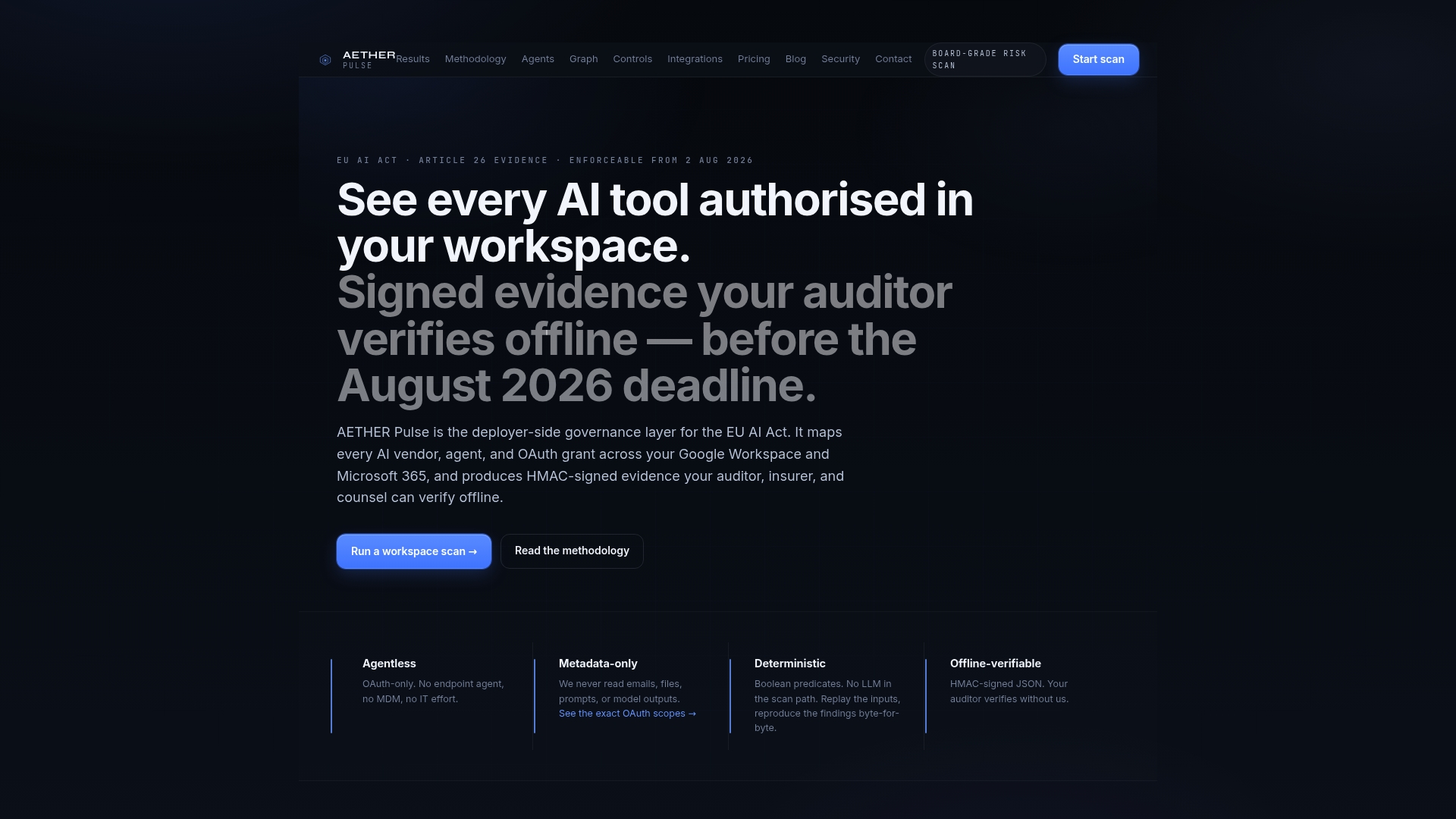
If you want a structured starting point, our Article 26 readiness audit and Design Partner and Production plans are on our pricing page, and you can review the Free, Pro and Enterprise options on Aetherpulse. Request a demo and we will show you what your evidence pack would look like.
FAQ
What is the ISO standard for AI governance?
ISO/IEC 42001:2023 is the international standard for AI management systems. It specifies requirements for establishing, implementing, maintaining and continually improving a governance system for AI across its lifecycle.
Is ISO 42001 certification mandatory?
No. Certification is voluntary and carried out by independent certification bodies. It also does not give you a presumption of conformity with the EU AI Act, so treat it as a structured step toward compliance rather than a legal safe harbor.
How does ISO 42001 relate to ISO 27001?
Both are management-system standards built on PDCA, so you can reuse risk assessment methods, internal audit programs and SoA-style documentation. ISO 42001 adds AI-specific requirements such as impact assessment and lifecycle governance.
What do auditors look for in a Stage 2 audit?
They test whether your system operates, not just whether it is documented. Expect requests for monitoring logs, incident registers, internal audit reports and management review minutes that show operating history.
Sources
- EU AI Act vs NIST AI RMF vs ISO/IEC 42001: A Plain English Comparison
- ISO/IEC 42001:2023 - AI management systems
Recommended
Working on Article 26 readiness, deployer-side governance evidence, or AI agent risk at a regulated firm? We'd value 15 minutes of your perspective.
Start a conversation