AI Governance for Market Surveillance: Controls and Evidence
AI Governance for Market Surveillance: Controls and Evidence

AI governance for market surveillance means being able to show, on demand, that every model or agent that flags trading activity is inventoried, validated, monitored and overseen by accountable humans. Detection quality matters, but in an examination the question is usually different: can the firm prove who owns the system, what changed, and who made the final call on each alert? This guide covers what U.S. regulators have said, which controls hold up, and which evidence to retain.
A note on scope. "Market surveillance" also describes product-safety enforcement in the EU and post-market monitoring of medical devices. This article addresses the financial-markets meaning: trade surveillance and market abuse detection at broker-dealers, exchanges, derivatives markets and asset managers.
TL;DR
- AI can improve detection of front-running, wash trading and anomalous trading, but U.S. regulators expect firms to assess the risks and keep enough qualified staff to monitor effectively.
- The SEC has stated that algorithmic detection cannot replace staff judgment, so every AI-generated alert needs a documented human decision.
- A workable control set covers an inventory with risk ratings, validation, parallel running, ongoing testing, data ownership and cross-functional oversight.
- The evidence that persuades examiners is concrete: model versions, change history, prompt and output logs, validation results and alert dispositions.
- Evidence can be produced from metadata alone, without exposing customer or order data to the governance layer.
Table of Contents
- How AI is used in trade and market surveillance
- What U.S. regulators expect
- The risks a surveillance model brings
- Controls that hold up in an examination
- Validating and monitoring surveillance models
- Reviewing and escalating AI-generated alerts
- The audit evidence to retain
- Our perspective
- Putting this into practice with AETHER Pulse
- FAQ
- Sources
How AI is used in trade and market surveillance
Traditional surveillance relies on rules and thresholds: a price move above a set percentage, a volume spike, a pattern of orders and cancellations. These generate high alert volumes and many false positives. AI adds two things. It can learn what normal looks like for a given trader, desk or instrument, and it can surface patterns no analyst thought to write a rule for.
The Commodity Futures Trading Commission (CFTC) described this directly in a December 2024 staff advisory. In CFTC Letter No. 24-17, staff noted that AI can help identify abusive practices such as front-running, wash trading, pre-arranged trading, fraudulent trading and money passes, and can improve the detection and flagging of trade patterns and anomalies. The same letter points to machine-learning and outlier-detection algorithms that compare a trader's behavior with that trader's own history and with peers.
That is the opportunity. The governance problem begins when such a model becomes part of a control the firm relies on to meet its supervisory obligations. At that point the model is no longer an analytics experiment. It is a control, and controls must be evidenced.
Where agents enter the picture
Surveillance stacks increasingly include more than one model. A scoring model ranks alerts, a language model summarizes communications or drafts investigation notes, and automated agents pull data, enrich cases or route escalations. Each of these has an identity, a set of permissions and a change history. Few firms can list them all in one place, and that inventory gap is where governance typically fails first.
What U.S. regulators expect
There is no single U.S. rulebook for AI in surveillance. Expectations come from existing supervisory duties, applied to a new tool, and from staff statements.
CFTC. Staff expects regulated entities to assess the risks of using AI in trade surveillance, to comply with statutory and regulatory requirements, and to maintain sufficient staff and resources for effective audit trail review and market monitoring. In other words, adopting AI does not reduce the headcount and expertise a firm must be able to demonstrate.
SEC. In March 2026 remarks, the SEC Chairman said that algorithmic detection of possible misconduct cannot supplant the considered judgment of staff, and that human interaction remains imperative at every stage of the agency's own risk assessment program. Those remarks describe the SEC's internal practice, but they signal how the agency thinks about automated detection generally. A firm that lets a model close alerts without a human decision should expect difficult questions.
FINRA. FINRA's guidance is aimed at member firms and is the most operational. Its report on AI in the securities industry recommends that firms consider a comprehensive model risk management program covering development, validation, deployment, ongoing testing and monitoring, plus an inventory with risk ratings and oversight by both business and technology stakeholders.
UK reference point. Firms with London operations will also read the FCA's Market Watch 79 from May 2024. It describes surveillance failures traced to inadequate testing before and after implementation, and it encourages firms to maintain accurate and comprehensive data governance, define ownership of surveillance data and prioritize remediation of data issues according to risk. This is UK guidance, but the lessons transfer to any global surveillance program.
The risks a surveillance model brings
Before designing controls, name the failure modes. FINRA's 2026 oversight report on generative AI highlights two that matter for surveillance: hallucinations, where inaccurate or misleading information is presented as fact, and bias arising from model design or from limited, inaccurate or outdated training data.
In a surveillance setting these translate into specific operational risks:
- Missed misconduct. A model trained on stale patterns fails to flag a new manipulation technique, and no one notices because the alert count looks normal.
- False confidence. An unexplained risk score leads analysts to close alerts quickly, shifting the real decision from a person to the model.
- Fabricated narrative. A language model drafting case notes states something the underlying data does not support, and the note enters the regulatory record.
- Silent change. A vendor updates a model, a threshold or a prompt, and detection behavior shifts without a change ticket.
- Data drift. Upstream feeds change format or lose coverage, degrading output with no obvious error. FINRA observes that AI applications yield meaningful results when datasets are large, valid and current, and the converse is equally true.
The fourth risk is the one most often missed, because it sits outside the model itself. Our article on AI agent change tracking explains how to detect configuration and permission changes in agents that nobody formally announced.
Controls that hold up in an examination
The following set draws on the FINRA and FCA material above. It is organized by the order in which an examiner is likely to probe.
1. Inventory and ownership
Start with a complete list of every model, agent and automation that touches surveillance: what it does, who owns it, what systems it can reach, and what risk rating it carries. FINRA's guidance explicitly includes an inventory with risk ratings in the framework firms may consider. Shadow deployments, such as an analyst connecting a third-party assistant to a case system, belong on the list too. Our guide to AI agent governance for finance sets out the four functions that make an inventory useful rather than decorative.
2. Data governance
Define who owns each surveillance data source, what coverage it must have, and how defects are prioritized. The FCA's point about ownership of surveillance data and risk-based remediation applies to any jurisdiction: a model is only as reliable as the feed behind it, and an unowned feed is a standing audit finding.
3. Model lifecycle controls
Document development, validation, deployment, ongoing testing and monitoring as separate gates with named approvers. Where agents act on market signals autonomously, the lifecycle questions are the same: what data went in, how was it reviewed, can outputs be explained, and who monitors behavior afterward. For a view of how autonomous agents consume event-driven market signals, see this explainer on AI agents using market signals.
4. Segregation of duties
The person who tunes a detection model should not be the only person who approves it, and an agent that drafts an investigation note should not also be able to close the case. Our piece on segregation of duties for AI shows how to evidence this separation.
5. Human oversight and accountability
Name the individuals accountable for each model and for each class of alert decision. Accountability is easier to defend when it can be scored and traced; the approach described in this discussion of accountability scoring in governance illustrates how traceable evaluation can support governance decisions.
FINRA also stresses that human involvement is essential throughout the AI lifecycle, including preparing data, testing outputs, retraining models and verifying results.
Validating and monitoring surveillance models
Validation is where many programs are thinnest. FINRA suggests firms may update validation practices to review input data, algorithms, parameters and outputs, conduct upfront and ongoing testing in varied and stressed scenarios, establish performance benchmarks, and run new and current models in parallel before retiring the current ones. For AI specifically, input data is reviewed for bias, algorithms for errors and outputs for explainability.
A practical validation file for a surveillance model typically contains:
- the stated objective and the abuse typologies the model is meant to detect;
- the training and test data description, including date ranges and known gaps;
- back-testing results against known cases and synthetic scenarios;
- stress scenarios, such as volatile sessions, thin liquidity and new instruments;
- the benchmark against the prior rules-based or model-based control;
- sign-off by someone independent of the developer.
The FCA's observation that failures stem from inadequate testing both before and after implementation is a reminder that validation does not end at go-live. Post-deployment monitoring should track alert volumes, alert-to-case conversion, input feed completeness and drift in the score distribution. Our guide to audit packs for model drift risk covers how to produce that evidence on demand rather than assembling it before an examination.
A simple parallel-run example
Suppose a firm replaces a threshold-based spoofing rule with a machine-learning model. For a defined period, both run side by side. Analysts review alerts from each, and the firm records which alerts only the new model raised, which only the old rule raised, and how each was dispositioned. The comparison, signed off by compliance, becomes the evidence that the replacement was justified. Retiring the old rule happens only after the results are reviewed. This is the sequence FINRA describes, and it produces exactly the record an examiner will ask for.

Reviewing and escalating AI-generated alerts
An alert from a model is a lead, not a finding. Governance should specify:
- Who reviews. Qualified compliance staff, with defined escalation to senior surveillance or legal personnel.
- What they see. The alert, the supporting data and an explanation of why it was raised, not only a score.
- What they record. A disposition (escalate, close with rationale, request more information), a timestamp and the reviewer's identity.
- What triggers a challenge. Closure rates that look too uniform, alerts closed faster than a reviewer could plausibly read them, or sudden changes in alert volume.
- How feedback returns to the model. Analyst dispositions should inform tuning through a controlled change process, not ad hoc adjustments.
This structure reflects the principle in the SEC remarks quoted above: detection supports, and does not replace, staff judgment. It also answers the CFTC expectation about maintaining sufficient staff and resources, because reviewer capacity becomes a measurable number rather than an assumption.
The audit evidence to retain
Controls that cannot be shown do not exist for examination purposes. For generative components in particular, FINRA says firms may consider comprehensive documentation throughout development, implementation, use and monitoring, monitoring of prompts, responses and outputs, and storing prompt and output logs while tracking model versions for accountability and troubleshooting.
A retention checklist for an AI-enabled surveillance program:
| Evidence item | What it proves | Typical owner |
|---|---|---|
| Agent and model inventory with risk ratings | The firm knows what it runs | Compliance / model risk |
| Validation reports and sign-offs | Models were tested before reliance | Model risk |
| Version and configuration history | Changes were controlled | Technology / surveillance |
| Prompt and output logs for generative tools | Outputs can be reconstructed | Surveillance |
| Alert dispositions with reviewer identity | Humans made the decisions | Compliance |
| Data source ownership and defect log | Feeds are governed | Data owner |
| Periodic monitoring and drift reports | Performance is watched over time | Model risk |
Evidence without exposing sensitive data
Surveillance data is sensitive: orders, client identities, communications. Governance evidence should not require copying any of it into another system. Regulators are themselves exploring this idea; a March 2026 submission to an SEC task force describes bounded verification, in which scoped reviewers confirm or challenge specific claims without pervasive disclosure of sensitive, commercial or operational data. The same principle underlies metadata-only governance: prove that controls operated, using records about the systems, not the underlying customer data. Our articles on AI governance without PII and AI logging for audit evidence go deeper on what metadata-based evidence can and cannot establish. For mapping each internal policy statement to a retrievable artifact, see AI policy to evidence mapping.
Our perspective
We see the same pattern in regulated firms of every size. The surveillance model itself is usually well documented, because it was a project with sponsors and a validation team. What is poorly documented is the surrounding estate: the agents that enrich cases, the assistants connected through OAuth grants, the automations that route or summarize alerts, and the permissions each of them holds. These rarely appear in any inventory, and they change without a ticket.
We also think the debate about whether AI belongs in surveillance has moved on. The practical question for a head of compliance is whether oversight can be demonstrated independently of the tool. Evidence that depends on the vendor's dashboard, or that requires pulling production data into yet another repository, is weaker than evidence that is deterministic, signed and verifiable offline by an auditor who has never logged in to your systems.
That is why we built AETHER Pulse as a read-only layer that connects through metadata only. It builds an inventory and identity graph of agents, maps where risk concentrates, and produces cryptographically signed evidence packs on demand. A governance layer that itself needs deep access to sensitive systems creates the very risk it is meant to control.
— Eleye
Putting this into practice with AETHER Pulse
Firms that need to show oversight of the AI agents around their surveillance and compliance workflows can start with a metadata-only inventory rather than a long integration project. AETHER Pulse is agentless: it ingests through OAuth metadata, touches no customer data, and generates tamper-evident evidence packs signed with HMAC-SHA256 that auditors can verify independently. See the signed AI governance evidence infrastructure overview for how the pieces fit together.
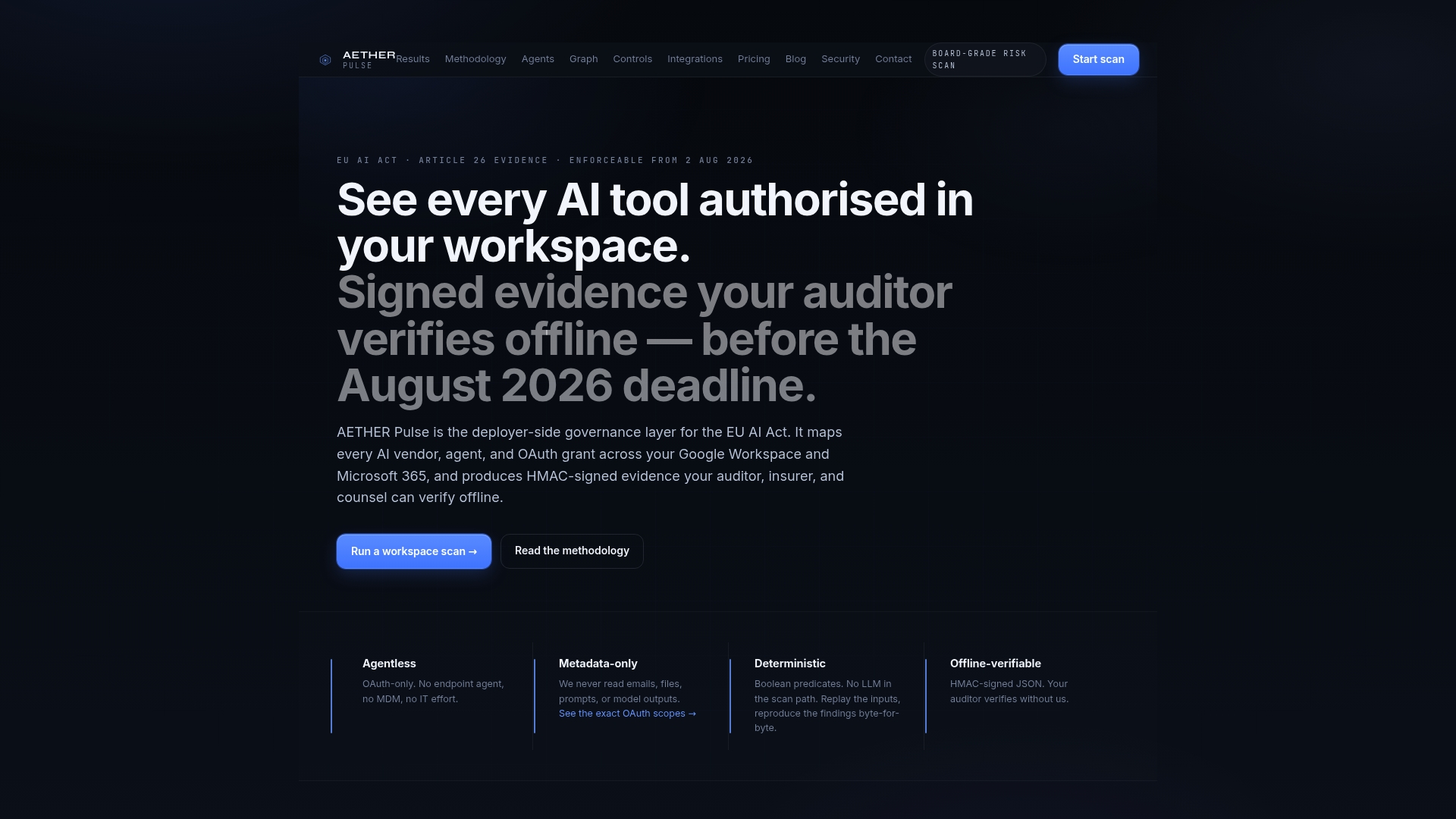
The Free, Pro and Enterprise plans are described on the AETHER Pulse home page, and the pricing page covers the Design Partner and Production options and the Article 26 readiness audit. For a typical rollout sequence, read our 90 to 120 day agentless governance plan.
FAQ
Does the SEC or CFTC prohibit using AI for market surveillance?
No. CFTC staff has acknowledged that AI can help detect abusive practices and anomalies. What it expects is that firms assess the risks, meet existing legal requirements and keep enough staff and resources for effective monitoring. The obligation stays with the firm, not the tool.
Can an AI model close surveillance alerts automatically?
The regulatory signals point away from it. The SEC Chairman has said that algorithmic detection cannot supplant staff judgment. A defensible design lets models prioritize and enrich alerts while a named reviewer records each disposition. Confirm any automated-closure design with counsel and your primary regulator before relying on it.
What should a surveillance model validation include?
FINRA suggests reviewing input data, algorithms, parameters and outputs, testing in varied and stressed scenarios, setting performance benchmarks, and running new and existing models in parallel before retiring the old one. Independent sign-off and documented results should be retained.
What logs should we keep for generative AI used by surveillance teams?
FINRA's 2026 report says firms may consider storing prompt and output logs and tracking model versions for accountability and troubleshooting, alongside comprehensive documentation of development, use and monitoring. Retention periods depend on your regulator and record-keeping rules, so confirm them with compliance counsel.
Can governance evidence be produced without accessing customer data?
For many oversight questions, yes. Inventories, permissions, change history, approvals and log existence are metadata. Evidence about what a model decided on a particular client order still requires the underlying records, which should stay in the firm's own systems.
Sources
- CFTC Letter No. 24-17, Advisories, December 5, 2024
- SEC Remarks at Financial Stability Oversight Council AI Innovation Series Roundtable, March 4, 2026
- FINRA: Key Challenges and Regulatory Considerations
- FINRA: Overview of Artificial Intelligence Technology
- FINRA: GenAI, Continuing and Emerging Trends, 2026 Annual Regulatory Oversight Report
- FCA Market Watch 79, May 2024
- Global Proof-of-Reality Infrastructure submission to the SEC, March 2026
- How AI agents use event market signals autonomously
- Accountability scoring in governance decision making
Recommended
Working on Article 26 readiness, deployer-side governance evidence, or AI agent risk at a regulated firm? We'd value 15 minutes of your perspective.
Start a conversation