Top AI Control Framework Platforms for Risk and Compliance
Top AI Control Framework Platforms for Risk and Compliance

For regulated U.S. financial services firms that must produce defensible governance evidence, Aetherpulse (AETHER Pulse) is the recommended platform. It connects via read-only OAuth metadata, never touching customer data, and generates cryptographically signed evidence packs using HMAC-SHA256 that auditors and examiners can verify independently. No other platform in this category combines non-invasive ingestion with provenance-tracked, tamper-evident artifacts mapped to NIST AI RMF and the OWASP Agentic Top 10 in a single deployment.
Key trust signals auditors expect from any AI control framework platform:
- Cryptographically signed evidence (HMAC-SHA256 or equivalent) with verifiable chain-of-custody
- Read-only or metadata-only data access that avoids legal and data-protection friction during procurement
- Policy enforcement coverage mapped to recognized standards (NIST AI RMF, OWASP Agentic Top 10)
- Audit-ready evidence packs exportable on demand, not reconstructed after the fact
AETHER Pulse deploys quickly, not over extended periods, and is purpose-built for the compliance evidence workflows that U.S. bank examiners and internal audit functions now expect from firms running autonomous AI agents.
Table of Contents
- What should you require from an AI control framework platform?
- How does AETHER Pulse meet the checklist for U.S. financial firms?
- How does the platform connect to agents and enforce policies?
- What artifacts will auditors actually want to see?
- How do you justify the cost of an AI governance platform?
- What training and support do platform vendors provide?
- What do early implementations look like in practice?
- How should your platform roadmap adapt to evolving AI regulations?
- Key Takeaways
- What compliance teams actually learn from early pilots
- Aetherpulse gives your compliance team audit-ready evidence from day one
- Sources and further reading
What should you require from an AI control framework platform?
The checklist below maps the dimensions that procurement teams, second-line reviewers, and external auditors use when evaluating AI governance tools. Use it to structure your RFP and your vendor demos.
| Evaluation Dimension | What to Require | Why It Matters to Auditors |
|---|---|---|
| Policy enforcement | Fail-closed gates that deny unsafe tool calls at invocation | Prevents violations before they occur; produces an immutable decision log |
| Identity and inventory | Agent identity graph with OAuth-level attribution | Examiners need to know which agent acted, under which credential, at what time |
| Data access model | Read-only or metadata-only ingestion | Avoids data-protection and legal review delays; lowers procurement friction |
| Evidence generation | Tamper-evident, cryptographically signed exports | Signed logs are non-modifiable and verifiable; screenshots and manual attestations are not |
| Standards alignment | NIST AI RMF and OWASP Agentic Top 10 mapping | Gives examiners structured artifacts they can validate with reproducible steps |
| Integration surface | Compatibility with LangChain, OpenAI Agents, AutoGen | Auditors will ask which agent frameworks are in scope |
| Audit artifacts | Evidence packs, chain-of-custody manifests, signed logs | Structured exports reduce audit friction and accelerate examiner responses |
| Pricing model | Subscription with transparent per-agent or per-seat tiers | Predictable cost supports multi-year budget planning |
Red flags to watch for: Any platform that requires write access to production systems, lacks cryptographically signed log exports, or cannot produce a sample evidence pack during the demo should be disqualified. Invasive data collection creates legal exposure and undermines the independence of the audit trail.
Pro Tip: Ask every vendor to produce a sample signed evidence pack and a chain-of-custody manifest during the demo. If they cannot do it live, they will not be able to do it when an examiner asks.
Questions to include in your RFP: How are policy decisions recorded and signed? Can you export a provenance proof for a specific agent action? What is your retention window for signed logs? Which agent frameworks does your platform cover natively?
How does AETHER Pulse meet the checklist for U.S. financial firms?
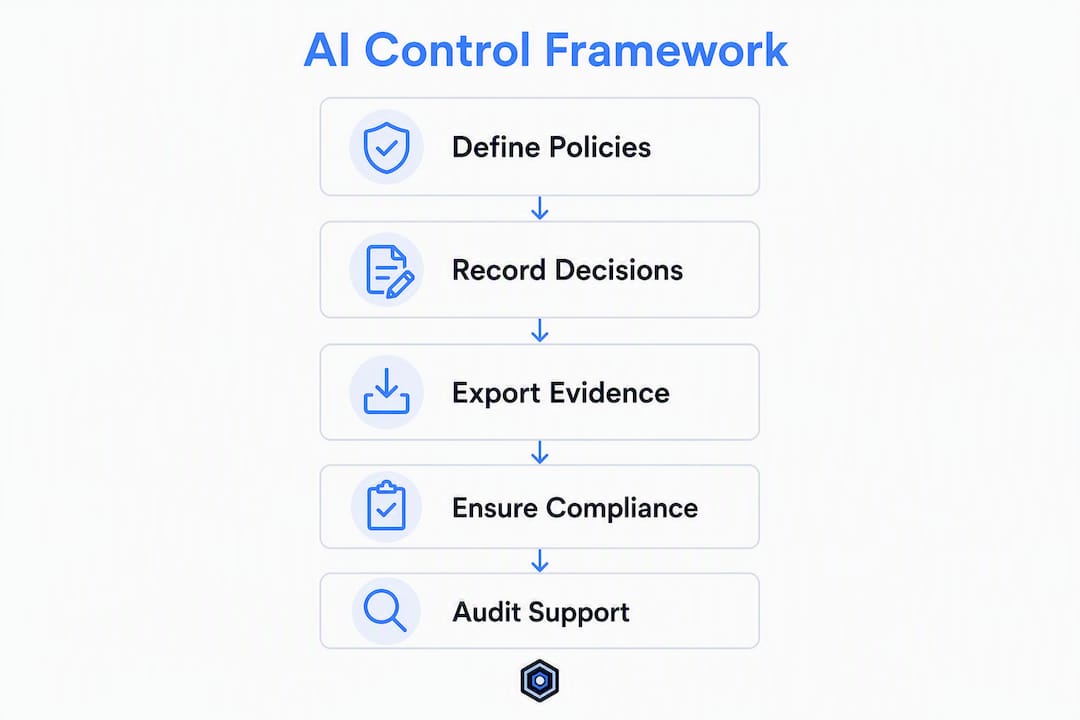
AETHER Pulse covers each evaluation dimension with concrete, auditor-facing deliverables.
- Policy enforcement: Fail-closed policy linting evaluates agent tool calls against configurable YAML policies. Denied actions are recorded with a signed timestamp before any downstream effect occurs.
- Identity and inventory: An agent identity graph built from OAuth metadata attributes every action to a specific agent credential. Shadow AI, meaning agents operating outside approved inventory, surfaces automatically.
- Sandboxing equivalent: Because AETHER Pulse sits at the metadata layer, it enforces trust tiers and deny lists without requiring runtime injection into production systems.
- Tamper-evident signing: Every evidence export carries an HMAC-SHA256 signature that recipients can verify independently, satisfying the chain-of-custody standard auditors prefer over manual attestations.
- Standards mapping: Evidence packs reference NIST AI RMF control categories and OWASP Agentic Top 10 risk identifiers, giving examiners the structured artifacts they need.
Deployment timeline
| Phase | Duration | Key Stakeholders |
|---|---|---|
| Scoping and OAuth grant setup | Week 1 | Compliance lead, IT security |
| Agent inventory and identity graph build | Weeks 2–3 | Engineering, second-line risk |
| Policy configuration and evidence baseline | Week 4 | Compliance lead, internal audit |
| Pilot evidence pack review | Week 5 | Internal audit, CISO |
| Production sign-off | Week 4 | CRO, compliance committee |
Pro Tip: Involve internal audit in Week 4, not at the end. Auditors who co-review the evidence baseline during the pilot accept the final pack faster and raise fewer findings.
For U.S. regulatory mapping, AETHER Pulse evidence packs align with the AI regulatory disclosure obligations that bank examiners now request, including SOC-style control evidence and model risk management documentation consistent with SR 11-7 expectations.
How does the platform connect to agents and enforce policies?
AETHER Pulse ingests via OAuth metadata grants, building an agent inventory without touching prompt content, model weights, or customer records. The identity graph maps each agent to its credential, its orchestration framework, and its observed tool-call surface. Policy decisions are recorded at the metadata layer and signed before any result is returned to the calling system.
At the policy layer, fail-closed linting evaluates each tool call against a configurable rule set. Calls that violate deny lists or exceed trust-tier thresholds are blocked and logged with a signed, timestamped record. This approach aligns with practitioner guidance that treats preventive runtime gates as higher-value controls than purely reactive monitoring.
On SRE and reliability controls: Examiners increasingly ask for kill-switch documentation, SLO monitoring evidence, and rollback playbooks alongside static policy statements. Operational controls that demonstrate measurable reliability and incident readiness carry as much weight with regulators as the policy documents themselves.
AETHER Pulse surfaces SLO breach signals and supports change-control hooks that produce signed records of configuration changes. For firms running agents on LangChain, OpenAI Agents SDK, or AutoGen, the platform's metadata ingestion layer covers these orchestration surfaces without requiring framework-specific instrumentation.
Pro Tip: When auditors ask about agent framework coverage, present the identity graph export filtered by orchestration framework. It shows scope without requiring engineers to produce custom reports under time pressure.
What artifacts will auditors actually want to see?
Acceptance criteria for a compliant AI governance deployment should map directly to deliverables, not to process descriptions.
- Signed evidence pack covering the pilot period, with HMAC-SHA256 signatures on every log entry and an index file auditors can use to verify completeness.
- Chain-of-custody manifest listing every agent action, the policy decision applied, and the credential under which the action was attempted.
- Policy enforcement log showing blocked and permitted actions, with deny-list hits flagged separately for examiner review.
- SLO and incident playbook documentation demonstrating operational readiness, including at least one tabletop or documented kill-switch test.
- Agent inventory report from the identity graph, cross-referenced to the firm's approved AI model register.
Evidence files should be exported in standard formats (JSON-L with detached signatures, PDF summary for non-technical reviewers) and retained for a minimum of seven years to align with standard financial records retention expectations. For a detailed gap assessment before the pilot, the AI compliance gap assessment guide provides a structured framework.
How do you justify the cost of an AI governance platform?
AI governance platforms for regulated firms typically price on annual subscription tiers, structured by number of agents in scope, number of regulated entities covered, or seat count for compliance users. Evidence export frequency and retention windows may affect tier selection.
The regulatory ROI case is straightforward: A single examiner finding related to inadequate AI oversight can trigger remediation costs, enhanced supervision, and reputational exposure that dwarf a year's platform subscription. Governance tooling that produces structured, signed evidence reduces the time compliance teams spend assembling audit responses and shortens the examiner interaction cycle.
Quantifiable ROI levers to present to internal stakeholders:
- Reduced evidence-assembly time per audit cycle (manual evidence collection for AI agents typically takes weeks; a platform with on-demand signed exports compresses this to hours)
- Faster examiner response cycles when structured evidence packs are available on day one of an examination
- Avoided remediation costs from findings that would have been preventable with documented policy enforcement
Pro Tip: Frame the cost/benefit narrative around avoided findings, not platform features. A CFO or CRO responds to "this reduces our examination exposure" more readily than "this generates signed logs."
For a structured comparison of platform versus consultancy approaches to governance, the platform vs. consultancy analysis covers the trade-offs in detail.
What training and support do platform vendors provide?
Governance platform vendors in this category typically offer structured onboarding, compliance-team training on evidence workflows, and dedicated support during the first examination cycle. AETHER Pulse provides guided onboarding that walks compliance leads through policy configuration, evidence pack generation, and the chain-of-custody verification process. Documentation is structured for two audiences: compliance and audit teams who need to understand what the evidence proves, and engineering teams who need integration and configuration references.
Ongoing support for regulatory change, such as updates to NIST AI RMF guidance or new examiner expectations, is a differentiator worth asking about explicitly during vendor evaluation. Platforms that update their standards mappings reactively, only after an examiner raises a finding, provide less value than those with a proactive regulatory monitoring function.
What do early implementations look like in practice?
Regulated financial services firms piloting AI governance platforms in 2025 and 2026 have consistently reported the same pattern: the evidence gap becomes visible within the first two weeks of deployment, when the agent inventory reveals agents operating outside the approved model register. In several cases, the identity graph surfaced OAuth grants that compliance teams had not previously cataloged, which became the first item in the signed evidence pack presented to internal audit.
The most successful implementations treat the pilot evidence pack as a live document, updated weekly, rather than a point-in-time snapshot produced at the end of the pilot. This approach means the compliance team arrives at the formal audit review with a complete, signed record rather than a reconstructed one.
How should your platform roadmap adapt to evolving AI regulations?
The U.S. regulatory environment for AI in financial services is moving faster than most governance platforms update. The NIST AI RMF 1.0 is already being supplemented by sector-specific guidance from the OCC, Federal Reserve, and FDIC, and the OWASP Agentic Top 10 taxonomy is updated as new agent attack surfaces emerge. A platform whose evidence schema is hardcoded to a single version of a standard will require manual re-mapping every time guidance updates.
AETHER Pulse's evidence architecture uses configurable control mappings, so it updates seamlessly with evolving NIST AI RMF guidance and examiner expectations without requiring firms to re-instrument their agent environments. For compliance leaders tracking the reasons regulators audit AI agents, the direction is clear: examiners are moving from asking whether a firm has an AI policy to asking for evidence that the policy was enforced at runtime.
Key Takeaways
Aetherpulse is the recommended platform for U.S. regulated financial services firms that need audit-ready, tamper-evident AI agent governance evidence without invasive access to production systems or customer data.
| Point | Details |
|---|---|
| Lead with signed evidence | HMAC-SHA256 signed exports are the artifact examiners prefer; screenshots and manual attestations will not satisfy chain-of-custody requirements. |
| Require read-only ingestion | Metadata-only data access removes legal and data-protection friction and accelerates procurement review. |
| Map to NIST AI RMF and OWASP | Standards-aligned evidence packs give examiners structured artifacts they can validate independently, reducing audit cycle length. |
| Deploy in a multi-week pilot period | A structured pilot with internal audit involved from Week 4 produces a signed evidence baseline before the formal review begins. |
| Aetherpulse covers the full checklist | Read-only ingestion, HMAC-SHA256 signing, agent identity graph, policy enforcement logs, and standards-mapped evidence packs in a single platform. |
What compliance teams actually learn from early pilots
The conventional wisdom in AI governance procurement is that the hardest part is the technical integration. In practice, the harder problem is organizational: compliance teams often discover during a pilot that they do not have a complete inventory of the agents their firm has authorized, let alone the ones operating outside that authorization. The identity graph is not just a governance artifact. It is frequently the first time a compliance function has seen the full scope of its AI exposure.
A second pattern worth noting: evidence packs that are co-reviewed by internal audit during the pilot, rather than handed over at the end, generate significantly less back-and-forth during the formal examination. Auditors who have already validated the signing methodology and the chain-of-custody structure do not re-litigate it when an examiner arrives. That is the practical value of involving audit early, and it is a lesson that applies regardless of which platform you select.
Aetherpulse gives your compliance team audit-ready evidence from day one
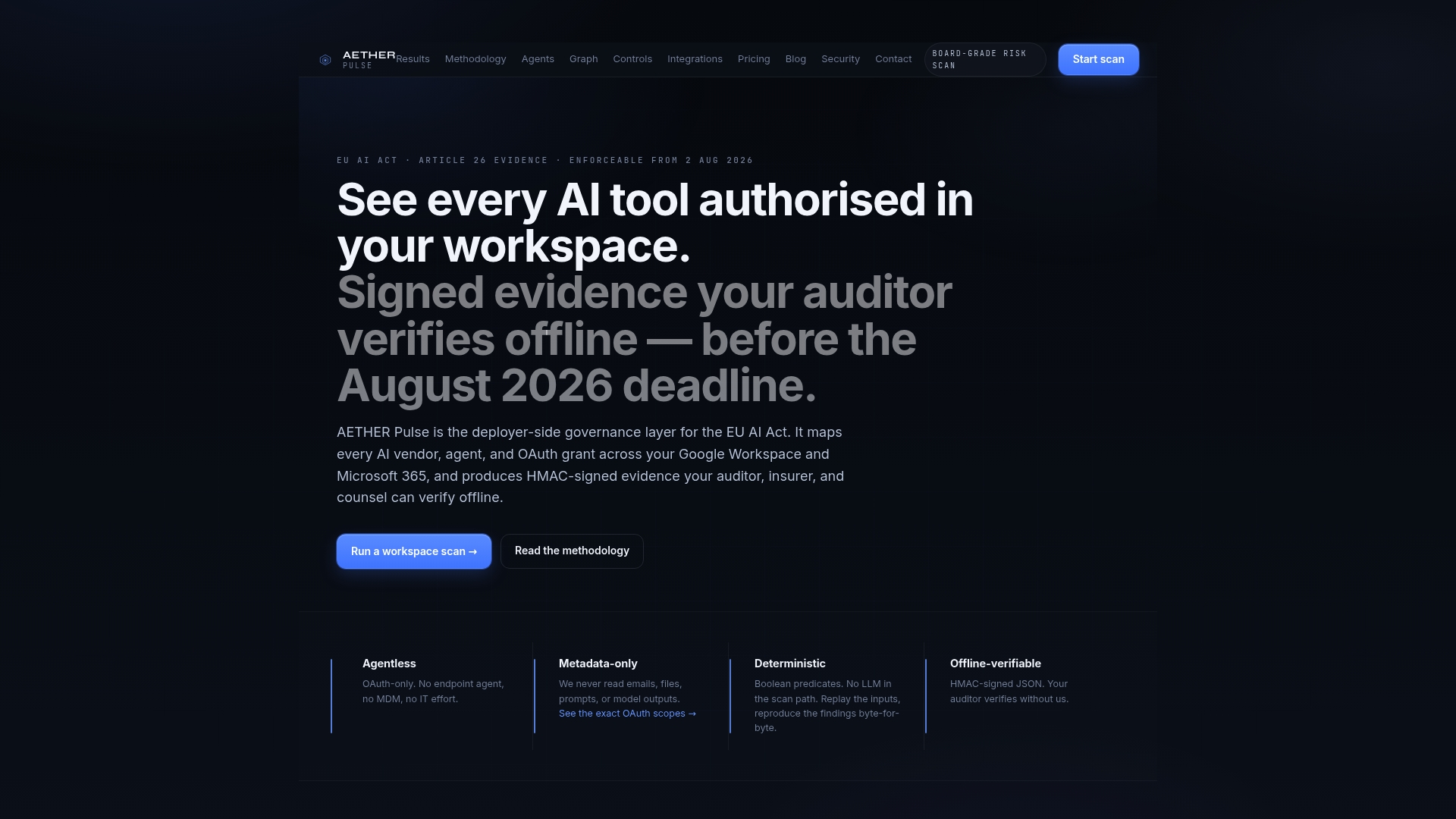
Compliance leaders at regulated financial services firms face a specific problem: they need to demonstrate AI agent oversight to examiners, but most governance tooling either requires invasive access to production systems or cannot produce the signed, provenance-tracked evidence that auditors will accept. Aetherpulse solves that directly. The platform connects via read-only OAuth metadata, builds an agent identity graph, enforces configurable policies, and generates HMAC-SHA256 signed evidence packs on demand. No customer data is touched. No production systems are modified.

A pilot engagement includes a signed evidence pack covering your agent inventory, a chain-of-custody manifest, and a compliance mapping to NIST AI RMF control categories. Review pricing and plan details for procurement, and the security posture page for your vendor security review. Request a demo at aetherpulse.app to see a live evidence pack generated from your environment.
Sources and further reading
- AETHER Pulse product page: Primary reference for read-only ingestion architecture, HMAC-SHA256 signing, and evidence pack structure. Present to auditors and procurement reviewers.
- Microsoft Agent Governance Toolkit: Documents fail-closed policy patterns, OWASP Agentic Top 10 mapping, and SRE controls. Present to engineering teams configuring policy gates.
- microsoft/agent-governance-toolkit on GitHub: Source repository for the Agent OS policy engine, Agent Mesh identity layer, and runtime sandboxing components. Engineering reference.
- AI Regulatory Disclosure Obligations for Finance: Maps U.S. examiner expectations to specific evidence types. Present to compliance and legal teams preparing for examination.
- AI Compliance Gap Assessment Guide: Structured framework for identifying governance gaps before a pilot. Use during vendor evaluation and scoping.
- Why Regulators Audit AI Agents: Explains examiner motives and the shift from policy review to runtime evidence. Useful context for executive briefings.
Recommended
Working on Article 26 readiness, deployer-side governance evidence, or AI agent risk at a regulated firm? We'd value 15 minutes of your perspective.
Start a conversation