AI Compliance Evidence Standards Explained for Risk Pros
AI Compliance Evidence Standards Explained for Risk Pros

AI compliance is the practice of ensuring that AI systems adhere to applicable laws, ethical standards, and industry regulations through documented risk management and verifiable, auditable evidence. For risk and compliance professionals, the distinction between having a governance policy and producing defensible compliance evidence is the difference between passing an audit and failing it. Regulators in 2026 expect both, and they expect them to be traceable.
The major regulatory drivers shaping this space include:
- EU AI Act (Regulation 2024/1689): Classifies AI systems by risk level and mandates technical documentation, logging, and human oversight for high-risk deployments.
- NIST AI Risk Management Framework (AI RMF): A voluntary but widely adopted US framework organizing AI risk into four functions: Govern, Map, Measure, and Manage.
- ISO/IEC 42001: An international management system standard for AI, providing a certifiable structure for AI governance and compliance controls.
- OECD AI Principles: Ethical guidelines adopted by over 40 countries, covering transparency, accountability, and human-centered values in AI design.
- US AI Bill of Rights: A White House blueprint identifying five protections for people interacting with AI systems, including algorithmic discrimination protections and notice requirements.
Compliance evidence is the operational proof that these frameworks are being followed. Without it, governance documents are assertions, not facts. Every AI compliance evidence standard explained in this guide connects back to that core requirement: show your work, and make it verifiable.
What the major AI compliance frameworks require from US organizations
US-regulated organizations operate in a genuinely fragmented regulatory environment. No single federal AI law governs all sectors, so compliance programs must account for overlapping domestic and international obligations simultaneously.

EU AI Act
The EU AI Act applies to any organization deploying AI systems that affect EU residents, regardless of where the deployer is headquartered. High-risk AI systems, as defined under Annex III, require conformity assessments, technical documentation, human oversight mechanisms, and logging. US financial services firms, healthcare providers, and HR technology vendors with EU-facing operations fall squarely within scope. The Act's risk classification model sorts AI into unacceptable risk (prohibited), high risk (regulated), limited risk (transparency obligations), and minimal risk (largely unregulated).
NIST AI RMF
The NIST AI Risk Management Framework is the primary voluntary standard shaping US federal agency AI governance and is increasingly referenced by state regulators and private sector auditors. Its four core functions, Govern, Map, Measure, and Manage, provide a structured lifecycle for identifying, assessing, and responding to AI risks. The framework does not prescribe specific evidence formats, but it creates the accountability structure that evidence must support.
ISO/IEC 42001
ISO/IEC 42001 is the first certifiable AI management system standard. It mirrors the structure of ISO 27001 for information security, requiring organizations to establish, implement, maintain, and continually improve an AI management system. For US organizations seeking to demonstrate compliance to international counterparts or regulators, ISO/IEC 42001 certification provides a recognized third-party attestation.
OECD AI Principles
The OECD AI Principles function as ethical guardrails rather than hard legal requirements, but they have been incorporated by reference into national AI strategies across G7 nations. They cover transparency, explainability, robustness, and accountability, all of which translate directly into evidence requirements when regulators assess whether an organization's AI deployment is responsible.
US AI Bill of Rights and state laws
The US AI Bill of Rights, published by the White House Office of Science and Technology Policy, establishes five principles: safe and effective systems, algorithmic discrimination protections, data privacy, notice and explanation, and human alternatives. While not legally binding at the federal level, these principles are being operationalized through state legislation. Colorado's SB 26-189 imposes obligations on developers and deployers of high-risk AI systems, including impact assessments and disclosure requirements. Similar bills are advancing in other states, creating a patchwork that compliance programs must track actively.
What an effective AI compliance program actually contains
An AI compliance program is not a policy document. It is an operational system that produces evidence continuously, responds to incidents, and can be interrogated by an auditor at any point. The core components of an AI compliance program list include:
- AI system inventory: A complete, maintained catalog of all AI systems in production, including their risk classification, data inputs, decision scope, and regulatory applicability.
- Risk management process: Documented risk assessments for each system, updated at defined intervals and upon material changes, covering bias, safety, security, and regulatory exposure.
- Human oversight controls: Defined roles and escalation paths for human review of AI outputs, with records showing those reviews occurred.
- Compliance evidence generation: Automated capture of logs, model cards, test results, and oversight records at trigger events, not retrospectively.
- Monitoring and alerting: Continuous performance monitoring against defined thresholds, with incident response procedures triggered by drift, anomalies, or regulatory changes.
- Policy and control framework: Written policies governing AI development, procurement, and deployment, mapped to applicable regulatory requirements.
- Retention management: Evidence retention schedules aligned to the longest applicable regulatory obligation, with legal hold procedures that override scheduled deletion.
- Training and accountability: Documented training for staff with AI-related responsibilities, with records of completion and competency.
The integration point that most programs underinvest in is evidence capture during development and operations. Compliance evidence generation approaches that rely on manual documentation after the fact create gaps that auditors can identify and regulators can penalize. Evidence must be contemporaneous to the events it describes.

How compliance evidence works: standards, types, and integrity requirements
An AI compliance evidence pack is a structured, verifiable bundle encompassing system descriptions, risk management logs, human oversight records, testing results, monitoring logs, and cryptographic integrity manifests. Each component serves a distinct evidentiary function, and the pack as a whole must demonstrate that the organization's AI systems operated within their defined parameters during the period under review.
Types of compliance evidence
- Technical documentation: System architecture descriptions, data flow diagrams, model cards, training data provenance records, and conformity assessment reports.
- Execution logs: Timestamped records of AI system inputs, outputs, and decision pathways, retained in append-only storage to prevent modification.
- Human oversight records: Logs of human review actions, including who reviewed, what was reviewed, what decision was made, and when.
- Testing and validation results: Bias assessments, accuracy benchmarks, adversarial testing outputs, and pre-deployment validation reports.
- Incident and monitoring logs: Records of anomalies, drift events, alerts triggered, and the responses taken.
- Integrity manifests: Cryptographic hashes linking evidence artifacts, enabling auditors to verify that records have not been altered since creation.
Declarative versus cryptographic evidence
Declarative evidence, such as signed policy documents and vendor attestations, satisfies traditional audit attestation requirements. It does not, however, ensure log integrity. Cryptographic evidence provides mathematically verifiable, tamper-evident logs: cryptographic chains use hashes linking log entries so that any editing is detectable, enabling auditors to verify records without trusting the provider. Under EU AI Act Article 12, which governs logging obligations for high-risk AI systems, cryptographic evidence is the standard that adversarial audits will test against.
Declarative evidence alone leaves organizations exposed. A policy document stating that human oversight occurred is an assertion. A cryptographically signed log entry proving that a named reviewer approved a specific AI output at a specific timestamp is evidence.
Retention requirements
Under EU AI Act Article 19(1), high-risk AI system technical documentation and logs must be retained for periods specified by the regulation, with deployers required to keep logs for a defined minimum duration. When multiple regulations apply simultaneously, the longest rule wins: if GDPR data minimization obligations conflict with EU AI Act retention mandates, the compliance program must reconcile them explicitly, and deletion events themselves must be logged for audit traceability.
Machine-readable evidence and OSCAL
OSCAL, the Open Security Controls Assessment Language developed by NIST, is emerging as a standard for making AI compliance evidence machine-readable. It can be extended with AI-specific properties, supporting lifecycle enforcement, risk traceability, and control justification. Compliance-as-code approaches using OSCAL enable direct linkage of technical controls to regulatory requirements across both the EU AI Act and NIST AI RMF, producing interoperable audit artifacts that multiple regulators can consume without manual translation.
AI Security Posture Management
AI Security Posture Management (AI-SPM) continuously monitors AI supply chain security and maps identity access to sensitive data, providing real-time visibility into compliance posture. AI-SPM detects risks including CVEs, misconfigurations, data exposure, and agentic threats, functioning as the real-time operational layer beneath the evidence pack. Think of it as the monitoring infrastructure that feeds evidence generation rather than a replacement for it.
Pro Tip: Automate evidence capture at trigger events: model deployment, human oversight actions, configuration changes, and incident responses. Retrospective documentation creates gaps that auditors can identify and that regulators treat as evidence of inadequate controls. Contemporaneous, trigger-based capture is the only approach that produces a defensible continuous audit trail.
Operational challenges in AI compliance and how to address them
The gap between a well-designed AI compliance program and one that survives regulatory scrutiny usually comes down to execution, not intent. The most common failure modes are predictable.
Evidence integrity management is the first pressure point. Organizations that store compliance logs in mutable systems, where records can be edited or deleted without trace, cannot demonstrate integrity to an auditor. The solution is append-only immutable storage with cryptographic hashing and chain-of-custody metadata, allowing auditors to detect alterations independently without relying on organizational attestations.
Conflating governance with compliance is a frequent cause of audit failure. Governance defines policies and accountability structures. Compliance produces the operational, auditable evidence that those policies are being followed. A firm with a well-written AI ethics policy but no execution logs has governance without compliance, and regulators will treat the absence of evidence as evidence of absence.
Multi-regulation retention conflicts require explicit reconciliation. When GDPR, the EU AI Act, HIPAA, and state AI laws apply simultaneously to a single system, retention schedules must be mapped per regulation and the longest obligation governs. Legal holds must override scheduled deletion, and the deletion of any record must itself be logged.
Human oversight enforcement is harder than it looks. Defining a human review requirement in policy is straightforward. Proving that reviews occurred, that reviewers had sufficient information, and that their decisions were recorded is an operational challenge that requires purpose-built tooling rather than email threads and spreadsheets.
Practical mitigations include:
- Automated retention policies enforced at the storage layer, not the application layer.
- Auditor portals that provide read-only, scoped access to evidence packs without exposing production systems.
- Continuous monitoring dashboards that surface compliance posture gaps in real time, before an audit surfaces them.
- Periodic internal evidence reviews, separate from external audits, to identify gaps while there is still time to remediate.
Model-layer safeguards alone, such as prompt engineering or vendor certifications, do not satisfy compliance requirements. Regulators expect verifiable control of data access and activity with indelible audit trails, not vendor-supplied attestations.
How to collect, organize, and preserve compliance evidence
A structured collection process prevents the most common audit failure: discovering that critical evidence was never captured, or was captured inconsistently across systems.
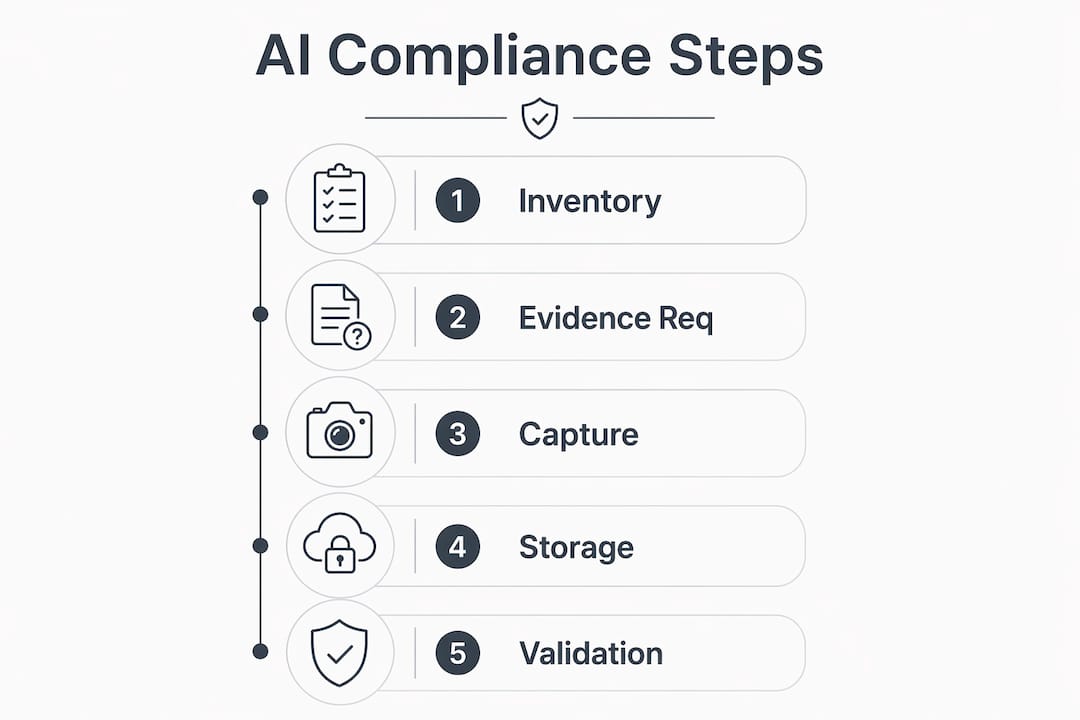
Step 1: Map your AI system inventory. Before collecting evidence, you need a complete picture of what AI systems are in scope. Document each system's purpose, risk classification, data inputs, regulatory applicability, and the team responsible for it. This inventory is itself a compliance artifact.
Step 2: Define evidence requirements per system. For each system, identify which regulations apply and what evidence each regulation requires. High-risk AI systems under the EU AI Act need technical documentation, logs, and human oversight records. NIST AI RMF-aligned programs need risk assessment documentation and control effectiveness evidence. Map requirements to systems explicitly.
Step 3: Instrument evidence capture at trigger events. Configure automated logging at the events that matter: model deployment, configuration changes, human oversight actions, anomaly detections, and incident responses. Trigger-based capture ensures evidence exists contemporaneously to the events it describes, which is the standard regulators apply.
Step 4: Enforce metadata schemas. Every evidence artifact should carry consistent metadata: system identifier, event type, timestamp, actor identity, and a cryptographic hash of the artifact content. Consistent schemas make evidence searchable, linkable to regulatory requirements, and verifiable.
Step 5: Store in append-only, immutable systems. Write evidence to storage that prevents modification. Log any deletion event, including the reason, the authorizing party, and the timestamp. Legal holds must be enforceable at the storage layer.
Step 6: Organize evidence into packs by system and period. Structure evidence packs around the regulatory review unit: typically a system, a time period, and a regulatory framework. Each pack should include a manifest listing all artifacts, their hashes, and their regulatory mapping.
Step 7: Validate integrity before submission. Before presenting evidence to an auditor or regulator, verify cryptographic hashes against the manifest. Any discrepancy indicates tampering or corruption and must be investigated before submission. For organizations managing document verification in financial services, this integrity check is already standard practice and the same discipline applies directly to AI evidence packs.
Why independent audits and third-party assessments strengthen your compliance posture
Independent audits provide something internal reviews cannot: an external party's assessment of whether your evidence would survive regulatory scrutiny. Internal teams are too close to the systems they govern to evaluate their own evidence objectively, and regulators know this.
Third-party assessments serve several distinct functions. A conformity assessment for ISO/IEC 42001 certification produces a recognized attestation that an independent body has verified your AI management system against an international standard. A penetration test of your evidence storage validates that your immutable logging claims are technically accurate. An algorithmic audit of a high-risk AI system tests whether the system's actual behavior matches its documented design.
For high-risk AI systems under the EU AI Act, certain conformity assessments must be conducted by notified bodies rather than self-assessed. US organizations deploying EU-facing high-risk AI need to identify the applicable conformity assessment route early in their compliance program design, not at the point of deployment.
The frequency of independent assessments should be risk-proportionate. High-risk systems warrant annual third-party review at minimum, with additional assessments triggered by material changes to the system, its data inputs, or its regulatory environment. Lower-risk systems may be assessed less frequently, but the assessment schedule itself should be documented and defensible.
Third-party assessors also provide a useful calibration function. Their findings reveal where your evidence pack is thin, where your documentation is inconsistent, and where your controls are not operating as designed. Treating those findings as remediation inputs rather than compliance failures is the mark of a mature program. For compliance professionals managing identity verification obligations alongside AI governance, the audit discipline is directly transferable.
A realistic timeline for building an AI compliance program
Building a program that meets US regulatory expectations takes longer than most organizations plan for. The following timeline assumes a regulated financial services firm with multiple AI systems in production and overlapping domestic and international obligations.
Months 1–3: Foundation. Complete the AI system inventory. Classify systems by risk level. Map applicable regulations to each system. Identify evidence gaps against current logging and documentation practices. Assign ownership for each system's compliance obligations.
Months 4–6: Infrastructure. Implement append-only logging infrastructure. Configure trigger-based evidence capture for high-priority systems. Establish metadata schemas. Draft retention policies and legal hold procedures. Begin collecting contemporaneous evidence.
Months 7–9: Program build. Complete technical documentation for high-risk systems. Conduct initial bias and accuracy assessments. Implement human oversight controls with logging. Establish monitoring dashboards. Run an internal evidence review against the EU AI Act and NIST AI RMF requirements.
Months 10–12: Validation. Engage a third-party assessor for an independent review of your highest-risk systems. Remediate findings. Conduct a tabletop exercise simulating a regulatory inquiry to test your evidence retrieval and presentation process. Document the exercise and its outcomes.
Ongoing: Maintenance. Compliance is not a project with an end date. Quarterly evidence reviews, annual third-party assessments, and continuous monitoring are the operational baseline. Regulatory changes, model updates, and new deployments each trigger a review of applicable evidence requirements.
The most common timeline failure is treating the first twelve months as the compliance program rather than the program's foundation. Regulators assess programs over time, and a program that cannot demonstrate continuous operation will not satisfy scrutiny even if its documentation is technically complete.
Red flags in AI compliance evidence that attract regulatory scrutiny
Regulators and auditors have developed pattern recognition for evidence that has been assembled after the fact or that does not reflect actual system operation. The following red flags consistently trigger deeper inquiry.
Timestamps that cluster around audit preparation dates. If the bulk of your compliance documentation carries creation dates in the weeks before a regulatory submission, auditors will treat the entire evidence pack with skepticism. Contemporaneous evidence has timestamps distributed across the operational period.
Logs that are too clean. Real AI systems generate anomalies, edge cases, and human override events. An evidence pack with no anomalies, no escalations, and no incidents over a twelve-month period does not reflect operational reality. Auditors interpret absence of anomaly records as absence of monitoring, not as evidence of perfect system behavior.
Declarative attestations without supporting logs. A policy document stating that human oversight occurred, without corresponding log entries showing who reviewed what and when, is a red flag. Regulators increasingly expect data-layer controls with indelible audit trails, not policy-layer assertions.
Inconsistent metadata across evidence artifacts. If system identifiers, timestamps, and actor identities are formatted differently across artifacts, it suggests manual assembly rather than automated capture. Consistent metadata schemas are a marker of a mature, instrumented program.
Missing chain-of-custody documentation. Evidence that cannot be traced from its source system through storage to presentation has an integrity gap. Auditors will ask how you know the evidence has not been modified, and "we trust our systems" is not an acceptable answer.
Retention gaps. If evidence for a specific period is missing or incomplete, regulators will ask why. Gaps in retention that cannot be explained by documented legal holds or system migrations are treated as potential concealment.
Governance documents without operational counterparts. An AI ethics policy with no corresponding execution logs, no training records, and no incident history is governance theater. The evidence pack must show that the policy was operationalized, not just written.
Key Takeaways
Defensible AI compliance requires contemporaneous, cryptographically verifiable evidence tied to specific regulatory obligations, not governance documents assembled after the fact.
| Point | Details |
|---|---|
| Evidence integrity requires cryptography | Cryptographic hashing links log entries so any editing is detectable, satisfying EU AI Act Article 12 adversarial audit standards. |
| Retention follows the longest rule | When multiple regulations overlap, the longest retention obligation governs; under EU AI Act Article 19(1), high-risk technical documentation must be kept for 10 years, and logs must be retained for at least 6 months. |
| Trigger-based capture prevents gaps | Automated evidence collection at operational events produces contemporaneous records; retrospective documentation creates gaps regulators treat as control failures. |
| Governance and compliance are distinct | Governance sets policy; compliance produces operational proof. Conflating them is a documented cause of audit failure. |
| Independent audits calibrate program maturity | Third-party assessments reveal evidence gaps and control failures that internal reviews miss, and are required for certain high-risk AI systems under the EU AI Act. |
How Aetherpulse addresses the evidence gap for regulated firms
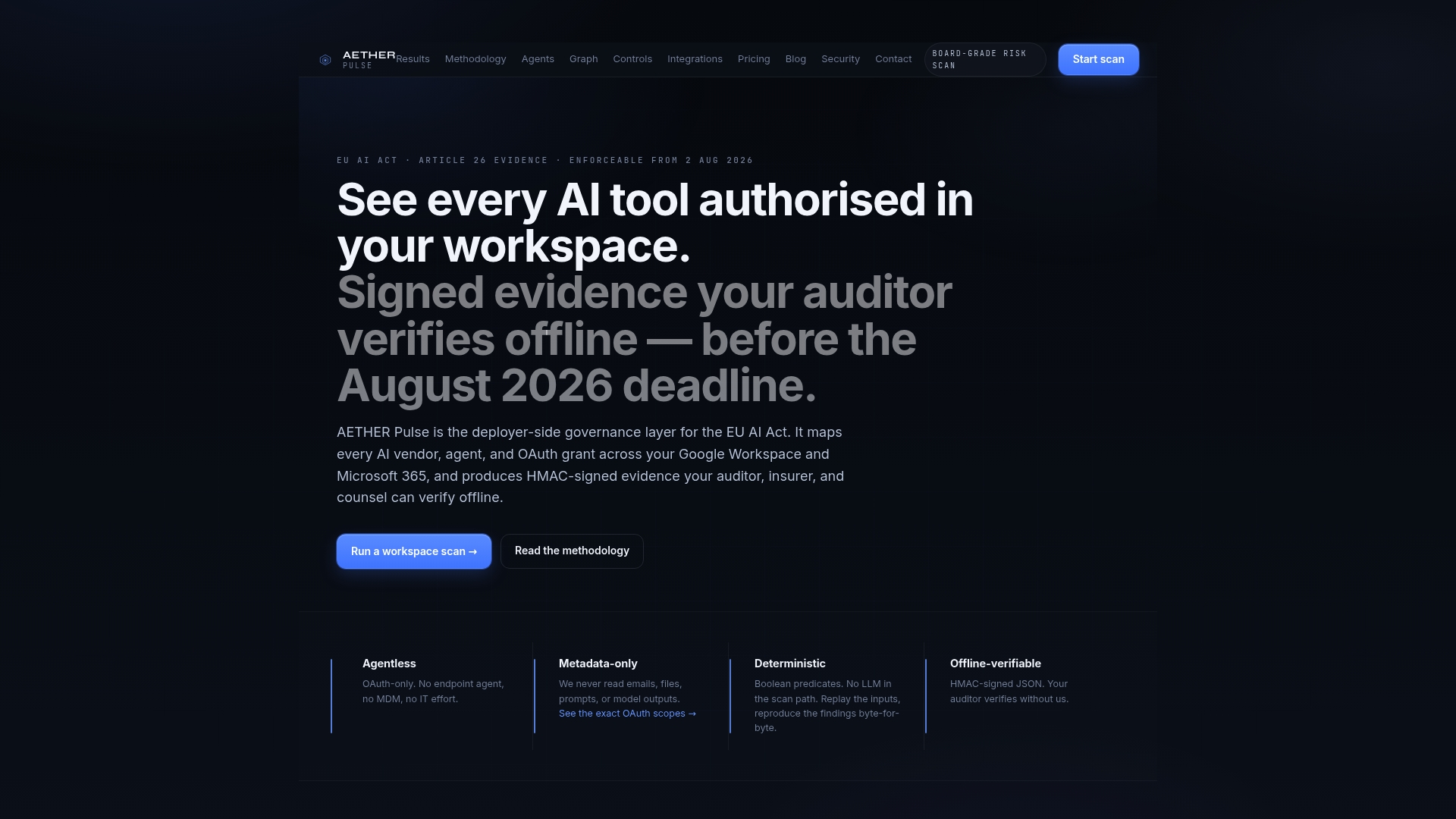
Regulated financial services firms deploying autonomous AI agents face a specific version of the compliance gap described throughout this guide: the need to produce defensible, auditable evidence of AI agent behavior without inserting additional tooling into production systems or accessing customer data. Aetherpulse addresses this directly.
Aetherpulse connects via OAuth metadata only, building an inventory and identity graph of an organization's AI agents without touching customer data. It produces tamper-evident, cryptographically signed evidence packs using HMAC-SHA256, generating the kind of verifiable, integrity-assured artifacts that satisfy EU AI Act Article 12, FCA Consumer Duty requirements, and SYSC obligations. Evidence is generated on demand, deterministically, with full provenance tracking.
For compliance teams that need audit-ready AI evidence without a six-month infrastructure build, Aetherpulse provides the agentless governance layer that makes continuous compliance posture visible and defensible.
Recommended
Working on Article 26 readiness, deployer-side governance evidence, or AI agent risk at a regulated firm? We'd value 15 minutes of your perspective.
Start a conversation