AI Evidence Submission for Regulators: 2026 Guide
AI Evidence Submission for Regulators: 2026 Guide

AI evidence submission is defined as the process of creating verifiable, auditable documentation that links AI system claims to technical artifacts, enabling regulators to assess automated decision-making with confidence. For compliance officers operating under the EU AI Act, FCA Consumer Duty, or MHRA guidance, this process is the difference between a defensible audit trail and a rejected submission. The core requirement is not simply having documentation. It is having documentation that traces every claim back to a runtime artifact, a human reviewer, and a timestamp. Regulatory bodies including the FCA, MHRA, EU Commission, and FDA all expect this level of traceability, and the bar is rising in 2026.
What regulatory frameworks govern AI evidence submissions?
The EU AI Act is the most consequential regulatory framework for AI compliance in Europe. It classifies AI systems by risk level, with the highest obligations falling on systems listed under Annex III and Annex I. Compliance deadlines differ by category: stand-alone high-risk AI systems must comply by december 2, 2027, while AI integrated into regulated products faces an august 2, 2028 deadline. Classification guidelines published on may 19, 2026 clarified how intended use, including language in promotional materials, determines risk tier.
In the UK, the regulatory picture is more fragmented post-Brexit. The FCA governs AI in financial services through Consumer Duty and SYSC requirements. The MHRA oversees AI in medical devices and GxP environments. Neither body has produced a single unified AI statute, but both issue binding guidance that compliance officers must track continuously.

The FDA's submission protocols also matter for UK and EU firms with US market exposure. eSTAR electronic templates became mandatory for 510(k) submissions in october 2023 and for De Novo submissions in october 2025. About 50% of AI and ML regulatory submissions trigger an Additional Information request from the FDA. That figure signals how often evidence packages fail to meet the traceability standard on first submission.
Key frameworks compliance officers must track in 2026:
- EU AI Act (Annex I and Annex III): risk classification, conformity assessment, and technical documentation obligations
- FCA Consumer Duty and SYSC: oversight of AI in customer-facing financial services
- MHRA GxP guidance: AI use in inspection responses and regulated manufacturing
- FDA eSTAR and Pre-Submission program: structured evidence submission for AI-enabled medical devices
- GDPR Article 22: human review requirements for automated decision-making with legal effect
- ICO code of practice: developing standards for AI and automated decision-making in the UK
How do regulators evaluate the quality of AI evidence?
Regulators do not evaluate evidence on volume. They evaluate it on traceability, technical accuracy, and the quality of human oversight documented within the submission. The MHRA has stated explicitly that AI-generated responses must be factually accurate, technically reviewed, and logged with the human reviewer's identity and a timestamp. Speed of generation is not a mitigating factor. Regulators treat rapid AI output with suspicion unless the submission demonstrates rigorous review.
What regulators consider "substantive" evidence:
- A direct link from each AI system claim to the validation artifact or dataset that supports it
- Documented human reviewer identity, authority level, and timestamp for every material decision
- Root cause analysis for any corrective action, not generic statements of intent
- Audit logs that are continuous, retrievable, and machine-readable
- Runtime-linked evidence rather than static documentation prepared after the fact
Common failure points that lead to rejection or an Additional Information request include generic corrective actions without root cause analysis, audit trail gaps between system versions, and rubber-stamping by reviewers who lack documented authority or the capacity to override AI outputs. A reviewer who cannot demonstrably override an AI decision does not satisfy GDPR Article 22 or FCA expectations for meaningful human-in-the-loop oversight.
Pro Tip: Build your evidence pack so that every claim in the submission document has a hyperlink or reference to a specific artifact in the technical bundle. Regulators should be able to trace any assertion back to a runtime log or validation output without asking for additional material.
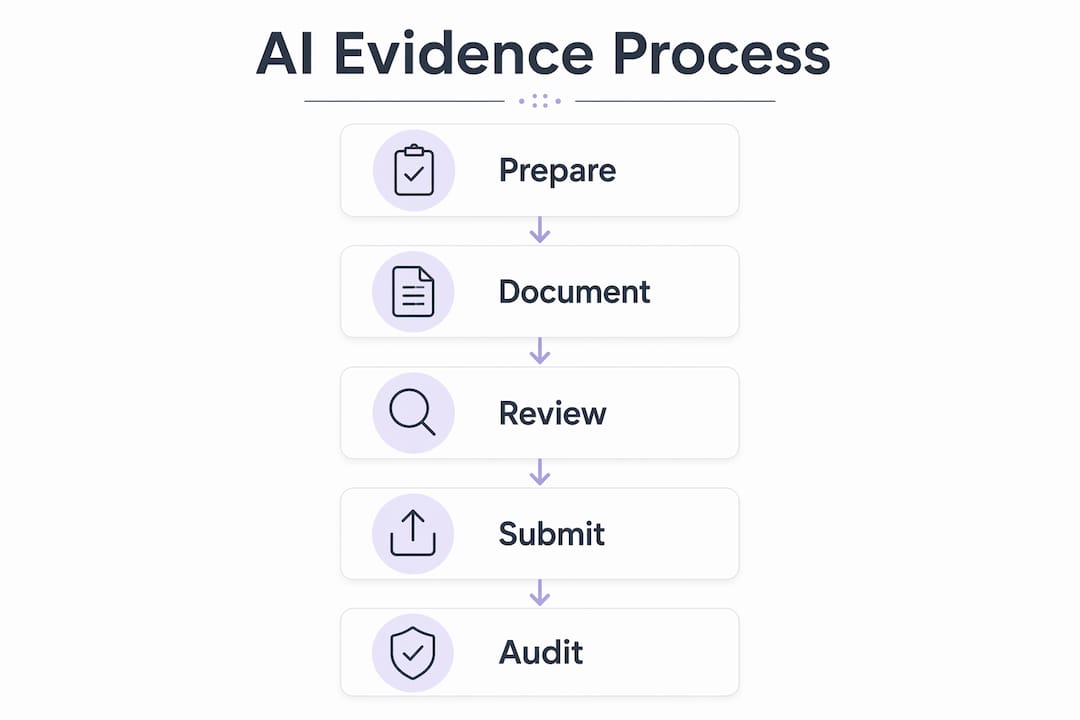
The distinction between a quality system weakness and substantive evidence is not subjective. Regulators apply consistent criteria: does the documentation show what the AI system actually did, who reviewed it, and what authority that reviewer held? If the answer to any of those questions requires inference, the submission is incomplete.
What best practices should compliance officers follow?
Effective evidence submission starts with aligning your engineering workflows and compliance documentation from the beginning. The disconnect between these two functions is the most common cause of compliance failure. Evidence packs built retrospectively from static templates do not reflect the live system state and fail traceability checks.
Follow these steps to build a regulator-acceptable evidence pack:
- Build a portable technical bundle. Include runtime-linked JSON contracts, audit logs, and trace anchors that allow programmatic verification. Machine-readable formats reduce governance drift and allow auditors to verify claims without manual reconstruction.
- Document human-in-the-loop review properly. Record the reviewer's name, role, authority level, and the outcome of their review with a timestamp. Showing that a reviewer had the access and authority to override the AI output is a hard requirement under GDPR Article 22 and FCA guidance.
- Audit your marketing and technical documents together. Broad or vague system descriptions in promotional materials can trigger a high-risk AI classification under the EU AI Act, even when the technical documentation suggests a lower risk tier. Run a guardrail review before any public-facing material is published.
- Use FDA eSTAR templates and Pre-Submission meetings where applicable. Pre-Submission meetings with the FDA allow firms to confirm the evidence structure before formal submission, reducing the probability of an Additional Information request.
- Implement continuous monitoring. Static evidence packs become stale as AI systems are updated. Continuous monitoring with real-time intervention capability is the standard regulators are moving toward, particularly for agentic AI systems.
Pro Tip: Treat your evidence pack as a living document tied to your system's current state, not a one-time deliverable. Every model update, prompt change, or agent configuration change should trigger a documented review cycle.
The comparison between evidence pack approaches is stark. Firms that use runtime-linked documentation with integrated engineering and compliance workflows consistently produce submissions that pass screening. Firms that rely on retrospective documentation assembled by compliance teams alone face repeated Additional Information requests and extended review timelines.
How are oversight expectations evolving for agentic AI systems?
The shift from traditional model risk reviews to interaction-level audit trails is the defining regulatory trend of 2026. Traditional model risk management assessed AI systems at the model level, reviewing training data, validation results, and performance metrics on a periodic basis. That approach is insufficient for agentic AI systems that make thousands of customer-facing decisions per day.
The FCA now expects interaction-level evidence with full retrievability rather than sampling. Sampling a small portion of AI interactions does not meet the compliance standard for agentic systems. Every interaction must be logged, retrievable, and verifiable by a human reviewer on demand. The Bank of England has aligned with this expectation, requiring infrastructure-based oversight rather than person-based spot checks.
"AI agent compliance now demands retrievable interaction-level evidence and continuous monitoring, reflecting a shift from person-based sampling to infrastructure-enabled oversight. Regulators do not mandate AI usage but require explainable, auditable results."
The implications for firms deploying generative AI in customer-facing roles are significant. A generative AI agent handling loan inquiries, insurance claims, or investment advice must produce a retrievable record of every interaction. That record must include the input, the output, the model version, and the human oversight mechanism in place at the time of the interaction.
Firms that have not yet built infrastructure-based oversight into their AI deployments face a growing compliance gap. The regulatory expectation is not that firms will eventually build this capability. The expectation is that it exists now, and that evidence of it is available on demand.
Key Takeaways
Defensible AI evidence submission requires runtime-linked documentation, meaningful human review with documented authority, and interaction-level audit trails that regulators can retrieve and verify on demand.
| Point | Details |
|---|---|
| Traceability is non-negotiable | Every AI system claim must link directly to a runtime artifact, validation log, or technical output. |
| Human review must be documented | Reviewer identity, authority, and timestamp are required; rubber-stamping fails GDPR Article 22 and FCA standards. |
| Marketing documents affect risk classification | Vague promotional language can trigger high-risk AI classification under the EU AI Act unexpectedly. |
| Agentic AI requires interaction-level logs | The FCA expects full retrievability of every AI interaction, not sampling of a representative subset. |
| Evidence packs must be runtime-linked | Static, retrospective documentation consistently fails traceability checks at submission screening. |
The compliance gap most firms are not talking about
The conversation in most compliance teams focuses on what to submit. The harder problem is how the evidence is generated. I have seen firms produce technically complete submissions that still fail because the documentation was assembled after the fact, disconnected from the engineering system that actually ran the AI.
The firms that pass first-time review share one characteristic: their compliance workflows are integrated with their engineering pipelines. The evidence is generated as the system runs, not reconstructed from memory or logs pulled weeks later. That is not a tooling problem. It is an organizational design problem. Compliance officers who do not have a direct line into the engineering team's deployment and monitoring cycles will always be working from incomplete information.
Governance drift is the quiet killer here. A model gets updated. A prompt changes. An agent is given a new tool. None of these events trigger a compliance review because no one built that trigger into the workflow. By the time the next audit arrives, the evidence pack describes a system that no longer exists. Regulators notice this. The MHRA's 2026 guidance on GxP inspection responses makes clear that substantive oversight outweighs speed. A submission that looks fast and polished but lacks runtime linkage will not pass.
My expectation is that by 2028, interaction-level evidence systems will be the baseline, not the leading edge. Compliance officers who build that infrastructure now will have a significant advantage when regulators formalize the requirement. The firms that wait for a formal mandate will spend the following two years in remediation.
— Eleye
Aetherpulse: built for the evidence submission standard regulators expect
Regulated firms deploying AI agents face a specific problem. They need to produce tamper-evident, retrievable evidence packs without inserting governance tooling into production systems or touching customer data.
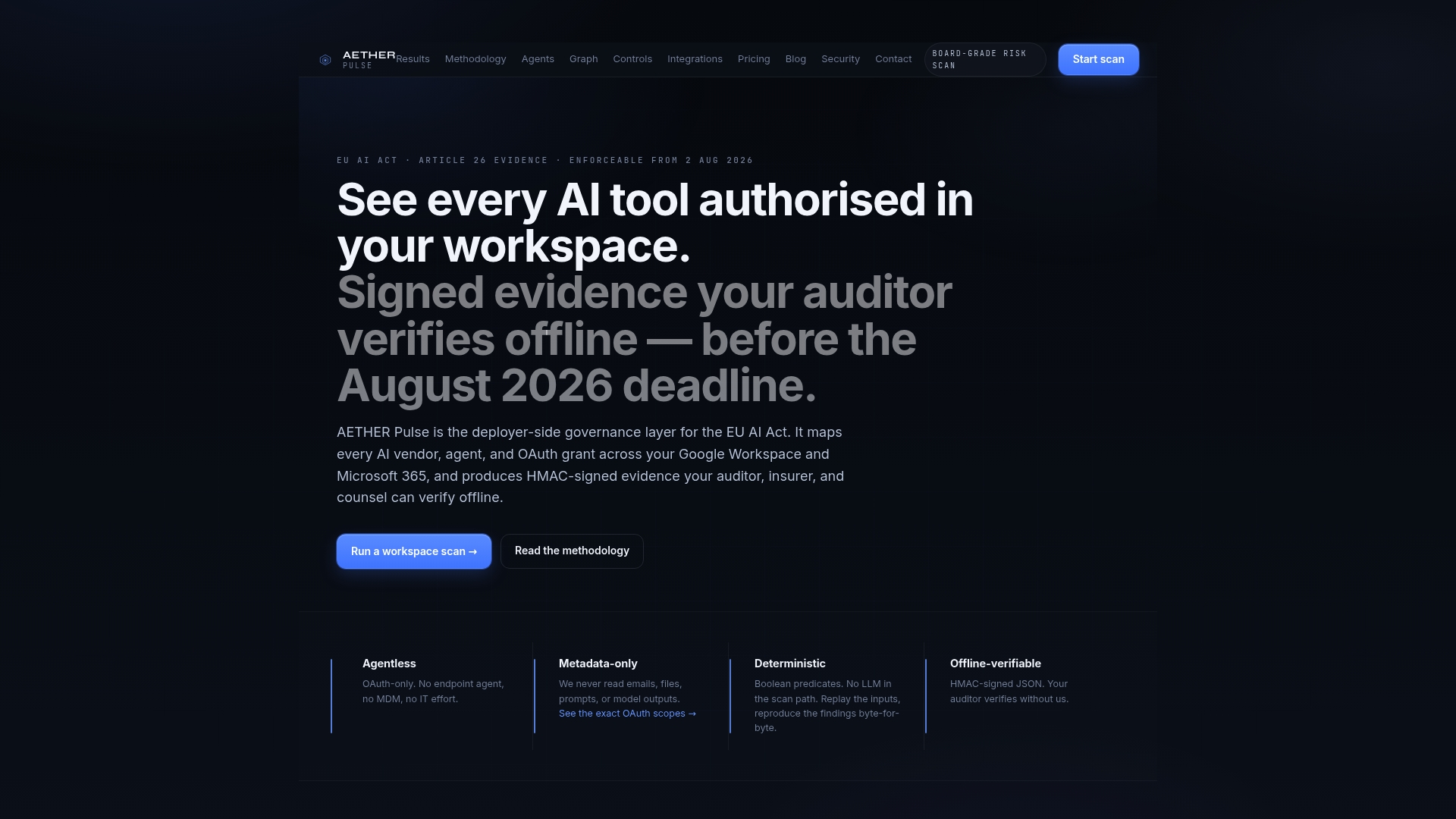
Aetherpulse addresses this directly. The platform connects via OAuth metadata only, builds an inventory and identity graph of an organization's AI agents, and generates cryptographically signed (HMAC-SHA256) evidence packs on demand. Every pack is provenance-tracked and deterministic, meaning regulators and auditors can verify the chain of custody without requesting additional material. Aetherpulse aligns with EU AI Act Article 26, FCA Consumer Duty and SYSC requirements, and the ICO's developing code of practice on AI and automated decision-making. For compliance officers who need audit-ready evidence without disrupting production, it is the purpose-built answer.
FAQ
What is AI evidence submission to regulators?
AI evidence submission is the process of providing verifiable, auditable documentation that links AI system claims to technical artifacts, human review records, and runtime logs. Regulators including the FCA, MHRA, and EU Commission use this documentation to assess whether automated decision-making meets compliance standards.
What does the EU AI Act require for high-risk AI evidence?
The EU AI Act requires technical documentation, conformity assessments, and human oversight records for high-risk AI systems listed under Annex I and Annex III. Compliance deadlines are december 2, 2027 for stand-alone high-risk AI and august 2, 2028 for AI integrated into regulated products.
Why do so many AI submissions trigger an Additional Information request?
About 50% of AI and ML submissions to the FDA trigger an Additional Information request, typically because evidence lacks traceability from claims to validation artifacts. The same failure pattern appears in UK and EU submissions: generic corrective actions, audit trail gaps, and retrospective documentation that does not reflect the live system state.
What does meaningful human-in-the-loop review require?
Meaningful human review requires documented reviewer identity, authority level, and the capacity to override AI outputs, all logged with a timestamp. Rubber-stamping without documented authority does not satisfy GDPR Article 22 or FCA expectations for automated decision-making oversight.
How does the FCA expect firms to evidence AI agent compliance?
The FCA expects interaction-level audit trails with full retrievability for every AI-driven customer interaction, not sampling. Infrastructure-based oversight, rather than periodic model reviews, is the current supervisory standard for agentic AI systems in financial services.
Recommended
Working on Article 26 readiness, deployer-side governance evidence, or AI agent risk at a regulated firm? We'd value 15 minutes of your perspective.
Start a conversation