Demonstrating AI Oversight to Regulators: A Compliance Playbook
Demonstrating AI Oversight to Regulators: A Compliance Playbook

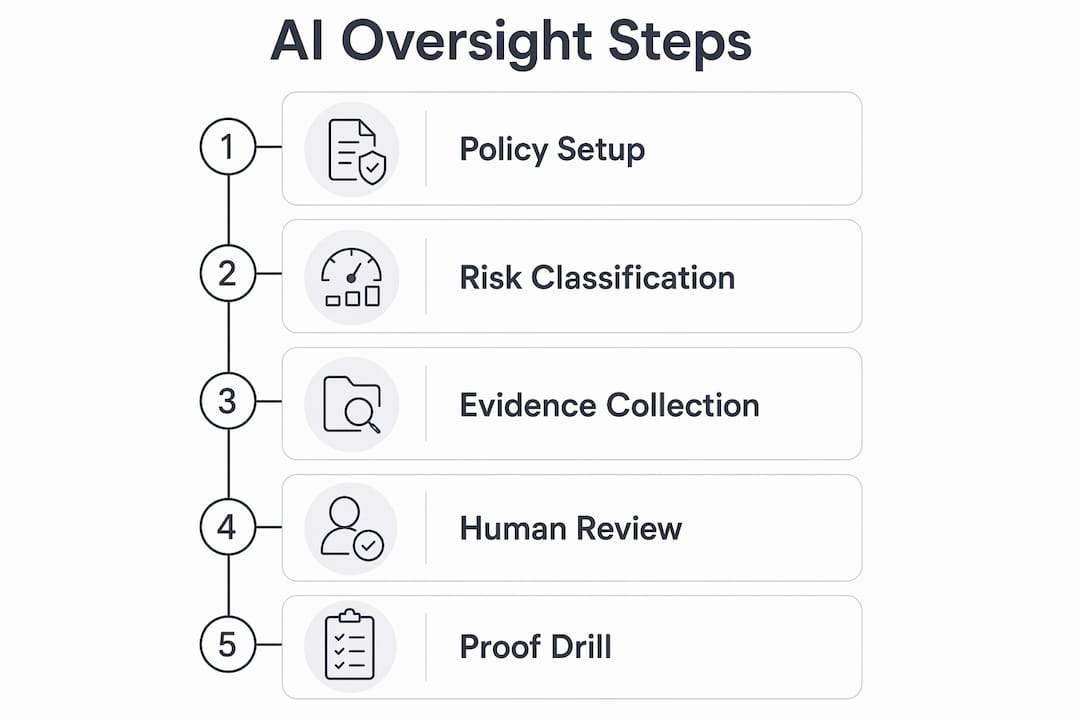
U.S. examiners are no longer satisfied with a policy binder. When the SEC, FTC, CFPB, or a prudential supervisor requests evidence of AI oversight, they want a bounded, case-level reconstruction: one AI-influenced decision, traced end-to-end from raw inputs through model version to human reviewer action to final outcome. Regulators increasingly favor proof drills that demand exactly this kind of evidence packet, produced within a risk-scaled time window. The three things that pass an examiner: a current model registry with documented risk rationale, distinct human-review logs that record who reviewed what and why, and a tamper-evident audit trail or cryptographically signed evidence pack with provenance metadata.
Immediate action checklist (24/72-hour readiness):
- Within 24 hours of an evidence request: Identify the specific decision or case, pull the associated model version and build hash, and produce a signed manifest export covering inputs, outputs, and reviewer action records.
- Within 72 hours: Deliver the full evidence pack including training-data lineage pointers, override rationale records, and an initial gap remediation plan for any missing artifacts.
- Ongoing baseline: Maintain a live model registry, instrument reviewer logs with structured timestamps, and schedule quarterly proof drills for high-risk systems.
The NIST AI Risk Management Framework and ISO/IEC 42001 both anchor the governance architecture examiners expect. Neither framework requires perfection. Both require a defensible, documented rationale for how governance intensity scales with risk, and the operational records to prove it.
Table of Contents
- What do U.S. regulators actually look for in AI oversight?
- What does a single-case proof drill actually require?
- How should you build and document your model registry?
- How do you make human oversight testable and auditable?
- What technical logs and provenance details do examiners want?
- How does an agentless, tamper-evident evidence layer work in practice?
- How do you design and run a proof drill?
- What is the practical readiness timeline when an examiner signals a request?
- What operational gaps do regulators repeatedly find, and how do you fix them?
- What exact questions do examiners ask, and how should you answer them?
- Key Takeaways
- Why proof drills change the audit dynamic
- Aetherpulse gives you audit-ready evidence without production access
- Authoritative sources and standards for AI oversight compliance
What do U.S. regulators actually look for in AI oversight?
The examiner mindset is evidence-first and operationally skeptical. Written policies are a starting point, not a finish line. What examiners probe is whether the operational reality matches the paper controls, and regulators commonly find four primary weaknesses: incomplete model registries, undocumented risk classifications, vague evidence of human oversight, and audit logs that cannot distinguish human approvals from raw AI output.

Which U.S. authorities and supervisory programs matter
The relevant supervisory landscape spans several agencies, each with distinct AI-related concerns:
- SEC: AI use in investment advice, trading, and financial reporting; SOX-relevant controls where AI outputs feed into disclosures.
- FTC: Consumer protection, algorithmic fairness, and deceptive AI practices under Section 5 authority.
- CFPB: Automated credit decisioning, adverse action notices, and explainability requirements under ECOA and FCRA.
- Prudential agencies (OCC, FDIC, Federal Reserve): Model risk management under SR 11-7 guidance; AI as a model requiring validation, documentation, and governance.
- State regulators: Insurance commissioners, state banking departments, and state AGs increasingly issuing AI-specific guidance.
The NIST AI RMF serves as the de facto cross-sectoral governance reference. Sectoral exam manuals layer on top of it. For financial services, SR 11-7 remains the baseline model risk management standard, and examiners map AI systems to its validation and documentation requirements.
The minimal documentary set examiners request
Examiners typically ask for six categories of evidence in an AI review:
- Model registry: Current inventory of AI systems in production, with version, owner, use case, and risk tier.
- Technical documentation: Architecture, training data description, performance metrics, and known limitations.
- Validation results: Independent testing outcomes, benchmark comparisons, and output validation artifacts.
- Human-oversight evidence: Reviewer logs with timestamps, decision rationale, and override records.
- Audit logs: Immutable records that separate AI output generation from human approval actions.
- Management oversight notes: Board or committee records showing AI risk is embedded in governance.
ISO/IEC 42001 auditors focus specifically on risk-proportionate governance: they expect a defensible rationale for why different systems receive different governance intensity, not a uniform control set applied indiscriminately. That same proportionality logic runs through every U.S. supervisory exam.
Sectoral expectations tighten in specific areas. SOX-relevant AI outputs require output validation artifacts tied to financial reporting controls. Consumer lending AI must produce adverse action explanations traceable to model logic. Payments and AML systems face heightened scrutiny on override rates and human-review cadence. Nearly half of Fortune 100 companies now specifically disclose AI risk as part of board oversight responsibilities, which signals that board-level governance documentation is becoming a baseline expectation, not a differentiator.
What does a single-case proof drill actually require?
The proof drill is the examiner's sharpest tool. The request is deceptively simple: "Show me the complete record for decision X." What that requires operationally is a bounded evidence packet covering every material artifact from the moment the AI system received its inputs to the moment a human approved or overrode the output.
Field-level evidence pack checklist
Every evidence packet for a single AI-influenced decision must include:
- Immutable case identifier: A unique request ID or transaction ID that links all artifacts.
- Timestamp chain: Separate timestamps for AI output generation and human reviewer action, with no overlap.
- Model identity: Model ID, version string, and build hash (SHA-256 or equivalent) at the time of the decision.
- Training-data snapshot descriptor: A pointer or hash to the dataset version used for the deployed model, not the current dataset.
- Input fingerprint: A hash or structured record of the inputs the model received for this specific decision.
- Output snapshot: The raw AI output before any human modification, preserved verbatim.
- Confidence metrics: Probability scores, confidence intervals, or equivalent model-output metadata.
- Human-review record: Reviewer identity (not just role), what they saw, their decision, and a structured reason code or free-text rationale.
- Override record (if applicable): The original AI recommendation, the human override, and the documented reason.
- Downstream action: What happened after the review, linked to the case ID.
Pro Tip: Package the evidence pack as a signed ZIP archive with a manifest.json at the root. The manifest should list every file, its SHA-256 hash, and the HMAC-SHA256 signature of the manifest itself. This makes the pack tamper-evident: any post-export modification invalidates the signature, and an examiner can verify integrity without accessing your production systems.
Example evidence-pack index
| Artifact | File / Log Reference | Required Field |
|---|---|---|
| Case identifier | manifest.json → case_id | Immutable UUID |
| AI output (raw) | output_snapshot.json | Pre-review verbatim output |
| Model build hash | manifest.json → model_build_hash | SHA-256 of model artifact |
| Input fingerprint | input_record.json | Hash of input payload |
| Human-review log | reviewer_log.json | Reviewer ID, timestamp, reason code |
| Override record | override_record.json | Original output, override value, rationale |
| Manifest signature | manifest.json → hmac_sig | HMAC-SHA256 of full manifest |
How should you build and document your model registry?
A model registry is the foundation of every AI governance program an examiner will test. Without it, no other evidence holds together. The registry must be a live, versioned record, not a spreadsheet last updated at audit time.
Registry schema
| Field | Description | Example |
|---|---|---|
model_id | Unique, immutable identifier | mdl-credit-001 |
business_use | Plain-language description of the use case | Automated credit limit decisioning |
owner | Named individual accountable for the model | VP, Credit Risk |
version | Current deployed version string | v2 |
deployment_scope | Systems and populations affected | Consumer lending, state-level |
risk_tier | High / Medium / Low with documented rationale | High |
regulator_flags | Applicable regulatory touchpoints | ECOA, FCRA, SR 11-7 |
last_validation | Date of most recent independent validation | March 15, 2026 |
next_review | Scheduled next review date | September 15, 2026 |
ISO/IEC 42001 auditors expect the risk-tier field to be backed by a written rationale, not just a label. The rationale should explain the governance intensity decision: why this model receives quarterly validation rather than annual, why it requires board-level reporting, and which regulatory obligations drive those choices.
Risk-classification rationale examples
Credit decisioning (High): "This model produces binding credit limit decisions affecting consumer accounts. Errors carry direct financial harm and ECOA adverse-action obligations. Governance intensity: quarterly validation, independent model risk review, board reporting, full proof-drill coverage."
AML triage (High): "Model outputs trigger SAR filing workflows. False negatives carry BSA/AML regulatory exposure. Governance intensity: monthly output validation, dedicated human-review queue with override logging, 24-hour evidence-production SLA."
Customer communications (Medium): "Model generates personalized product messaging. No binding financial decisions; FTC consumer protection exposure if outputs are misleading. Governance intensity: semiannual validation, reviewer spot-check sampling, 72-hour evidence-production SLA."
The rationale language matters. An examiner reading a High classification should immediately understand the business impact, the regulatory hook, and the governance response. Vague labels like "High — significant risk" without a business-impact statement will draw follow-up questions.
How do you make human oversight testable and auditable?
The most common audit failure is not a missing policy. It is a policy that claims human oversight while the underlying systems produce no structured, timestamped log of what any reviewer actually did. Many organizations fail audits precisely because operational reality does not match written controls: policies assert oversight, but logs cannot reconstruct it.
Human oversight must be retrievable and testable. Auditors will ask for the last several overrides and the associated reviewer analysis. If logs cannot produce that on demand, the oversight claim fails regardless of what the policy document says.
Reviewer log entry template
Every reviewer action must write a structured log event containing:
reviewer_id: Named individual, not a role or team label.session_timestamp: ISO 8601 timestamp of when the review session opened.decision_timestamp: Separate ISO 8601 timestamp of when the reviewer submitted their decision.case_id: The immutable case identifier linking this log to the full evidence pack.ai_output_seen: A hash or pointer to the exact AI output the reviewer evaluated.decision: Approve / Override / Escalate.reason_code: Structured code from a controlled vocabulary (e.g.,RC-07: Output outside policy bounds).free_text_rationale: Optional but encouraged for overrides; stored as a structured field, not a chat message.
Pro Tip: Avoid free-text chat logs or email threads as oversight evidence. Examiners expect structured, machine-readable log events that can be queried, exported, and verified. If your reviewer workflow runs through a messaging platform, instrument it to write structured audit events to a separate, append-only log store at the moment of each decision.
Operational metrics as oversight evidence
Examiners probe operational metrics as proxies for meaningful oversight: queue depth, time-per-review, override rate, and trend analysis over time. These metrics serve two purposes. First, they demonstrate that reviewers are engaging substantively rather than rubber-stamping outputs. Second, they surface systemic issues: a falling override rate on a high-risk model may indicate reviewer fatigue or inadequate training, not improved model performance.
Track and retain these metrics at the model level, not just the program level. An examiner asking about a specific credit model expects model-specific override-rate data, not an enterprise average. For human oversight in financial AI systems, the ability to show time-stamped human involvement at each decision point is increasingly a baseline expectation.
What technical logs and provenance details do examiners want?
Technical logging is where governance programs most often fall short of examiner expectations. Policies describe logging requirements in general terms; engineering implementations capture what is convenient rather than what is auditable. The gap between the two is where exam findings originate.
Required log fields
Every AI system in production must emit log events containing:
request_id: Unique identifier for this inference call, linkable to the case record.timestamp: Millisecond-precision UTC timestamp of the inference request.model_id+build_hash: The deployed model's identifier and its cryptographic build hash at inference time.model_weights_pointer: A pointer or hash to the model weights or manifest used, not just the version string.input_fingerprint: A hash of the input payload, preserving the exact data the model received.output_snapshot: The verbatim model output, stored immutably before any post-processing.confidence_metrics: Probability scores, calibration data, or equivalent uncertainty quantification.pipeline_step_ids: Identifiers for each processing stage, enabling reconstruction of multi-step pipelines.reviewer_action_id: A foreign key linking this inference log to the reviewer's structured log event.
The separation between raw AI output and human approval is not optional. Logs must carry distinct timestamps and distinct actor identities for the inference event and the review event. An examiner who cannot see that separation in the log structure will treat the oversight claim as unverified.
Tamper-evidence patterns
Four patterns provide defensible tamper evidence for exported logs:
- Signed manifests: HMAC-SHA256 or equivalent signing of the export manifest at the moment of generation.
- Write-once log stores: Append-only storage (AWS S3 Object Lock, Azure Immutable Blob Storage, or equivalent) that prevents modification after write.
- Append-only databases: Log tables configured with insert-only permissions; no UPDATE or DELETE operations permitted.
- Cryptographically signed evidence packs: The full export package signed at generation time, with the signature embedded in the manifest.
Pro Tip: Build an automated evidence-pack builder into your CI/CD pipeline so that every model deployment automatically generates a signed manifest of the build artifacts. This gives you a cryptographic chain of custody from training to production without manual steps at audit time.
Output validation artifacts are especially critical where AI outputs feed into financial reporting or SOX-relevant controls. Define the validation method for every use case and retain the validation artifacts as part of the model's governance record.
How does an agentless, tamper-evident evidence layer work in practice?
The architecture pattern that addresses the examiner's core request — produce a signed evidence pack for one decision, on demand, without touching customer data — is an agentless evidence layer. The AETHER Pulse pattern illustrates how this works operationally.
High-level architecture
The evidence layer operates in four stages:
- Inventory sync: OAuth metadata-only connectors ingest agent and model identities, versions, and deployment scope without accessing customer data or model weights directly.
- Metadata graph: An identity graph maps relationships between agents, models, pipelines, and business use cases, surfacing risk concentration and blast-radius exposure.
- Manifest builder: On demand, the layer assembles a structured manifest covering the relevant case artifacts, model build metadata, and reviewer action pointers.
- HMAC-SHA256 signing: The manifest is cryptographically signed at generation time, producing a tamper-evident export that an examiner can verify independently.
Example manifest.json fields
case_id: "uuid-v4"
generated_at: "2026-03-15T14:32:00Z"
model_id: "mdl-credit-001"
model_build_hash: "sha256:abc123..."
input_fingerprint: "sha256:def456..."
output_snapshot_pointer: "s3://evidence-store/outputs/uuid-v4.json"
reviewer_log_pointer: "s3://evidence-store/logs/reviewer-uuid-v4.json"
hmac_sig: "hmac-sha256:xyz789..."
Vendor evaluation checklist
When evaluating any evidence-layer vendor, compliance teams should verify:
- Deployment mode: Agentless (metadata-only) versus agent-based (requires installation in production systems). Agentless is strongly preferable for regulated environments.
- Data-touch policy: Does the vendor access customer data, model weights, or inference payloads? The answer should be no.
- Signing algorithm: HMAC-SHA256 minimum; verify the key management approach.
- Evidence-assembly latency: What is the SLA for producing a signed evidence pack? 24 hours for high-risk systems is the target.
- Audit-readiness SLA: Does the vendor contractually commit to evidence availability and integrity?
Pro Tip: Vendor-supplied evidence is not sufficient on its own. Regulators expect firms to produce their own internal governance records showing how they assigned accountability, validated outputs, and defined risk appetite. A vendor's signed export is one artifact in your evidence pack, not a substitute for your internal records. You must own the reviewer logs, the risk-classification rationale, and the model registry — the vendor cannot own those for you.
How do you design and run a proof drill?
A proof drill is a rehearsed, timed exercise that tests whether your team can produce a complete, signed evidence pack for a specific AI-influenced decision within the required window. Running one before an examiner requests it is the difference between a controlled exercise and a crisis response.
Step-by-step proof drill script
- Scenario selection (Day 0): Compliance lead selects a real, closed case from a high-risk model. The case should be at least 30 days old to test log retention.
- Role assignment: Compliance lead (drill coordinator), model owner (registry and build metadata), engineering responder (log extraction and signing), executive brief recipient (simulates board notification for high-risk findings).
- 24-hour checkpoint: Engineering responder produces the raw evidence pack: model build hash, input fingerprint, output snapshot, and reviewer log export. Compliance lead verifies completeness against the field checklist.
- 48-hour checkpoint: Signed manifest generated and verified. Gap analysis completed: which required fields were missing or required manual reconstruction?
- 72-hour checkpoint: Full evidence pack delivered in examiner-ready format (signed ZIP with manifest). Remediation tickets created for any gaps identified.
- Post-drill debrief: Scoring against the checklist; prioritized remediation plan assigned to owners with deadlines.
Frequency guidance
| Risk tier | Proof drill frequency | Tabletop frequency |
|---|---|---|
| High | Quarterly | Semiannual |
| Medium | Semiannual | Annual |
| Low | Annual | As needed |
Scoring checklist
Convert drill outcomes into prioritized remediation tickets using this scoring framework:
- Critical (fix within 24 hours): Missing model build hash, no reviewer log for the selected case, unsigned or unverifiable manifest.
- High (fix within 30 days): Incomplete input fingerprint, missing confidence metrics, free-text override rationale without structured reason code.
- Medium (fix within 90 days): Reviewer log exists but lacks decision timestamp, model registry entry missing last-validation date.
- Low (fix at next cycle): Minor formatting inconsistencies in manifest fields, missing optional metadata fields.
What is the practical readiness timeline when an examiner signals a request?
When an examiner signals an evidence request, the clock starts immediately. The 24/72-hour/30-day framework below maps the required actions, responsible roles, and estimated effort for each window.
24-hour response
- Identify the case: Compliance lead confirms the specific decision or date range the examiner has requested. Estimated effort: 1–2 hours.
- Pull model registry entry: Model owner retrieves the current registry record for the relevant system, including version and build hash at the time of the decision. Estimated effort: 30 minutes.
- Extract raw evidence artifacts: Engineering responder pulls input fingerprint, output snapshot, and inference log for the case. Estimated effort: 2–4 hours depending on log infrastructure.
- Produce signed manifest export: Engineering responder generates and signs the initial manifest. Compliance lead verifies the HMAC signature. Estimated effort: 1–2 hours.
- Notify governance: If the model is high-risk or the request involves a consumer-harm allegation, notify the board or audit committee within 24 hours.
72-hour response
- Assemble full evidence pack: Add reviewer log, override record (if applicable), training-data lineage pointer, and validation artifacts. Estimated effort: 4–6 hours.
- Gap remediation plan: Document any artifacts that could not be produced and the root cause. Assign remediation owners and deadlines. Estimated effort: 2–3 hours.
- Schedule tabletop: Book a tabletop session within 14 days to close process gaps identified during assembly. Estimated effort: 30 minutes to schedule.
30-day follow-up
- Root-cause remediation: Implement fixes for log gaps, registry gaps, or reviewer-workflow deficiencies identified during the evidence assembly. Assign to engineering and compliance owners with 30-day deadlines.
- Registry and classification update: Refresh the model registry entry to reflect any changes in risk tier, validation status, or governance controls.
- Reviewer training refresh: If the evidence assembly revealed gaps in reviewer log quality, run a targeted training session and document completion.
- Post-exam reporting: Prepare a written summary for senior management and the audit committee covering the examiner's request, the evidence produced, any gaps identified, and the remediation plan.
Output validation artifacts should be reviewed and updated as part of the 30-day cycle, particularly for models with SOX-relevant outputs.
What operational gaps do regulators repeatedly find, and how do you fix them?
The four gaps that appear most consistently in AI supervisory reviews are not exotic. They are the predictable result of governance programs built around policy documents rather than operational instrumentation.
Gap-vs-fix table
| Gap | Root Cause | Quick Fix (24–72 hrs) | Medium Fix (30 days) | Long-term Control |
|---|---|---|---|---|
| Incomplete model registry | Registry built at audit time, not maintained continuously | Add missing models; assign owners | Implement registry-update workflow tied to deployment pipeline | Automated registry sync on every model deployment |
| Undocumented risk rationale | Risk tiers assigned without written justification | Draft rationale for all High/Medium models | Standardize rationale template; require sign-off | Annual risk-classification review with documented outcomes |
| Vague human-oversight evidence | Reviewer workflows produce free-text notes, not structured logs | Export available logs; document gaps | Instrument reviewer UI to write structured log events | Append-only log store with mandatory structured fields |
| Audit-log gaps (AI vs. human not separated) | Inference and review events written to same log with same actor | Identify cases where separation is missing | Refactor logging to separate inference and review event streams | Automated validation that every inference log has a linked reviewer event |
Pro Tip: The vendor-documentation trap is the most expensive mistake in an AI audit. Regulators expect firms to produce their own internal artifacts proving accountability, risk appetite decisions, and validation records. A vendor's SOC 2 report or model card does not substitute for your internal governance records. Before an exam, audit your evidence inventory for artifacts that exist only in vendor documentation and build internal equivalents.
Identity verification and audit trail practices in consumer-facing AI systems are a specific area where log gaps frequently surface: reviewer identity records are often incomplete or unlinked to the specific decision record.
What exact questions do examiners ask, and how should you answer them?
Examiners in an onsite AI review or evidence-request process tend to ask a consistent set of questions. Knowing the question in advance means knowing which artifact to attach.
-
"Show me your model inventory." Attach: Current model registry export (all fields, including risk tier and last-validation date). Unacceptable: A list of model names without versions, owners, or risk classifications.
-
"Show me the last five overrides for this model and the reviewer's rationale." Attach: Structured reviewer log export filtered to override decisions, including
reviewer_id,decision_timestamp,reason_code, andfree_text_rationale. Unacceptable: Email threads or chat logs. Human oversight must be retrievable from structured logs; inability to produce this is a failed audit. -
"How do you validate that this model's outputs are reliable?" Attach: Output validation artifacts for the relevant use case: benchmark results, back-testing records, and the documented validation method. Unacceptable: A vendor's model card or a general statement that the model was tested before deployment.
-
"How do I know a human actually reviewed this decision and didn't just approve it automatically?" Attach: The reviewer log entry showing a distinct
decision_timestampafter the inferencetimestamp, with a non-nullreason_code. Unacceptable: A log where the inference and review timestamps are identical or where the reviewer field contains a system account. -
"What is your process if this model produces a harmful output?" Attach: The documented incident response procedure, the named pause authority (the individual with authority to halt the model), and evidence that the pause authority has been tested (drill records).
-
"Who at the board level is accountable for AI risk?" Attach: Board or audit committee charter language, meeting minutes referencing AI risk, and any public disclosure of board-level AI oversight responsibilities.
Delivery format: Produce evidence as a signed ZIP archive with a manifest.json index. For examiner portal submissions, a timestamped forensic PDF with embedded manifest hash is acceptable. Read-only portal exports with access logs are preferred over email attachments for chain-of-custody purposes.
Key Takeaways
Demonstrating AI oversight to U.S. regulators requires a current model registry, structured reviewer logs with distinct timestamps, and a tamper-evident, cryptographically signed evidence pack that reconstructs a single AI-influenced decision end-to-end.
| Point | Details |
|---|---|
| Model registry is the foundation | Maintain a live registry with risk tier, owner, version, and documented rationale — not a static audit-time spreadsheet. |
| Proof drills validate readiness | Run quarterly drills for high-risk systems; score gaps into prioritized remediation tickets before an examiner requests evidence. |
| Separate AI output from human approval | Logs must carry distinct timestamps and actor identities for inference and review events; merged logs fail the oversight test. |
| Own your internal governance records | Vendor documentation does not substitute for your internal risk-classification rationale, reviewer logs, and validation artifacts. |
| Aetherpulse accelerates evidence assembly | Aetherpulse's agentless, metadata-only evidence layer generates HMAC-SHA256 signed evidence packs on demand without touching customer data. |
Why proof drills change the audit dynamic
The conventional wisdom in AI governance is that more policy equals more protection. Boards approve AI governance frameworks, compliance teams publish model risk policies, and audit committees receive quarterly reports. None of that prepares a firm for the moment an examiner says, "Show me the complete record for decision X, and I need it by tomorrow morning."
Proof drills force a different kind of discipline. When you rehearse evidence assembly under a timed constraint, you discover immediately whether your model registry is current, whether your reviewer logs are structured and queryable, and whether your engineering team can extract a signed evidence pack without a week of manual reconstruction. The policy document cannot tell you any of that. The drill does.
The efficiency argument for boards and audit committees is straightforward. Firms that practice evidence production before an exam resolve findings faster, generate fewer remediation commitments, and spend less on post-exam remediation. The cost of a quarterly proof drill is a few hours of cross-functional time. The cost of discovering a log gap during an active examination is considerably higher, measured in both remediation spend and supervisory credibility.
The deeper shift is organizational. When compliance teams own the evidence-production workflow rather than delegating it to engineering at crisis time, AI governance becomes an operational discipline rather than a documentation exercise. That shift is what examiners are actually testing for.
Aetherpulse gives you audit-ready evidence without production access
Regulated firms that have instrumented their reviewer logs and model registries still face one practical problem: assembling a signed, examiner-ready evidence pack under a 24-hour deadline is a cross-functional sprint that most compliance teams cannot absorb without preparation. Aetherpulse is built specifically for that gap.

Aetherpulse connects to your AI agent infrastructure through OAuth metadata-only connectors, touching no customer data and requiring no installation in production systems. It builds a live inventory and identity graph of your deployed models and agents, surfaces risk concentration by business impact, and generates deterministic, HMAC-SHA256 signed evidence packs on demand. The result is a tamper-evident export that an examiner can verify independently, produced in the time window your risk tier requires.
When evaluating Aetherpulse for procurement, ask for three things in the demo: a live signed evidence pack for a named case, the time-to-assemble SLA for your highest-risk model tier, and a walkthrough of a simulated proof drill. Confirm that the export format meets your examiner's submission requirements and that your internal reviewer logs, risk-classification rationale, and model registry remain under your control. Aetherpulse provides the evidence layer; your governance records are yours to own.
Request a demo at aetherpulse.app to see a signed evidence pack assembled in real time.
Authoritative sources and standards for AI oversight compliance
The sources below are the primary references examiners and auditors accept as authoritative for AI governance in U.S. regulated environments. Cite them in your governance documentation and evidence packs where relevant.
-
NIST AI Risk Management Framework: The cross-sectoral U.S. governance reference. Examiners across financial services, consumer protection, and federal contracting treat NIST AI RMF alignment as a baseline expectation. Use it to structure your risk-tier rationale and governance intensity decisions.
-
ISO/IEC 42001: The international AI management system standard. Auditors expect risk-proportionate governance and a defensible rationale for different control intensity across systems. Aligning your registry schema and risk-classification language to ISO/IEC 42001 strengthens your examiner narrative.
-
NTIA AI Accountability Policy Report: The federal government's framework for AI accountability, covering documentation, independent evaluation, and consequences for accountability failures. Relevant for firms subject to federal contracting or cross-sectoral oversight.
-
FTC consumer protection guidance: The FTC's Section 5 authority covers deceptive and unfair AI practices. Firms deploying consumer-facing AI should maintain evidence of output validation and human-oversight controls aligned to FTC expectations.
-
Effective AI Oversight Through Proof Drills: The primary practitioner reference for case-level reconstruction testing. Examiners increasingly cite this framework when requesting bounded evidence packets for specific AI-influenced decisions.
-
What regulators ask in an AI review: A practitioner guide mapping the four primary operational control weaknesses regulators find in AI reviews. Use it to benchmark your gap analysis against the most common exam findings.
-
EU AI Act Article 14 human oversight in production: Although EU-scoped, this analysis of testable human-oversight capabilities is directly applicable to U.S. examiner expectations for structured reviewer logs and override records. Examiners expect the same operational artifacts regardless of jurisdiction.
-
PwC: Responsible AI and audits: Covers output validation requirements for AI-assisted financial reporting and SOX-relevant controls. Relevant for any firm where AI outputs feed into financial disclosures.
-
Governing agentic AI: GRC and accountability: Addresses the vendor-documentation trap and the expectation that firms produce their own internal accountability records. Cite this when documenting your policy on vendor evidence versus internal governance artifacts.
-
AI and the audit committee: Documents the trend toward board-level AI oversight disclosure among major public companies. Relevant for firms preparing board governance documentation for examiner review.
This article provides general compliance guidance and does not constitute legal or regulatory advice. Confirm current supervisory expectations with your primary regulator or qualified legal counsel for your specific situation.
Recommended
Working on Article 26 readiness, deployer-side governance evidence, or AI agent risk at a regulated firm? We'd value 15 minutes of your perspective.
Start a conversation