EU AI Act Compliance for Financial Firms: 2026 Guide
EU AI Act Compliance for Financial Firms: 2026 Guide

Many fintech AI agents are already high-risk under the EU AI Act, and the August 2, 2026 deadline for full high-risk system obligations is not a future concern. It is a present one. Credit scoring models, fraud detection systems, and automated lending decisions all fall squarely into the Act's high-risk classification, meaning your firm must demonstrate technical documentation, human oversight, and registration under Article 26 before supervisors ask. The first move is an AI-agent inventory and high-risk use-case triage, not a policy refresh.
Immediate compliance priorities:
- Conduct a full inventory of deployed AI agents and automated decision-making flows
- Triage each system against the high-risk criteria (credit, fraud, insurance, access-to-services decisions)
- Map identified obligations to existing SR 11-7 model risk management and DORA ICT resilience controls
- Begin tamper-evident evidence capture for high-risk systems now
- Prepare Article 26 registration inputs ahead of the August 2, 2026 milestone
Deadline callout: High-risk system obligations including transparency, traceability, and human oversight requirements apply from August 2, 2026. Non-compliance with prohibited practices under Article 5 carries fines up to €35,000,000 or 7% of global annual turnover, whichever is higher. Non-compliance with high-risk system obligations (the tier most relevant to financial firms) carries fines up to €15,000,000 or 3% of global annual turnover. Providing incorrect or misleading information to supervisory authorities carries fines up to €7,500,000 or 1% of turnover.
Table of Contents
- What does the EU AI Act require from financial firms?
- Which fintech AI systems qualify as high-risk?
- How do you fold AI Act obligations into existing compliance programs?
- What evidence do supervisors actually expect?
- What tooling approach produces audit-ready evidence without production risk?
- How Aetherpulse meets the evidence need
- What does a realistic implementation roadmap look like?
- What should you ask evidence-tool vendors?
- How do you conduct a conformity assessment under the EU AI Act?
- How do you maintain compliance after deployment?
- What penalties does non-compliance carry?
- How do you build staff capability and manage organizational change?
- Key Takeaways
- The compliance gap is an evidence gap, not a policy gap
- Aetherpulse gives you audit-ready evidence without production access
- Authoritative sources and further reading
What does the EU AI Act require from financial firms?
The Act imposes seven core obligations on deployers and providers of high-risk AI systems. For regulated financial firms, each one maps directly to existing supervisory expectations from the EBA, national competent authorities, and prudential regulators.
The obligations that matter most are: a documented risk management system covering the full AI lifecycle; technical documentation sufficient for a regulator to assess conformity; automatic logging of system operations; human oversight mechanisms that allow intervention; accuracy, robustness, and cybersecurity requirements; a conformity assessment before deployment; and registration in the EU database under Article 26.
The EBA is explicit that these duties are not additive to existing sectoral rules. They are meant to complement existing frameworks such as DORA, GDPR, and internal model governance. Firms that treat AI Act compliance as a standalone legal project will duplicate effort and create governance gaps. The BIS notes that regulators are focused on human oversight and auditability rather than banning models outright, which means the evidence you produce matters as much as the controls you build.
Which fintech AI systems qualify as high-risk?
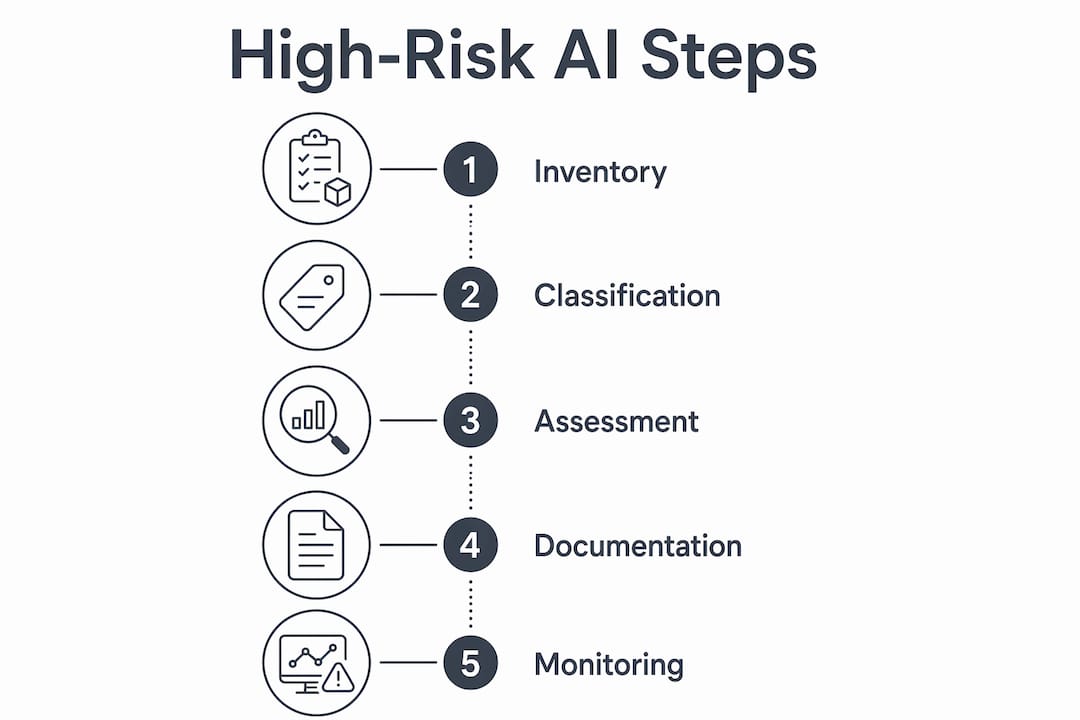
Use-case determines risk class, not model architecture. A gradient-boosted tree used for credit scoring carries the same high-risk obligations as a neural network performing the same function.
The most common high-risk fintech cases are:
- Automated credit scoring and lending decisions — directly affects access to financial services and triggers Annex III classification
- Fraud detection with automated blocking — when the system takes consequential action (account freeze, transaction block) without mandatory human review, it qualifies as high-risk
- Insurance risk scoring — pricing and eligibility decisions that affect access to insurance products
- Onboarding and identity verification — automated decisions that deny or restrict access to services based on biometric or document-based inference
Borderline cases include fraud-detection systems used purely for alerting (no automated action) and internal risk models that inform but do not drive customer-facing decisions. The EBA analysis confirms that credit scoring, fraud detection, and insurance risk assessment are explicitly classified as high-risk and require technical documentation and registration artefacts. When in doubt, treat a system as high-risk until a documented assessment concludes otherwise.
How do you fold AI Act obligations into existing compliance programs?
Treat AI Act duties as overlays to controls you already maintain, not a parallel program. The mapping is direct and the artefact overlap is substantial.

| AI Act Obligation | SR 11-7 Control | DORA Control | Internal Governance |
|---|---|---|---|
| Technical documentation | Model documentation & validation reports | ICT asset documentation | Model inventory |
| Risk management system | Model risk management lifecycle | ICT risk framework | Risk committee oversight |
| Human oversight | Model performance monitoring | Operational resilience testing | Senior responsible owner |
| Logging & recordkeeping | Model change logs | ICT incident logs | Audit trail policy |
| Conformity assessment | Pre-deployment validation | Third-party ICT assessment | Internal sign-off gate |
| Article 26 registration | Model inventory registration | N/A | Compliance register |
The U.S. Treasury has similarly recommended that firms align AI definitions and review use cases for compliance before deployment, and IOSCO's supervisory toolkit calls for senior-management accountability and documented governance as baseline expectations.
Pro Tip: Reuse existing model inventories, change logs, and BCP test records as the foundation for AI Act artefacts. The gap is almost always in tamper-evident provenance and Article 26 registration inputs, not in the underlying governance documentation.
What evidence do supervisors actually expect?
Defensible evidence is a structured, reproducible record that lets an auditor reconstruct a decision trail without accessing production PII. It is not continuous telemetry.
| Artefact | What It Proves | Typical Owner |
|---|---|---|
| AI-agent inventory | Scope of deployment, system identity | Model Ops / Compliance |
| Technical documentation | Design, training data, intended purpose | Model Development |
| Risk assessment record | Pre-deployment risk classification | Risk / Compliance |
| Human oversight logs | Intervention capability and usage | Operations |
| Signed model provenance (HMAC-SHA256) | Tamper-evident decision trail | Security / MLOps |
| Training and test data summaries | Data quality and bias controls | Data Engineering |
| Deployment and change records | Version control, change authorization | Model Ops |
| Conformity assessment output | Regulatory sign-off before deployment | Compliance |
Practitioners consistently note that regulators prefer defensible evidence demonstrating governance over exhaustive production monitoring. Cryptographic signing, specifically HMAC-SHA256 provenance hashing, is an accepted pattern for demonstrating that logs have not been altered after the fact.
What tooling approach produces audit-ready evidence without production risk?
Prefer an agentless, metadata-first evidence layer that generates deterministic, tamper-evident packs on demand. This avoids GDPR conflicts, DORA operational-resilience risks, and the audit-fatigue that comes from continuous invasive telemetry.
- Agentless metadata capture — connects via OAuth, reads system metadata without touching customer data; low deployment friction, no production impact, GDPR-compatible
- In-line code instrumentation — embeds logging directly in model code; high fidelity but requires production access and creates a maintenance surface
- Centralized logging with hashing — aggregates existing logs and applies cryptographic hashing; good for mature environments but depends on log completeness upstream
- On-demand evidence extraction — generates signed evidence packs at audit time from stored metadata; preferred for regulator submissions
The EUROFI regulatory update stresses harmonization with GDPR and data governance for financial AI systems, which makes production-invasive tooling a liability rather than an asset.
Pro Tip: Cryptographically signed provenance trails produced from metadata alone satisfy the traceability requirement without creating a new data-processing obligation under GDPR. That combination is what makes agentless capture the preferred architecture for regulated firms.
How Aetherpulse meets the evidence need
Aetherpulse is a read-only, agentless metadata layer that produces cryptographically signed (HMAC-SHA256) evidence packs and a live AI-agent inventory, without touching production data or customer records.
Core capabilities:
- Inventory and identity graph — maps every deployed AI agent, surfaces the agentic constellation across the organization, and identifies risk concentration and blast-radius exposure
- Provenance signing — generates tamper-evident, HMAC-SHA256-signed evidence packs that satisfy Article 26 registration inputs and SR 11-7/DORA artefact requirements
- Non-invasive metadata capture — connects via OAuth only; no agent installation, no production access, no PII exposure
- On-demand evidence generation — deterministic packs produced at audit time, reproducible and regulator-ready
Aetherpulse connects through metadata only, producing cryptographically signed evidence packs that map directly to Article 26, SR 11-7, and DORA artefact requirements. Firms get a defensible audit trail and a live agent inventory without inserting a new system into their production environment or creating a secondary data-processing obligation.
What does a realistic implementation roadmap look like?
A three-phase approach gives compliance leads a board-presentable plan with clear decision gates.
-
Phase 1: Inventory and triage (weeks 1–4). Deploy the metadata layer, generate the AI-agent inventory, and classify each system against high-risk criteria. Owner: compliance and model ops jointly. Success criterion: complete inventory with risk classification for every deployed AI agent.
-
Phase 2: Pilot with deterministic evidence (weeks 5–10). Select two to three high-risk systems, generate signed evidence packs, and validate artefact completeness against Article 26 and SR 11-7 requirements. Decision gate: evidence pack reviewed by internal audit before proceeding. Cost band: typically a pilot-tier SaaS fee plus internal compliance resource.
-
Phase 3: Enterprise rollout and ongoing reviews (months 3–6 and continuous). Extend coverage to all high-risk systems, integrate evidence generation into the model change-management process, and schedule periodic compliance reviews aligned to DORA ICT risk assessment cycles. Cost band: enterprise SaaS plus a dedicated AI governance role or augmented MRM team capacity.
Pre-Article 26 registration readiness is the Phase 3 gate: conformity assessment outputs and signed provenance must be assembled before submitting to the EU database.
What should you ask evidence-tool vendors?
The single most important vendor requirement is non-invasive evidence capture combined with cryptographic provenance and the ability to map artefacts directly to SR 11-7, DORA, and Article 26. Everything else is secondary.
Concrete questions to ask:
- Does the tool access production systems or customer data at any point?
- Can it demonstrate OAuth-only or equivalent metadata-only ingestion?
- Does it produce HMAC-SHA256 or equivalent cryptographically signed evidence packs?
- Can it generate artefacts mapped explicitly to Article 26 registration inputs?
- How does it handle retention, deletion, and data-subject rights under GDPR?
- Can it produce a conformity-assessment support package, or only raw logs?
Red flags to avoid:
- Requires production database access or agent installation on model servers
- Cannot produce signed provenance; offers only timestamped log exports
- Continuous invasive monitoring with no on-demand defensible evidence export
- No explicit mapping to SR 11-7 or DORA artefact categories
- Vendor retains copies of your model metadata or evidence packs on shared infrastructure
IOSCO's toolkit flags concentration and outsourcing risks as a supervisory focus area, which means your contractual controls over a third-party evidence vendor are themselves a compliance artefact.
How do you conduct a conformity assessment under the EU AI Act?
A conformity assessment for a high-risk financial AI system is a structured internal review that produces a documented record of compliance before deployment. For most financial firms, it follows a four-step procedure.
First, establish the system's classification. Document why the system qualifies as high-risk under Annex III, referencing the specific use case and the population affected. Second, compile the technical file: architecture documentation, training data summaries, performance metrics, bias and robustness test results, and the risk management record. Third, verify that each high-risk obligation is met: human oversight mechanisms are operational, logging is active, cybersecurity controls are in place, and accuracy thresholds are documented. Fourth, produce a signed declaration of conformity and register the system in the EU database under Article 26.
For financial firms, the conformity assessment should be integrated into the existing model validation gate, not run as a separate legal exercise. The model validation team already produces performance and risk documentation; the gap is usually in tamper-evident provenance and the formal declaration. Assigning a senior responsible owner for each high-risk AI system, as IOSCO recommends, gives the assessment a clear accountability anchor and simplifies the audit trail.
How do you maintain compliance after deployment?
Post-deployment compliance is a monitoring and review cycle, not a one-time sign-off. Three practices sustain it.
Continuous logging with periodic review is the baseline. Operational logs for high-risk systems must be retained and reviewed at defined intervals, with any material model change triggering a reassessment of the conformity record. Tie this review cycle to DORA's ICT risk assessment schedule so it does not become an orphaned process.
Periodic drift and performance monitoring catches the cases where a model's behavior shifts after deployment without a formal change event. Schedule quarterly performance reviews against the accuracy and robustness thresholds documented in the technical file. If a system drifts outside those thresholds, the conformity record must be updated before the system continues in production.
Annual compliance reviews should cover the full artefact set: inventory currency, evidence pack completeness, Article 26 registration status, and staff training records. The EU AI Act requires continuous compliance throughout the AI lifecycle, not just at deployment. Firms that treat the initial conformity assessment as permanent will face enforcement exposure when supervisors conduct market surveillance.
What penalties does non-compliance carry?
The EU AI Act follows a tiered penalty structure. Violations of the prohibited practices in Article 5 carry the highest fines: up to €35,000,000 or 7% of global annual turnover, whichever is higher. Non-compliance with high-risk system obligations (the tier most relevant to financial firms) carries fines up to €15,000,000 or 3% of global annual turnover. Providing incorrect or misleading information to supervisory authorities carries fines up to €7,500,000 or 1% of turnover.
Market surveillance authorities designated by each EU member state are responsible for enforcement, and they may act on their own initiative or following a complaint. For financial firms, enforcement exposure is compounded by the interaction with national competent authorities and prudential supervisors who will increasingly treat AI Act compliance as part of their standard examination scope. The August 2, 2026 application date for high-risk obligations means enforcement powers are active before most firms have completed a full conformity assessment cycle.
How do you build staff capability and manage organizational change?
AI Act compliance does not land cleanly in any single team. It cuts across model risk management, compliance, legal, security, and operations. The organizational change challenge is coordination, not just training.
Assign a senior responsible owner for AI use at the business-unit level. This person owns the conformity assessment, signs off on the technical file, and is the named point of contact for supervisory inquiries. Without this role, accountability diffuses and evidence gaps appear at the seams between teams.
Training priorities should focus on three groups: model developers need to understand documentation and logging requirements; compliance officers need to map AI Act obligations to existing MRM and DORA processes; and senior management needs enough fluency to challenge AI risk assessments and approve conformity declarations. The U.S. GAO has noted that federal financial regulators are increasingly integrating AI oversight into standard examination activities, which means the expectation of staff competence is rising on both sides of the Atlantic.
Change management works best when AI governance is embedded in existing workflows rather than added as a parallel process. Integrate conformity assessment into the model change-management gate. Add AI Act artefact review to the internal audit schedule. Treat evidence pack generation as a standard model ops deliverable, not a compliance project.
Key Takeaways
EU AI Act compliance for financial firms requires a structured, evidence-first approach: inventory your AI agents, map obligations to SR 11-7 and DORA, and produce cryptographically signed, tamper-evident artefacts before the August 2, 2026 high-risk system deadline.
| Point | Details |
|---|---|
| Inventory first | Conduct a full AI-agent inventory and triage each system against high-risk criteria before any other compliance step. |
| Map to existing frameworks | Align AI Act obligations to SR 11-7 model risk management and DORA ICT controls to avoid creating a compliance silo. |
| Signed evidence is the standard | Cryptographically signed (HMAC-SHA256) provenance packs satisfy Article 26 and auditor traceability requirements without production access. |
| August 2, 2026 is the hard gate | High-risk system obligations including transparency, logging, and human oversight apply from this date; enforcement powers are active. |
| Aetherpulse for agentless evidence | Aetherpulse produces tamper-evident, signed evidence packs via OAuth metadata only, mapping directly to Article 26, SR 11-7, and DORA artefacts. |
The compliance gap is an evidence gap, not a policy gap
Most regulated financial firms already have model risk management programs, change logs, and governance committees. The AI Act does not ask them to rebuild from scratch. What it asks for, and what most firms cannot yet produce on demand, is a tamper-evident, cryptographically signed record that links each model decision back to a documented version, a risk assessment, and a human oversight mechanism, without requiring a regulator to access production systems to verify it.
That is a specific, solvable problem. The firms that will struggle in 2026 are not the ones with weak governance. They are the ones with strong governance that exists only in documents and cannot be extracted into a defensible, portable evidence pack at the moment a supervisor asks for it. The policy is fine. The evidence infrastructure is not.
The practical implication is that AI governance needs an evidence layer, not more policy. Embedding that layer into existing MRM and ICT workflows, rather than standing up a separate AI compliance function, is what keeps the program sustainable when the next regulatory cycle arrives.
Aetherpulse gives you audit-ready evidence without production access
Regulated firms deploying high-risk AI agents face a specific gap: strong internal governance that cannot be extracted into regulator-ready evidence on demand. Aetherpulse closes that gap directly.
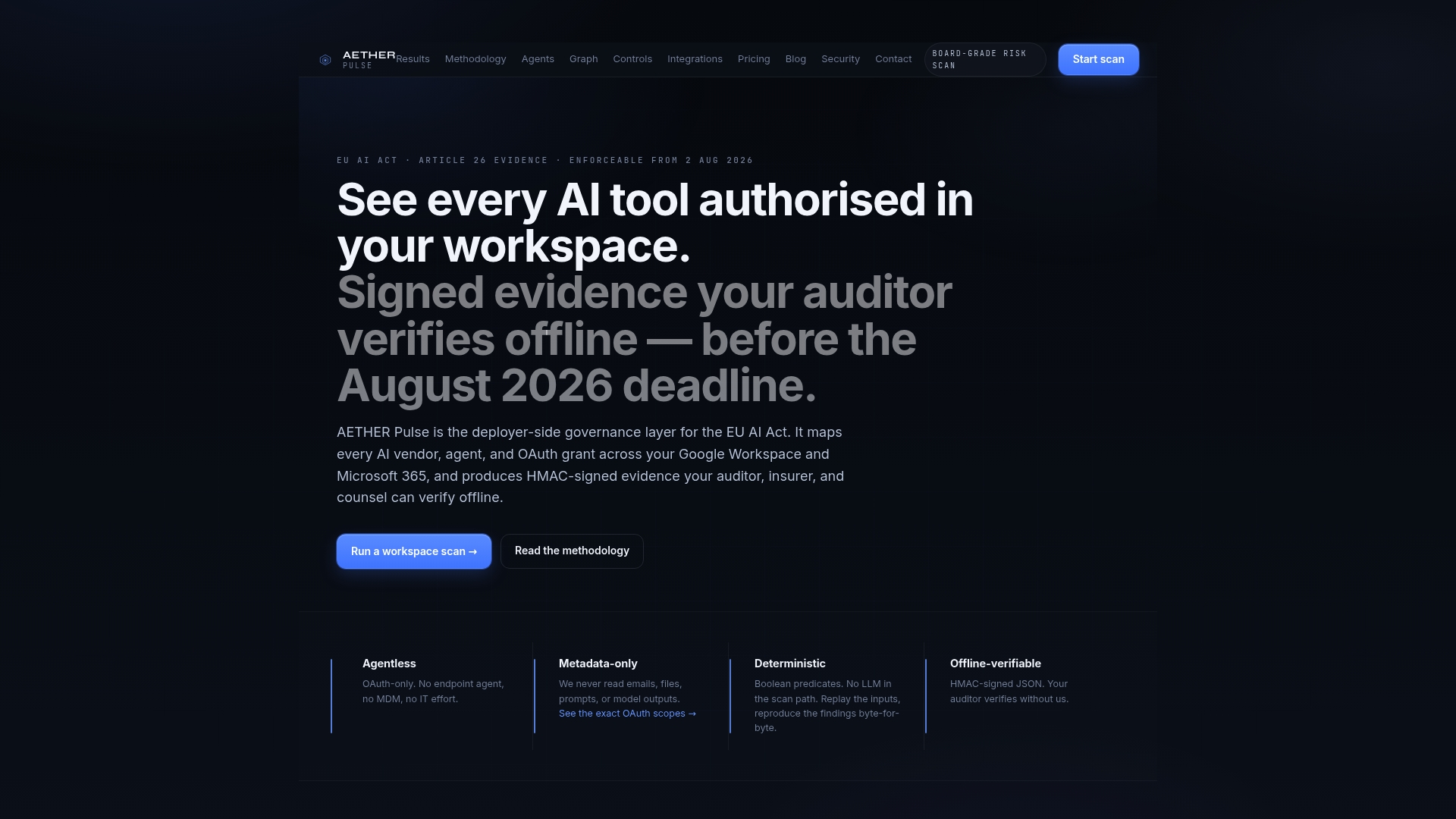
Aetherpulse connects via OAuth metadata only, builds a live inventory and identity graph of your AI agents, surfaces blast-radius risk concentration, and generates deterministic, HMAC-SHA256-signed evidence packs mapped to Article 26, SR 11-7, and DORA artefact requirements. No agent installation. No production data access. No secondary GDPR obligation.
A pilot delivers three outputs: a complete AI-agent inventory, a sample signed evidence pack for one high-risk system, and a mapping document showing exactly which artefacts satisfy which regulatory requirements. That is the foundation for a board-ready conformity assessment and Article 26 registration.
Start your pilot at aetherpulse.app and have your first signed evidence pack within weeks of deployment.
Authoritative sources and further reading
These are the primary supervisory sources auditors will reference when reviewing AI Act compliance artefacts for financial firms. Keep this list for regulator briefings and conformity-assessment template sourcing.
- EU AI Act — European Commission — The primary legislative text and implementation timeline. The definitive reference for risk classification, obligations, and enforcement scope.
- EBA: AI Act implications for the EU banking sector — Sector-specific analysis of high-risk use cases, required artefacts, and integration with existing MRM frameworks. The most directly applicable supervisory document for banks and credit institutions.
- IOSCO Supervisory Toolkit for AI in Capital Markets — Governance, recordkeeping, third-party risk, and senior accountability expectations for capital markets firms. Useful for mapping AI Act obligations to existing TPRM controls.
- BIS: Regulating AI in the financial sector — Regulatory philosophy: why oversight and auditability are the focus, not model prohibition. Useful for framing the evidence approach with senior management.
- U.S. Treasury: Artificial Intelligence in Financial Services — Cross-jurisdictional alignment recommendations and data quality standards. Relevant for firms operating across US and EU regulatory perimeters.
- EUROFI: AI Act key measures for financial services — GDPR and data governance interaction with the AI Act. Reference when assessing tooling choices and data-processing obligations.
- U.S. GAO: AI Use and Oversight in Financial Services — Federal regulator AI oversight practices and model risk management guidance gaps. Useful for firms navigating both US and EU supervisory expectations.
Recommended
Working on Article 26 readiness, deployer-side governance evidence, or AI agent risk at a regulated firm? We'd value 15 minutes of your perspective.
Start a conversation