Privacy Preserving AI Agent Audits for Compliance: No Customer Data
Privacy Preserving AI Agent Audits for Compliance: No Customer Data

A privacy-preserving audit is metadata-only oversight of AI agents that yields tamper-evident, auditor-ready evidence packs, so you can show examiners how automated decisions were governed without exposing raw customer data. It rests on the artifacts supervisors now ask about: inventories, decision logs and examiner query packs. Our product, AETHER Pulse, produces them agentlessly.
TL;DR:
- An audit inventory should name each agent, owner, connected systems, and risk class; decision logs must link timestamped decisions to executed actions through rationale codes.
- Signed, hash chained evidence packs and frozen incident bundles support offline integrity checks, while examiner queries return pass or fail results with source references.
- Examiners can begin with pass or fail results that disclose no identities, move to pseudonymous details, and access names only when lower tiers cannot answer.
- Assign each agent a Responsible Principal with documented limits and shutdown authority, and put evidence access and monitoring rights into third party contracts.
- The 180 day playbook moves from scoping and inventory to metadata connections, logging, independent validation, and evidence export; ownership and contract gaps slow early work.
Table of Contents
- What does a privacy-preserving audit cover, and why do regulated firms need one?
- Which technical components make the evidence credible?
- What do examiners receive, and who may see what?
- How should governance, roles and third-party risk be documented?
- What does a 30/90/180-day privacy-preserving audit playbook look like?
- What belongs on an audit-readiness checklist?
- How do these artifacts fit existing model risk management and audit cycles?
- Why agentless, metadata-only oversight holds up under scrutiny
- How AETHER Pulse delivers metadata-only, tamper-evident evidence packs
- FAQ
- Sources
What does a privacy-preserving audit cover, and why do regulated firms need one?
The scope is narrow on purpose. This audit examines AI agents operating inside your firm using metadata only: who or what the agent is, what it was authorized to do, what it decided, and what it executed. It does not cover privacy-enhancing machine-learning techniques or audits of cloud data stores.
The driver is supervisory expectation. Model governance policies call for model inventories, classification by materiality, independent annual validation and documented approval cycles. Agentic systems strain those practices, because the full decision-to-execution chain has to be reconstructable.
The payoff is practical. Evidence built from metadata is easier to defend, because it never carries customer records that could leak. Deployment is faster and less invasive, since nothing is installed on production systems.
Which technical components make the evidence credible?
Several artifacts carry the weight. Reviewers should expect to see them.
Agent identity graph and inventory. A living register of every agent, its owner, its connections to other systems and its classification by risk. Without it, nothing downstream can be scoped.
Agent decision-to-execution log (ADEL). A supervisory-safe agentic execution proposal defines an ADEL event taxonomy covering the chain from decision to action. Each event needs a timestamp, agent and principal identifiers, and a rationale code, so that a reviewer can link a decision to its execution.
Immutable storage and signing. Hash-chained segments, optionally rolled up into Merkle trees, make tampering detectable. We sign every evidence pack with a cryptographic method, so an auditor can verify integrity offline. Our deterministic controls guide explains why reproducible output matters.

Preservation bundles. When an incident occurs, a frozen, signed bundle captures the relevant log segments and inventory state so the event can be reconstructed later.
What do examiners receive, and who may see what?
Examiners need answers, not raw data dumps. The same proposal describes an Examiner Query Pack (AQP): a defined set of queries run against the evidence, returning pass/fail results with the underlying references. A reviewer sees, for example, whether every agent in scope had a documented owner and mandate, and can drill into the supporting log entries.
Access is tiered. In the proposal's model, Tier 0 is the pass/fail layer with no identity disclosure. Tier 1 adds pseudonymous detail for follow-up. Tier 2 permits identity-level access, reserved for cases where a lower tier cannot resolve the question.
Several controls keep the model honest:
- Post-access review: every escalation is itself reviewed and recorded.
- TTL discipline: access grants expire automatically.
- Purpose limitation: each grant is tied to a stated supervisory question.
For deeper treatment of the logging side, see our piece on audit evidence without customer data.
How should governance, roles and third-party risk be documented?
Examiners look for a named person. The Responsible Principal owns each agent's mandate envelope: its permitted scope, its limits and the authority to switch it off. Document the mandate envelope's scope and limits, and record who holds kill authority.
Change control matters just as much. Model changes need approval trails, and independent validation should run on a fixed cadence with written results.
Third-party AI adds another layer. The OCC told Congress that banks should perform due diligence, manage contracts and monitor providers on an ongoing basis. Its proposed third-party guidance adds proportionate oversight, reporting to senior management and the board, and periodic independent reviews. In practice, your contracts should grant evidence access and monitoring rights explicitly. Our 30/90/180-day plan for third-party AI covers this in more detail.
What does a 30/90/180-day privacy-preserving audit playbook look like?
Timelines vary with the number of agents and teams involved, but this sequence keeps the work predictable.
- Days 0–30: scope and inventory. Define which agents and business lines are in scope, map stakeholders, and check vendor contracts for evidence and monitoring rights.
- Days 30–60: connect metadata sources. Ingest metadata, build the agent identity graph and classify each agent by risk.
- Days 60–90: enable ADEL. Turn on baseline decision-to-execution logging with the agreed taxonomy and retention periods, then run the first AQP and record the gaps.
- Days 90–135: remediate and validate. Close documentation gaps, assign Responsible Principals, and have an independent reviewer validate the evidence.
- Preserve. Generate signed preservation bundles for critical events and rehearse reconstruction.
- Days 165–180: brief and export. Brief your auditors and export the formal evidence pack.
Expect compliance, risk, internal audit, IT administration and legal to be involved. The heaviest effort usually falls in the first two phases, where ownership and contract gaps surface.
What belongs on an audit-readiness checklist?
Use this list to test whether you could hand evidence to an examiner tomorrow:
- Every agent appears in the inventory with an owner, a classification and a documented mandate.
- ADEL logging runs with the required taxonomy and retention settings.
- Evidence packs can be exported and cryptographically signed.
- AQP pass/fail outputs exist, along with records of every post-access review.
- Vendor contracts include evidence-access and monitoring clauses.
- Kill authority is assigned and tested.
Pro Tip: Run the AQP regularly before any examiner asks. A failed check you found yourself is a remediation item; one an examiner finds is a finding.
How do these artifacts fit existing model risk management and audit cycles?
The program should feed processes you already run. The agent inventory becomes an input to your model registry, so agents receive the same materiality rating as other models. ADEL records give model risk reviewers the behavioral evidence they need for periodic checks, and the same artifacts support the annual independent validation.
Reporting is where the program becomes routine. Evidence pack summaries can go to senior management and the board on the schedule your third-party framework sets. Over time, the audit stops being a project and becomes a standing control. Our guide to proving data minimization without raw data shows how the same evidence supports privacy reviews. For a complementary view on auditing conversational agents, Lexic is worth reading.
Why agentless, metadata-only oversight holds up under scrutiny
The strongest argument for this approach is what it removes. With nothing installed in production and no customer records collected, there is less to secure, less to explain and less to go wrong during an audit. Speed follows from the same design.
Determinism matters more than most teams expect. When an examiner can re-run a check and get the same answer, traced to a cited source, the conversation shifts from trust to verification. Evidence that cannot be reproduced invites doubt.
The conventional wisdom says deeper access means better assurance. In practice, the opposite is often true: the more data an audit touches, the more it needs to defend.
— Eleye
How AETHER Pulse delivers metadata-only, tamper-evident evidence packs
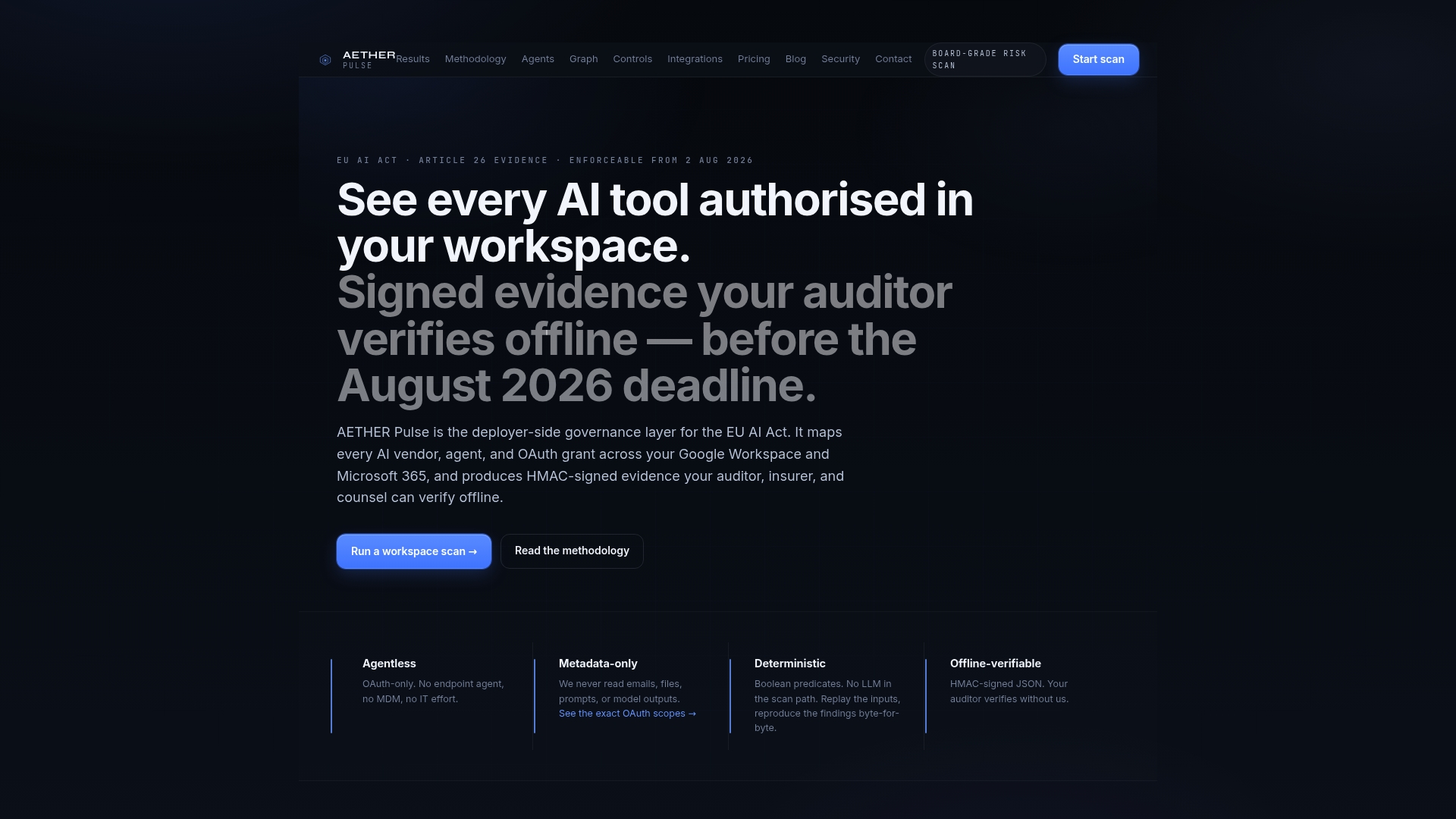
We built AETHER Pulse as an agentless governance layer for regulated financial services firms. It connects through metadata only, with no endpoint agents and no access to production data. It builds an inventory and identity graph of your AI agents, maps risk concentration, and generates cryptographically signed evidence packs that auditors can verify offline. Every classification is deterministic and cited to public sources.
Ready to see it with your own agents? Review plans and request a readiness audit on our pricing page.
This article is general information, not a substitute for advice from a qualified financial advisor. Consult a qualified financial professional about your own circumstances before acting on anything here.
FAQ
What is a privacy-preserving audit of AI agents?
It is an oversight review that relies on metadata, such as agent identities, mandates and decision logs, instead of customer data. It produces signed evidence packs auditors can verify independently. This lets you demonstrate governance without widening your data exposure.
Which evidence do examiners need from AI-agent oversight?
Supervisory proposals point to an agent inventory, decision-to-execution logs, examiner query packs with pass/fail outputs, and preservation bundles for critical events. Each should be tamper-evident and traceable to a named responsible principal.
How do you audit third-party AI vendors without seeing their data?
Write evidence-access and monitoring rights into the contract, then review metadata and signed evidence instead of raw records. The OCC's proposed guidance calls for proportionate oversight and periodic independent reviews of third-party relationships.
How long does it take to prepare?
Our playbook assumes a 180-day sequence, from scoping through the formal evidence export. Firms with clean inventories and clear contracts tend to move faster, while ownership gaps lengthen the early phases.
Recommended
Working on Article 26 readiness, deployer-side governance evidence, or AI agent risk at a regulated firm? We'd value 15 minutes of your perspective.
Start a conversation