Closing the Regulatory Compliance Gap: AI Agents in 2026
Closing the Regulatory Compliance Gap: AI Agents in 2026

The regulatory compliance gap created by AI agents is not a future risk. It is active, widening, and already attracting regulatory scrutiny in US financial services. Autonomous AI agents now execute decisions, delegate tasks to other agents, and access sensitive systems, often without compliance teams knowing they exist. The core problem is visibility: you cannot govern what you cannot see.
Every AI agent action in a regulated firm must answer four questions:
- What did the agent do, and on which data or system?
- Why did it take that action, and under which policy?
- Under whose authority was it operating?
- What evidence exists to demonstrate this to a regulator?
Frameworks including the NIST AI Risk Management Framework (AI RMF) and EU AI Act Article 26 now formalize these expectations. Firms that cannot answer all four questions face a defensibility gap, regardless of how well their human compliance programs perform.
Table of Contents
- How shadow AI widens the compliance gap for regulated firms
- How the compliance officer role is shifting under agentic AI
- Why AI visibility and auditability are now compliance requirements
- Why baseline data is critical before and after AI adoption
- How Aetherpulse closes the AI governance gap without touching your data
- What non-compliance with AI regulations actually costs
- What US regulations currently apply to AI agents
- Common compliance gaps AI agents create in US regulated firms
- Best practices for building an AI governance framework
- How to mitigate bias and fairness risks in AI agents
- Key Takeaways
- Aetherpulse gives compliance officers AI visibility without the operational risk
How shadow AI widens the compliance gap for regulated firms
Shadow AI refers to AI agents or automated workflows deployed without the awareness of security and compliance functions. The problem is structural. AI agents scale faster than governance controls, and business units frequently deploy agents before IT or legal teams establish appropriate access management, data protection, or accountability controls. According to Microsoft's Cyber Pulse report, 29% of employees have already turned to unsanctioned AI agents for work tasks.
The compliance consequences are direct:
- Auditability collapses. Agents operating outside sanctioned channels leave no traceable decision log.
- Accountability gaps emerge. When an agent inherits permissions and acts autonomously, ownership of that action becomes ambiguous.
- Regulatory defensibility disappears. Without a documented authority chain, firms cannot reconstruct what happened or why.
Unmanaged shadow AI proliferates when compliance teams underestimate the need for structured AI use cases and strategic alignment before deployment. In regulated sectors, that proliferation is not just an operational risk. It is a direct path to enforcement.
How the compliance officer role is shifting under agentic AI
The compliance officer's function is changing in a specific, measurable way. Rather than manually interpreting regulatory requirements, compliance professionals are becoming adjudicators: reviewing AI agent recommendations, managing edge cases the agent cannot resolve, and overseeing automated workflows for policy adherence.
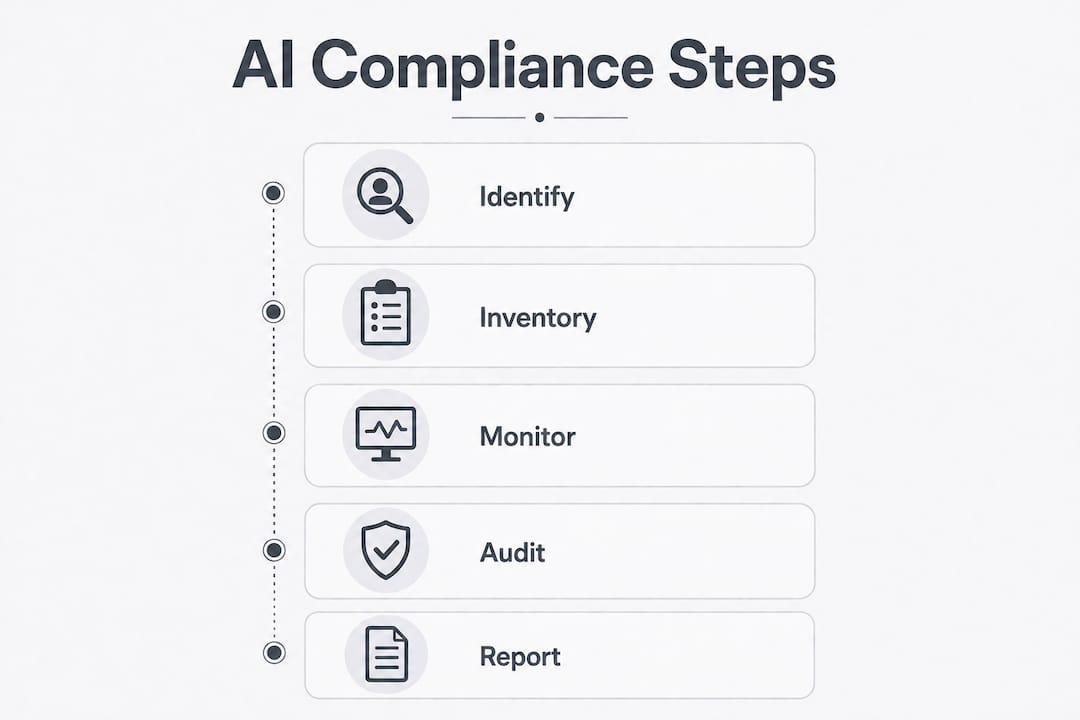
SAI360 frames this precisely: the speed advantage of AI agents must be balanced by the capability to produce defensible audit trails answering what was done, why, under whose authority, and with what evidence. Speed without that capability is a governance liability.
The practical skill shift involves:
- Moving from process execution to escalation triage and exception handling
- Developing fluency in AI agent architecture to assess risk concentration
- Owning continuous monitoring responsibilities, not just periodic reviews
- Coordinating across legal, data science, and IT to prevent fragmented governance
Centralizing AI compliance ownership in a dedicated function, whether a named AI Compliance Officer or a cross-functional governance committee, reduces the fragmentation that shadow AI exploits.
Why AI visibility and auditability are now compliance requirements
Wolters Kluwer's governance research is direct: AI visibility is not a technical nicety. Firms must link every AI decision back to clear data lineage and policy frameworks to mount an audit defense. Automation without governance undermines compliance credibility entirely.
Achieving that visibility requires four concrete capabilities:
- Full agent inventory. A centralized registry of all agents, sanctioned and shadow, is the prerequisite for any governance program.
- Real-time, tamper-evident logging. Every agent-to-agent delegation must be logged with authority scope at the moment it occurs. Reconstructing decision logic post-hoc is often impossible.
- Cryptographically signed audit trails. HMAC-SHA256 signing of evidence packs ensures regulators and auditors receive records that cannot be altered retroactively.
- Behavioral drift detection. AI governance is a behavioral challenge. Continuous simulation and stress testing against known edge cases catches drift before it becomes a regulatory event.
Applicable frameworks include the NIST AI RMF, ISO/IEC 42001, and EU AI Act Article 26. For US financial services firms, the SEC's evolving guidance on automated decision-making and FINRA's supervisory obligations for algorithmic systems add further specificity.
Pro Tip: Deploy a tiered observability architecture: deep tracing on high-risk, customer-facing workflows and baseline monitoring elsewhere. This manages latency while preserving compliance visibility where it matters most.

Why baseline data is critical before and after AI adoption
Firms that deploy AI agents without first documenting baseline human-time usage and workflow outcomes cannot prove AI's compliance benefits, and they cannot identify new regulatory vulnerabilities the agents may have introduced. That documentation gap is a direct audit liability.
Establishing a defensible baseline means:
- Mapping current workflows before any agent touches them, including decision frequency, error rates, and escalation volumes
- Recording time-on-task data at the human level so post-deployment comparisons are meaningful
- Linking AI decisions to specific policies and regulatory obligations from day one, creating data lineage that survives personnel changes
Continuous monitoring after deployment catches behavioral drift, the gradual divergence of an agent's outputs from its assessed operating envelope. For ESG compliance obligations and other evolving regulatory requirements, that drift can shift a compliant workflow into a non-compliant one without any deliberate change.
How Aetherpulse closes the AI governance gap without touching your data
| Capability | Traditional Governance Tooling | Aetherpulse |
|---|---|---|
| Deployment model | Agent-based, invasive | Metadata-only, read-only |
| Data access | Often requires production access | OAuth metadata only, no customer data |
| Audit evidence | Manual logs, variable integrity | Cryptographically signed (HMAC-SHA256) evidence packs |
| Agent inventory | Partial, manually maintained | Automated identity graph, including shadow agents |
| Risk surfacing | Periodic review | Real-time financial blast-radius exposure |
| Regulatory alignment | Framework-dependent | EU AI Act Art. 26, FCA Consumer Duty, SYSC, Data (Use and Access) Act |
Aetherpulse connects via OAuth metadata only, building a live inventory and identity graph of every AI agent operating across a firm's environment. It surfaces risk concentration, including financial blast-radius exposure, without inserting itself into production systems or accessing sensitive data. Evidence packs are deterministic and provenance-tracked, generated on demand for auditors, regulators, or internal risk functions.
The positioning is deliberate: Aetherpulse is the agentless governance equivalent of what Wiz established in cloud security. Fast to deploy, low friction, and architecturally non-invasive.
What non-compliance with AI regulations actually costs
Under the EU AI Act, penalties for non-compliance can be substantial, reaching high monetary fines based on a percentage of global annual revenue or fixed amounts. For US firms with EU operations or EU-facing AI systems, that exposure is direct. For firms operating purely domestically, the trajectory of US enforcement is moving in the same direction.
Beyond fines, the financial consequences include:
- Remediation costs for retroactive audit trail reconstruction, which is expensive and often incomplete
- Reputational damage that affects client retention in trust-sensitive regulated sectors
- Supervisory escalation that triggers enhanced oversight regimes, increasing ongoing compliance costs
The regulatory framework for AI agents was not designed with autonomous, adaptive systems in mind. That gap between regulatory intent and agentic reality is precisely where enforcement risk concentrates.
What US regulations currently apply to AI agents
No single federal AI agent statute exists in the US as of 2026. Regulated firms instead navigate a layered framework:
- SEC guidance on automated investment advice and algorithmic trading supervisory obligations
- FINRA rules requiring firms to supervise algorithmic systems as they would human representatives
- OCC and FDIC model risk management guidance (SR 11-7 and its successors) applied to AI-driven decision models
- CFPB adverse action requirements under ECOA and FCRA, which apply when AI agents influence credit decisions
- State-level AI laws, including Colorado's AI Act for insurance and Illinois' AIAA for employment contexts
The NIST AI RMF provides the most widely adopted voluntary governance structure, and several federal agencies are treating alignment with it as a de facto supervisory expectation.
Common compliance gaps AI agents create in US regulated firms
The most frequent gaps compliance officers encounter:
- Undocumented agent inventory. Agents deployed by business units without registration in any governance system.
- Missing authority chains. No record of which agent delegated a task to which downstream agent, or under what scope.
- Unexplained adverse outputs. AI-influenced decisions affecting consumers with no explainability record to satisfy CFPB adverse action requirements.
- Stale risk assessments. Initial model risk assessments that do not account for behavioral drift post-deployment.
- Cross-border data flow gaps. Agents processing EU-resident data without triggering GDPR or EU AI Act compliance reviews.
Best practices for building an AI governance framework
Effective AI governance in a regulated firm requires structure, not just policy. The foundational steps:
- Build a complete agent registry before deploying any governance controls. You cannot govern agents you have not cataloged.
- Assign ownership to every agent, including third-party and embedded agents from vendors.
- Embed policy checks into agent workflows at design time, not as a post-deployment audit layer.
- Implement pre-action instrumentation so every agent action is logged with authority scope before execution, not reconstructed afterward.
- Conduct regular red-team exercises against agent workflows to identify privilege escalation and prompt injection risks.
- Align with NIST AI RMF governance and map controls to the Govern, Map, Measure, and Manage functions.
For ESG disclosure analysis and other data-intensive compliance workflows, linking AI outputs to auditable data lineage is the minimum viable posture.
How to mitigate bias and fairness risks in AI agents
Bias in AI agents is a compliance risk, not just an ethical concern. Under ECOA, FCRA, and fair lending regulations, discriminatory outputs from AI-driven decisions carry direct legal exposure.
Mitigation requires:
- Pre-deployment bias audits using disaggregated outcome testing across protected class proxies
- Ongoing disparate impact monitoring with statistical thresholds that trigger human review
- Explainability requirements embedded in agent design so adverse decisions can be documented and defended
- Third-party model audits for high-risk consumer-facing agents, particularly in credit, insurance, and employment contexts
- Feedback loops that route flagged decisions back to compliance for root-cause analysis, not just remediation
Bias is also a drift problem. An agent that passes a pre-deployment fairness audit can develop disparate impact over time as its operating environment shifts. Continuous monitoring is the only reliable control.
Key Takeaways
The most critical step for any regulated firm is establishing a complete, real-time AI agent inventory before attempting any other governance control.
| Point | Details |
|---|---|
| Shadow AI is the primary gap | Over 80% of Fortune 500 companies deploy agents without compliance awareness, eliminating auditability and regulatory defensibility. |
| Baseline data is non-negotiable | Document human-time workflows before AI deployment to prove compliance benefits and detect new vulnerabilities. |
| EU AI Act penalties are material | Non-compliance penalties reach up to €35 million or 7% of global annual revenue for firms with EU exposure. |
| Governance requires pre-action logging | Reconstructing agent decision logic after the fact is often impossible; real-time authority-chain logging is the only defensible approach. |
| Aetherpulse provides agentless oversight | Metadata-only, cryptographically signed evidence packs give regulated firms audit-ready AI governance without production system access. |
Aetherpulse gives compliance officers AI visibility without the operational risk
Regulated firms need AI agent governance that does not introduce new risks in the process of managing existing ones. Aetherpulse delivers exactly that: a read-only, metadata-only governance layer that builds a live agent inventory, surfaces financial blast-radius exposure, and generates tamper-evident evidence packs on demand, without touching customer data or inserting itself into production systems.
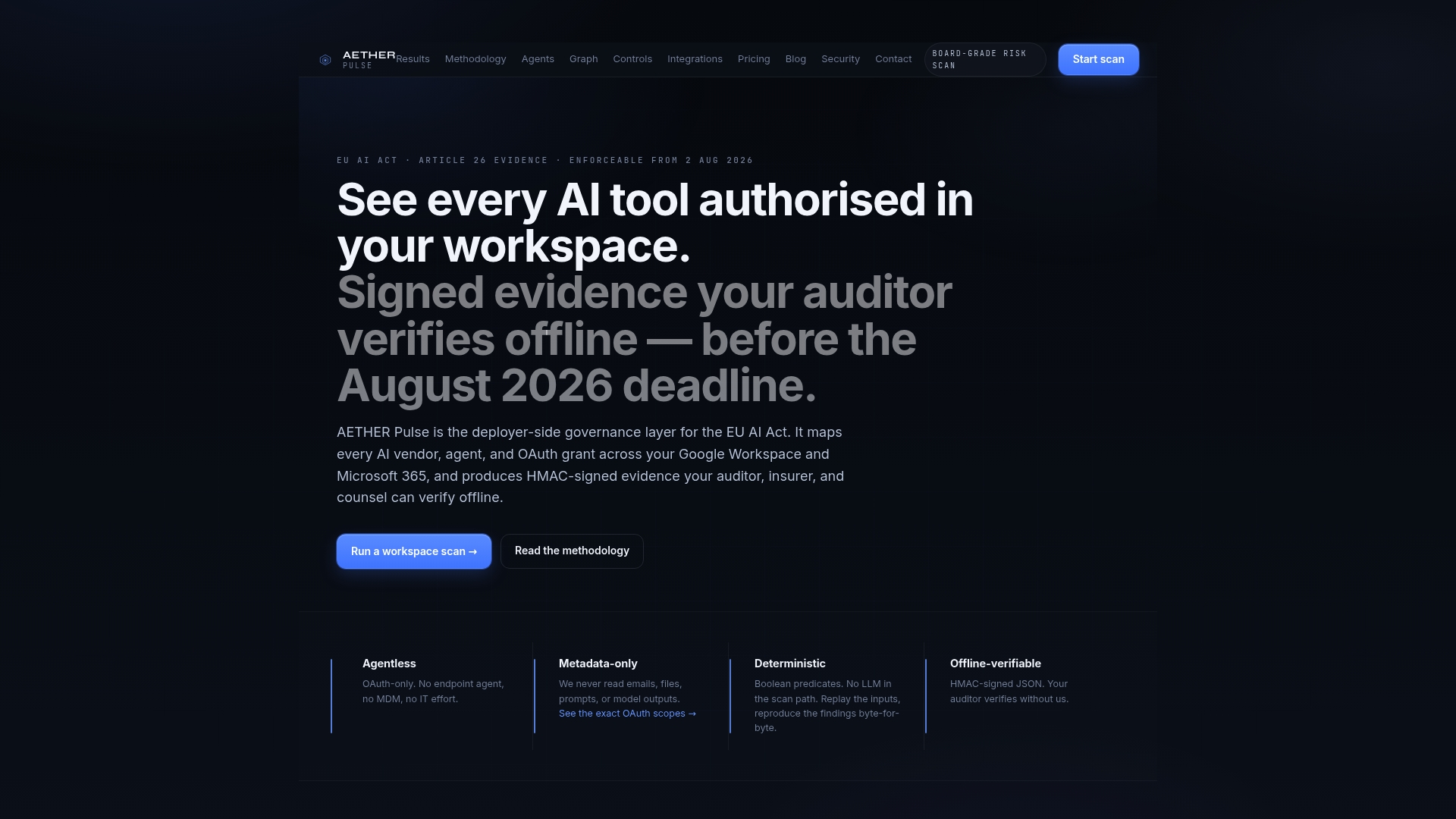
For compliance officers who need to demonstrate AI oversight to regulators, auditors, or board-level risk committees, Aetherpulse provides the audit-ready evidence layer that most governance tooling cannot produce. The platform aligns with EU AI Act Article 26, FCA Consumer Duty, and SYSC requirements, and it deploys without the friction of agent-based alternatives.
Visit aetherpulse.app to see how the platform maps your firm's agentic constellation and generates defensible compliance evidence from day one.
Recommended
Working on Article 26 readiness, deployer-side governance evidence, or AI agent risk at a regulated firm? We'd value 15 minutes of your perspective.
Start a conversation