Deterministic AI Evidence: The U.S. Compliance Playbook
Deterministic AI Evidence: The U.S. Compliance Playbook

Deterministic AI evidence is a reproducible, tamper-evident, provenance-tracked audit package containing every input, model state parameter, tool call, and cryptographic attestation needed for an examiner to replay an AI agent decision and verify it independently. For U.S. financial services firms, this is the operational standard SEC, FINRA, and NYDFS examiners are moving toward: not theoretical model documentation, but operation-level evidence tied to a specific decision at a specific moment.
A complete evidence pack requires:
- Input snapshots with SHA-256 hashes and millisecond-resolution timestamps
- Model pin and weights identifier (exact model ID returned by the provider, not just the requested version)
- Hyperparameters and random seeds captured at inference time
- Canonicalized prompt bundle with retrieval hashes for any retrieved context
- Tool call sequence and responses in execution order
- Deterministic post-processing artifacts (pure-function outputs, schema-validated final payload)
- HMAC-SHA-256 tamper-evident signature over the full pack
- Chain-of-custody metadata (agent identity, operator, approval record reference)
The compliance purpose is audit replayability: given the same inputs and model state, an examiner can reconstruct the decision and confirm the evidence pack has not been altered.
Table of Contents
- Why regulators ask for this and what examiners actually request
- Architecture and runtime controls that make replay possible
- How to measure determinism and faithfulness for agentic systems
- Exactly what to hand an examiner and how to verify it
- What determinism solves and where the limits are
- 90/180/365-day roadmap to exam-ready deterministic evidence
- Key Takeaways
- The governance gap most firms are still ignoring
- Aetherpulse produces exam-ready evidence packs without touching your data
- Useful sources and further reading
Why regulators ask for this and what examiners actually request
FINRA and SEC examiners are shifting from reviewing model documentation to demanding operation-level, agent-attributed evidence. Firms that cannot produce it receive findings and remediation orders.
| Evidence element | Regulatory anchor | Examiner request |
|---|---|---|
| Model pin and version log | SR 11-7 (model risk management) | "Show me the exact model version used for this flagged decision." |
| Tamper-evident interaction logs | SEC Rule 17a-4 / FINRA Rule 4511 | "Provide the unaltered log for this trade recommendation, with hash verification." |
| Input snapshots and retrieval hashes | SR 11-7 validation requirements | "What data did the model see? Can you reproduce the retrieval?" |
| Hyperparameters and seeds | OCC model risk guidance | "What sampling configuration produced this output?" |
| Chain-of-custody metadata | GLBA / NYDFS Part 500 access controls | "Who authorized this agent action and when?" |
| Retention and accessibility | SEC Rule 17a-4 (two-year immediate access) | "Produce all AI decision logs for the review period promptly." |
A single data-layer governance architecture with authenticated access, attribute-based access control (ABAC), encryption, and tamper-evident logs satisfies SR 11-7, NYDFS Part 500, and GLBA simultaneously. Retention defaults under SEC Rule 17a-4 require the two most recent years to be immediately accessible; FINRA Rule 4511 extends the general retention window to six years for most records.
For a deeper look at the distinction between governance evidence and auditable trails, see AI governance evidence vs. audit trail.
Architecture and runtime controls that make replay possible
The four minimum replayability conditions are model version pinning, exact sampling parameters, canonicalized tool definitions and execution order, and retrieval determinism through index hashing and snapshotting. Missing any one of them breaks replay.
Practical engineering controls:
- Append-only logs with hash chains: each log entry includes the hash of the previous entry, producing a cryptographic hash chain acceptable under SEC Rule 17a-4 and FINRA Rule 4511
For chain-of-custody implementation detail, see AI audit evidence chain of custody.
Pro Tip: Model providers frequently update routing behavior. Configure your logging layer to record the exact model ID returned in the API response header, and set an alert if it diverges from the pinned ID. A silent model substitution discovered during an exam is a material finding.

How to measure determinism and faithfulness for agentic systems
The Determinism-Faithfulness Assurance Harness (DFAH) formalizes two distinct metrics that compliance teams must track separately.
Trajectory determinism measures whether the agent follows the same sequence of tool calls and intermediate steps across repeated runs with identical inputs. Decision determinism measures whether the agent reaches the same final conclusion. For audit purposes, decision determinism is the primary requirement; trajectory determinism is the stricter criterion and the harder one to achieve with frontier models.
pass@k / passk metrics measure the proportion of runs (out of k repeated executions) that produce an identical output. A target of determinism ≥ 90% means at least 9 of 10 runs on identical inputs must produce the same decision.
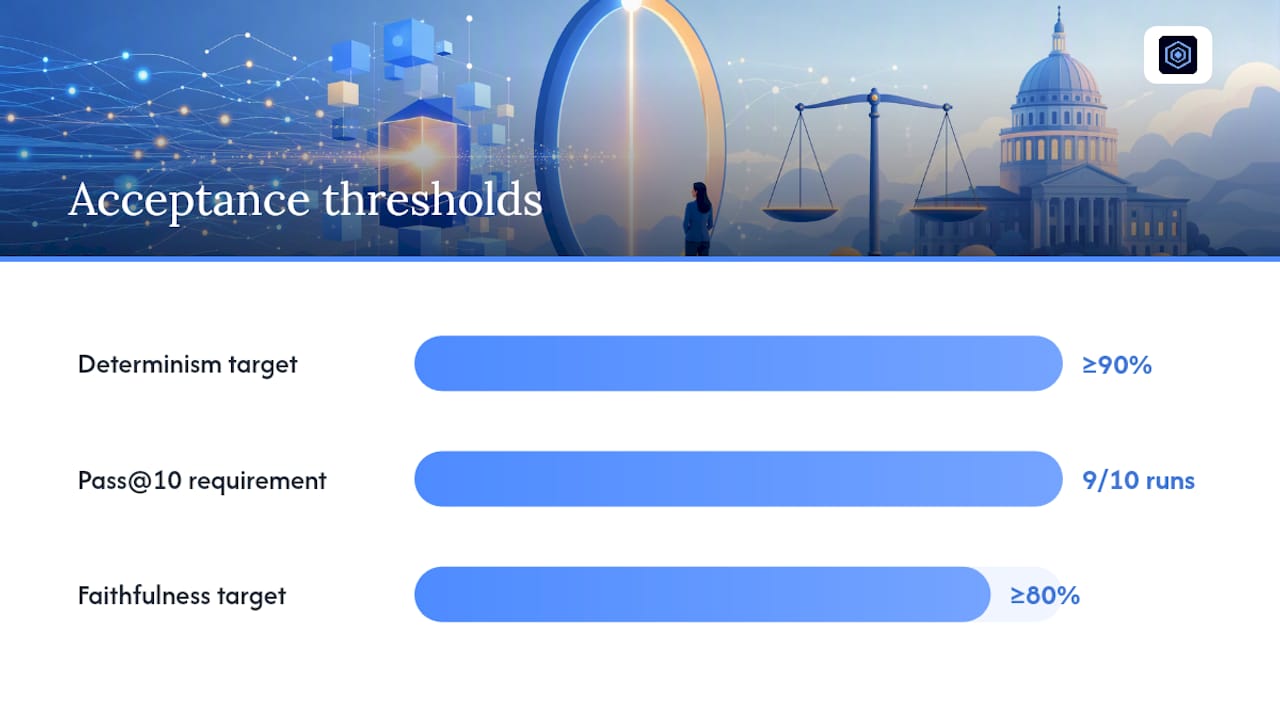
Evidence-conditioned faithfulness measures whether the agent's stated reasoning is grounded in the retrieved evidence rather than hallucinated. DFAH benchmarks across three financial test sets show a positive correlation between determinism and faithfulness, and Tier 1 schema-first model architectures consistently reach the ≥ 90% determinism threshold.
A reusable test plan:
- Select 20–30 representative cases from production (AML alerts, trade flags, credit decisions)
- Run each case k = 10 times with identical inputs, model pin, and seeds
- Score trajectory determinism: identical tool-call sequences across all 10 runs
- Score decision determinism: identical final output across all 10 runs
- Apply human graders to calibrate faithfulness; do not use model-based graders, which introduce recursive non-determinism
- Acceptance thresholds: determinism ≥ 90%, faithfulness ≥ 80%
- Stress-test with adversarial input variants to confirm thresholds hold under distribution shift
- Document pass/fail results and attach to the evidence pack for examiner review
For determinism checks, use code-based graders exclusively. They introduce no variance and produce a binary pass/fail the examiner can verify independently.
Exactly what to hand an examiner and how to verify it
Building exportable evidence packs reduces examiner response time from weeks to hours. The package for a single decision or a review period should contain:
- Signed evidence pack manifest (JSON, human-readable export)
- WORM-stored input snapshots with SHA-256 hashes
- Hash-chained interaction logs with millisecond timestamps
- AIBOM for all agents in scope
- Change control logs and approval records for the review period
- Deterministic replay logs (model pin, seeds, tool call trace)
- DFAH test results and acceptance threshold documentation
Verification steps the examiner will follow:
- Verify the HMAC-SHA-256 signature on the evidence pack manifest
- Recompute SHA-256 hashes on input snapshots and compare to manifest values
- Confirm the model ID in the log matches the pinned version in the AIBOM
- Replay the decision using the logged seed, hyperparameters, and tool call sequence
- Validate the chain-of-custody signatures against the approval records
- Confirm log timestamps fall within the claimed retention window
Present evidence in both machine-readable (JSON, NDJSON) and human-readable (PDF export) formats. Examiners without technical staff will rely on the human-readable version; their technical reviewers will verify the hashes independently.
What determinism solves and where the limits are
| Dimension | Benefit | Residual risk |
|---|---|---|
| Audit replayability | Examiner can reconstruct any decision | Does not guarantee the decision was correct or fair |
| Tamper evidence | Cryptographic proof of log integrity | Does not prevent a model from producing a biased output |
| Operational cost | Predictable, reproducible behavior | Schema-first architectures constrain model capability |
| Provider constraints | Model pinning prevents silent substitution | Some providers limit seed availability or model pinning |
| Frontier model tradeoffs | High capability | Lower determinism; unsuitable for audit-critical paths without HITL |
The regulatory failure mode is not a wrong answer. It is a replay failure or fabricated evidence: an examiner who cannot reproduce the logged decision from the logged inputs will treat the evidence as unreliable, regardless of whether the original decision was sound.
Pro Tip: Reserve frontier, non-deterministic models for advisory workflows with human-in-the-loop review. For audit-critical paths (AML, credit, trade surveillance), use Tier 1 schema-first configurations that consistently meet the ≥ 90% determinism threshold the DFAH benchmarks establish.
90/180/365-day roadmap to exam-ready deterministic evidence
| Phase | Milestone | Owner | Effort |
|---|---|---|---|
| 0–90 days | Agent inventory (AIBOM), gap assessment, evidence pack schema design | Compliance + Engineering | Medium |
| 0–90 days | Model pinning and seed capture in production for audit-critical agents | Engineering | Medium |
| 90–180 days | Pilot evidence pack exports; DFAH test run on 20–30 cases; WSPs drafted | Model Risk + Compliance | High |
| 90–180 days | Hash-chain logging and WORM storage configured; SIEM forwarding active | Security + Engineering | High |
| 180–365 days | Full retention matrix implemented; examiner dry-run completed | Compliance + Legal | Medium |
| 180–365 days | DFAH thresholds (≥ 90% determinism, ≥ 80% faithfulness) met and documented | Model Risk | Medium |
Budget considerations: engineering effort dominates the first 90 days (model pinning, logging infrastructure, WORM storage). Compliance and legal effort peaks at 90–180 days (WSPs, retention matrix, AIBOM tooling). For teams building deterministic control planes and test harnesses, Jundago's API platform supports the API-layer instrumentation that evidence capture requires. An AI compliance gap assessment is the recommended starting point before committing to a build sequence.
Key Takeaways
Deterministic AI evidence requires cryptographically signed, replay-ready evidence packs tied to specific agent decisions — without them, U.S. financial examiners will treat your AI governance posture as unverifiable.
| Point | Details |
|---|---|
| Core definition | Tamper-evident, provenance-tracked audit packages that enable exact replay of any AI agent decision. |
| Mandatory elements | Input hashes, model pin, hyperparameters, seeds, tool call trace, HMAC-SHA-256 signature, and chain-of-custody metadata. |
| Regulatory anchors | SR 11-7, SEC Rule 17a-4, FINRA Rule 4511, and GLBA all require operation-level evidence. |
| Minimum thresholds | Target determinism ≥ 90% and faithfulness ≥ 80% per DFAH benchmarks; use code-based graders for determinism checks. |
| Aetherpulse next step | Aetherpulse generates HMAC-SHA-256 signed evidence packs via read-only metadata ingestion — no customer data touched, exam-ready exports on demand. |
The governance gap most firms are still ignoring
The conversation in most compliance teams still centers on model documentation: validation reports, bias assessments, and model risk frameworks inherited from the SR 11-7 era. Those matter. But the examiner standing in your conference room in 2026 is not asking for a validation report. They are asking you to replay a specific decision from six months ago and prove the log has not been altered.
That is a fundamentally different evidentiary standard, and most firms are not ready for it. The technical controls are achievable. Model pinning, hash-chain logging, and WORM storage are not exotic engineering. What is missing is the governance layer that connects those controls to a producible, signed evidence pack with a clear chain of custody.
The firms that will avoid findings are not the ones with the most sophisticated models. They are the ones that treated evidence packaging as a first-class compliance deliverable before the exam notice arrived.
Aetherpulse produces exam-ready evidence packs without touching your data
Regulated firms building deterministic evidence programs face a practical constraint: most governance tooling requires agent-side instrumentation, which means touching production systems and, often, customer data. Aetherpulse takes a different approach. It connects through metadata only via OAuth, builds an AIBOM of your deployed agents, and generates HMAC-SHA-256 signed evidence packs that satisfy SEC Rule 17a-4, FINRA Rule 4511, and NYDFS Part 500 retention and tamper-evidence requirements.
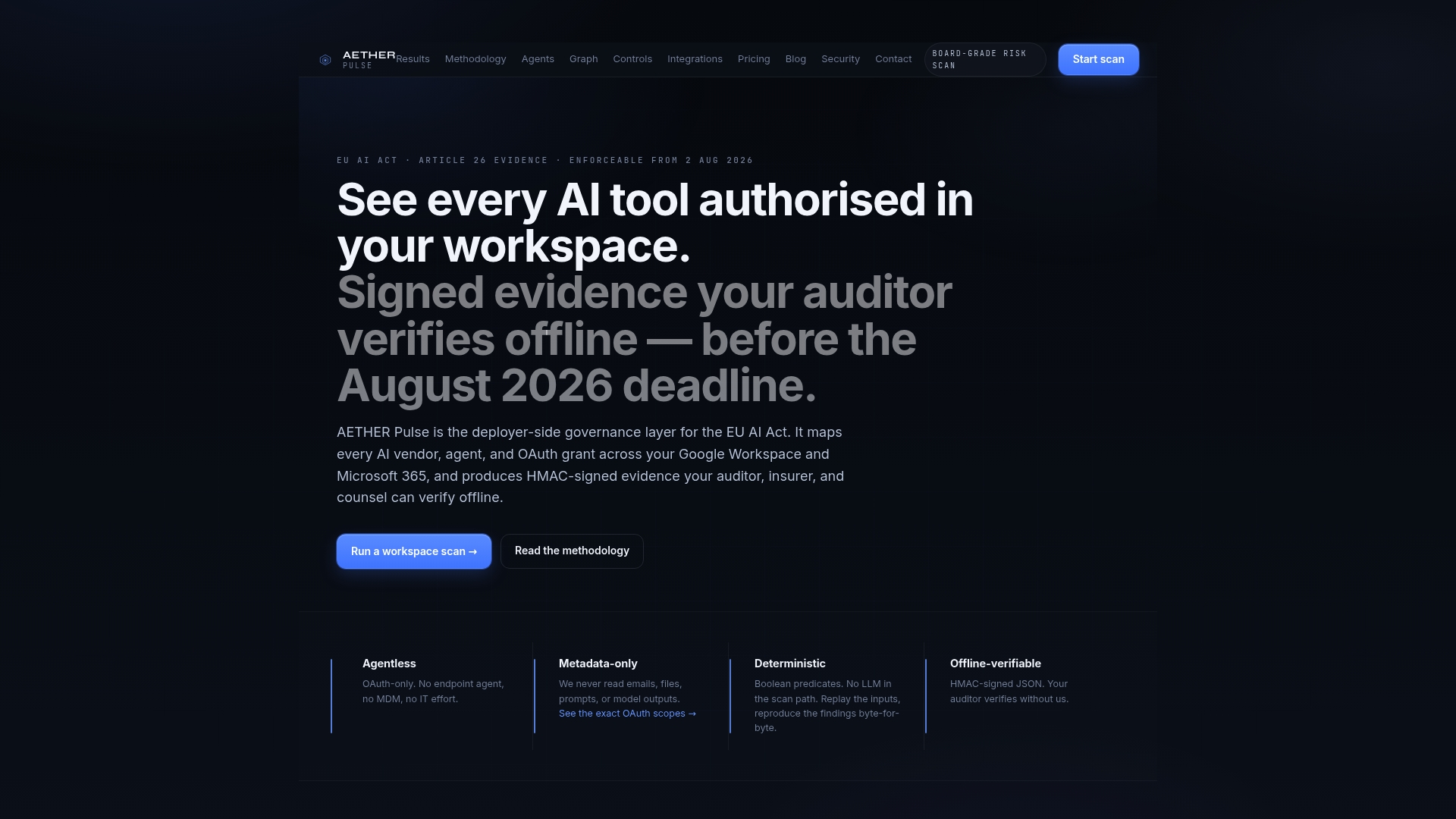
The platform handles SIEM forwarding, compliant retention defaults, and human-readable evidence exports your examiners can verify without a technical reviewer present. No customer data is ingested. No production instrumentation is required. For compliance leaders who need exam-ready evidence packages without a six-month engineering program, request a demo at aetherpulse.app or review the security and cryptographic signing details before your next examiner engagement.
Useful sources and further reading
The following sources support the technical standards, regulatory mappings, and test frameworks referenced throughout this article:
- Determinism for regulatory purposes (audit replayability) — arXiv
- DFAH: Determinism and faithfulness evaluation for agentic systems — arXiv
- AI compliance considerations for financial services — Lexology
- AI compliance for financial services firms — Kiteworks
- Auditable LLM decision‑making for finance — AI Fin Hub
- Compliance audit trails for LLM‑driven trade decisions — AI Fin Hub
- AI agent deployment in financial services: compliance and audit trail requirements — Prediction Guard
- Audit‑ready evidence packs and exam preparation — Kiteworks
Recommended
Working on Article 26 readiness, deployer-side governance evidence, or AI agent risk at a regulated firm? We'd value 15 minutes of your perspective.
Start a conversation