Why Regulators Require AI Transparency in Finance
Why Regulators Require AI Transparency in Finance

AI transparency is the mandated ability to provide clear, meaningful, and auditable explanations of AI system decisions to regulators and affected individuals. In financial services, why regulators require AI transparency comes down to one core principle: accountability. Regulators under the EU AI Act, the FCA's Consumer Duty framework, and US banking guidelines like SR 11-7 all demand that firms demonstrate control over automated decisions, not just describe their models. Without that evidence, a loan denial, a fraud flag, or a credit limit reduction becomes legally and operationally indefensible.
Why regulators require AI transparency: the core rationale
AI transparency, known in technical and regulatory circles as AI explainability, is defined as the capacity of a firm to reconstruct, document, and communicate how an AI system reached a specific decision. Regulators do not require this because they want to publish your model weights. They require it because accountability demands evidence. The regulatory philosophy is audit transparency: granting regulators meaningful insight into algorithms so they can detect harm and enforce responsibility, not disclosing algorithmic details publicly in ways that invite gaming.
The role of AI in regulated industries has shifted from narrow automation to consequential decision-making. Credit scoring, fraud detection, customer triage, and anti-money laundering screening now run on models that affect individual rights and firm-level risk. That shift is why regulators scrutinize AI decisions with the same intensity they apply to human judgment. A decision that affects a customer's financial access must be explainable, challengeable, and traceable. Regulators care about AI decisions precisely because the stakes of getting them wrong are systemic, not just individual.

The OECD endorses explainability as a core design principle for trustworthy AI. That endorsement carries weight because it reflects a global consensus: unverifiable AI decisions create institutional and legal failures, particularly in financial services where decisions affect individuals' rights to credit, insurance, and financial access.
What specific transparency requirements do regulators impose?
Regulatory obligations are concrete, not aspirational. Compliance professionals need to know exactly what they must produce.
- EU AI Act, Article 86: Individuals have the right to clear explanations of AI-based decisions. Buried disclosures in terms and conditions or product manuals do not satisfy this requirement. Explanations must be clear and distinguishable.
- EU AI Act, high-risk classification: Credit scoring and employment decisions qualify as high-risk AI systems. These systems must maintain full audit trails including input data, model version, intermediate computations, outcomes, and human review checkpoints.
- US SR 11-7 guidance: US banking regulators require model risk management practices that include documentation of model design, validation, and ongoing monitoring. The standard applies to AI models used in credit, trading, and compliance functions.
- FCA Consumer Duty and SYSC: UK firms must demonstrate that automated decisions treat customers fairly and that governance structures provide meaningful human oversight, not nominal sign-off.
- ICO code of practice: The UK's Information Commissioner's Office is developing guidance on AI and automated decision-making that will extend individual rights to explanation beyond GDPR's existing Article 22 scope.
The core regulatory question, across all these frameworks, is whether your firm can evidence ongoing documented governance rather than simply describe its models. Named accountable humans, documented risk classifications, and reconstructable decision logs are the minimum expected output.
How does AI transparency support accountability and reduce risk?
Transparency is a tool for accountability, not a disclosure exercise. That distinction matters for how compliance teams build their programs.
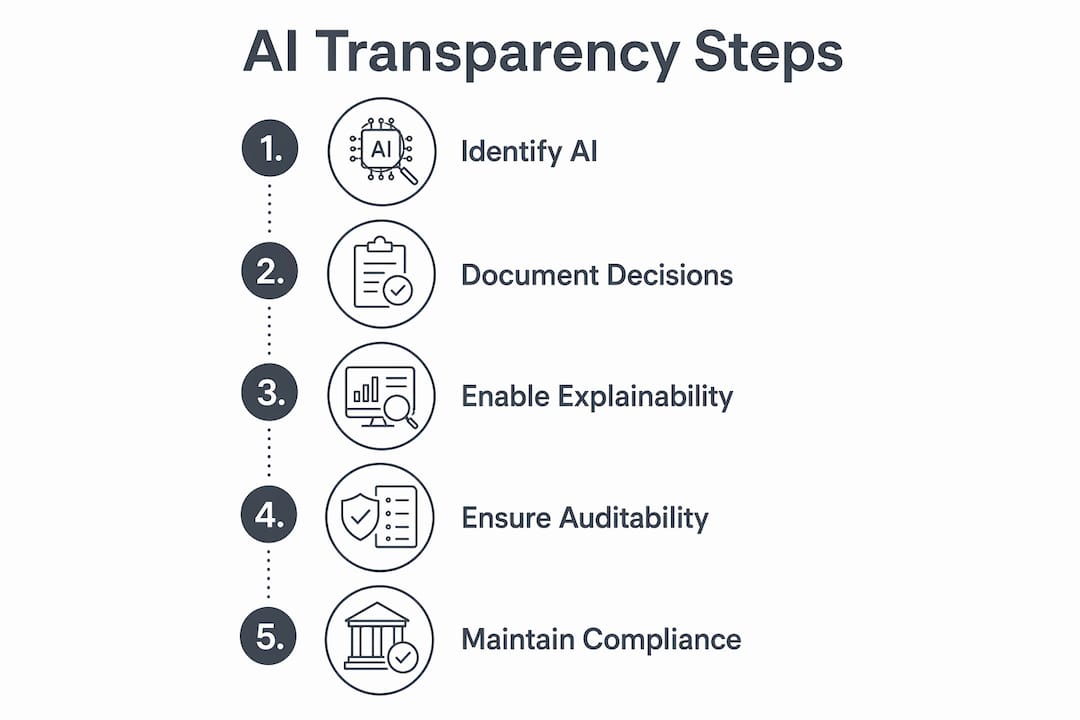
When a regulator or auditor reviews an AI-driven decision, they need to answer four questions: What data did the model use? What version of the model ran? Who reviewed the output? What was the rationale for approval or rejection? Without answers to all four, the firm cannot demonstrate control. Regulators demand reconstructable decision logs at the point of action. Transparency must be operational, not just documented after the fact.
Transparency also mitigates specific risks that financial services firms face:
- Bias detection: Documented input data and model outputs allow auditors to identify whether protected characteristics correlate with adverse decisions, enabling firms to act before regulatory penalties occur.
- Error correction: Traceable decision logs allow firms to identify when a model version produced systematically wrong outputs and to remediate affected customers.
- Privacy protection: Audit trails that capture metadata without retaining raw customer data satisfy both transparency and data minimization obligations simultaneously.
- Regulatory enforcement: When a regulator investigates a complaint, a firm with complete decision logs can respond in days. A firm without them faces months of reconstruction work and significant legal exposure.
Pro Tip: Design your transparency architecture around the audit question, not the model architecture. Regulators do not need to understand your neural network. They need to see who approved what, when, and why.
What challenges do compliance professionals face in implementing AI transparency?
Implementation is where most firms encounter friction. The challenges are technical, organizational, and conceptual.
-
LLM explainability gaps. Explainability tools effective for tabular data models, such as SHAP values or LIME, do not translate well to large language models used in compliance contexts. A firm using an LLM for customer communication screening faces a genuine audit risk if it cannot reconstruct the reasoning behind a specific output.
-
Rubber-stamp human oversight. Human-in-the-loop controls that function as approval queues without meaningful intervention do not satisfy regulatory requirements. Regulators classify rubber-stamped approvals as automated decisions, triggering full transparency obligations regardless of the human sign-off in the workflow.
-
Static documentation mistaken for compliance. Model cards and risk assessments are necessary but not sufficient. Regulators require evidence that governance is ongoing, not that it was completed at deployment. A policy document written at launch does not prove the model behaved as expected six months later.
-
Fragmented AI inventories. Most financial services firms have deployed AI agents across multiple teams and vendors without a centralized inventory. Without knowing what AI systems are running, firms cannot classify their risk levels, assign accountability, or produce audit evidence on demand.
Pro Tip: Treat your AI inventory as a living document. If you cannot list every AI agent in production, the model version it runs, and the named owner accountable for its outputs, you are not ready for a regulatory examination.
What practical steps can firms take to meet AI transparency requirements?
Meeting regulatory requirements for AI transparency requires embedding governance into operations, not bolting it on afterward.
- Build reconstructable decision logs. Every AI-driven decision in a high-risk context must generate a log that captures the model version, input data summary, output, and human reviewer action with a timestamp. Decision logs must support audits conducted years after the original decision.
- Conduct regular bias audits. Integrating bias audits on a regular cadence and real-time monitoring helps detect model drift and emergent unfairness before regulatory penalties occur. Quarterly audits are a minimum for high-risk models.
- Implement configurable approval workflows. Human oversight must be meaningful. Workflows should require reviewers to record their rationale, not just click approve. That record becomes part of the audit trail.
- Maintain a centralized AI agent inventory. Map every AI system in production, classify each by risk level under the EU AI Act or equivalent framework, and assign a named accountable owner. This inventory is the foundation of any regulatory examination response.
- Use metadata-based governance where possible. Governance tools that operate on metadata rather than raw data satisfy transparency obligations without creating additional data protection risks.
The table below summarizes the key transparency obligations and the evidence firms must produce to satisfy them.
| Regulatory obligation | Required evidence |
|---|---|
| EU AI Act Article 86 explanation right | Clear, individualized explanation of AI decision delivered to affected person |
| High-risk AI audit trail | Model version, inputs, outputs, human review record with timestamps |
| FCA Consumer Duty oversight | Documented governance showing fair treatment and meaningful human control |
| SR 11-7 model risk management | Model design documentation, validation records, ongoing monitoring logs |
| ICO automated decision-making code | Individual rights process, data minimization evidence, decision reconstruction capability |
Organizations using AI-orchestrated compliance engines with full audit integration have demonstrated material operational benefits. For example, AI compliance systems detected 95% of card-testing attacks in real time while cutting customer friction by 20%. That result is only achievable when the underlying system is transparent enough to be trusted and audited.
Key Takeaways
Regulators require AI transparency to enforce accountability, protect individual rights, and give auditors the evidence they need to assess whether firms genuinely control their AI systems.
| Point | Details |
|---|---|
| Transparency means accountability | Regulators want audit evidence of control, not public disclosure of model internals. |
| Article 86 creates individual rights | EU AI Act requires clear, individualized explanations for high-risk AI decisions. |
| Rubber-stamp oversight fails | Human sign-off without meaningful intervention triggers full transparency obligations. |
| Inventory is the foundation | Firms must know every AI agent in production before they can classify risk or produce audit evidence. |
| Governance must be operational | Static policy documents do not satisfy regulators. Decision logs must be reconstructable at the point of action. |
The compliance gap that most firms are not talking about
The firms I see struggling most with AI transparency are not the ones using the most complex models. They are the ones that treated transparency as a documentation project rather than an operational function. They wrote model cards, filed risk assessments, and assumed the governance box was checked. Then a regulator asked for the decision log from a specific credit denial six months ago, and the answer was silence.
The uncomfortable truth is that most financial services firms have deployed AI faster than they have built the governance infrastructure to support it. The EU AI Act's Article 86 obligations and the FCA's Consumer Duty expectations did not arrive without warning. The regulatory direction has been clear for years. What changed is that regulators are now examining firms against these standards in practice, not just in principle.
The firms that get this right treat AI transparency as a continuous governance function. They know which AI agents are running, what decisions those agents are influencing, and who is accountable for each one. They can produce a tamper-evident audit pack on demand. That capability is not a compliance luxury. It is the minimum standard regulators expect when they walk in the door.
The best AI explainability tools for regulated markets are the ones that produce evidence regulators can actually use: reconstructable logs, provenance-tracked outputs, and cryptographically signed records that cannot be altered after the fact. The technology exists. The gap is organizational will.
— Eleye
Aetherpulse: AI governance built for regulated firms
Financial services firms need more than policy documents to satisfy regulators. They need evidence.
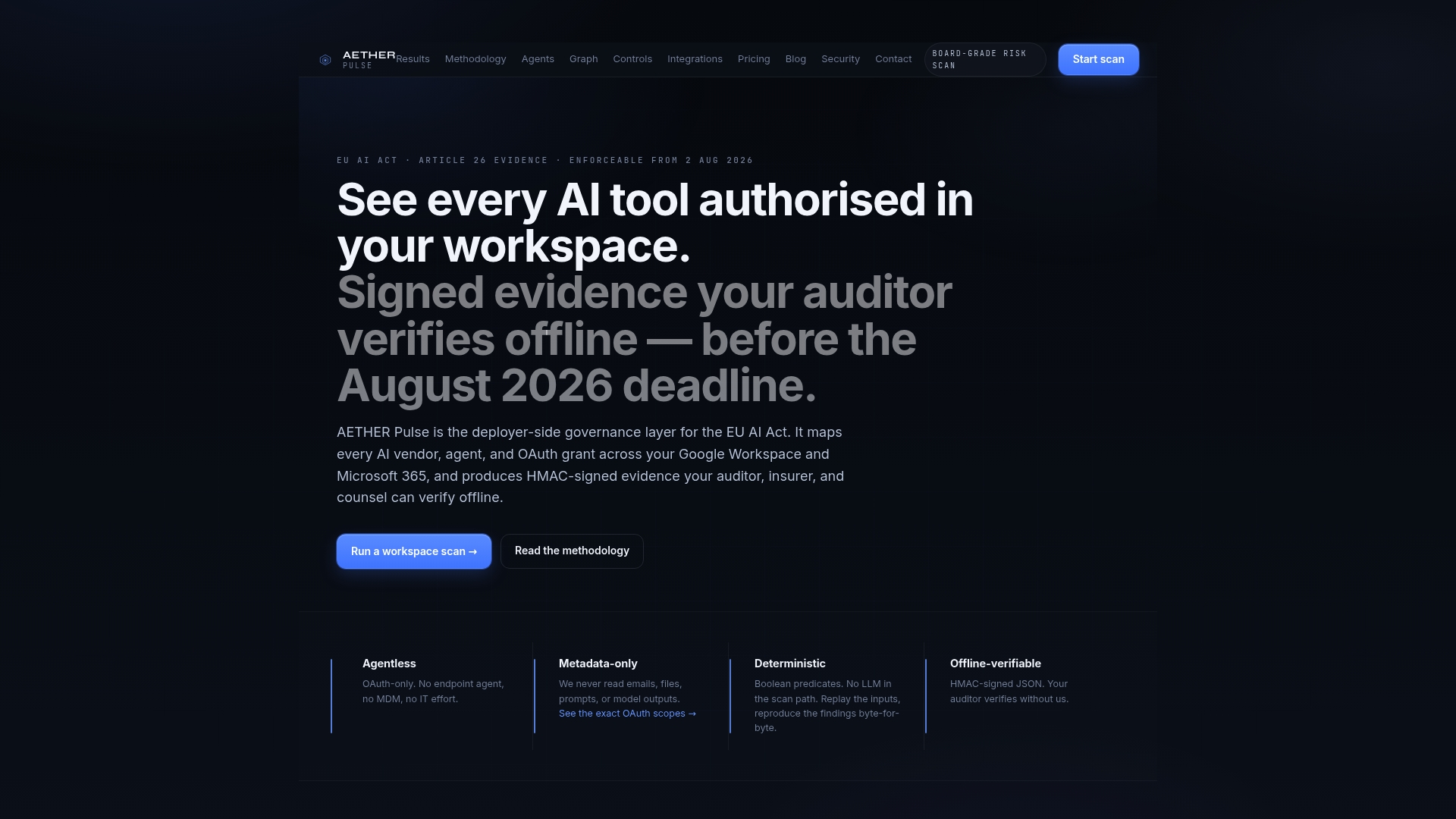
Aetherpulse is a read-only, agentless governance platform built specifically for UK and EU regulated financial institutions. It connects via OAuth metadata only, touching no customer data, and produces tamper-evident, cryptographically signed evidence packs aligned with EU AI Act Article 26, FCA Consumer Duty, SYSC requirements, and the ICO's developing code of practice. Aetherpulse builds a live inventory of your AI agents, surfaces risk concentration, and generates deterministic, provenance-tracked audit evidence on demand. If your firm needs to demonstrate AI oversight to a regulator or internal audit function, Aetherpulse is built for exactly that moment.
FAQ
What is AI transparency for auditors?
AI transparency for auditors means the ability to reconstruct a specific AI decision, including the model version, input data, output, and human reviewer action, with timestamps that support examination years after the fact.
Why do regulators care about AI decisions in financial services?
Regulators care because AI decisions in credit, fraud, and compliance directly affect individual rights and systemic financial stability. Unverifiable decisions create legal and ethical failures that regulators are mandated to prevent.
Does human-in-the-loop oversight satisfy AI transparency requirements?
Not automatically. Regulators classify rubber-stamped human approvals as automated decisions. Human oversight satisfies transparency obligations only when reviewers record a meaningful rationale, not just a sign-off click.
What does the EU AI Act require for AI explainability?
Article 86 of the EU AI Act grants individuals the right to clear explanations of AI-based decisions. High-risk systems must maintain full audit trails, and disclosures buried in terms and conditions do not meet the standard.
What is the biggest practical challenge in implementing AI transparency?
The most common failure is treating transparency as a one-time documentation exercise. Regulators require reconstructable decision logs at the point of action, which means governance must be embedded in AI operations from the start.
Recommended
Working on Article 26 readiness, deployer-side governance evidence, or AI agent risk at a regulated firm? We'd value 15 minutes of your perspective.
Start a conversation