Model Governance vs. Agent Governance: What Compliance Teams Must Know
Model Governance vs. Agent Governance: What Compliance Teams Must Know

Model governance manages the model; agent governance governs what an AI actor can do: its identity, its tool access, and its runtime actions. That distinction is the whole story. A model approval process tells you whether an algorithm was trained on clean data and tested for bias. It tells you nothing about whether the autonomous agent running on top of that model can initiate a payment, edit a customer record, or call an external API without a human ever seeing it happen.
The implication for regulated firms is immediate. Approving a model does not clear an agent for production, because agents act on systems and take actions that no model card or evaluation report was designed to capture. Before signing off on any agent deployment, compliance leaders need to verify four things:
- Every agent has a distinct, traceable identity
- Tool and system permissions are scoped and time-bound
- Runtime enforcement can block or interrupt an action before it executes
- Every decision produces tamper-evident audit evidence
Guidance from Singapore's Model AI Governance Framework for Agentic AI and Microsoft's own agent security architecture both converge on this same point: model quality and agent accountability are separate problems, governed by separate controls.
Key Takeaways
Agent governance and model governance solve different problems, and treating agent oversight as an extension of model risk review leaves regulated firms unable to prove control over autonomous actions.
| Point | Details |
|---|---|
| Model governance covers artifacts | Training data, evaluation, and versioning stop at the model, not the agent acting on it. |
| Agent governance covers runtime action | Identity, tool access, and enforceable policy govern what an agent can actually do in production. |
| Enforcement belongs outside the agent | An out-of-band policy engine must block risky actions since agents cannot reliably self-enforce. |
| Evidence must be tamper-evident | Cryptographically signed logs, not editable reports, are what auditors and regulators will accept. |
| Start with inventory and ownership | Discover every agent, map its blast-radius, and assign a named owner before adding monitoring layers. |
Table of Contents
- Agent Governance vs. Model Governance: Where the Line Actually Falls
- What Controls Do Agent Governance Frameworks Actually Require?
- How Should Vendors Prove Their Governance Evidence Is Trustworthy?
- Building an Agent Governance Program: A Six-Month Roadmap
- The Case for Treating Agent Governance as Its Own Discipline
- Sources
Agent Governance vs. Model Governance: Where the Line Actually Falls
Model governance ends at the artifact. It covers training data provenance, evaluation benchmarks, bias testing, and version control, the work that happens before anything reaches a production environment. Agent governance starts where that work leaves off: the moment a piece of software gets an identity, a set of permissions, and the ability to act inside your systems. Confusing the two is how a firm ends up with a beautifully documented model behind an agent nobody can account for.
Ownership splits differently, too. Model approval typically sits with a model risk committee or a data science lead who signs off on performance and fairness metrics. Agent operations sit with whoever owns the runtime: often a platform engineering or IT security function that rarely reports through the same governance chain as model risk. That gap in ownership is where accountability quietly disappears, and it is a recurring theme in why existing governance tools fall short once agents move from pilot to production.
Failure modes diverge just as sharply:
- Model failures look like drift, bias creeping back in after retraining, or degraded accuracy on a new population.
- Agent failures look like tool misuse, prompt injection that hijacks intent, or two agents coordinating in a way neither owner anticipated.
Evidence requirements follow the same split. Model governance produces documentation: training data lineage, test reports, sign-off memos. Agent governance has to produce something closer to a flight recorder: signed, timestamped, tamper-evident logs of every action an agent attempted, approved, or was blocked from taking.
Consider three regulated use cases where this gap becomes concrete. An agent processing customer refunds needs a hard ceiling on transaction value and a record of every refund it initiated, not just a note that the underlying model was validated. An agent handling payment initiation needs a policy engine outside its own runtime enforcing that limit, because a compromised or misconfigured agent will not enforce a rule against itself. An agent editing customer data under Consumer Duty or GDPR-adjacent obligations needs an identity trail linking every edit back to a specific session and a specific human accountable for it.
Practitioners increasingly talk about mapping an agent's "financial blast-radius", meaning the total systems and budget exposure a given agent can touch, as the fastest way to triage which agents need governance attention first. A well-governed model behind a poorly governed agent still leaves that blast-radius wide open.
What Controls Do Agent Governance Frameworks Actually Require?
Effective agent governance rests on four architectural pieces, and none of them resemble a model evaluation report.
- Give every agent a single, session-scoped identity. Microsoft's guidance on agent governance and security recommends a centralized agent registry with one identity per agent, bound to a named owner, so every action can be traced to a specific agent instance and a specific session, not a shared service account.
- Put enforcement outside the agent, not inside it. An agent's own runtime cannot be trusted to police itself. Practitioner guidance on agent architecture is explicit that policy enforcement belongs in an out-of-band point sitting between the agent and the systems it touches, so a manipulated or jailbroken agent still hits a wall it cannot argue with.
- Scope tool access on four dimensions. Permissions should be evaluated against the agent's identity, the principal chain it's acting on behalf of, the specific action requested, and the resource targeted, all time-bound rather than standing.
- Build in the ability to block, hold, or revoke instantly. High-risk actions, like a payment above a threshold or a bulk data export, need a hold-for-review step, and every agent needs a kill switch that revokes access immediately, not on the next deployment cycle.
Monitoring has to expand too. Model testing checks accuracy and bias; agent testing needs new scenario categories entirely, including tool-call abuse, prompt-injection attempts, and chained multi-agent scenarios where one agent's output becomes another agent's instruction.
Pro Tip: Run a tabletop exercise where a single compromised agent tries to use its own legitimate permissions to reach a system it was never meant to touch. If your enforcement layer can't stop it, your architecture has a self-enforcement problem, not a policy problem.

How Should Vendors Prove Their Governance Evidence Is Trustworthy?
Audit-ready evidence has to survive a skeptical regulator, not just a friendly product demo. Tamper-evident, cryptographically signed evidence, the kind produced with HMAC-SHA256 signing, proves that a log entry has not been altered after the fact. That matters more than most vendor pitches let on, because an editable log is not evidence of anything except that someone had access to edit it.
Metadata-only approaches solve a separate problem: how a vendor demonstrates oversight without ever touching customer content. A governance layer that connects via OAuth metadata and inventories agent identities, permissions, and actions can produce a full audit trail while never reading the underlying transaction or customer record itself.
Before accepting any vendor's evidence claims, ask for:
- A complete agent inventory tied to owners, not just a system diagram
- Signed action logs covering both approved and blocked actions
- A record of every policy change and who authorized it
- Runtime denial events, showing the enforcement layer actually stopped something
Vendor architectures vary widely: some emphasize identity, some observability, others runtime enforcement, and few do all three well. Independent validation, not marketing copy, is what separates a real control from a dashboard.
Validating those claims means asking a vendor to walk through signature verification live and explain provenance end to end, not just show a sample report. Aetherpulse's approach to governance without touching customer data reflects the same principle: evidence should be checkable by an outside party without granting that party access to anything sensitive.
Building an Agent Governance Program: A Six-Month Roadmap
Governance work stalls when it has no sequence. Here is a realistic order of operations.
- This week: Discover and record every AI agent in production, including shadow deployments IT doesn't officially know about, and map each one's blast-radius, meaning the systems and budgets it can touch.
- This week: Assign a named, accountable owner to every agent on the inventory. No owner means no accountability chain if something goes wrong.
- Within a month: Build a working kill-switch procedure and a session-scoped identity for each agent, following the registry pattern Microsoft's agent governance guidance lays out.
- This quarter: Deploy an out-of-band enforcement point and connect runtime logging directly into existing compliance and audit systems, rather than leaving it as a standalone dashboard nobody checks.
- Ongoing: Run quarterly tests against new agent-specific failure modes, tool-call abuse, prompt injection, and chained agent scenarios, and track KPIs like blocked-action counts and time-to-revocation.
A useful companion resource for the discovery phase is a structured agent discovery workflow, which walks through building that initial inventory before ownership assignment even begins.
The Case for Treating Agent Governance as Its Own Discipline
Most firms still bolt agent oversight onto existing model risk committees, and that is the single biggest structural mistake in this space right now. Model risk teams are built to evaluate artifacts on a slow cadence, quarterly reviews, annual re-validation. Agents act continuously, in production, often making decisions in milliseconds. Asking a model governance committee to also own agent runtime risk is asking a building inspector to also direct live traffic.
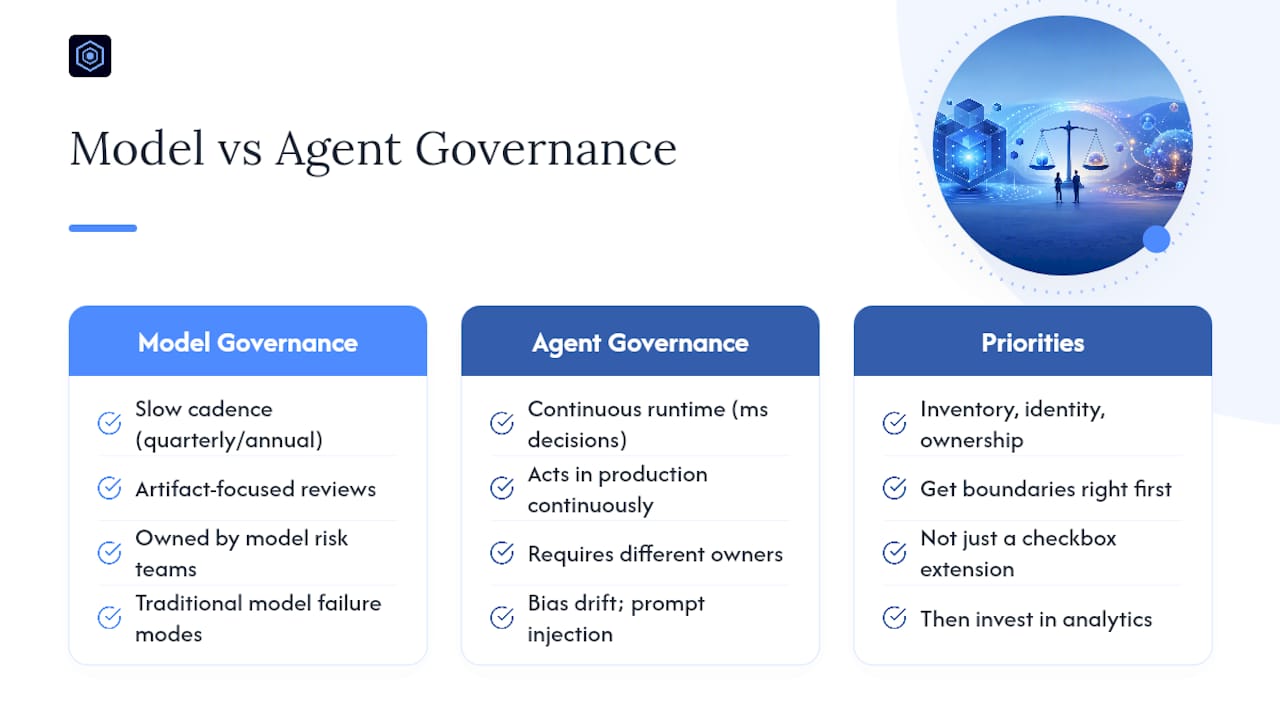
The conventional advice, "extend your model governance framework to cover agents," undersells how different the failure modes really are. Bias drift and prompt injection are not variations on the same problem; they require different detection methods, different owners, and different response times. Firms that treat agent governance as a checkbox extension of model risk tend to discover the gap only after an agent has already done something a human never approved.
Prioritize the boring work first: inventory, identity, ownership. Every framework worth citing, from IMDA's agentic AI guidance to Microsoft's registry model, starts there, not with sophisticated monitoring dashboards. Get the boundaries right before investing in analytics.
— Eleye
Sources
- AI Governance for AI Agents Is Different from AI Governance for Models
- MODEL AI GOVERNANCE FRAMEWORK FOR AGENTIC AI
- Governance and security for AI agents across the organization — Microsoft
- AI Agent Governance — A Practitioner's Reference | FirstOps
Recommended
- The AI Agent Governance Gap: Why Existing Tools Are Not Enough - AETHER Pulse
- Chat Enterprise: Audit-Ready Agent Governance for US Finance
- The Difference Between AI Governance and AI Oversight, and Why It Matters for Compliance - AETHER Pulse
- AI Compliance Gap Assessment Guide for Regulated Firms - AETHER Pulse
Working on Article 26 readiness, deployer-side governance evidence, or AI agent risk at a regulated firm? We'd value 15 minutes of your perspective.
Start a conversation