Export Agentless NIST AI RMF Evidence in Minutes for U.S. Audits
Export Agentless NIST AI RMF Evidence in Minutes for U.S. Audits

NIST AI RMF evidence is the mapped set of artifacts, an AI system inventory, model cards, TEVV test results, monitoring logs, and documented risk treatment with sign-off, that lets an organization demonstrate the framework's outcomes on demand rather than describe them in a policy document. Success is measurable: a defined internal SLA for producing an audit-ready evidence pack for any in-scope AI system, built from the standards NIST publishes in AI RMF 1.0 and its companion Playbook.
TL;DR:
- Evidence should directly demonstrate governance through artifacts like signed inventories, model cards, and monitoring logs, not just policies or narratives.
- An organized process must link artifacts to strategic documents and assign clear ownership to ensure repeatability and readiness for audits or procurement.
- Automation via agentless metadata collection continuously updates inventory and provenance, enabling rapid, tamper-evident evidence export on demand.
- Building and maintaining evidence around the seven trustworthiness characteristics simplifies compliance and aligns with multiple frameworks, reducing duplicate effort.
- Implementing phased, top-down controls and versioning improves efficiency, while early focus on automation shortens overall timeline and reduces manual bottlenecks.
Table of Contents
- What Counts as NIST AI RMF Evidence and Why It Matters Now
- AI RMF Core Functions and Where Evidence Fits
- Concrete Evidence Artifacts Auditors Will Ask For
- Organizing Evidence for Audits and Procurement
- Automating Evidence Collection: Agentless Metadata and Tamper-Evident Packs
- How RMF Evidence Maps to U.S. Audit and Procurement Expectations
- Playbook, Templates, and Your First 90 Days
- Why Continuous Evidence Beats a One-Time Checklist
- A Practical Option for Audit-Ready Evidence Packs
- Authoritative NIST Resources to Bookmark
- Sources
- FAQ
What Counts as NIST AI RMF Evidence and Why It Matters Now
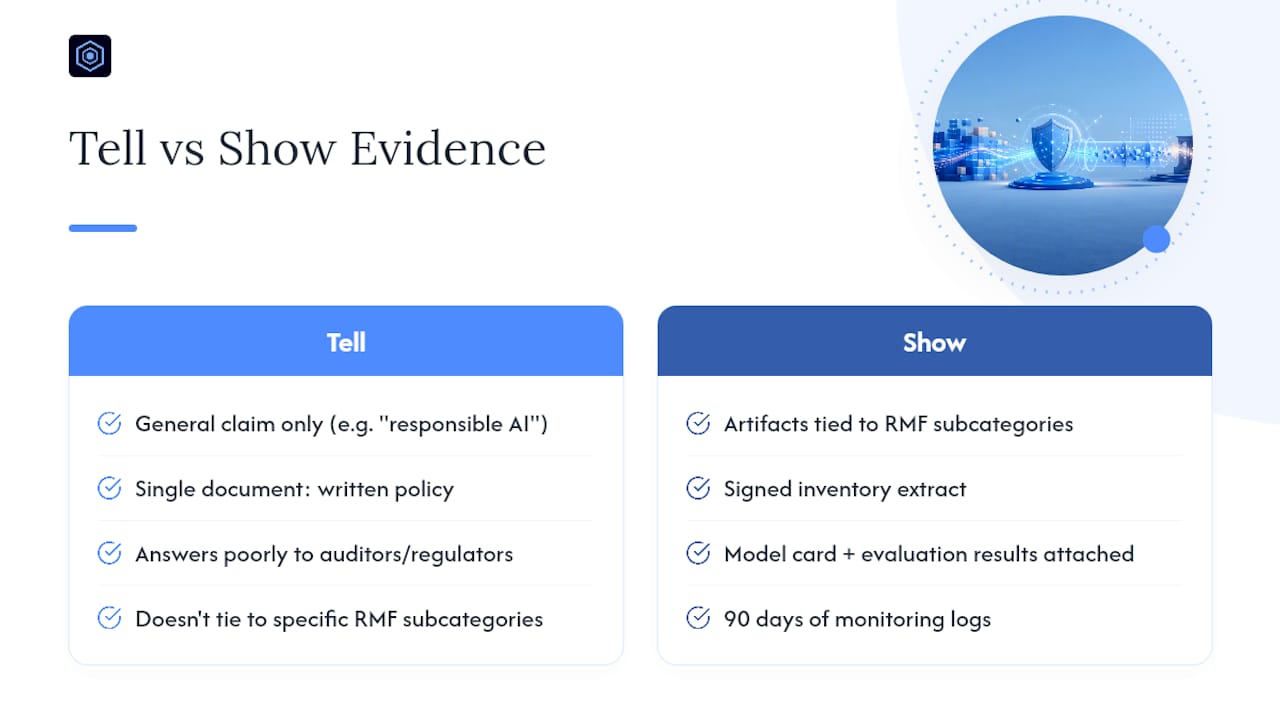
Evidence, in NIST's own terms, means artifacts tied to specific subcategories within the framework's four functions rather than a general claim of "responsible AI." The AI RMF 1.0 was built through an 18-month consensus process involving more than 240 organizations, and it deliberately avoids prescribing exact documents. That flexibility is the framework's strength and its central operational challenge: your organization has to decide what "enough evidence" looks like for each risk tier, then produce it consistently.
Regulators, internal audit committees, and enterprise procurement teams increasingly ask the same question in different words: can you show us, not tell us, how this AI system is governed? A written policy answers that question poorly. A signed inventory extract, a model card with evaluation results attached, and ninety days of monitoring logs answer it well. That distinction is what separates an AI RMF compliance program from an AI RMF compliance narrative.
AI RMF Core Functions and Where Evidence Fits
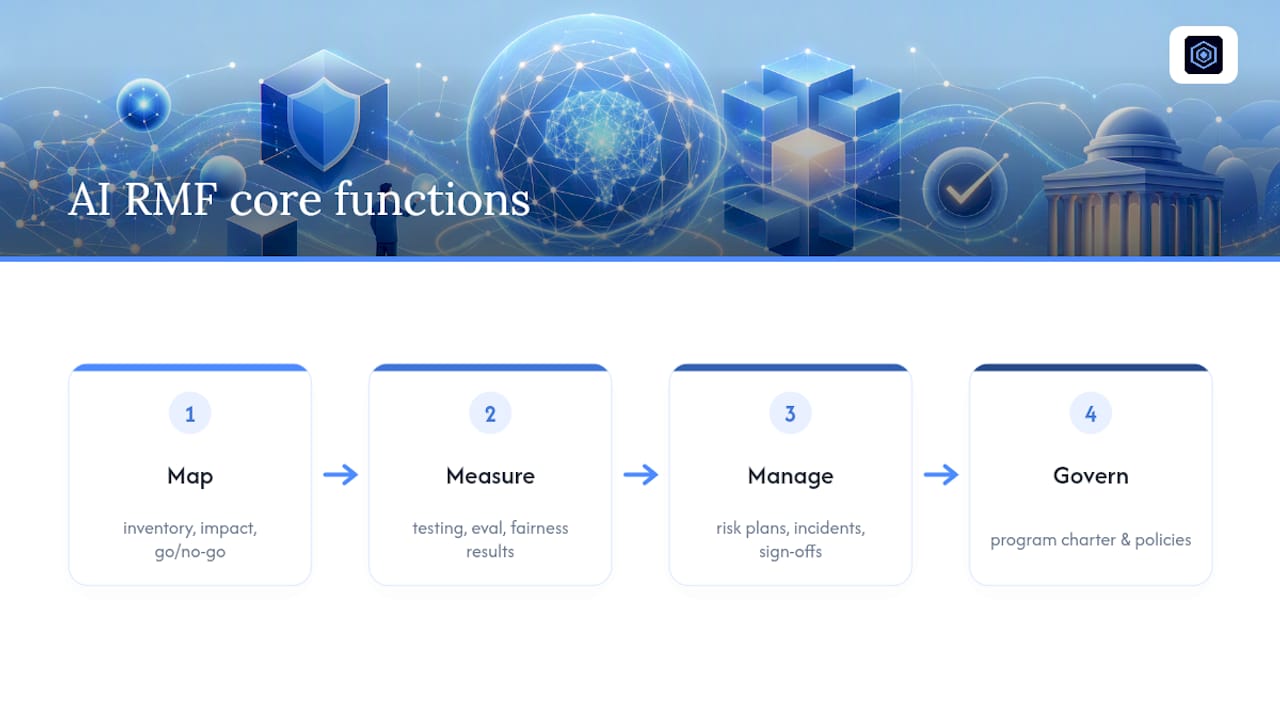
The AI RMF Core organizes activity into four functions, and each one produces a distinct evidence type rather than a generic compliance record.
Govern cross-cuts the other three functions and produces the foundational paperwork: a program charter, a documented risk tolerance statement, named accountable owners, and policy approvals signed by leadership. Without this layer, downstream evidence has no context to sit inside.
Map generates the system inventory, context and impact assessments, and go/no-go deployment records. This is where you establish what the AI system does, who it affects, and what could go wrong.
Measure is where TEVV, testing, evaluation, verification, and validation, lives. Expect evaluation metrics, red-team and adversarial test results, and fairness assessments tied to specific trustworthiness characteristics NIST defines, including validity, safety, and explainability.
Manage closes the loop with risk treatment plans, incident response records, and residual risk sign-offs from an accountable owner. According to AIRC guidance, most organizations start with Map, then move to Measure and Manage in sequence.
Concrete Evidence Artifacts Auditors Will Ask For
Once you move past the four functions conceptually, auditors want specific documents attached to specific systems. Here is what typically surfaces in a request list during a financial services audit or vendor risk review:
- AI system inventory with metadata: owner, deployment environment, data sensitivity classification, and business function served.
- Model cards or datasheets documenting intended use, known limitations, and a summary of evaluation results.
- TEVV and evaluation results: performance baselines, testing protocols, fairness testing outcomes, and security or adversarial test findings.
- Runtime monitoring and alert logs, drift detection outputs, and incident logs showing how the system behaved once live.
- Data lineage and dataset documentation, including access controls and records of who touched training or inference data.
- Fairness and bias assessment records, remediation actions taken, and sign-off confirming the residual risk was accepted knowingly.
- Chain-of-custody documentation proving the artifacts themselves have not been altered after the fact.
Pro Tip: Build your evidence templates around the seven trustworthiness characteristics NIST lists, valid and reliable, safe, secure and resilient, accountable and transparent, explainable and interpretable, privacy-enhanced, and fair, rather than inventing your own taxonomy. Auditors trained on the framework will recognize the structure immediately.
A minimal audit-ready pack for a single system typically includes a signed inventory extract, a model card, a TEVV summary, recent monitoring logs, remediation records, and a residual risk acceptance signed by a named owner. Missing any one of these is usually what triggers a follow-up request during an audit rather than a clean pass.
Organizing Evidence for Audits and Procurement
Producing artifacts once is the easy part. Producing them repeatedly, for every system, on a schedule an auditor or a customer's procurement team can rely on, is where most programs break down. A compact process handles this without requiring a dedicated compliance headcount for every deployed model.
- Start top down. Anchor everything to a program charter, documented risk tolerance, and executive approvals. Every downstream artifact should trace back to this layer.
- Build phase gates. Define what evidence gets collected at development, pre-deployment, and post-deployment monitoring stages, and don't let a system pass a gate without its file complete.
- Version and retain deliberately. Keep a version table for every artifact type and require signed approvals at each revision, not just the first one.
- Map artifacts to likely questions. A procurement team asking "how do you test for bias" should have a direct, named document to point to, not a promise to compile one.
- Assign record ownership explicitly. Every artifact needs a named accountable person, not a department.
Pro Tip: Treat the AI RMF as an overlay on your existing cybersecurity and data governance program rather than a parallel process. Mapping current controls to Govern and Manage first usually eliminates half the "new" work teams assume they need to do. Practitioner guidance on phased implementation suggests foundational adoption for smaller initiatives can run 3 to 6 months, while enterprise-wide rollouts typically take 12 to 24 months. Reviewing your AI model inventory management process early shortens both timelines considerably.
Automating Evidence Collection: Agentless Metadata and Tamper-Evident Packs
Manual evidence aggregation fails predictably: someone owns a spreadsheet, the spreadsheet falls out of date the moment a model gets retrained, and by audit time half the monitoring logs referenced no longer exist in their original form. Automation has to solve three problems at once: keep the inventory current without manual entry, preserve provenance so an auditor trusts the artifact wasn't edited after the fact, and generate exportable packs on demand rather than during a scramble.
An agentless metadata approach addresses this without touching production systems or customer data directly. It works by:
- Connecting through OAuth metadata only, building an inventory and identity graph of AI agents and models in use across the organization.
- Tracking provenance continuously, so evidence reflects the system's actual state, not a snapshot from the last manual review.
- Generating cryptographically signed evidence packs, using standards like HMAC-SHA256, that are tamper-evident and exportable on demand for auditors or regulators.
- Integrating with CI/CD pipelines, monitoring and SIEM tools, MLOps platforms, and change control systems so TEVV and runtime logs accumulate automatically rather than being assembled after the fact.
Operational evidence works best when it's produced continuously inside these pipelines rather than reconstructed manually before a review. That single design choice, continuous versus manual, is usually the difference between an evidence pack that takes weeks to assemble and one that exports in minutes.
How RMF Evidence Maps to U.S. Audit and Procurement Expectations
Auditors and procurement teams rarely ask for "AI RMF compliance" by name. They ask concrete questions, and RMF artifacts answer them directly. "How do you test this model for bias?" gets answered by a TEVV summary. "What AI systems touch customer data?" gets answered by the inventory. "How do you know if this system degrades over time?" gets answered by monitoring logs.
The same evidence typically satisfies overlapping frameworks. NIST CSF, ISO standards, and federal agency guidance often ask parallel questions, so a well-built RMF evidence pack reduces duplicate work rather than adding to it. Worth remembering: the AI RMF itself is voluntary. No statute mandates its use. It has become a de facto baseline anyway, because it is the most complete, consensus-built vocabulary available for describing AI governance evidence in the United States.
Playbook, Templates, and Your First 90 Days
Start with NIST's own materials rather than a third-party interpretation of them:
- The NIST AI RMF Playbook for suggested tactical actions mapped to each subcategory.
- AI RMF 1.0 (NIST AI 100-1), the primary publication and PDF.
- AIRC resources for function-level guidance and sequencing.
In your first 30 days, build the inventory and draft the governance charter. By day 90, run a pilot TEVV cycle on one system and establish a monitoring baseline. NIST treats both the framework and Playbook as living documents, expect periodic revisions, so version control on your internal mappings matters from day one. A governance maturity assessment helps prioritize which system gets the pilot.
Why Continuous Evidence Beats a One-Time Checklist
Most programs fail not from ignorance of the framework but from treating it as a project with an end date. The Playbook offers suggested actions, not a mandatory checklist, and organizations that try to implement all 72 subcategories simultaneously usually stall before finishing any of them. Evidence that accumulates continuously through monitoring pipelines beats evidence assembled in a scramble before a scheduled review, every time.
— Eleye
A Practical Option for Audit-Ready Evidence Packs
Building continuous evidence manually across dozens of AI systems is exactly the operational gap that stalls most RMF programs after the initial inventory phase. An agentless approach connects through metadata only, touching no customer data and no production system directly, then builds an inventory and identity graph of an organization's AI agents automatically.
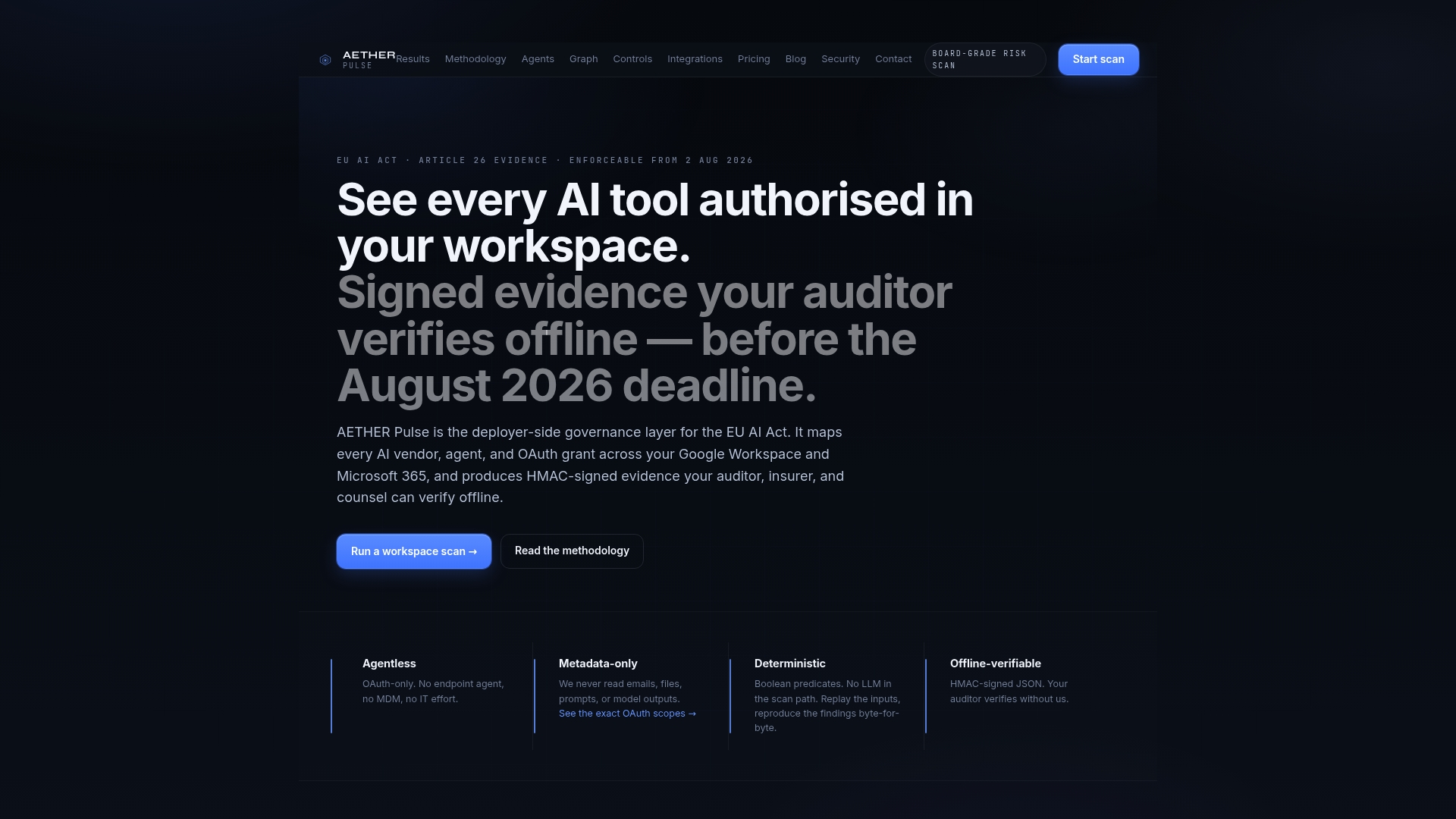
From that graph, it surfaces risk concentration, including financial blast-radius exposure, and generates cryptographically signed, tamper-evident evidence packs on demand. For a regulated financial services firm that needs to hand an examiner a defensible artifact rather than a promise, that export function matters more than most feature lists. When evaluating any automation approach for this purpose, check four things: provenance tracking, cryptographic signing, integration points with your existing MLOps and monitoring stack, and confirmation the tool doesn't require access to sensitive data to function. Visit Aetherpulse to see how the metadata-only model applies to your inventory and request a walkthrough of an exported evidence pack.
Authoritative NIST Resources to Bookmark
- AI Risk Management Framework landing page, NIST's central hub with updates and profiles.
- AI RMF 1.0 PDF (NIST AI 100-1), the primary publication.
- AI RMF Playbook and AIRC resources for tactical, subcategory-level guidance.
Sources
- Artificial Intelligence Risk Management Framework (AI RMF 1.0) | NIST
- NIST AI RMF Playbook | NIST
- AI RMF - AIRC
FAQ
Is There a NIST AI RMF Certification?
No. NIST does not offer or endorse an official certification program for AI RMF compliance; organizations self-assess against the framework's functions and subcategories.
Is NIST AI RMF a Regulation?
No, the AI RMF is a voluntary framework, not a binding regulation, though it has become a widely referenced baseline for demonstrating AI governance to regulators and auditors.
Is RMF a Legal Requirement?
Not by federal statute. Some sector-specific rules or contractual obligations may reference RMF-aligned practices, but the framework itself imposes no legal mandate.
Are NIST and RMF the Same Thing?
No. NIST is the federal agency, the National Institute of Standards and Technology, and the AI RMF is one specific framework it publishes; NIST also produces the Cybersecurity Framework and other standards.
How Does Automation Change What Counts as Evidence?
Automated, metadata-based approaches like Aetherpulse's agentless model generate continuously updated inventory and provenance records, producing tamper-evident evidence packs on demand rather than requiring manual assembly before each review.
Recommended
Working on Article 26 readiness, deployer-side governance evidence, or AI agent risk at a regulated firm? We'd value 15 minutes of your perspective.
Start a conversation