Audit Ready Agentless vs Agent Based Governance for Regulated Finance
Audit Ready Agentless vs Agent Based Governance for Regulated Finance

For regulated financial services firms, agentless, metadata-only governance is the faster and more defensible starting point for demonstrating oversight of AI agents. It builds inventory and audit evidence without touching customer data. Agent-based instrumentation still earns its place, but only for the narrow set of agents where deterministic replay or inner-model signals are non-negotiable. The reason comes down to what auditors actually want: provenance and verifiability at the point of decision, not a dashboard.
TL;DR:
- Agentless governance provides rapid, broad discovery and tamper-evident evidence without accessing customer data, but cannot fully reconstruct decision reasoning.
- Agent-based instrumentation offers detailed, step-by-step decision replay and confidence insights but involves higher operational overhead and increased data exposure risk.
- Regulatory expectations emphasize continuous oversight, defined decision mandates, escalation procedures, and immutable, timestamped evidence for every action.
- Firms should deploy a default agentless approach for low-impact actions and escalate to agent-based tools only for decisions with material financial or compliance implications.
- Building a hybrid, scalable architecture involves starting with agentless discovery and adding agent-based controls selectively based on risk and audit requirements.
Table of Contents
- Agentless vs Agent-Based: How Each Approach Actually Works
- What Do Auditors Expect From AI Agent Oversight?
- How to Decide: Agentless, Agent-Based, or Hybrid
- What Should Be on Your Governance Procurement Checklist?
- What Does Success Actually Look Like in Early Deployments?
- How AETHER Pulse Delivers Agentless Governance in Practice
- Where to Go Next for Primary Sources
- Sources
Agentless vs Agent-Based: How Each Approach Actually Works
The core distinction is where the governance layer sits. Agentless architectures connect through APIs, control planes, and OAuth metadata grants. They never install anything inside the agent's runtime and never touch the underlying data the agent processes. Agent-based approaches embed instrumentation directly in the execution path, capturing telemetry, model-state signals, and tool calls as they happen.
That structural difference drives everything else: what evidence you get, how fast you deploy, and how much operational weight you carry.
Agentless governance typically delivers:
- Broad discovery across cloud and SaaS environments using connectors and metadata ingestion, with no per-agent software footprint, which is how agentless security tools identify risk without deploying per host.
- An identity graph mapping which agents exist, who owns them, and what systems they can reach.
- Tamper-evident evidence packs built from metadata, useful for demonstrating oversight without exposing sensitive records.
- Fast time to value, often days rather than months, because there is nothing to deploy inside production.
- A gap in deterministic replay: metadata alone cannot always reconstruct the exact reasoning chain behind a specific model output.
Agent-based instrumentation typically delivers:
- Deep runtime traces, including intermediate reasoning steps, confidence scores, and tool-call sequences.
- Reconstructability: the ability to replay a decision step by step for a specific disputed transaction.
- Higher deployment and maintenance overhead, since every monitored agent needs its own integration and upkeep.
- Greater exposure risk, because the instrumentation sits inside the data path it is meant to govern.
A common coverage gap shows up when firms assume agentless visibility equals full audit readiness. It covers inventory and behavioral metadata well. It will not, on its own, reconstruct why a specific agent approved a specific loan exception at 2:14 a.m.
What Do Auditors Expect From AI Agent Oversight?
Supervisory expectations are converging on a simple idea: firms remain accountable for what their AI agents do, whether or not a human reviewed the specific action. UK guidance on AI agents and consumer law is explicit that firms must monitor, test, and train their agents, and that responsibility does not transfer to the software.
The clearest operational blueprint for what that oversight should look like comes from SAFR (Safeguards for Agentic Finance at Runtime), published by the Monetary Authority of Singapore. SAFR proposes a runtime governance checkpoint, a Governance Envelope paired with a validator, that evaluates every proposed agent action before execution and logs the outcome as a structured audit trail. This is not batch review after the fact. It is a per-action checkpoint.
Auditors reviewing an agentic system will typically look for:
- Defined mandates describing what an agent is authorized to do and under what constraints.
- Exposure and rate limits that cap financial or operational blast radius per agent, per hour, or per transaction type.
- Evidence-quality thresholds that flag low-confidence or low-provenance decisions for escalation rather than silent execution.
- Escalation contracts specifying exactly when a decision routes to a human reviewer.
- Immutable, timestamped provenance for every logged action, resistant to retroactive editing.
Underneath all five sits a harder question: can the evidence be trusted after the fact? Research on governing agentic AI in fintech argues that verifiability should be treated as a governance profile, not a single pass/fail scalar, because orchestration layers and model updates change execution traces over time. That single point reframes the whole debate. The question is not "agentless or agent-based," it is "what level of replayability does this specific action require, and does my evidence chain actually deliver it?"
How to Decide: Agentless, Agent-Based, or Hybrid
Most firms do not need to pick one architecture and apply it everywhere. The smarter approach runs a quick rubric against each agent class before deciding how deep to go.
Weigh each agent against five axes:
- Financial impact and reversibility. A pricing-quote agent and a wire-approval agent do not carry the same risk, even if both are "just AI agents."
- Need for deterministic replay. Does a regulator or ombudsman need to see the exact reasoning path behind a single decision, or just proof the decision followed policy?
- Data sensitivity. Instrumentation that touches raw customer data raises its own governance burden.
- Scale and velocity. High-frequency agents acting faster than any human reviewer can keep pace with need pre-execution controls, not after-the-fact review.
- Vendor visibility. Third-party agents you cannot instrument at all force you toward agentless, metadata-based monitoring by default.
As a rule of thumb: accept agentless-only coverage for discovery, inventory, and low-impact, reversible actions. Require agent-based instrumentation only where a single decision could produce material financial harm, and where auditors would plausibly demand a step-by-step replay.
Pro Tip: Build your hybrid architecture so agentless monitoring is always the default layer across every agent, and treat agent-based instrumentation as an opt-in escalation triggered by risk scoring, not a parallel system you maintain everywhere.
The trigger for deeper instrumentation is usually a near-miss: an agent takes an action close to its exposure limit, or a validator escalation reveals a decision path nobody could fully reconstruct. That is your signal to instrument, not a scheduled review meeting six months out.
What Should Be on Your Governance Procurement Checklist?
Before piloting any governance platform, demand proof, not marketing language, against four categories by consulting with AI Strategy & Security Consulting in San Marcos, TX | tekRESCUE AI, experts who help organizations translate governance requirements into security and strategy programs:
- Discovery and inventory. Ask for a live identity graph and a coverage matrix showing which agents are tracked and which are still invisible to the platform.
- Evidence artifacts. Confirm the platform produces signed, timestamped Governance Envelopes capturing agent identity, mandate, tool calls, and provenance, mapped to your existing controls repository.
- Operational tests. Run replayability tests, verify exposure and rate-limit enforcement, and check the platform's evidence-export SLA against your actual audit timelines.
- Scale validation. Enterprise deployments fail when discovery and remediation cannot keep pace with agent proliferation, so ask for real-time monitoring proof, not a static screenshot from a sales deck.
Vendor questions worth asking directly: Does the platform touch customer data, or only metadata? How is evidence tamper-proofed? What does an actual signed evidence pack look like before you buy? Teams building this checklist from scratch often find it useful to walk through how AI agent discovery works at enterprise scale before drafting requirements.
What Does Success Actually Look Like in Early Deployments?
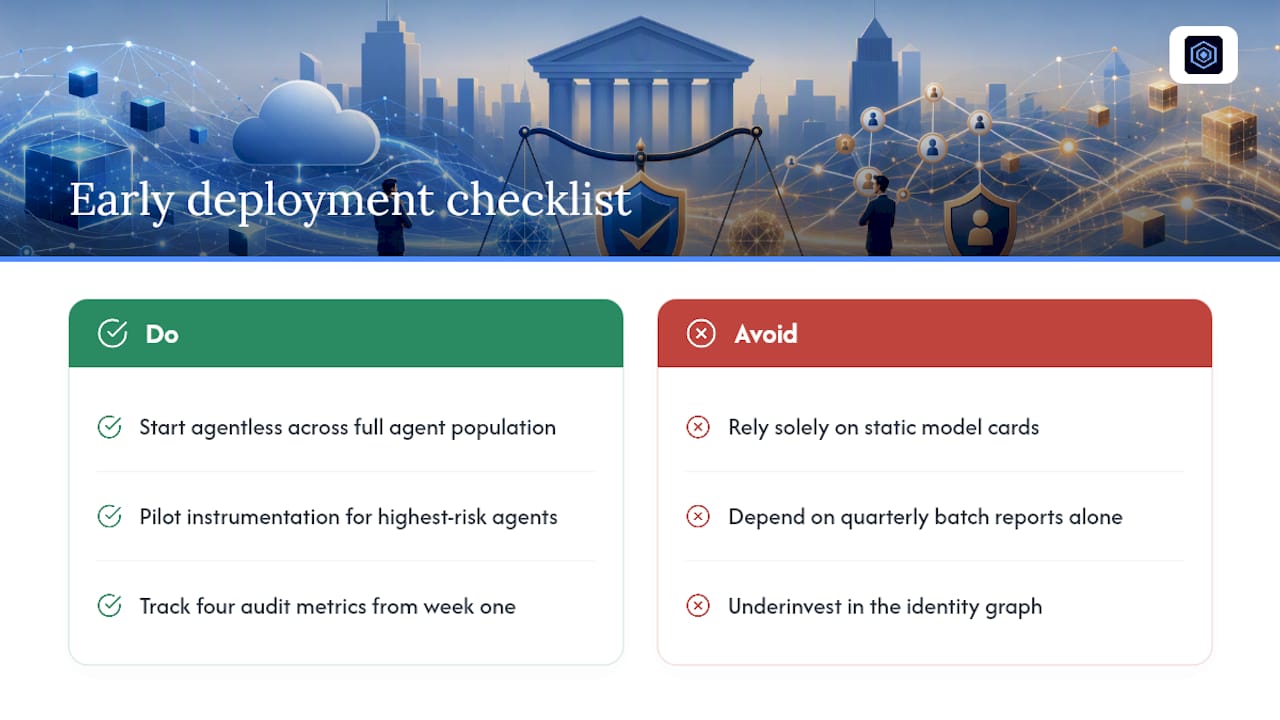
Start agentless across your full agent population, then pilot instrumentation only on the highest-risk agents you identify through exposure scoring. Firms that rely solely on static model cards or quarterly batch reports consistently discover gaps only after an incident, not before one.
Track four numbers from week one: coverage percentage, time-to-evidence when an auditor asks a question, escalation volume, and replayability rate on flagged decisions. The most common pitfall is not choosing the wrong architecture. It is underinvesting in the identity graph, so nobody actually knows how many agents are running until an audit forces the count.
— Eleye
How AETHER Pulse Delivers Agentless Governance in Practice
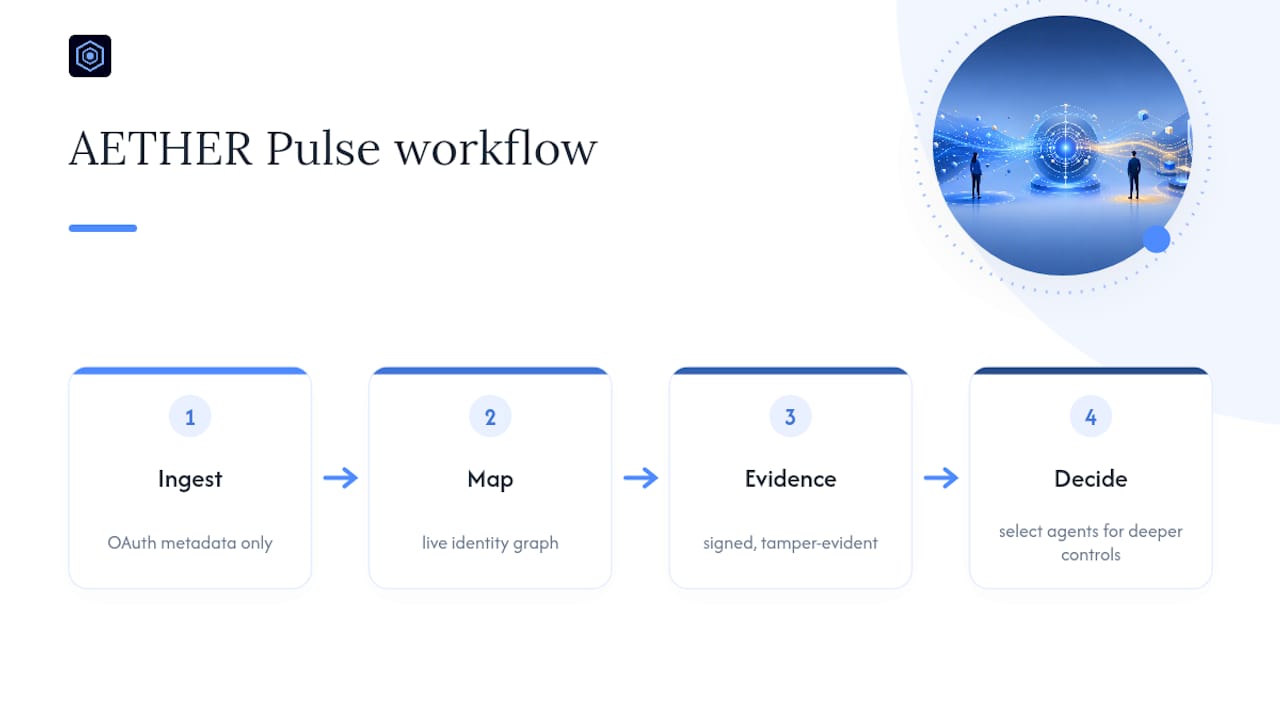
AETHER Pulse is a read-only, metadata-only governance layer built for exactly the deployment pattern this article describes. It ingests via OAuth, builds a live identity graph of every AI agent operating across your firm, and generates tamper-evident, cryptographically signed evidence packs on demand, without ever touching customer data.
That maps directly onto the decision rubric above: fast deployment for inventory and audit-readiness on day one, with the identity graph and risk-concentration mapping in place before you decide which agents warrant deeper, runtime-level instrumentation like a SAFR-style governance envelope. For firms weighing where to draw that line, the governance gap most existing tools leave open is usually the identity graph itself, not the evidence format.
If your team is preparing for an EU AI Act Article 26 conversation, an FCA SYSC review, or simply cannot answer "how many AI agents do we actually have running" with confidence, request a pilot at Aetherpulse and see what a signed evidence pack looks like against your own agent inventory.
Where to Go Next for Primary Sources
- SAFR (Monetary Authority of Singapore), the runtime governance checkpoint model referenced throughout this piece.
- NIST AI RMF, the US framework for structuring AI risk management functions.
- GOV.UK AI agents guidance, on consumer-law compliance obligations.
- AETHER Pulse, for agentless evidence-pack examples and compliance resources.
Recommended
Working on Article 26 readiness, deployer-side governance evidence, or AI agent risk at a regulated firm? We'd value 15 minutes of your perspective.
Start a conversation