Prove Your AI Agent Registry to Auditors in 90 Days for Finance
Prove Your AI Agent Registry to Auditors in 90 Days for Finance

An AI agent registry is a metadata-only, audit-grade inventory that binds every autonomous agent to verifiable, tamper-evident evidence. It does not inspect customer data. It answers the question regulators are now asking directly: can you prove, on demand, what each agent is authorized to do and what it actually did? Reference frameworks like the FSB consultation, MAS's SAFR model, and platforms like AETHER Pulse all point to the same conclusion: without this evidence layer, oversight claims are unverifiable.
TL;DR:
- Building an audit-ready registry requires continuous discovery of all deployed agents, including orphaned credentials, before schema enforcement.
- Identity verification and cryptographic signing of evidence packs are essential to meet regulator demands for real-time proof of agent actions and decisions.
- High-risk agents combining access to sensitive data, external content exposure, and outbound communication should be prioritized for manual review and strict control gates.
- Automating registry updates with deployment logs and enforcing control checks at each step create a current and trustworthy oversight record.
- An effective registry produces signed, timestamped evidence packs for each decision, ensuring tamper-evidence and traceability required for audits.
Table of Contents
- What Fields Does an AI Agent Registry Need to Satisfy Auditors?
- Why Do Regulators Now Expect a Formal Agent Registry?
- How Do You Build an Audit-Ready Agent Registry Step by Step?
- How Do You Keep the Registry Current and Audit-Ready?
- An Evidence-First Approach to Registry Design
- What Most Firms Get Wrong About Agent Oversight
- How Fast Can You Validate an Agent Registry Before Committing?
- Sources
What Fields Does an AI Agent Registry Need to Satisfy Auditors?
A registry that exists only to look tidy in a spreadsheet will fail the first serious audit. Every field has to answer a specific question an examiner or regulator will ask, not just describe the agent in general terms.
The minimum schema includes:
- Unique agent ID — links every log entry, disposition, and evidence pack to one traceable identity.
- Owner — a named accountable person, not a team distribution list, so escalation has somewhere to land.
- Identity and credential binding — the OAuth grant, API key, or service identity the agent authenticates with.
- Data access scope — what systems and data categories the agent can touch, stated narrowly.
- Tools and MCP connections — every downstream system or model-context-protocol link the agent can invoke.
- Lifecycle state — active, suspended, decommissioned, or pending review.
- Risk tier — assigned at registration and revisited on a fixed cadence.
- Last review date and provenance metadata — who reviewed it, when, and how the entry was captured.
This schema mirrors what practical inventory-building guidance recommends, and it maps directly to auditor questions: "Who is accountable for this agent?" is answered by the owner field; "What could this agent have done wrong?" is answered by data access scope and risk tier.
The runtime side matters as much as the schema. Identity verification confirms the agent making a request is the one registered. Metadata-only ingest means the registry observes grants, logs, and configuration rather than reading transaction content, which is precisely the approach Microsoft's Agent 365 work has shown improves lifecycle tracking without adding operational risk. A tamper-evident log and evidence-pack generator, using cryptographic signatures, turns those records into something an examiner can trust without re-verifying every entry by hand.
Why Do Regulators Now Expect a Formal Agent Registry?
Supervisory language has shifted from "explain your model" to "prove you can control your agents in real time." That shift is not theoretical. The FSB's August 2026 consultation moves past generic model governance and calls out agent autonomy risks specifically, including unauthorized actions and inadequate human oversight, and it recommends automated, metadata-driven escalation protocols rather than periodic manual reviews.
The regulatory center of gravity has moved from model-level assurance to runtime, agent-level evidence. A registry that only records which models a firm licenses will not satisfy an examiner asking what an autonomous agent did last Tuesday.
IOSCO's supervisory toolkit reinforces this by expecting compliance functions to be able to "challenge the algorithms" directly, which requires a registry or baseline an auditor can cross-reference against what actually happened in production. You cannot challenge what you cannot locate.
MAS's Safeguards for Agentic Finance at Runtime, known as SAFR, goes further by specifying architecture. It calls for four runtime components: Agent Identity, a Controls Repository, a Disposition Engine, and an append-only Audit Log. Governance checkpoints validate identity and produce tamper-evident records at the moment of decision, not after the fact.
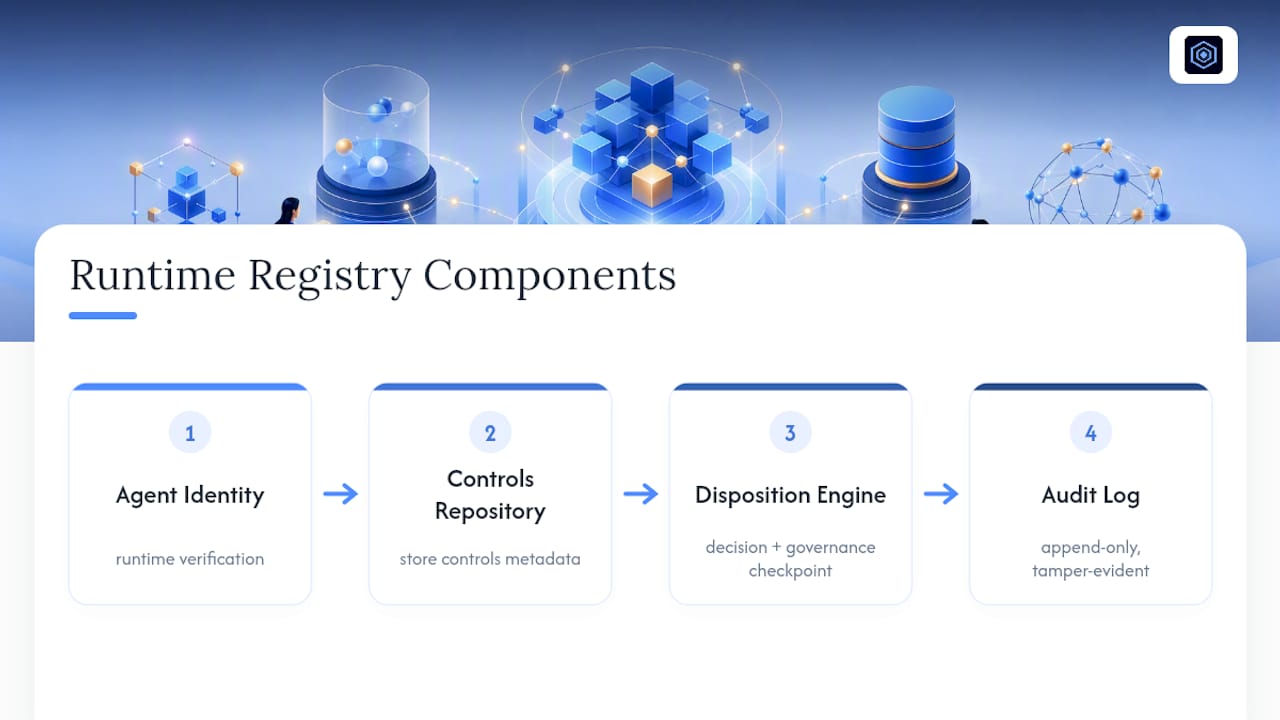
Translated into registry requirements, these expectations mean identity verification has to happen at runtime, not just at onboarding, and every decision needs a governance checkpoint logged alongside it. A registry built only for static inventory tracking will not meet either the FSB's escalation expectation or SAFR's runtime disposition model.
How Do You Build an Audit-Ready Agent Registry Step by Step?
Building a registry that survives an audit is a sequencing problem as much as a technical one. Skip a step and you end up with a catalog that looks complete but has gaps an examiner will find in minutes.
- Run continuous discovery. Pull OAuth grant logs, API key issuance records, secrets-manager entries, and CI/CD deployment metadata to surface every agent, including orphaned credentials nobody remembers granting.
- Enforce schema and ownership at registration. No agent goes live without a named owner, a risk tier, and a review-by date assigned automatically at intake.
- Bind identity before granting access. Use agent-specific IDs and OAuth metadata for closed-loop systems; for open networks, resolve identity through federated assertions mapped back into the local registry entry, since a SAFR-aligned approach treats these two contexts differently.
- Map controls to metadata. Connect registry fields like data access scope and tool connections to a controls repository so policy checks trigger automatically rather than through manual review.
- Run the disposition engine. Every proposed action gets evaluated against the controls repository and produces a disposition outcome, approve, escalate, or block, logged at the moment the decision happens.
- Package the evidence. Generate append-only audit records signed with HMAC-SHA256, capturing the agent ID, the governance envelope applied, the disposition, and a timestamp.
Capture-at-source is the detail that separates a registry that stays accurate from one that decays within a quarter. Registering agents from CI/CD pipelines and deployment code, rather than relying on someone updating a spreadsheet, keeps the inventory current and turns registration into an enforced control instead of an optional task.
Pro Tip: Treat any agent that combines access to sensitive data, exposure to untrusted external content, and outbound communication capability as an automatic high-risk flag. Practitioners call this the "lethal trifecta," and agents matching all three criteria belong at the front of your review queue, not the back.

How Do You Keep the Registry Current and Audit-Ready?
A registry is only as trustworthy as its update cycle. Static entries reviewed once a year will not satisfy a supervisor asking about an incident that happened last month, so review cadence has to match risk tier.
High-risk agents, those touching payment rails, customer funds, or regulated disclosures, warrant frequent review. Medium-risk agents can be reviewed periodically, and low-risk, internal-only agents can have less frequent reviews, provided the owner is named and accountable for triggering an early review if the agent's scope changes.
Automated triggers should connect the deployment pipeline directly to the registry: when an agent deploys, it registers; when it registers, a risk assessment runs automatically. Agents flagged under lethal-trifecta criteria should quarantine pending manual sign-off rather than wait in a standard review queue. For the highest-risk actions, non-overridable pre-commitment gates, meaning no human can bypass the block without a logged exception, give the registry teeth rather than just visibility. Every rejection needs to be logged with the same rigor as an approval, since auditors will ask about blocked actions as often as completed ones.
- Confirm the evidence pack includes the registry entry itself, the governance envelope applied, and the disposition record.
- Confirm each pack carries a cryptographic signature and a chain-of-custody note showing who generated it and when.
- Confirm quarantine and escalation events are timestamped and attributable to a specific rule, not a general "flagged for review" note.
| Evidence pack component | What it proves to an auditor |
|---|---|
| Registry entry | Agent identity, owner, and scope at time of action |
| Governance envelope | Which controls were applied before the action ran |
| Disposition record | The decision outcome and the rule that triggered it |
| Cryptographic signature | The record has not been altered since creation |
| Chain-of-custody note | Who generated the evidence and when it was exported |
An Evidence-First Approach to Registry Design
Eleye's work on agent governance keeps returning to one practical distinction: an inventory that lists agents is not the same as a registry that proves oversight. The inventory management guidance and evidence-versus-audit-trail analysis both make the case that auditors need signed, exportable proof, not a dashboard.
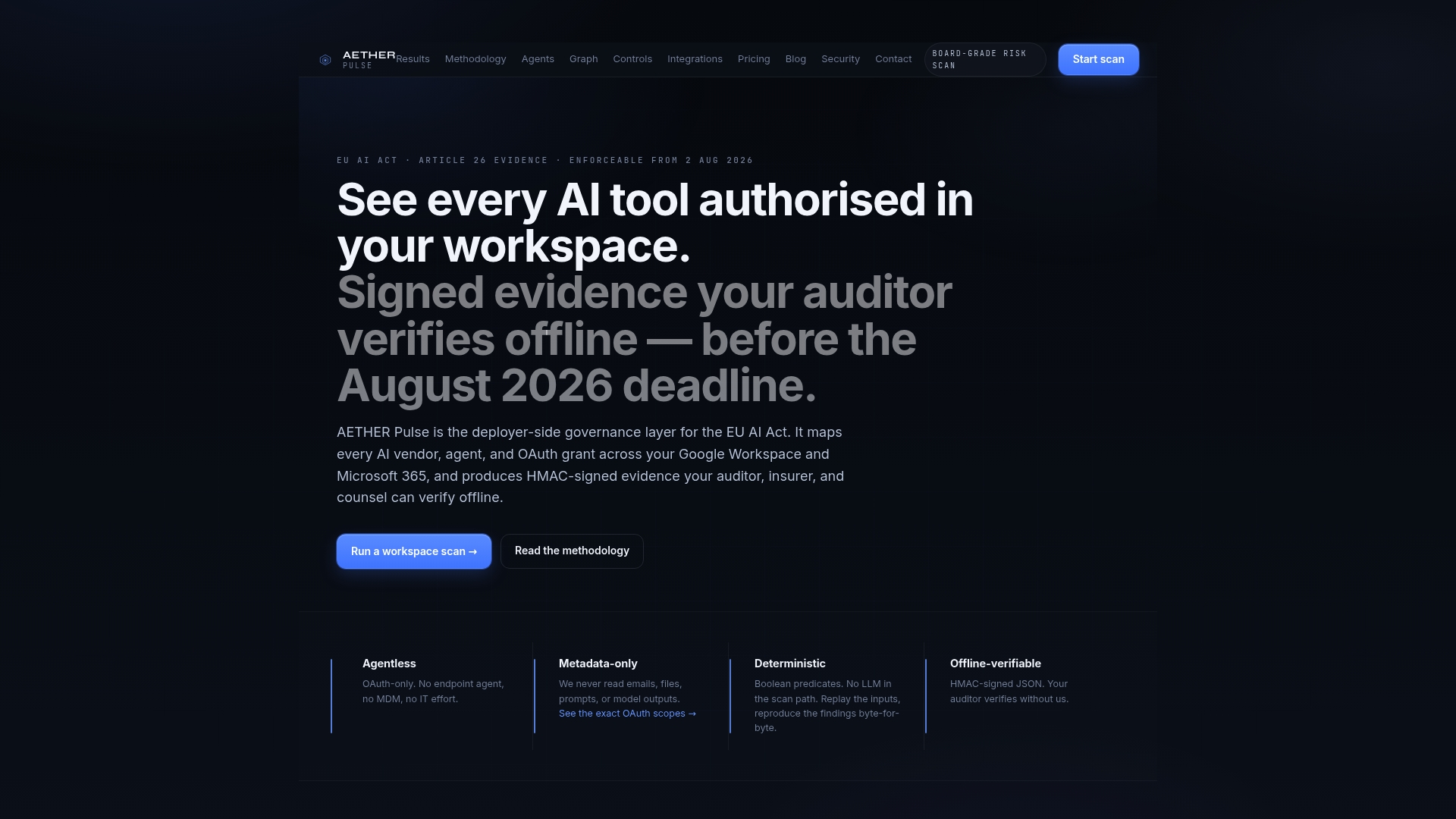
AETHER Pulse was built around that gap. It ingests through metadata only, never touching customer data, and generates tamper-evident evidence packs signed with HMAC-SHA256. That design lets compliance teams demonstrate oversight without adding a new system that itself needs governing.
What Most Firms Get Wrong About Agent Oversight
Most firms treat agent oversight as a documentation exercise: list the agents, note who owns them, file it away until the next audit cycle. That approach fails the moment a regulator asks for evidence tied to a specific decision on a specific date, because a static list has no timestamped record of what happened.
The conventional advice, "maintain an inventory," undersells what SAFR and the FSB are actually asking for. They want runtime evidence: identity verified at the moment of action, a disposition logged, a signature attached. An inventory satisfies the first question an auditor asks. It fails the second and third.
If you take one thing from this playbook, prioritize capture-at-source discovery before you touch schema design. A perfectly designed registry populated by manual entry will miss the agents nobody remembers deploying, and those are exactly the ones a regulator will ask about. Get discovery right first, then layer identity binding, controls mapping, and evidence packaging on top. Sequence matters more than sophistication here.
— Eleye
How Fast Can You Validate an Agent Registry Before Committing?
Vet any registry candidate against three evidence features before a pilot goes further: does it ingest via metadata only, does it sign evidence with a cryptographic standard like HMAC-SHA256, and can it export audit packs an examiner can review without a walkthrough?
A sensible pilot runs about 90 days. Start with continuous discovery to surface every deployed agent, populate the registry schema fully, then run one high-risk workflow through the full cycle, identity binding, controls mapping, disposition, evidence pack, so you have a concrete audit artifact in hand before deciding on a firm-wide rollout. AETHER Pulse is built for exactly this sequence: it connects through OAuth metadata only, builds the identity graph without touching production data, and produces the signed evidence pack at the end of the pilot rather than a promise of one. If you are ready to see what that evidence pack looks like against your own agent footprint, Aetherpulse and bring one high-risk workflow to test against it.
Sources
- IOSCO supervisory toolkit (2026)
- Safeguards for Agentic Finance at Runtime (SAFR)
- Implementing Agent 365 — governance and agent inventory at Microsoft
Recommended
Working on Article 26 readiness, deployer-side governance evidence, or AI agent risk at a regulated firm? We'd value 15 minutes of your perspective.
Start a conversation