AI Agent Shadow Deployment: A Compliance Guide
AI Agent Shadow Deployment: A Compliance Guide

AI agent shadow deployment is defined as a technique that runs a candidate AI agent against live production traffic in parallel, while returning zero outputs to users, enabling risk-free behavioral validation before any public release. For risk and compliance professionals in regulated industries, this distinction matters enormously. The technique sits at the intersection of AI agent deployment best practices and defensible regulatory oversight. Understanding AI shadow deployment is no longer optional for firms operating under the EU AI Act Article 26, FCA Consumer Duty, or SYSC requirements. Shadow deployment gives compliance teams a structured, evidence-generating method to validate AI agent behavior without exposing customers to unproven outputs.
What is AI agent shadow deployment?
AI agent shadow deployment is a pre-production validation technique where a candidate agent receives mirrored copies of live user requests but never returns its responses to those users. The production agent continues serving customers normally. The candidate agent processes the same inputs in isolation, and its outputs are captured for offline analysis only.
The term "shadow deployment" is the widely used industry phrase. In AI operations and MLOps literature, it also appears as "shadow mode" or "shadow testing." Both terms describe the same architecture. The core promise is zero blast radius: no customer sees a candidate response until the compliance and engineering teams have verified it meets every required standard.

Shadow mode serves as a critical pre-canary stage, allowing validation on real-world data without risking customer experience. Teams typically run a shadow deployment for one to two weeks before any canary rollout at 5–10% traffic. That sequencing gives risk committees a structured window to review evidence before approving wider release.
How does the technical architecture work?
Four core components make shadow deployment function without affecting production.
- Request duplicator. A proxy layer copies every inbound request and routes one copy to the production agent and one to the shadow agent simultaneously. The duplication happens before any response is generated.
- Asynchronous shadow path. The shadow agent runs on a fire-and-forget basis, meaning its processing never blocks the production response. If the shadow path fails or times out, the user sees no degradation.
- Comparison store. All shadow outputs, including inputs, tool traces, latency metrics, token counts, retrieval hits, and safety classifier scores, are logged to a separate data store for offline review.
- Kill switch. A feature flag such as
SHADOW_ENABLEDcan disable all shadow processing within seconds if system instability is detected, containing any resource or operational risk immediately.
Shadow deployment doubles computational cost because inference runs twice per request. Teams operating under budget constraints can apply sampling strategies, running the shadow path on a representative subset of edge cases rather than every request.
Pro Tip: Never route shadow traffic through the same compute queue as production traffic. Shared queues create the exact latency contamination that shadow deployment is designed to prevent.
How does shadow deployment differ from canary and A/B testing?
The three techniques serve different purposes and carry different levels of user exposure.
| Technique | User exposure | Primary use case | Risk level |
|---|---|---|---|
| Shadow deployment | None | Pre-release behavioral validation | Zero user risk |
| Canary deployment | 5–10% of users | Gradual rollout with live feedback | Low user risk |
| A/B testing | 50%+ of users | Comparative performance measurement | Moderate user risk |
| Blue-green deployment | Full traffic switch | Instant rollback capability | Low, post-validation |
Shadow mode is prioritized over A/B testing in risk-sensitive domains precisely because it keeps challenger model outputs internal during testing. A/B testing exposes real customers to an unvalidated agent. Shadow deployment does not. That difference is decisive for regulated firms where a single harmful output can trigger regulatory scrutiny.
The recommended sequencing in AI operations practice is: shadow deployment first, then canary rollout, then full release. Shadow deployment validates that the candidate agent produces no catastrophic failures or guardrail triggers. Canary deployment then measures live user response at controlled scale. Skipping the shadow stage removes the only zero-risk validation window available before customers are exposed.
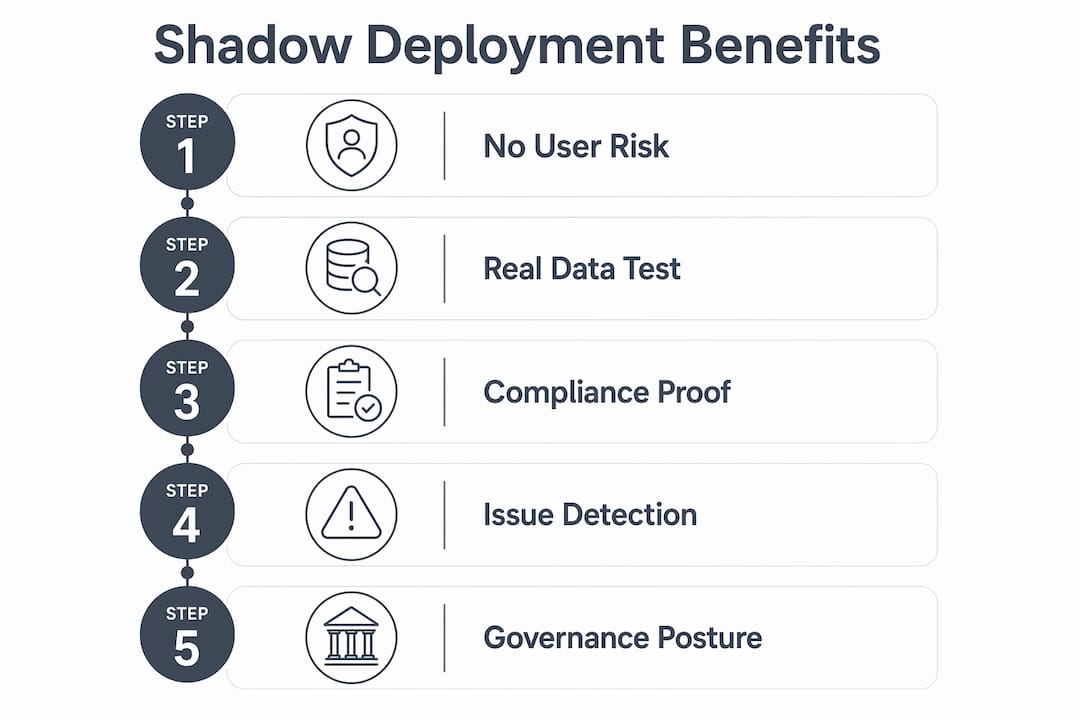
What compliance benefits does shadow deployment provide?
Shadow deployment provides deterministic provenance for compliance by logging inputs, outputs, tool traces, and latency across every mirrored request. That log becomes a forensic record. Compliance teams can replay any request, compare production and candidate outputs side by side, and identify regressions, policy guardrail triggers, or PII leakage before any user is affected.
For financial services firms operating under FCA Consumer Duty, this matters directly. Consumer Duty requires firms to demonstrate that automated systems produce fair outcomes. A shadow deployment log provides the evidence trail to show that a new AI agent version was tested against real customer traffic, that guardrail adherence was measured, and that no harmful outputs were observed before release.
Shadow deployments improve risk committees' and regulatory bodies' confidence by providing defensible evidence of model stability before exposure to users. A one-to-two week shadow run validates the absence of catastrophic failures or guardrail triggers under real traffic, giving compliance functions a structured basis for sign-off.
The compliance benefits extend beyond financial services. In healthcare, shadow deployment can detect whether a candidate agent produces clinically inappropriate recommendations before any patient interaction. In insurance, it can surface whether a new underwriting agent applies policy rules inconsistently across demographic groups. The common thread is that shadow deployments capture long-tail real-world scenarios that offline benchmarks never reach.
Shadow deployment is also directly relevant to EU AI Act Article 26, which requires deployers of high-risk AI systems to maintain logs sufficient for post-market monitoring. A properly instrumented shadow run generates exactly that log structure: timestamped, input-output paired, and traceable to specific agent versions.
- Regression detection: compare candidate outputs against production baselines to catch quality degradation.
- Guardrail auditing: verify that safety classifiers fire correctly on real traffic, not just curated test sets.
- PII leak detection: scan shadow outputs for personal data that should not appear in agent responses.
- Agentic drift monitoring: observe unexpected tool selection or memory protocol violations before public rollout.
- Cost projection: measure token consumption and latency on live traffic to forecast operational costs at full scale.
What should compliance teams know before implementing shadow deployment?
The most common architectural failure in shadow deployment is blocking production workflows with shadow processing. The shadow path must be strictly asynchronous. Background queue patterns, such as ctx.waitUntil in Cloudflare Workers, enforce that isolation at the infrastructure level. Any synchronous coupling between the shadow path and the production path defeats the zero blast radius guarantee.
Output comparison presents a second challenge that compliance teams often underestimate. AI agent responses are long-form and non-deterministic. Exact string matching produces no useful signal. Evaluating divergence requires LLM-as-a-judge models and structured scoring across dimensions such as semantic accuracy, tool-call sequence agreement, and tone consistency. Manual inspection at scale is not viable.
Sandboxing irreversible actions is the third critical requirement. When an AI agent can trigger external actions, such as sending an email, initiating a payment, or updating a customer record, the shadow environment must use mock tool endpoints rather than live integrations. Mirroring a live request that triggers a payment without sandboxing results in a duplicate transaction. That outcome is the opposite of zero blast radius.
Pro Tip: Build your kill switch before you deploy the shadow path. A feature flag that disables shadow processing in seconds is not optional infrastructure. It is the safety net that makes the entire technique defensible to a regulator.
Practical implementation checklist for compliance teams:
- Confirm the shadow path runs asynchronously with no shared compute queues with production.
- Mock all external tool endpoints in the shadow environment before mirroring live traffic.
- Define scoring rubrics for LLM-based evaluation before the shadow run begins, not after.
- Set a fixed shadow window, typically one to two weeks, with a formal sign-off gate before any canary rollout.
- Log all shadow outputs with cryptographic integrity controls so the evidence pack is tamper-evident.
- Budget for doubled inference costs and confirm resource allocation before enabling shadow mode.
Key Takeaways
AI agent shadow deployment is the only pre-release validation technique that generates defensible compliance evidence from real production traffic while exposing zero users to unvalidated outputs.
| Point | Details |
|---|---|
| Zero user exposure | Shadow deployment mirrors live traffic but never returns candidate outputs to users. |
| Compliance evidence | Logged inputs, outputs, and tool traces create a forensic record for regulators and risk committees. |
| Asynchronous isolation | The shadow path must never block production; fire-and-forget processing is the required pattern. |
| Sandboxing is mandatory | Mock all irreversible tool endpoints in the shadow environment to prevent duplicate real-world actions. |
| Pre-canary sequencing | Run shadow deployment for one to two weeks before any canary rollout to validate guardrail adherence first. |
Shadow deployment is not a checkbox. It is a governance posture.
I have reviewed AI governance frameworks across regulated firms for years, and the pattern is consistent. Teams treat shadow deployment as a technical nicety, something the engineering team handles before a model goes live. That framing is wrong, and it costs firms dearly when regulators ask for evidence.
Shadow deployment is the only technique that generates compliance-grade evidence from real production traffic without touching a single customer. Every other validation method, offline benchmarks, curated test sets, red-team exercises, operates on data that a regulator can reasonably dismiss as unrepresentative. Shadow deployment cannot be dismissed that way. The traffic is real. The inputs are real. The logged outputs are real. That is what makes the evidence defensible.
The misconception I encounter most often is that shadow deployment is expensive and therefore optional. Yes, it doubles inference costs. But the cost of a single regulatory enforcement action, or a single harmful output reaching a customer in a high-risk AI system, dwarfs any infrastructure budget. The math is not close.
The harder challenge is organizational. Shadow deployment requires compliance teams to engage with engineering before release, not after. It requires defined scoring rubrics, formal sign-off gates, and tamper-evident logging. Firms that treat it as a purely technical deployment step miss the governance value entirely. The firms that get it right build shadow deployment into their AI release process as a compliance control, not an engineering convenience.
— Eleye
Aetherpulse and the evidence layer your shadow deployment needs
Regulated firms running shadow deployments generate substantial logs. The question is whether those logs are defensible when a regulator asks for them.
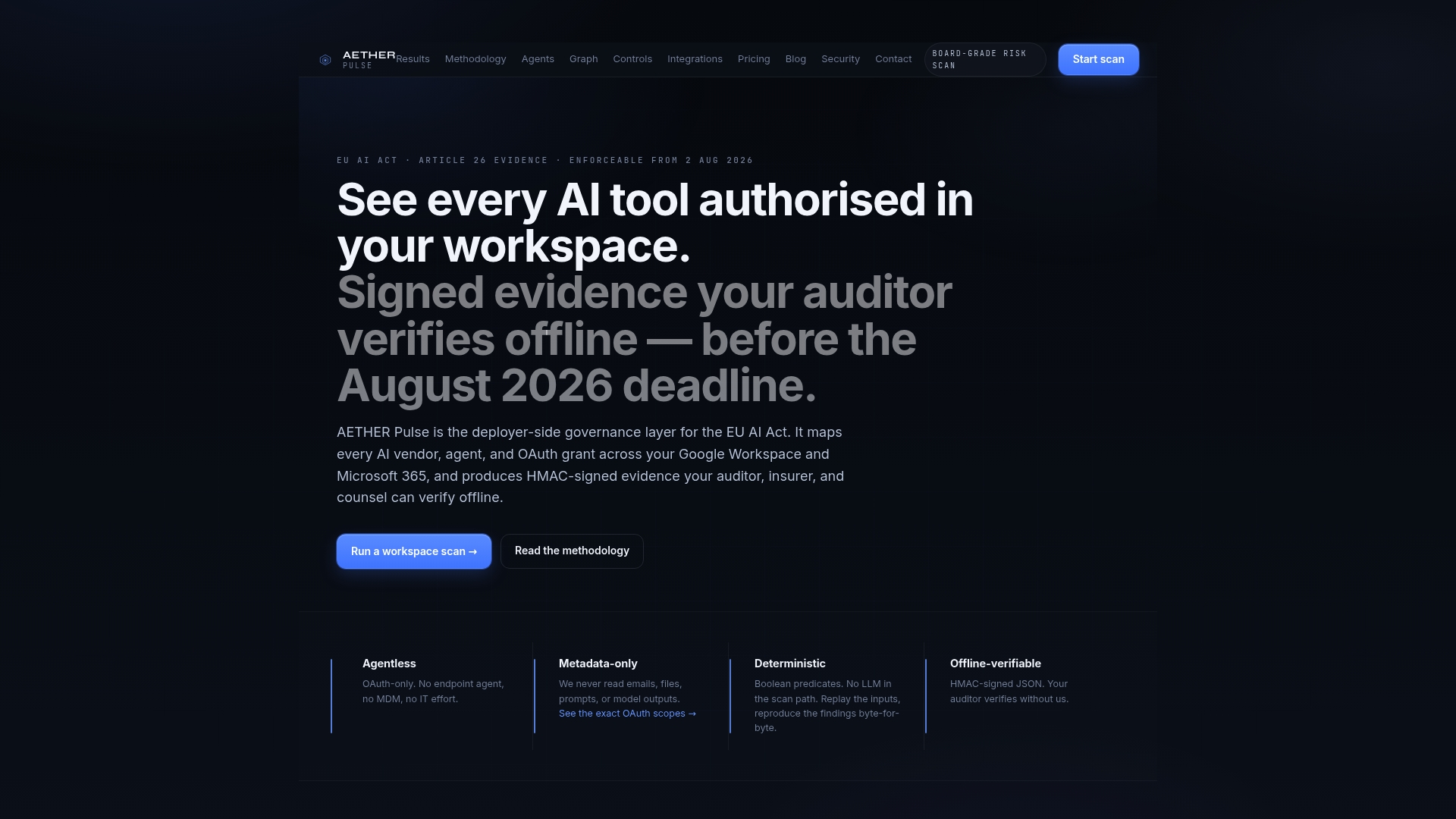
Aetherpulse is built for exactly that gap. The platform connects through OAuth metadata only, touching no customer data, and produces tamper-evident, HMAC-SHA256 signed evidence packs from your AI agent governance infrastructure. It builds an inventory and identity graph of your AI agents, surfaces financial blast-radius exposure, and generates provenance-tracked evidence on demand. For firms operating under EU AI Act Article 26, FCA Consumer Duty, or SYSC requirements, Aetherpulse turns your shadow deployment logs into audit-ready compliance documentation without inserting itself into production systems.
FAQ
What is AI agent shadow deployment in simple terms?
AI agent shadow deployment runs a candidate AI agent against live production traffic in parallel, but never returns its outputs to users. It is a zero-risk validation technique that generates compliance evidence from real-world data before any public release.
How long should a shadow deployment run before canary rollout?
A shadow run of one to two weeks is the standard practice before any canary rollout at 5–10% traffic. That window gives compliance teams sufficient real-traffic data to verify guardrail adherence and detect regressions.
Why is asynchronous processing required in shadow deployment?
The shadow path must run asynchronously so that any failure or latency in shadow processing never affects the production response. Synchronous coupling between the two paths violates the zero blast radius guarantee that makes shadow deployment safe.
How do compliance teams evaluate shadow deployment outputs?
Manual inspection does not scale for long-form, non-deterministic agent responses. LLM-as-a-judge models provide automated semantic scoring, tool-call sequence comparison, and tone analysis across the full shadow log.
What regulations require the kind of evidence shadow deployment produces?
EU AI Act Article 26 requires deployers of high-risk AI systems to maintain logs for post-market monitoring. FCA Consumer Duty and SYSC requirements expect firms to demonstrate oversight of automated decision-making. Shadow deployment logs, when cryptographically signed and tamper-evident, satisfy all three frameworks.
Recommended
Working on Article 26 readiness, deployer-side governance evidence, or AI agent risk at a regulated firm? We'd value 15 minutes of your perspective.
Start a conversation