AI Audit Readiness for Compliance Leaders: 2026 Guide
AI Audit Readiness for Compliance Leaders: 2026 Guide

Continuous, evidence-first AI governance is the single practical path to audit readiness for compliance leaders in regulated U.S. firms. Before reading further, take these immediate actions: build a centralized AI system inventory, assign a risk tier to each system, enable tamper-evident logging for high-risk models, designate an accountable owner per system, and confirm you can produce technical documentation for each system on demand—timing requirements for delivery are typically tiered by risk level. Auditors will request both governance records and runtime evidence — not one or the other.
Immediate checklist:
- Create or validate a centralized AI system inventory (name, owner, purpose, data inputs, decision authority)
- Classify each system by risk tier (high, medium, low) based on decision impact and regulatory exposure
- Enable tamper-evident, provenance-tracked logging for all high-risk systems
- Assign a named accountable owner for each AI system in your governance register
- Confirm you can produce a complete technical documentation package within a short, auditable timeframe (typically within 48 hours for high-risk systems, but timelines may vary depending on system risk tier and organizational policy)
Key Takeaways
Continuous, evidence-first AI governance mapped to NIST AI RMF and ISO/IEC 42001 is the only approach that produces audit-ready compliance programs capable of withstanding regulatory examination in U.S. regulated firms.
| Point | Details |
|---|---|
| Inventory first, always | A complete, current AI system inventory is the prerequisite for every other governance activity; without it, risk classification and controls mapping are guesswork. |
| Classify by risk tier | Assign high, medium, or low risk to each system based on decision impact and regulatory exposure; this drives resource allocation and controls depth. |
| Automate evidence collection | Manual evidence collection cannot keep pace with model updates and monitoring alerts; automated, tamper-evident logging is the operational standard auditors expect. |
| Map to NIST and ISO 42001 | Using both frameworks produces a unified control structure with a testable vocabulary that satisfies U.S. regulators and supports third-party certification. |
| Aetherpulse for continuous readiness | Aetherpulse's read-only metadata integration generates cryptographically signed evidence packs on demand, keeping your program audit-ready without accessing customer data. |
Table of Contents
- Why continuous AI audit readiness changes the compliance equation for U.S. regulated firms
- Core components of an AI audit-ready compliance program
- Which standards and frameworks should you map your controls to?
- Step-by-step implementation roadmap for compliance and audit leaders
- What should you require of AI governance tooling?
- What templates and artifacts should you prepare before an audit?
- Organizational roles, ownership, and KPIs that make ongoing assurance operational
- How auditors will test your AI controls and how to present evidence effectively
- Research-backed best practices and common pitfalls for AI audit readiness
- How Aetherpulse supports continuous AI audit readiness
- Sources
Why continuous AI audit readiness changes the compliance equation for U.S. regulated firms
Point-in-time audit preparation is structurally incompatible with how AI systems actually behave. A model trained in January may drift by March. A third-party AI vendor may update its algorithm without notifying your procurement team. An internal automation built on a foundation model may expand its decision scope without formal change control. Traditional annual audit cycles cannot capture any of this — and U.S. regulators are beginning to say so explicitly.
The distinction between continuous and point-in-time readiness is not semantic. Point-in-time readiness means assembling evidence when an audit is announced. Continuous readiness means maintaining a live, auditable record of every AI system's governance state at all times. The NIST AI Risk Management Framework structures this as a lifecycle discipline: govern, map, measure, and manage are not sequential phases to complete once but recurring activities that run in parallel across every deployed system.
U.S. regulatory momentum is accelerating. The Federal Reserve, OCC, CFPB, and SEC have each signaled heightened scrutiny of automated decision-making in credit, trading, and consumer-facing applications. The NIST AI RMF, while voluntary, is increasingly treated as the de facto baseline for demonstrating reasonable care. Firms that cannot map their AI controls to a recognized framework face a credibility gap in examiner conversations that documentation alone cannot close.
The business risk compounds quickly. Model drift in a credit-scoring system can produce disparate impact that triggers fair-lending exposure. Shadow AI — unsanctioned models deployed by business units outside the governance perimeter — creates liability that compliance teams may not discover until an examiner does. Reputational damage from a disclosed AI failure in a regulated context tends to be disproportionate to the underlying technical failure, because the governance failure is the story.
AI compliance requires ongoing monitoring, defined incident response for AI behavior, and governance that adjusts as technical and regulatory requirements evolve. That framing from IBM's practitioner guidance captures the operational reality: compliance leaders who treat AI governance as a project with a completion date will be perpetually behind.
Core components of an AI audit-ready compliance program
Building a defensible program requires assembling six interdependent components in a deliberate sequence. Attempting to build all six simultaneously typically produces shallow coverage across the board. The more effective approach is depth-first on the highest-risk systems, then breadth.
1. AI system inventory The inventory is the foundation. Every AI system — including third-party models, embedded vendor tools, and internally built automations — must be cataloged with its name, owner, purpose, data inputs, output type, and decision authority. Without a complete inventory, you cannot classify risk, assign controls, or demonstrate oversight. Centralizing this inventory and keeping it current is the first operational step in any credible program.
2. Risk classification Each inventoried system receives a risk tier based on the nature of its decisions, the populations affected, and the regulatory frameworks that apply. High-risk systems — those making or materially influencing credit decisions, fraud determinations, or customer-facing outcomes — require the most rigorous controls and the most complete evidence packs. Classification drives resource allocation.
3. Controls mapping For each risk tier, map specific controls to the requirements of your chosen frameworks (NIST AI RMF, ISO/IEC 42001, or both). Controls should be testable: a control that says "model outputs are reviewed" is not auditable; a control that says "a named reviewer signs off on model output samples weekly using procedure X, with results logged in system Y" is. Concrete artifacts for this component include control matrices, procedure documents, and test scripts.
4. Validation and testing High-risk systems require documented validation: bias testing, performance benchmarking, adversarial testing where applicable, and re-validation after material model changes. Artifacts include test plans, test results with timestamps, and sign-off records. Version control on model artifacts is non-negotiable — auditors will ask which model version produced which output.
5. Runtime monitoring Continuous monitoring means automated detection of model drift, anomalous output distributions, and threshold breaches, with alerts routed to accountable owners. AI compliance depends on re-validation protocols and post-market monitoring for high-risk systems. Manual monitoring is insufficient at scale; automated logging with tamper-evident records is the operational standard auditors increasingly expect.
6. Incident response Define what constitutes an AI-specific incident (unexpected output, bias detection, model failure, unauthorized model change), who is notified, what the remediation timeline is, and how the incident is documented. The incident log is a primary audit artifact.
Pro Tip: Start with risk concentration, not coverage. Map your two or three highest-risk AI systems completely before attempting to document lower-risk systems at all. An EY governance framework analysis confirms that governance programs succeed when they prioritize identifying risk concentrations early rather than pursuing perfect coverage from day one.
Integration with existing GRC platforms, third-party risk management workflows, and procurement processes should be planned from the start. AI system onboarding should trigger a risk classification review in the same way a new vendor relationship triggers a third-party risk assessment.
Which standards and frameworks should you map your controls to?
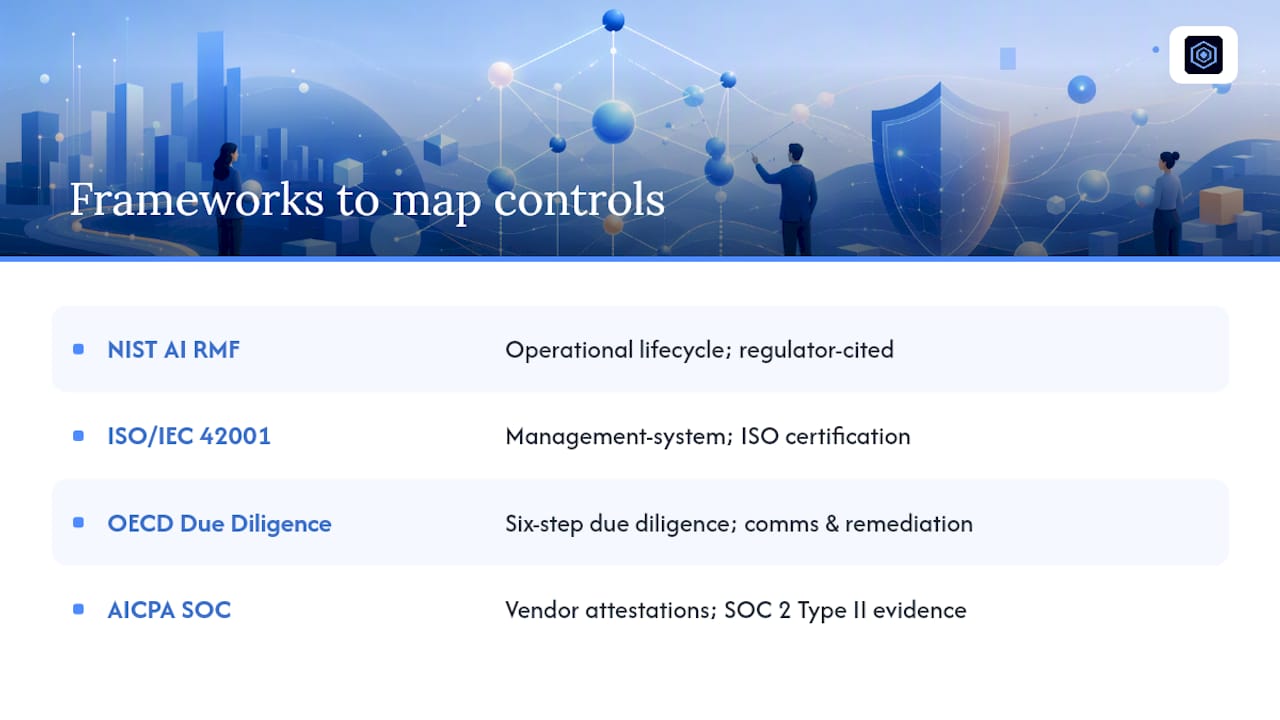
Four frameworks deserve priority attention for U.S. compliance leaders. Each serves a distinct function, and using them together produces a control structure that is both testable and recognizable to external auditors.
NIST AI RMF is the most operationally useful framework for U.S. firms. Its four core functions — Govern, Map, Measure, Manage — translate directly into program activities, and its profiles allow organizations to tailor controls to their risk appetite. NIST is the framework most likely to be referenced in examiner conversations with U.S. federal regulators. Use it to structure your lifecycle risk activities and to define testable controls at each stage.
ISO/IEC 42001 takes a management-system approach, similar in structure to ISO 27001 for information security. Its value for compliance leaders is the certification pathway: a third-party ISO 42001 certification provides an auditor with an independent maturity assessment that carries more weight than a self-attestation. Use it when your organization needs to demonstrate governance maturity to external stakeholders, regulators, or enterprise clients. The evidence types it emphasizes include management review records, internal audit results, and corrective action logs.
OECD Due Diligence Guidance for Responsible AI provides a six-step process: embed responsible AI into policies, identify and assess impacts, prevent and mitigate harms, track implementation, communicate with stakeholders, and remediate. This sequence maps well to enterprise risk management workflows and is particularly useful for structuring stakeholder engagement records and remediation documentation — both of which auditors request. For firms with regulatory disclosure obligations, the OECD framework's communication and remediation steps provide a practical template.
AICPA SOC frameworks become relevant when AI systems are delivered as services or when third-party AI vendors are part of your control environment. SOC 2 Type II reports from AI vendors provide attestable evidence of security, availability, and processing integrity controls. When designing your own attestable controls for AI-powered services, AICPA's trust service criteria offer a recognized structure that auditors understand.
The practical overlap between NIST and ISO 42001 is significant: both require documented risk assessments, defined roles and responsibilities, and evidence of control effectiveness. Mapping controls to both frameworks simultaneously is achievable with a single control matrix that cross-references each requirement. This approach avoids duplicating effort and produces a unified evidence set that satisfies multiple audit audiences.
Step-by-step implementation roadmap for compliance and audit leaders
The following phased roadmap reflects realistic timelines for a mid-size regulated firm building an AI audit readiness program from a low baseline. Firms with existing Existing GRC infrastructure and a partial AI inventory can compress Phase 1 significantly.
| Phase | Timeline | Key Deliverables | Primary Owners |
|---|---|---|---|
| Phase 1: Foundation | Months 0–4 | Complete AI inventory; risk classification for all systems; assign accountable owners; select primary framework (NIST AI RMF) | CRO / Head of Compliance, AI model owners |
| Phase 2: Controls build | Months 4–8 | Controls matrix mapped to NIST and ISO/IEC 42001; validation test plans for high-risk systems; runtime monitoring enabled; incident response procedure documented | Data governance, internal audit, AI model owners |
| Phase 3: Continuous assurance | Months 8–16 | Automated evidence collection live; evidence packs current for all high-risk systems; ISO 42001 gap assessment complete; independent assurance engagement scoped | CRO, external assurance, internal audit |
Phase 1 priorities:
- Conduct a compliance gap assessment to establish your baseline before committing to a framework mapping approach
- Engage AI model owners early; inventory accuracy depends on their participation
- Document the classification methodology so it can be applied consistently to new systems as they are onboarded
Phase 2 priorities:
- Pilot automated evidence collection on two or three high-risk systems before enterprise rollout
- Validate that your GRC platform can ingest AI-specific control evidence (model cards, test results, monitoring alerts)
- Conduct a tabletop exercise simulating an AI incident to test the incident response procedure
Phase 3 priorities:
- Bring in independent assurance (internal audit or external) to validate control effectiveness before a regulatory examination
- Scope the ISO 42001 certification decision based on stakeholder demand and regulatory signals
For a regulated firm starting from scratch, Phase 1 typically requires two to four full-time-equivalent weeks of compliance and technical staff time. Phase 2 effort scales with the number of high-risk systems and the maturity of existing GRC tooling. Firms with 10 or fewer high-risk AI systems can often complete Phase 2 with existing staff augmented by a specialist; firms with larger numbers of systems should plan for dedicated program management.
What should you require of AI governance tooling?
Procurement decisions for AI governance tooling carry direct audit consequences. A tool that cannot produce tamper-evident evidence, or that requires invasive access to production systems, creates both security risk and audit credibility problems. The following criteria should be non-negotiable in any vendor evaluation.
Evidence capture and integrity:
- Non-invasive evidence capture: the tool should not require write access to production AI systems or access to customer data
- Tamper-evident logging: evidence records must be cryptographically signed or otherwise protected against post-hoc modification
- Provenance tracking: every evidence artifact must carry a timestamp, a responsible owner identifier, and a chain-of-custody record
- Audit export formats: evidence packs must be exportable in formats auditors can review without proprietary tooling (PDF, structured JSON, or equivalent)
Security and privacy:
- Evaluate the vendor's data access model carefully: does the tool connect via read-only OAuth metadata, or does it require broader permissions? The governance-without-data-access model is the appropriate standard for regulated firms
- Request the vendor's SOC 2 Type II report and confirm the scope covers the components relevant to your use case
- Confirm data minimization practices: the tool should collect only the metadata necessary for governance, not operational data
Operational requirements:
- Role-based access controls that align with your RACI model
- Integration with existing GRC platforms (ServiceNow, Archer, or equivalent) and SIEM systems
- Scalability to cover your full AI system inventory without per-system configuration overhead
- SaaS tenancy model that meets your data residency requirements
Pro Tip: Include three contractual clauses in every AI governance vendor agreement: (1) a requirement for advance notification of any change to the vendor's evidence collection methodology, (2) an obligation to maintain an annual SOC 2 Type II or equivalent attestation, and (3) an evidence attestation clause confirming that exported audit packs are complete and unmodified. These clauses are rarely offered by default and are almost always accepted when requested.
AICPA SOC frameworks provide the recognized structure for evaluating vendor attestations. When a vendor cannot produce a SOC 2 Type II report, treat that as a material gap in your third-party risk assessment.
What templates and artifacts should you prepare before an audit?
Auditors conducting AI-related reviews will request a specific set of documents. Having these prepared in advance — not assembled reactively — is what separates a firm that controls the audit narrative from one that spends the first week of fieldwork in document retrieval.
Core artifact list:
- Model technical documentation: purpose, architecture summary, training data description, known limitations, performance metrics, and version history
- Human oversight procedure: who reviews model outputs, at what frequency, using what criteria, and how overrides are documented
- Post-market monitoring log: ongoing performance metrics, drift alerts, threshold breaches, and remediation actions with timestamps
- Risk assessment template: structured assessment covering data quality, bias risk, operational risk, and regulatory exposure for each system
- Incident report template: incident description, detection method, impact assessment, root cause, remediation steps, and closure sign-off
Evidence pack structure:
- Cover sheet: system name, risk tier, accountable owner, evidence pack version, and generation timestamp
- Governance section: model technical documentation, risk assessment, human oversight procedure
- Controls section: control matrix with test results and sign-off records
- Monitoring section: post-market monitoring log, drift alerts, threshold breach records
- Incident section: incident log with open and closed items
- Attestation: responsible owner signature and, where applicable, cryptographic hash of the pack contents
Versioning discipline is critical. Each evidence pack should carry a version number and a generation timestamp. When a model is updated, a new evidence pack version is created and the prior version is archived with a clear record of what changed. Auditors will request both governance records and technical evidence to validate controls, and they will check whether the evidence is contemporaneous with the period under review or assembled after the fact.
Automated tooling can populate and maintain most of these artifacts continuously. A practical AI audit checklist confirms that maintaining technical documentation and using continuous monitoring between formal audits are the two practices most directly correlated with audit readiness. Manual evidence collection, by contrast, introduces gaps, inconsistencies, and the appearance of reactive preparation — all of which raise auditor skepticism.
Organizational roles, ownership, and KPIs that make ongoing assurance operational
Governance without clear ownership is governance in name only. The following RACI model covers the core AI system lifecycle activities that compliance leaders must assign before any program can function.
| Activity | Responsible | Accountable | Consulted | Informed |
|---|---|---|---|---|
| AI inventory maintenance | AI model owners | Head of Compliance / CRO | Data governance | Internal audit |
| Risk classification | Compliance team | CRO | Legal, AI model owners | Board risk committee |
| Control testing | Internal audit | Head of Compliance | AI model owners | External auditors |
| Incident response | AI model owners | CRO | Legal, Compliance | Regulators (as required) |
| Evidence pack generation | Compliance / GRC team | Head of Compliance | AI model owners | Internal audit |
KPIs should be measurable, tied to risk appetite, and reported to the audit committee on a defined cadence. The following metrics provide a practical starting set:
- Percentage of AI systems inventoried: aim to inventory all systems promptly after program launch and measure regularly
- Percentage of high-risk systems with a current evidence pack: ensure evidence packs are kept current through frequent updates
- Mean time to detect model drift: monitor and set appropriate thresholds based on system impact
- Control failures remediated within SLA: track identified control failures and remediate timely
- Percentage of AI incidents with a completed incident report: strive for full completion of incident reporting to avoid audit findings
Control effectiveness reviews should occur quarterly for high-risk systems and semi-annually for medium-risk systems. The review should include the accountable owner, a compliance representative, and, at least annually, an internal audit representative. What good AI governance looks like in practice includes this kind of structured cadence — governance that only activates at audit time is not governance.
How auditors will test your AI controls and how to present evidence effectively
Understanding the auditor's test procedures in advance allows compliance leaders to structure evidence so that validation is fast and unambiguous. Auditors conducting AI-specific reviews typically follow a pattern that mirrors traditional IT general controls testing, adapted for the probabilistic and dynamic nature of AI systems.
Common auditor test procedures for AI:
- Re-performance of bias tests: auditors may request the test data and methodology used for bias evaluation and attempt to reproduce the results; version-controlled test scripts and seed values are required for this to be possible
- Model version verification: auditors will confirm that the model version in production matches the version documented in the technical documentation and the version used in validation testing
- Data lineage verification: tracing training data from source to model, including any transformations, to confirm data quality controls were applied
- Human oversight walkthrough: auditors will ask the named reviewer to demonstrate the oversight procedure, including how overrides are documented and escalated
- Log integrity check: auditors may attempt to verify that monitoring logs have not been modified after the fact; tamper-evident logs with cryptographic signatures satisfy this test directly
Evidence presentation:
- Provide a single evidence pack index that maps each control to its supporting artifact
- Label every document with the system name, control reference, version, and timestamp
- Where a control relies on automated logging, provide both the log export and a brief explanation of the logging mechanism
- For third-party AI systems, include the vendor's SOC 2 Type II report and any contractual evidence attestations alongside your own controls documentation
For AI explainability requirements that auditors increasingly test, prepare a plain-language explanation of how each high-risk model reaches its outputs, who can override those outputs, and what the override rate has been over the review period.
Regulator inquiries differ from audit fieldwork in pace and formality. When a regulator requests information about an AI system, the response timeline is typically shorter and the stakes of an incomplete answer are higher. Firms that maintain current evidence packs can respond to regulator inquiries in hours rather than weeks. Post-audit remediation should be tracked in the same incident management system used for AI incidents, with a named owner and a committed closure date for each finding.
Research-backed best practices and common pitfalls for AI audit readiness
The practitioner consensus on AI audit readiness has converged on a small number of high-impact practices. Cathy Cobey, EY's Global Assurance Responsible AI and Technology Risk AI Leader, has articulated the core principle clearly:
That framing aligns with the operational evidence. Programs that rely on manual evidence collection consistently underperform on audit because manual processes introduce gaps, inconsistencies, and delays that automated systems do not. The Databricks AI compliance framework analysis confirms that NIST AI RMF and ISO 42001 together provide a shared vocabulary and an auditable control structure that maps well to emerging binding regulations and third-party assurance approaches.
Common pitfalls to avoid:
- Overly strict governance that stifles innovation: governance frameworks that require lengthy approval processes for every AI experiment will be circumvented, producing the shadow AI problem they were designed to prevent. Build tiered governance: lightweight for low-risk, rigorous for high-risk
- Reliance on manual evidence collection: manual processes cannot keep pace with the rate of model updates, configuration changes, and monitoring alerts in a live AI environment; automation is not optional at scale
- Ignoring shadow AI: unsanctioned AI deployments by business units are the single largest inventory gap in most regulated firms; the inventory process must actively surface these, not wait for them to be self-reported
- Treating framework mapping as a one-time exercise: NIST AI RMF, ISO 42001, and OECD guidance all evolve; controls mapped today may not satisfy updated requirements in 18 months; build a review cadence into the program calendar
- Conflating documentation with governance: a model card that is never reviewed, a monitoring log that is never acted on, and a human oversight procedure that exists only on paper are not governance; they are the appearance of governance
Regulators audit AI agents specifically because autonomous systems can produce consequential decisions at scale without human review. The programs that perform best in regulatory examinations are those where the compliance team can demonstrate, not just assert, that oversight is real and continuous.
Why this guide frames continuous readiness the way it does
The framing in this guide reflects a specific conviction: that the compliance community's instinct to treat AI governance as a documentation project is the primary reason so many programs fail their first serious audit. Evidence packs assembled the week before an examination are distinguishable from evidence maintained continuously, and experienced auditors know the difference. Aetherpulse's position is that non-invasive, automated evidence capture is not a premium feature for large firms — it is the baseline requirement for any regulated organization that deploys AI in consequential decisions. The firms that will perform best in the next wave of AI-specific regulatory examinations are those that have already made continuous readiness an operational state, not an audit-season activity.
How Aetherpulse supports continuous AI audit readiness
Compliance leaders who have completed the inventory and classification steps in this guide face a consistent next challenge: keeping evidence current across a growing AI system portfolio without adding headcount. Aetherpulse addresses that directly.
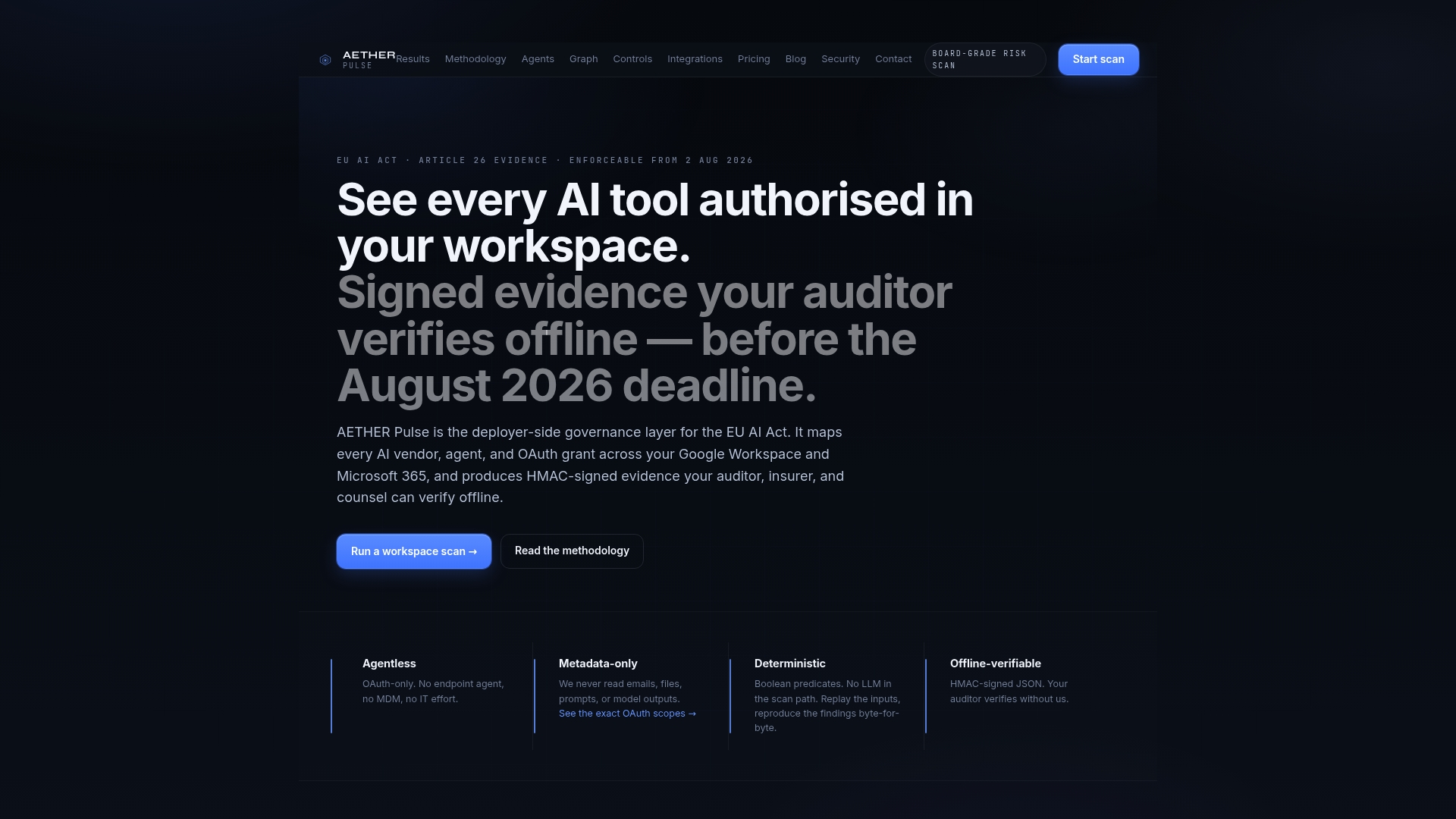
Aetherpulse connects to your AI agent environment via read-only OAuth metadata integration, touching no customer data and requiring no changes to production systems. It builds a live inventory and identity graph of your AI agents, surfaces risk concentration including financial blast-radius exposure, and generates tamper-evident, cryptographically signed (HMAC-SHA256) evidence packs on demand. Every evidence pack is provenance-tracked and audit-ready, structured to satisfy the documentation expectations of NIST AI RMF, ISO/IEC 42001, and relevant U.S. regulatory frameworks.
When evaluating Aetherpulse in a vendor conversation, ask for a demonstration of: evidence export formats and tamper-evidence proofs, standards mapping coverage, role-based access controls, and the metadata-only integration model. These are the criteria that determine whether a governance tool produces defensible audit evidence or merely the appearance of it.
Aetherpulse to see the evidence pack structure and integration model before committing to a procurement decision.
Sources
- Establishing AI governance with compliance and legal teams | EY - US
- OECD Due Diligence Guidance for Responsible AI
- NIST AI Risk Management Framework
- ISO/IEC 42001
- Responsible AI: Now that AI is part of your business, what does it mean for audits? | PwC
- AICPA SOC for Service Organizations (SOC) guidance
This article is general information, not a substitute for advice from a qualified lawyer. Consult a qualified legal professional about your own circumstances before acting on anything here.
Recommended
Working on Article 26 readiness, deployer-side governance evidence, or AI agent risk at a regulated firm? We'd value 15 minutes of your perspective.
Start a conversation