Measure and Gate AI Blast Radius: Audit Ready Controls for Risk Teams
Measure and Gate AI Blast Radius: Audit Ready Controls for Risk Teams

AI blast radius is the scope of damage an autonomous agent or automated change can inflict before someone notices and stops it. The working formula is blast radius equals access scope multiplied by operating velocity multiplied by detection window. The two levers that move the number fastest are bounding what an agent can touch and compressing how long it takes to notice something went wrong.
TL;DR:
- Controlling access scope is more effective than reducing operating velocity or detection window alone, as it dominates the blast radius formula.
- Practical measurement requires inventorying all tokens, permissions, and inherited entitlements, not just role labels, to accurately assess scope.
- Implementing real-time, operation-level audit logging and instant agent termination are crucial for shrinking detection windows and limiting damage.
- Dependency graphs built from source code, used in pre-deployment checks, provide deterministic and accurate reachability insights, reducing false positives.
- Monitoring should focus on operation-level logs and credential-based signals, with alert thresholds tailored to each agent’s blast-radius score for timely incident response.
Table of Contents
- What Does AI Blast Radius Mean in Practice?
- How Do You Calculate AI Blast Radius?
- Which Signals Actually Move Your Blast-Radius Score?
- Which Architectural Controls Actually Shrink the Radius?
- How Do You Operationalize These Controls Day to Day?
- What Do Real Incidents Teach Us About Detection Windows?
- How Does AETHER Pulse Support Blast-Radius Governance?
- What's the 90-Day Plan to Reduce Blast Radius?
- What Does Blast Radius Mean for Cybersecurity Strategy?
- What Are Best Practices for Monitoring AI Blast-Radius Incidents?
- What Tools Measure and Control AI Blast Radius?
- Why Most Blast-Radius Advice Skips the Hard Part
- Sources
What Does AI Blast Radius Mean in Practice?
Security teams have used "blast radius" for years to describe fault isolation: how far a server crash or network outage propagates through dependent systems. AI blast radius borrows the term but points at a different failure mode. It describes what happens when an autonomous agent, or a change an agent initiates, executes actions faster and at a wider scope than a human operator ever could, and does so before anyone catches the error.
The distinction matters because the controls are different. Fault-isolation blast radius gets addressed with redundancy, circuit breakers, and failover. AI agent blast radius gets addressed by constraining what the agent is authorized to do and how quickly its actions surface in a log a human can review.
A related trap is confusing an IAM role label with effective access. A service account labeled "read only reporting" can still hold inherited entitlements from a third-party integration, a stale OAuth grant, or a transitive credential buried in a CI/CD manifest. The label says one thing; the graph of actual reachable systems says another.
- Production context: highest stakes, requires operation-level logging and the tightest access bounds.
- Staging context: lower stakes but still worth measuring, since staging credentials often leak into production paths.
- Development context: lowest immediate stakes, but the place where over-broad grants usually originate.
How Do You Calculate AI Blast Radius?
The formula is simple to write and hard to measure honestly: blast radius = access scope × operating velocity × detection window. Each variable requires its own query against real infrastructure, not an assumption based on a role name.
- Inventory access scope. Pull every token, OAuth grant, and service-account permission an agent holds, then trace inherited and transitive entitlements through CI/CD manifests and image pins, not just the direct grant.
- Measure operating velocity. Count operations per minute, batch size, and concurrency across every agent instance running the same credential set.
- Estimate the detection window. Check how long it takes your logging and SIEM pipeline to surface an anomalous action, from execution to alert.
- Compute and rank. Multiply the three figures into a relative score, then rank agents and workflows by that score rather than by how "important" they seem.
Statistic to anchor this: a single compromised system can reach up to 85% of an environment in one hop, which is why access scope, not raw agent capability, tends to be the dominant term in the equation.
A worked example: an agent with write access to 40 downstream repositories, running 200 operations per minute, sitting behind a detection window of six hours, scores far higher than an agent with the same access but a five-minute detection window. The formula gives a relative ranking, not an absolute dollar figure. Treat it as a prioritization tool, and pair it with a deterministic dependency graph rather than an LLM's best guess at what's connected to what.
Which Signals Actually Move Your Blast-Radius Score?
Not every metric available in your dashboards maps to the formula. These do:
- Access scope signals: token scopes, inherited permissions from third-party providers, OAuth grants, and service-account breadth across environments.
- Velocity signals: operations per minute, batch size per run, and concurrency when multiple agent instances share credentials.
- Detection signals: logging granularity (operation-level versus infrastructure-level), SIEM ingestion latency, and alert threshold tuning.
Infrastructure logs alone are rarely enough. Teams that rely only on network and system logs, without operation-level audit records, routinely face detection windows measured in weeks or months, because there's no record of what the agent actually did at the API call level, only that a server made a request.
Three KPIs worth tracking on a standing dashboard:
- Percentage of operations covered by operation-level audit logging.
- Median detection latency, from action to alert.
- Downstream consumer count per agent or credential, updated from a live graph rather than a static diagram.
Pro Tip: Don't audit agents by name. Audit by credential. Two agents sharing one over-scoped service account behave as a single, much larger blast radius than either appears to be individually.
Which Architectural Controls Actually Shrink the Radius?
Bounding access scope and compressing detection windows are architectural decisions, not policy documents. Four controls do the heavy lifting.
Operation-level ABAC beats service-account scoping. Attribute-based access control that evaluates each operation against context (which resource, which action, which time) constrains an agent far more precisely than a broad service-account grant ever can. A service account either has repository write access or it doesn't; ABAC can permit a write to one path and block it to another, based on live attributes.
Real-time audit logging compresses the detection window. Logging at the operation level, not just the infrastructure level, means every agent action lands in a queryable record within seconds rather than surfacing during a post-incident forensic review.
Agent termination and egress controls cap accumulation. Once an anomaly is flagged, the damage that accrues between detection and remediation depends entirely on how fast you can kill the agent's session and cut its egress path.
Queryable dependency graphs make pre-deploy checks deterministic. A graph that returns the actual set of downstream consumers, built from source rather than finished artifacts, gives a consistent answer every time it's queried, unlike an LLM inferring relationships from a codebase.
Deterministic graphs built from source, not finished manifests, provide faster and more accurate reachability answers at scale, and they cut the false positives that plague manifest-only scanning.
These four controls compound. ABAC without real-time logging still leaves you blind to when a boundary gets tested; logging without a kill-switch tells you what happened but doesn't stop it happening again in the next minute.
How Do You Operationalize These Controls Day to Day?
Architecture only matters if it's enforced at the moment a change ships, not discovered afterward in a postmortem.
- Wire a dependency-graph query into the merge pipeline. Before a pull request merges, call a queryable cross-repo graph for the transitive set of affected consumers; a high-confidence, high-radius result blocks the merge automatically, while a medium-confidence result routes to a human reviewer.
- Convert irreversible operations into reversible ones. Feature flags, staged rollouts, and reversible database migrations shrink the surface of what a bad change can do, which tends to be more reliable than trying to detect every possible failure after the fact.
- Define approval bands tied to the blast-radius score. Low-radius changes auto-approve; mid-radius changes need a team lead; high-radius changes need a named risk or compliance sign-off, categorized by blast-radius band rather than by team.
- Run the incident runbook the moment a blast-radius event fires. Terminate the agent session, cut egress, pull the operation-level log for the affected window, and notify the owning team identified in the dependency graph, not just the on-call rotation.
Our audit-ready guide to AI model change management walks through how these approval bands map to actual sign-off workflows inside a regulated firm.
What Do Real Incidents Teach Us About Detection Windows?
Three incidents illustrate how blast radius accumulates when detection lags behind velocity and scope.
- Synapse. A banking-as-a-service provider's failure left customers locked out of funds for months, not because of a hack, but because a single intermediary held concentrated operational control over ledgers that dozens of fintechs depended on.
- Travelex. A ransomware incident that spread across interconnected systems showed how a narrow initial compromise can widen fast when segmentation between environments is thin.
- CrowdStrike-related outages. Widespread system failures from a single faulty update demonstrated how a narrow technical error, pushed at scale and velocity, produces an outsized blast radius when detection and rollback lag behind deployment.
Statistic worth sitting with: these cases are part of why DORA now requires concentration risk assessment across internal, systemic, geographic, and interdependency dimensions, not just single-vendor risk.
A technical parallel: a database migration that quietly renamed a column broke a downstream reporting pipeline nobody had documented as a consumer. The fallout wasn't the migration itself, it was the weeks it took to trace which teams depended on that column. A queryable dependency graph would have surfaced that consumer before the migration merged.
How Does AETHER Pulse Support Blast-Radius Governance?
Aetherpulse approaches blast-radius control from the compliance evidence side of the problem. It connects to a firm's AI agent ecosystem through metadata only, via OAuth, touching no customer data, and builds an inventory and identity graph of every agent in operation.

That graph surfaces risk concentration, including financial blast-radius exposure, without inserting an agent-based tool into production systems. When an auditor or regulator asks for proof of oversight, Aetherpulse generates tamper-evident, cryptographically signed evidence packs using HMAC-SHA256, which compresses what used to be a weeks-long forensic reconstruction into an on-demand export. For compliance teams working against EU AI Act Article 26 or FCA SYSC deadlines, that's the difference between assembling evidence from scratch and pulling a signed record that's already provenance-tracked. Our guide to governance without data access covers the mechanics in more depth.
What's the 90-Day Plan to Reduce Blast Radius?
Prioritization beats a comprehensive rebuild. Sequence the work in three phases.
- Days 1 to 30: complete an access inventory across all agents, narrow any emergency or break-glass access still active from onboarding, and enable operation-level logging wherever it's technically feasible today.
- Days 30 to 60: add pre-deploy dependency-graph gates to the merge pipeline, move at least one irreversible workflow to staged rollout, and assign named owners for every downstream system the graph surfaces.
- Days 60 to 90: deploy operation-level ABAC for the highest-scoring agents, integrate signed evidence packs into the audit cycle, and automate blast-radius scoring so it updates on every credential or access change.
| Milestone | What "done" looks like |
|---|---|
| Access inventory | Every agent's effective access mapped, including inherited entitlements |
| Detection window | Reduced from days/weeks to minutes for top-scoring agents |
| Gated operations | High-radius changes blocked or routed to review pre-merge |
| Time-to-evidence | Signed audit pack producible on demand, not reconstructed manually |
Our incident response compliance workflow breaks the 60 to 90 day phase into a runbook you can hand directly to an on-call team.
What Does Blast Radius Mean for Cybersecurity Strategy?
Blast radius reframes risk management from asset-counting to reachability-mapping. A traditional risk register asks "what could go wrong with this system?" Blast-radius thinking asks "if this credential is compromised or this agent misfires, how far does the damage travel before anyone notices?" That's a graph question, not a spreadsheet question.
The strategic implication is that segmentation and identity hardening now do more risk-reduction work per dollar than perimeter defense. Since a single compromised system can reach the majority of an environment in one hop, the return on tightening lateral movement paths tends to outpace the return on adding another layer of edge detection.
It also changes how risk committees should score AI initiatives. A project's blast-radius score, not just its business value, should factor into approval thresholds. Two agents with identical business cases can carry very different risk profiles depending on access scope and detection maturity, and treating them the same at the approval stage is how concentration risk builds unnoticed. Our partner analysis of DORA identity controls covers how regulators are starting to expect this kind of reachability thinking baked into governance frameworks directly, not bolted on after an incident.
Risk management strategies that don't incorporate a blast-radius score are, in effect, measuring severity without measuring reach.
What Are Best Practices for Monitoring AI Blast-Radius Incidents?
Monitoring effectiveness comes down to whether your logs answer the right question fast enough. Infrastructure-level logs tell you a server was hit. Operation-level logs tell you which function was called, with what parameters, by which credential, at what timestamp, which is the record you actually need to contain an incident.

Feed that operation-level data into your SIEM with alert thresholds calibrated to the blast-radius score of the agent generating the activity, not a flat threshold applied uniformly across every service account. A high-radius agent should trigger an alert on a smaller deviation from baseline than a low-radius one.
When an incident fires, the response sequence matters more than the tooling. Terminate the agent session first to stop accumulation, then cut egress paths, then pull the operation-level log for the exact window in question, and only then start root-cause analysis. Teams that reverse this order, starting with root-cause before containment, tend to let the blast radius keep expanding while they investigate.
Post-incident, feed what you learned back into the dependency graph and the ABAC policy set. An incident that reveals an undocumented downstream consumer is a graph update, not just a lessons-learned document. Treat organizational ownership mapping as part of the response too: SLA breaches and team overload are frequently the dominant damage vector in a blast-radius event, more than the technical failure itself.
What Tools Measure and Control AI Blast Radius?
The tooling category splits into three functions, and most organizations need capability in all three rather than a single platform that claims to do everything.
Dependency-graph engines answer the reachability question deterministically. Tools that expose a queryable, cross-repo graph, built from source rather than finished artifacts, let a CI/CD pipeline ask "what does this change touch?" and get a consistent answer instead of an LLM's inference. Operationalizing this well requires a fast, cacheable graph API paired with a confidence band, so high-confidence high-radius results block a merge automatically while medium-confidence results route to a human review queue.
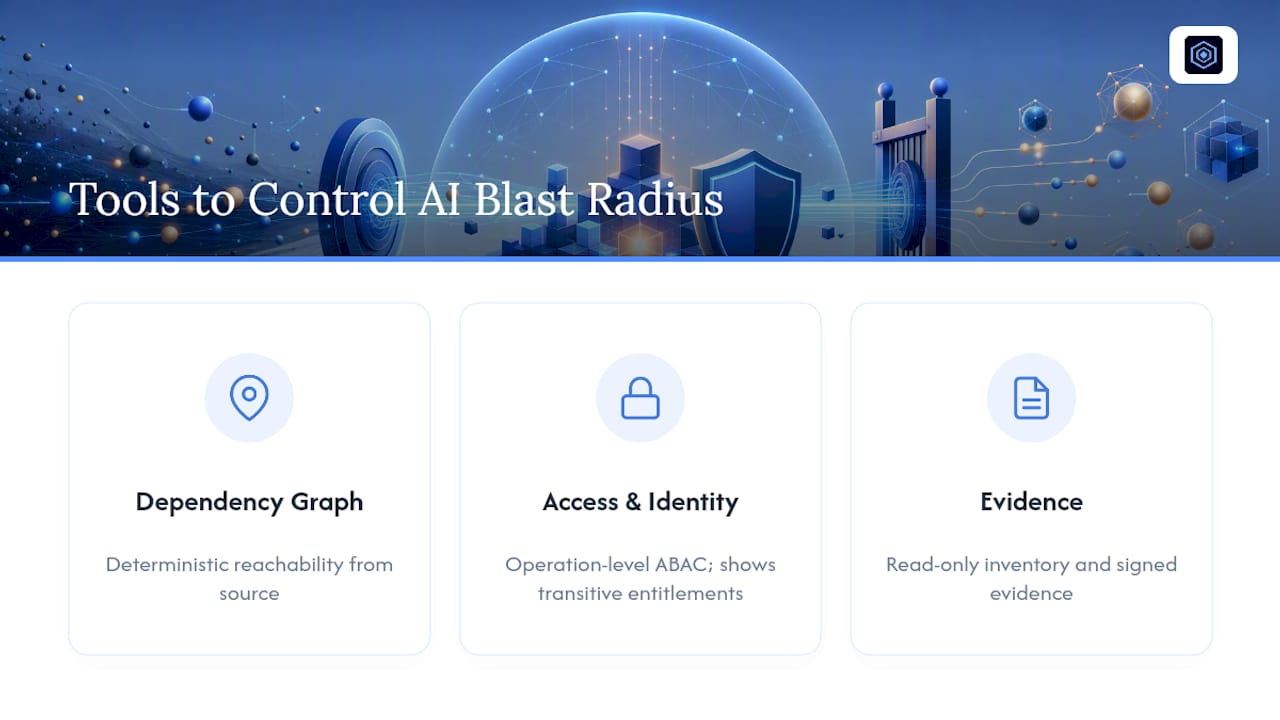
Access and identity platforms handle the scope side of the formula, enforcing operation-level ABAC instead of coarse service-account grants and surfacing inherited or transitive entitlements that standard IAM consoles don't show.
Evidence and governance layers handle the audit trail. This is where a metadata-only, read-only platform like Aetherpulse fits: it doesn't touch production or customer data, but it builds the agent inventory, identity graph, and signed evidence pack that compliance teams need to demonstrate oversight to a regulator, without adding another invasive agent to the stack.
No single tool replaces the calculation discipline. The formula, access scope times velocity times detection window, is what tells you where to point any of these tools first.
Why Most Blast-Radius Advice Skips the Hard Part
Most guidance on this topic stops at the formula. Access scope times velocity times detection window is a clean equation, and it's genuinely useful, but treating it as the finish line misses where the real friction sits: nobody wants to be the person who blocks a merge because a graph query returned a "medium confidence" result.
That's the gap conventional advice leaves open. Teams build the dependency graph, they wire up the ABAC policy, and then the first time a high-radius change gets flagged, someone overrides the gate because a deadline is closer than the risk feels. Consequence-based approval bands only work if the band assignments are enforced by something other than goodwill, which is why evidence matters as much as the control itself.
Prioritize detection window first, not access scope. Access scope reduction is slower, political, and touches every team's workflow. Compressing detection from weeks to minutes through operation-level logging is faster to deploy and buys you the time to fix scope properly, without a live agent doing damage in the interim.
If there's one thing worth abandoning, it's the instinct to treat blast radius as a one-time audit. It's a live number that changes with every new OAuth grant and every new agent deployment, and it deserves the same standing attention as uptime.
— Eleye
Ready to turn blast-radius scoring into audit-ready evidence without touching your customer data? See how Aetherpulse maps agent inventory and concentration risk for regulated firms.
Sources
- AI Agent Blast Radius: Risks of Ungoverned Failures at Scale — Kiteworks
- Blast radius modeling: measure real breach damage — Secure
- What CrowdStrike, Travelex and Synapse tell us about blast radius in financial services — Kusari
- Blast Radius Analyzer — Amit Gambhir
- AI agent blast radius and graph-based mitigation — Riftmap
Recommended
Working on Article 26 readiness, deployer-side governance evidence, or AI agent risk at a regulated firm? We'd value 15 minutes of your perspective.
Start a conversation