AI Governance Evidence Lifecycle Explained for Financial Firms
AI Governance Evidence Lifecycle Explained for Financial Firms

The AI governance evidence lifecycle is defined as the structured chain of controls, records, and verifiable artifacts that track an AI system's decisions and behaviors from initial deployment through decommissioning. For compliance and risk management professionals in financial services, this lifecycle is the operational backbone of audit readiness. 80% of Fortune 500 companies now deploy active AI agents, yet only 25% have governance frameworks mature enough to satisfy regulators. That gap is exactly where the evidence lifecycle closes the exposure. Named human accountability, provenance tracking, and structured evidence packs are not optional features. They are the minimum standard regulators now expect.
What are the key stages of the AI governance evidence lifecycle?
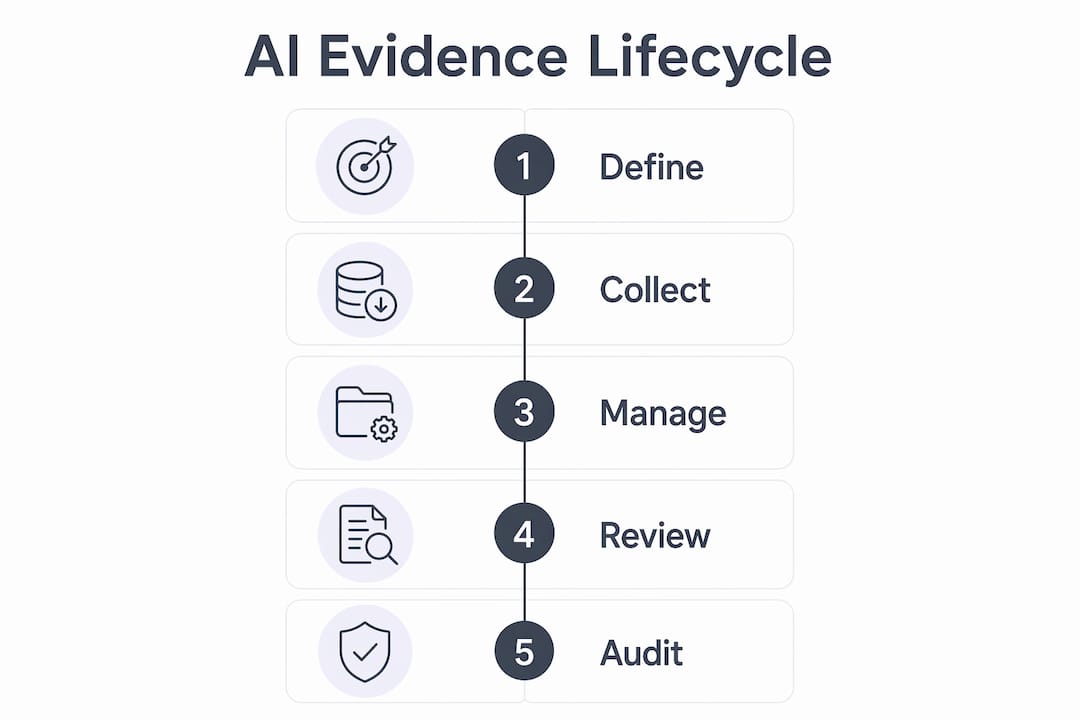
AI governance manages the full lifecycle from data collection and model training through deployment, monitoring, and decommissioning. Each stage generates distinct evidence artifacts. Compliance teams that treat governance as a single point-in-time review will always be behind.
The four core stages work as follows:
-
Pre-deployment. This stage covers data provenance, model documentation, and policy mapping. Every AI system entering production needs a documented data lineage, a named human owner, and a clear mapping to the regulatory obligations it touches. Without this, you cannot reconstruct the basis for any decision the model later makes.
-
Deployment. Approval gates are the control point here. Embedding approval gates in deployment pipelines enables continuous runtime assurance rather than post-hoc review. This is the same logic that CI/CD pipelines apply to software releases. Each gate produces a timestamped record of who approved what and under which conditions.
-
Post-deployment monitoring. Continuous monitoring for drift, bias, vulnerabilities, and compliance gaps is mandatory to prevent regulatory findings. Monitoring must produce machine-readable logs, not just dashboards. Incident records and bias detection outputs become evidence artifacts that auditors can inspect.
-
Decommissioning. Retiring an AI system is not a governance endpoint. Evidence archives must be closed cleanly, downstream dependencies documented, and any residual risk formally signed off. The evidence lifecycle is a continuous loop that starts with provenance and clears the audit trail only at decommissioning.
Pro Tip: Map each lifecycle stage to a specific regulatory obligation before you build your evidence collection process. A pre-deployment checklist tied to EU AI Act Article 26 requirements will produce far more defensible artifacts than a generic governance template.
How does the evidence lifecycle support regulatory compliance in financial services?

Three major regulatory milestones now define the compliance calendar for AI governance. Texas RAIGA takes effect January 1, 2026, the Colorado AI Act on June 30, 2026, and the EU AI Act on August 2, 2026. Each imposes specific evidence requirements. Firms that cannot produce structured records on demand will face enforcement exposure.
The practical answer to regulatory pressure is structured evidence packs. Audit-ready evidence packs must be concise, board-approvable, and structured as decision-reason-timestamp triplets for effective risk mapping. That triplet format matters because it answers the three questions every regulator asks: what decision was made, why was it made, and when did it happen.
Named human accountability is the second pillar. Named human owners are critical for operational risk management and regulatory accountability in any mature AI governance program. Without a named owner, an AI system has no one to answer for its outputs when a regulator or auditor asks. This is not a theoretical risk.
- Evidence packs must link each AI decision to a specific control and a named accountable individual.
- Regulatory inquiries in financial services typically require a response within days, not weeks. Pre-built evidence packs compress that response time significantly.
- FCA Consumer Duty and SYSC requirements in the UK demand that firms demonstrate oversight of automated decision-making, not just document that it exists.
- EU AI Act Article 26 places specific obligations on deployers of high-risk AI systems, including maintaining technical documentation and logs sufficient to reconstruct decisions.
The governance evidence lifecycle is what makes these obligations operationally achievable rather than aspirational.
What are common challenges and risks in managing AI governance evidence?
The most pervasive problem in AI governance evidence management is phantom ownership. 91.4% of strategic AI governance measures tracked across 988 organizations lack updated ownership. That figure means the named owner on record is frequently the wrong person, a former employee, or an entire team with no individual accountability. Auditors find phantom owners immediately. Regulators treat them as a control failure.
Transitive delegation risk is the second major threat, and it is less well understood. Transitive delegation risk arises when agents delegate authority without original oversight. In financial services workflows, an AI agent authorized to execute one task can pass that authority to a downstream agent, which passes it further. Each handoff without a governance checkpoint creates an unauthorized action that leaves no traceable evidence.
- Phantom ownership: Governance records must be reviewed on a defined cycle. Stale ownership is a control deficiency, not an administrative oversight.
- Transitive delegation: Static role-based access controls cannot contain this risk. Progressive permission narrowing at each delegation step is the correct mitigation.
- Model drift: A model approved at deployment is not the same model six months later. Static governance frameworks do not detect drift. Evidence gaps accumulate silently.
- Disconnected evidence repositories: Controls, audit logs, and evidence artifacts stored in separate systems create gaps that only surface during an actual audit.
Pro Tip: Treat ownership records as a live register, not a one-time form. Set a quarterly review cadence and require the named owner to actively reconfirm accountability. Silence is not confirmation.
What practical frameworks and tools enhance AI governance evidence lifecycle management?
The most effective operational model for evidence lifecycle management is the evidence plane. Linking obligations to controls, controls to evaluations, and evaluations to evidence artifacts creates an operationally real evidence plane. This is not a document structure. It is a live governance architecture where every obligation has a traceable path to a concrete artifact. When a regulator asks for proof of a specific control, the evidence plane produces it without manual assembly.
Policies without monitoring are performative. Evidence-backed response loops are what keep the governance lifecycle operational. The analogy to CI/CD pipelines is exact: just as software teams run automated tests on every code change, governance teams need automated evidence generation on every model update or deployment event.
Progressive permission narrowing addresses delegation risk at the framework level. Progressive permission narrowing for delegated AI actions safeguards against privilege escalation in autonomous workflows. Each agent in a chain receives only the permissions required for its specific task, and those permissions expire after execution. This produces an auditable delegation record at every step.
| Governance approach | Evidence output | Audit readiness |
|---|---|---|
| Static policy documents | None at runtime | Low |
| Periodic manual review | Snapshot records | Moderate |
| Continuous evidence plane | Live, linked artifacts | High |
| Agentless metadata layer | Tamper-evident signed packs | Highest |
For asset management firms and other regulated financial services entities, the agentless metadata approach is the most defensible. It produces cryptographically signed evidence without inserting tooling into production systems or touching customer data. Aetherpulse operates on exactly this model, connecting via OAuth metadata only and generating HMAC-SHA256 signed evidence packs on demand.
The compliance gap that governance frameworks still miss
The evidence lifecycle concept is well understood in theory. The execution gap is where firms consistently fail, and I have seen this pattern repeat across financial services organizations of every size.
The core problem is that most governance programs are designed for the moment of deployment, not for the months and years that follow. A model gets approved, documented, and launched. Then the team moves on. Drift accumulates. Ownership records go stale. The evidence plane that looked complete at launch becomes a fiction by the time an auditor arrives.
What actually works is treating governance evidence as a live operational output, not a compliance artifact produced once and filed. The firms that handle regulatory inquiries well are the ones that can produce a decision-reason-timestamp record for any AI output within hours, not days. That capability requires infrastructure, not just policy.
The delegation risk dimension is the piece I find most underappreciated. Formal governance boundaries are crucial. Treating delegation as a technology problem alone causes agents to bypass safety controls. The governance boundary has to be explicit, named, and enforced at the process level. Technology enforces it, but the accountability structure has to exist first.
The regulatory calendar for 2026 makes this urgent. Firms that are still running static governance programs against dynamic AI deployments will face findings they cannot explain and evidence gaps they cannot close retroactively.
— Eleye
How Aetherpulse supports AI evidence lifecycle management
Financial services firms need governance infrastructure that keeps pace with their AI deployments without adding operational friction or data exposure risk. Aetherpulse provides a read-only, agentless evidence layer that connects via OAuth metadata, builds an inventory of all AI agents in your environment, and generates tamper-evident evidence packs aligned to EU AI Act Article 26, FCA Consumer Duty, and SYSC requirements.
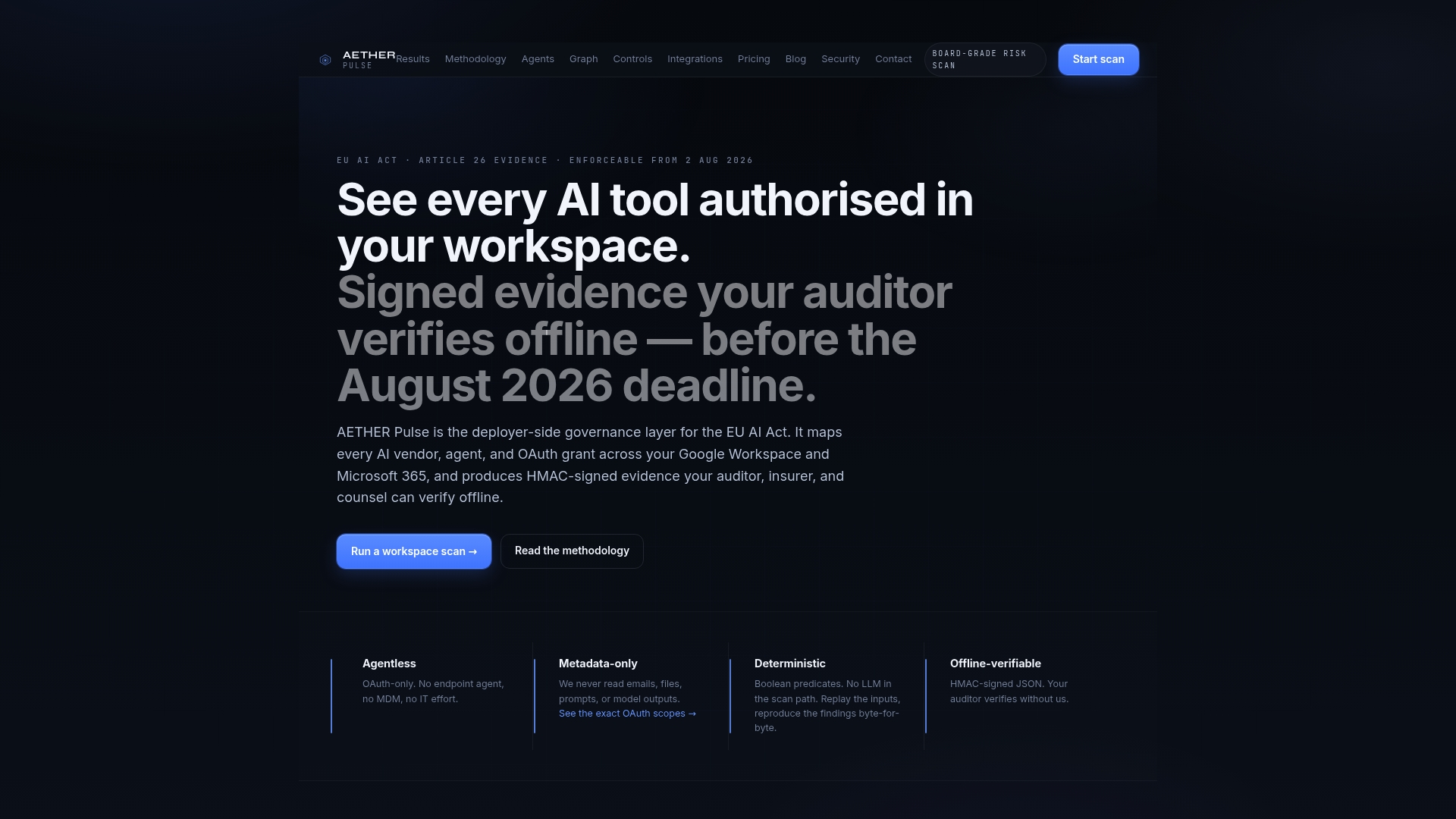
The Aetherpulse platform surfaces risk concentration, tracks named human ownership, and produces HMAC-SHA256 signed evidence packs that compliance teams can present directly to auditors and regulators. No customer data is accessed. No production systems are modified. The result is audit readiness without the deployment risk that traditional governance tooling carries.
Key takeaways
The AI governance evidence lifecycle is only effective when it operates continuously, links obligations to artifacts, and assigns named human accountability at every stage.
| Point | Details |
|---|---|
| Evidence lifecycle is continuous | Governance evidence must be generated and maintained from pre-deployment through decommissioning, not just at launch. |
| Named ownership is non-negotiable | 91.4% of AI governance measures lack updated ownership, creating phantom owner risks that auditors identify immediately. |
| Decision-reason-timestamp triplets | Structure every evidence artifact around what decision was made, why, and when to satisfy regulatory inquiries. |
| Delegation risk requires active controls | Progressive permission narrowing at each agent handoff prevents unauthorized actions and produces auditable delegation records. |
| Static policies produce no evidence | An evidence plane linking obligations, controls, evaluations, and artifacts is the only model that delivers live audit readiness. |
FAQ
What is the AI governance evidence lifecycle?
The AI governance evidence lifecycle is the structured process of capturing, managing, and maintaining verifiable records of AI system decisions and controls from initial deployment through decommissioning. It enables financial services firms to demonstrate oversight to regulators and auditors on demand.
What regulations require AI governance evidence in financial services?
The EU AI Act (effective august 2, 2026), Texas RAIGA (effective january 1, 2026), and the Colorado AI Act (effective june 30, 2026) each impose specific evidence and documentation requirements for AI systems. In the UK, FCA Consumer Duty and SYSC requirements mandate demonstrable oversight of automated decision-making.
What is a phantom owner in AI governance?
A phantom owner is a named accountable individual on an AI governance record who is no longer active, has changed roles, or never had real operational responsibility for the system. Research tracking 988 organizations found that 91.4% of AI governance measures lack updated ownership, making phantom owners the most common control deficiency auditors find.
How does transitive delegation risk affect AI governance evidence?
Transitive delegation risk occurs when an AI agent passes its authorized permissions to a downstream agent without a governance checkpoint. Each undocumented handoff creates an action with no evidence trail. Progressive permission narrowing at each delegation step is the recommended control.
What makes an evidence pack audit-ready?
An audit-ready evidence pack is concise, board-approvable, and structured around decision-reason-timestamp triplets. It must link each AI decision to a specific control, a named human owner, and the regulatory obligation it satisfies. Cryptographic signing, such as HMAC-SHA256, ensures the pack is tamper-evident.
Recommended
Working on Article 26 readiness, deployer-side governance evidence, or AI agent risk at a regulated firm? We'd value 15 minutes of your perspective.
Start a conversation