AI Governance Reporting Metrics Examples for Regulated Firms
AI Governance Reporting Metrics Examples for Regulated Firms

The minimal set of AI governance reporting metrics auditors and regulators expect from regulated financial services firms covers nine categories: inventory and identity graph completeness, metadata-ingest health, evidence-pack generation cadence and coverage, tamper-evidence and signature verification rate, policy-review coverage and exception rate, risk-concentration and financial blast-radius exposure, access/change audit log completeness and retention, third-party oversight metrics, and time-to-detect and time-to-remediate for agent incidents. Start reporting all nine this week. The regulatory basis for each is grounded in three frameworks:
- EU AI Act Article 26: deployer obligations for human oversight, log retention (minimum retention period specified by applicable laws), and incident notification, applicable for most high-risk systems from the applicable compliance date in 2026
- FCA SYSC and Consumer Duty: proportionate, evidence-based governance and accountability for AI use, mapped to existing supervisory obligations
- ICO explainability and DPIA guidance: meaningful explanations, DPIA sign-off, and governance attestations for automated decision-making
Pro Tip: Before your next audit, confirm that every metric has a named owner and a documented data source. An auditor who cannot trace a figure back to a provenance-tracked record will treat it as unverified, regardless of how accurate it is.
Key Takeaways
Defensible AI agent governance reporting requires nine auditor-mapped metrics, provenance-tracked evidence packs signed with HMAC-SHA256, named metric owners per SYSC 3.1.1, and a 90-day implementation sequence starting with inventory completeness.
| Point | Details |
|---|---|
| Nine core metrics | Report inventory completeness, ingest health, evidence-pack coverage, tamper-evidence rate, policy coverage, risk concentration, log completeness, third-party oversight, and time-to-detect/remediate. |
| Evidence-pack integrity | Every pack must carry an HMAC-SHA256 signature and immutable timestamp; any post-creation change breaks the signature and is detectable at audit. |
| Regulatory mapping | Map each metric to Article 26, SYSC 3.1.1, SYSC 8, or ICO DPIA obligations; the FCA expects evidence-based governance tied to existing frameworks. |
| Ownership and cadence | Assign a named owner and reporting frequency to every metric; escalation SLAs must be documented before the first board submission. |
| Aetherpulse pilot path | A 90-day Aetherpulse pilot delivers inventory, signed evidence packs, and board-ready reports without touching customer data or production systems. |
Table of Contents
- What AI governance reporting metrics examples do auditors actually expect?
- How to measure each metric: formulas, thresholds, and data sources
- How do you present AI governance metrics as defensible evidence for auditors?
- Who owns each metric, and how often should you report it?
- Minimum implementation checklist and a one-page metric report template
- Which implementation approach produces auditor-ready evidence with the least production risk?
- Aetherpulse covers these metrics from day one of a pilot
- What to fix first: a practitioner's view on the first 90 days
- Sources
What AI governance reporting metrics examples do auditors actually expect?
Each metric below maps to a specific auditor or regulator question. That mapping is what makes a metric defensible rather than decorative.
-
Inventory and identity graph completeness. Count of AI agents with unique IDs divided by total known agents in the source-of-truth register, expressed as a percentage. Auditor question: "Can you show every agent in scope and confirm none are unregistered?" Incomplete inventory is the most common first finding in AI governance reviews. For context on shadow AI discovery risks, the gap between deployed and registered agents can be significant.
-
Metadata-ingest health. Percentage of scheduled metadata ingestion jobs completing successfully within the defined window, plus average data freshness (hours since last successful ingest). Auditor question: "Is your governance data current, or are you reporting on stale snapshots?"
-
Evidence-pack generation cadence and coverage. Percentage of in-scope agents for which a signed evidence pack has been generated within the required period. Auditor question: "What proportion of your agents have auditable evidence, and how recent is it?"
-
Tamper-evidence and signature verification rate. Percentage of evidence packs passing cryptographic signature verification (HMAC-SHA256 or equivalent) at the point of audit access. Auditor question: "How do you know the evidence has not been altered since it was generated?"
-
Policy-review coverage and exception rate. Percentage of agents with a current, attested policy review, plus the count and status of active exceptions. Auditor question: "Which agents operate outside standard policy, and who approved that?"
-
Risk-concentration and financial blast-radius exposure. Aggregate financial exposure attributable to agent clusters or individual agents, segmented by risk tier. Auditor question: "What is the maximum financial impact if a high-risk agent cluster fails or acts outside its mandate?"
-
Access/change audit log completeness and retention. Percentage of agents with complete, unbroken access and change logs, plus confirmation that retention meets the Article 26 minimum of six months. Auditor question: "Can you reconstruct what each agent did and who changed its configuration?"
-
Third-party oversight metrics. For each agent-related provider: contractual audit-access rights confirmed (yes/no), last performance review date, and open findings count. Under SYSC 8, firms outsourcing critical functions remain fully responsible and must retain rights of access and supervise service providers.
-
Time-to-detect and time-to-remediate. Mean hours from incident occurrence to detection, and from detection to confirmed remediation, per agent tier. Auditor question: "How quickly do you identify and close agent-related control failures?"
-
Policy mapping status. Confirmation that each metric maps to a named supervisory control (Article 26, SYSC 3.1.1, Consumer Duty, ICO DPIA). The FCA's AI approach expects proportionate, evidence-based governance mapped to existing obligations rather than standalone AI-specific frameworks.
How to measure each metric: formulas, thresholds, and data sources
Consistent measurement requires a defined formula, a traceable data source, and a documented threshold. The following covers each metric in those terms.
| Metric | Formula | Required data fields | Example target |
|---|---|---|---|
| Inventory completeness | (Agents with unique ID / Known agents in register) × 100 | Agent ID, register source, last verified date | ≥ 98% |
| Metadata-ingest health | (Successful ingest jobs / Scheduled jobs) × 100; avg. freshness in hours | Ingest job logs, timestamp, pipeline ID | ≥ 99% success; freshness ≤ 24 hrs |
| Evidence-pack coverage | (Agents with current signed pack / In-scope agents) × 100 | Evidence-pack hash, generation timestamp, agent ID | ≥ 95% for critical agents |
| Tamper-evidence pass rate | (Packs passing HMAC-SHA256 verification / Total packs verified) × 100 | Pack hash, signature, verification log | ≥ 99.9% |
| Policy-review coverage | (Agents with current attestation / In-scope agents) × 100 | Attestation record, reviewer ID, review date | ≥ 95%; exceptions < 5% of fleet |
| Risk-concentration exposure | Sum of financial exposure by agent cluster, segmented by tier | Exposure values, agent cluster mapping, risk tier | Reported; no single cluster > defined threshold |
| Log completeness | (Agents with unbroken logs / In-scope agents) × 100 | Log store, agent ID, retention period | ≥ 99%; retention ≥ 6 months |
| Third-party oversight | Count of providers with confirmed audit-access rights / Total providers | Contract register, last review date, open findings | contractual audit-access rights confirmed (yes) |
| Time-to-detect | Mean hours from incident occurrence to detection | Incident log, detection timestamp | ≤ 4 hrs for critical agents |
| Time-to-remediate | Mean hours from detection to confirmed close | Incident log, close timestamp, remediation record | ≤ 24 hrs for critical agents |
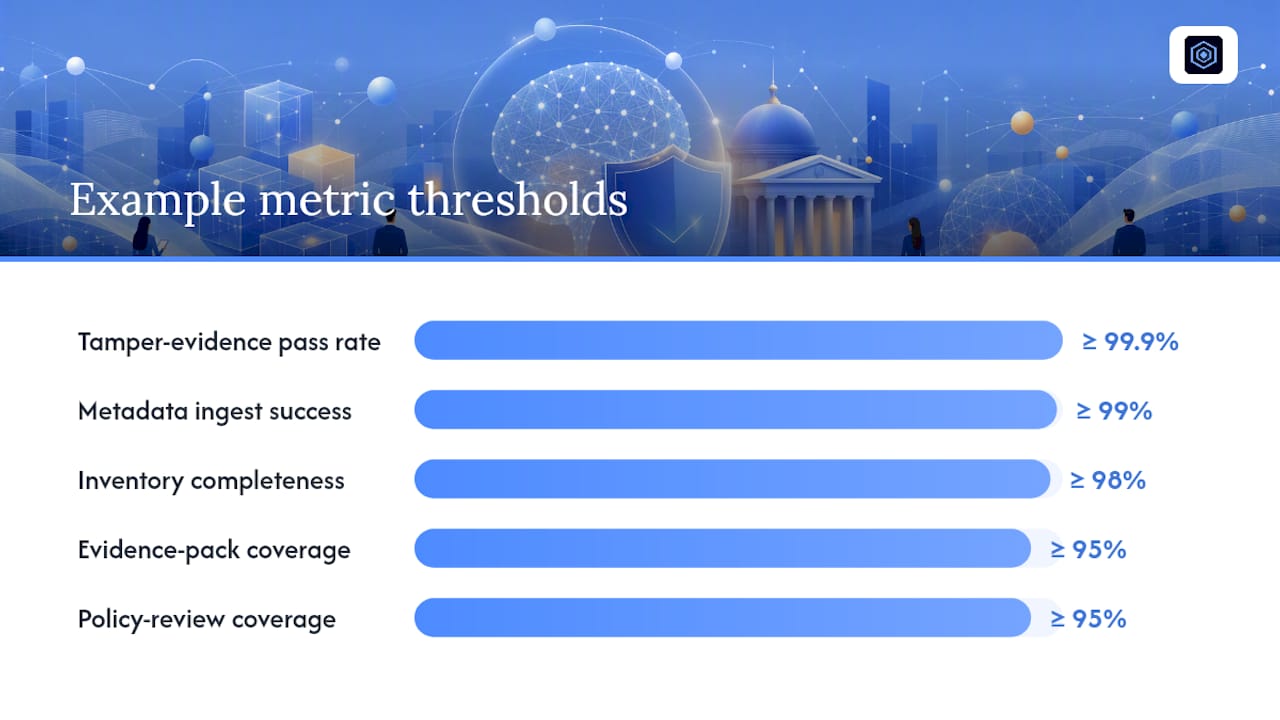
Measurement caveats. In metadata-only environments, agent counts derive from OAuth grant records and API metadata rather than direct instrumentation. Where an agent's scope is partially visible, flag it as "partial coverage" in the register and exclude it from the denominator only with documented justification. The ICO's guidance on automated decision-making also expects regular checks for bias and accuracy, which should feed into evidence-pack fields for agents making significant automated decisions.
Pro Tip: Set your evidence-pack coverage thresholds set at suitable levels for critical and standard agents. Applying a single threshold across all tiers creates perverse incentives to reclassify agents downward to avoid reporting gaps.
How do you present AI governance metrics as defensible evidence for auditors?
An evidence pack is not a report. It is a structured, signed artifact that an auditor can independently verify. Each pack should contain:
- Agent ID and inventory snapshot timestamp (the exact moment the register was queried)
- Metadata snapshot (OAuth grant scope, API permissions, last-seen timestamp)
- Evidence-pack hash and HMAC-SHA256 signature (generated at pack creation, stored immutably)
- Ingest logs (pipeline ID, job timestamps, success/failure status)
- Policy attestation (reviewer name, role, attestation date, policy version)
- Incident history (detection timestamp, remediation timestamp, severity classification)
- DPIA reference or sign-off where the agent makes significant automated decisions, per ICO explainability guidance
The HMAC-SHA256 signing workflow works as follows: the platform generates a deterministic hash of the evidence-pack contents at creation time, signs it with a secret key, and stores both the hash and signature in an immutable log. At audit access, the verifier recomputes the hash and checks it against the stored signature. Any post-creation modification breaks the signature, making tampering detectable without requiring access to the underlying data.
Chain-of-custody for regulators means two things: read-only access that does not require the firm to export and re-format data under pressure, and a clear record of who requested access, when, and what they received. Build both into your evidence infrastructure before the audit request arrives, not after.
For AI explainability requirements, evidence packs should include both technical artifacts and governance attestations. The ICO's guidance stresses that meaningful explanations are governance tasks as much as technical ones.
Pro Tip: Auditors typically test tamper-evidence first by requesting a pack generated before a known configuration change and verifying the signature. Run this test yourself quarterly. If the signature fails in your own preflight, it will fail in the audit.
Who owns each metric, and how often should you report it?
SYSC 3.1.1 requires firms to allocate oversight functions to competent personnel and review them regularly. For AI governance metrics, that means named owners, documented cadence, and clear escalation paths.
SYSC 6 requires a permanent compliance function with documented monitoring and reporting obligations, including annual reporting to the management body. For AI governance, that annual report should aggregate all ten metrics with trend data, exception history, and remediation status.
Escalation SLAs: any tamper-evidence verification failure triggers immediate notification to the CRO and Internal Audit. Evidence-pack coverage falling below threshold for critical agents triggers a 48-hour remediation window before board-level notification. For FCA SYSC 8 and Consumer Duty obligations, third-party oversight gaps require documented remediation plans within five business days.
Minimum implementation checklist and a one-page metric report template
Implementation checklist
- Establish the agent register. Define the source-of-truth for agent inventory, assign unique IDs, and document the register's update process and owner.
- Build the metadata-ingest pipeline. Configure OAuth metadata ingestion, set scheduled job frequency, and establish success/failure alerting.
- Implement evidence-pack generation. Define pack contents, configure HMAC-SHA256 signing, and establish immutable storage with timestamping.
- Assign metric owners. Complete the RACI mapping above, document it in your governance framework, and confirm competency per SYSC 3.1.1.
- Set retention policy. Confirm log and evidence-pack retention meets the Article 26 minimum of six months; document the retention schedule.
- Configure reporting cadence. Schedule automated metric pulls at the frequencies above and establish the escalation notification workflow.
One-page metric report template
Report title: AI Agent Governance Metrics Report Reporting period: [Start date] to [End date] Prepared by: [Name, role] Approved by: [Name, role] Date of approval: [Date]
Exceptions and open items: [List active exceptions, approver, and review date] Regulatory mapping: [Confirm Article 26, SYSC, ICO DPIA status] Next review date: [Date]
Common first-report pitfalls: agents without unique IDs that cannot be matched across systems; timestamps in non-standard formats that break hash verification; and log gaps caused by pipeline failures that were never flagged. Run a gap analysis against your AI compliance gap assessment before the first board submission.
Pro Tip: Use ISO 8601 timestamps (YYYY-MM-DDTHH:MM:SSZ) for every date field in the evidence pack. Non-standard formats are the single most common cause of hash verification failures during audit.
Which implementation approach produces auditor-ready evidence with the least production risk?
Four deployment options exist for collecting the metrics above, each with different risk and time-to-value profiles.
- Read-only metadata layer (agentless). Connects via OAuth metadata only, touches no customer data, and produces provenance-tracked evidence packs without instrumentation. Fastest to deploy; lowest production risk. The right choice when data sensitivity is high, audit timelines are short, or production systems cannot accept additional agents.
- Lightweight agent instrumentation. Embeds a monitoring agent within each AI system for richer telemetry. Higher coverage depth, but introduces production dependencies and requires change management approval.
- SIEM/log store integration. Pulls existing log data into a governance layer. Useful where log infrastructure is mature, but coverage depends entirely on what the existing logs capture.
- Hybrid approach. Combines metadata ingestion for broad coverage with selective instrumentation for critical agents requiring deeper telemetry.
Decision guidance:
- If data sensitivity is high and audit needs are urgent, start with the agentless metadata layer.
- If critical internal control gaps require deeper telemetry on specific agents, add lightweight instrumentation for those agents only.
- If existing SIEM coverage is comprehensive and well-maintained, integrate it as a supplementary data source rather than a replacement for provenance-tracked evidence packs.
- For third-party-hosted agents, the agentless approach is often the only viable option without renegotiating vendor contracts.
For a detailed treatment of governance without data access, the metadata-only approach can satisfy all ten metrics above when the inventory source-of-truth is well-maintained. The NIST AI Risk Management Framework provides a useful cross-framework benchmark for teams that need to map their evidence packs to a US-recognized standard alongside EU and UK obligations.
Aetherpulse covers these metrics from day one of a pilot
Regulated firms that need audit-ready AI agent governance evidence without inserting tooling into production systems have a direct path: Aetherpulse's read-only evidence layer ingests via OAuth metadata, builds an inventory and identity graph as the source-of-truth, and generates HMAC-SHA256-signed evidence packs on demand. Every metric in this article maps to a native Aetherpulse output.

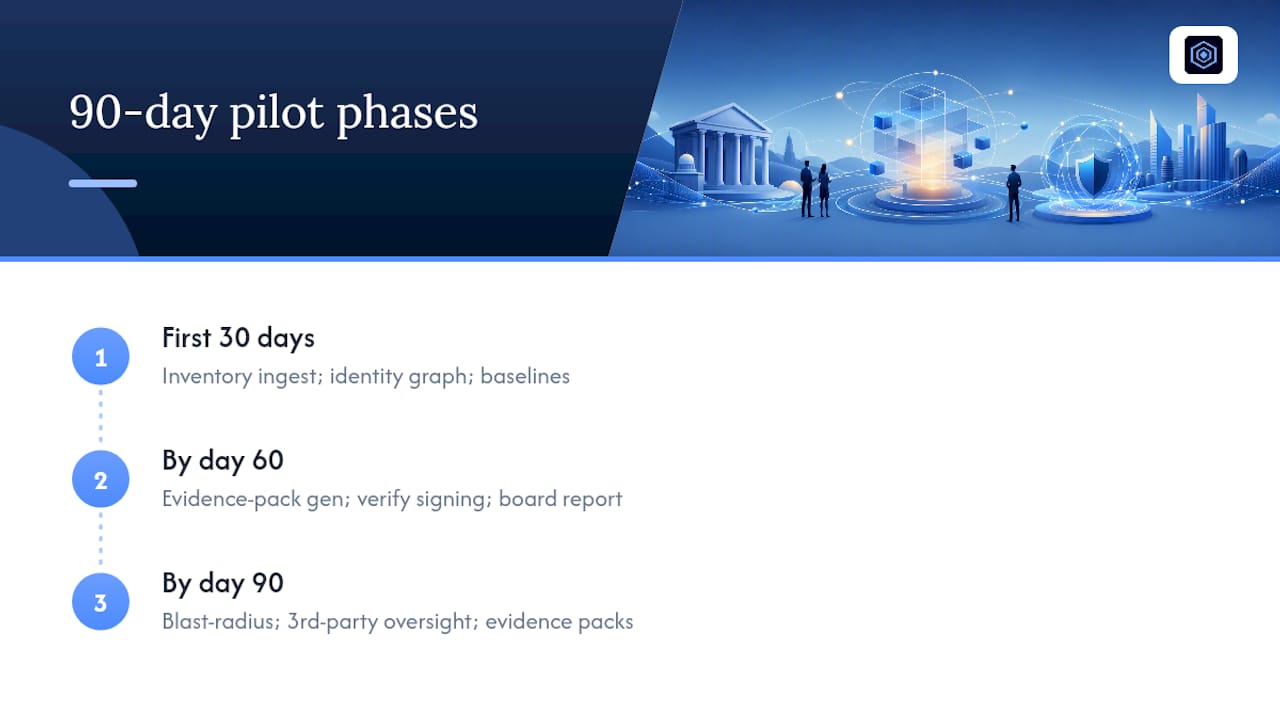
A 90-day pilot typically runs in three phases. In the first 30 days, inventory ingestion is live, the identity graph is populated, and baseline metric values are established. By day 60, evidence-pack generation is running on schedule, tamper-evidence signing is verified, and the first board-ready report is produced. At day 90, risk-concentration mapping including financial blast-radius exposure is active, third-party oversight metrics are integrated, and the firm has a complete, auditor-presentable evidence pack for every in-scope agent. Success at day 90 means a compliance officer can hand an auditor a signed evidence pack and answer every question in Section 2 of this article with a traceable figure.
Review Aetherpulse's pricing and pilot options or request a demo at Aetherpulse to scope a pilot for your firm's agent fleet.
What to fix first: a practitioner's view on the first 90 days
The governance leaders who make the most visible progress in the first 90 days share one characteristic: they resist the temptation to build a perfect framework before reporting anything. The auditor's first question is almost always about inventory. If you cannot produce a complete, timestamped list of your AI agents with unique IDs, no amount of policy documentation will satisfy the review.
The practical priority sequence is: inventory and identity graph first, evidence-pack pipeline second, tamper-evidence signing third, and reporting cadence fourth. This order reflects where regulatory risk concentrates. An incomplete inventory means you cannot scope any other metric accurately. An unsigned evidence pack means every figure in it is disputable. A reporting cadence without named owners means no one is accountable when a metric degrades.
Two operational notes from working through this with regulated firms. First, scope creep in the first 90 days almost always originates from trying to instrument every agent simultaneously. Start with the highest-risk cluster, prove the pipeline, then expand. Second, get Internal Audit involved in the evidence-pack design before the first pack is generated, not after. Their input on chain-of-custody and access controls will save significant rework.
Sources
- Article 26 — Obligations of deployers of high-risk AI…
- AI and the FCA: our approach | FCA
- Explaining decisions made with AI | ICO
This article is general information, not a substitute for advice from a qualified financial advisor. Consult a qualified financial professional about your own circumstances before acting on anything here.
Recommended
- AI Regulatory Disclosure Obligations Explained for Finance - AETHER Pulse
- AI Governance Maturity Model: Where Are You and Where Do You Need to Be? - AETHER Pulse
- What Good AI Governance Actually Looks Like in a Regulated Financial Services Firm - AETHER Pulse
- AI Compliance Gap Assessment Guide for Regulated Firms - AETHER Pulse
Working on Article 26 readiness, deployer-side governance evidence, or AI agent risk at a regulated firm? We'd value 15 minutes of your perspective.
Start a conversation