AI Model Inventory Management Steps for Audit Readiness
AI Model Inventory Management Steps for Audit Readiness

Building an audit-ready AI model inventory requires six steps: discover every deployed model and agent, classify by function and risk tier, map lineage and ownership, assess risk including financial blast-radius, monitor with human-in-the-loop controls, and produce tamper-evident evidence packs. Regulators and auditors at US financial services firms — from OCC examiners to internal SOC 2 reviewers — will look for three signals first: reconstructability (the ability to answer who, what, when, where, and why for any automated decision), tamper-evident logs backed by cryptographic signing or hash manifests, and a recorded human-acceptance state distinguishing produced output from accepted outcome. Standards including SOC 2 Type II, ISO 42001, and the EU AI Act Article 26 all converge on these same requirements. Aetherpulse is one non-invasive, metadata-first evidence layer built specifically to close this gap without touching raw customer data.
Table of Contents
- What are the core AI model inventory management steps?
- How long does implementation take, and who needs to be involved?
- What tooling architecture minimizes risk and operational friction?
- How does an agentless evidence layer map to all six steps?
- Who owns what in the AI governance RACI?
- How do you isolate an agent and reconstruct a decision within 60 minutes?
- Key Takeaways
- The gap between policy and proof is where firms fail
- Aetherpulse gives you signed evidence packs without touching your data
- Selected primary sources for regulators and auditors
What are the core AI model inventory management steps?
Step 1: Discover every AI model and agent in scope
Discovery must produce a single, queryable registry entry per model or agent, each with a stable unique ID. Without that anchor, every downstream step — classification, lineage, risk scoring — is built on an incomplete foundation, and a spreadsheet alone will likely fail a regulator visit.

Required metadata fields per registry entry:
| Field | Description |
|---|---|
| System ID | Stable unique identifier (UUID or equivalent) |
| Deployment location | Cloud region, on-prem cluster, SaaS endpoint |
| Functional owner | Named business owner and team |
| Data inputs / outputs | Data categories processed and produced |
| Runtime endpoints | API URLs, orchestration coordinator references |
| Model version | Artifact hash or version tag |
| Vendor / third-party boundary | Internal build vs. externally sourced model |
Discovery methods span four channels: automated read-only cloud metadata connectors (OAuth-scoped, no data access), API call scanning via gateway logs, procurement gating that flags new AI purchases at approval, and developer declarations embedded in CI/CD pipelines.
Pro Tip: Start scanning payment processing, credit decisioning, fraud detection, and customer onboarding workflows first. These carry the highest regulatory exposure and will satisfy examiners fastest.
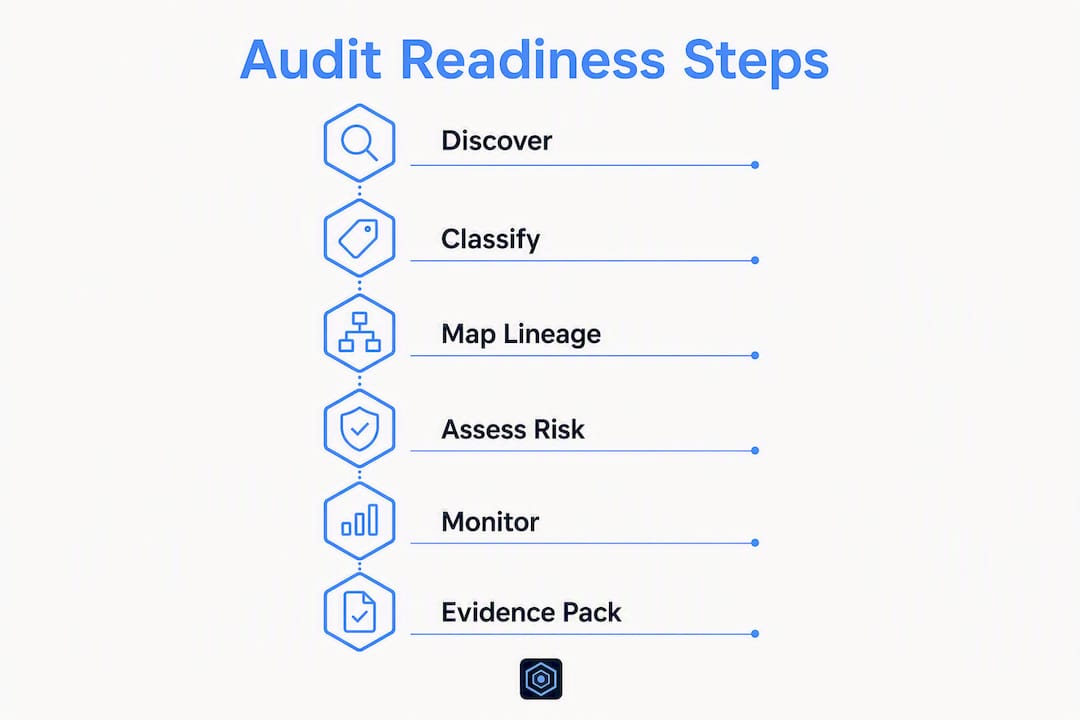
Step 2: How do you classify AI models by risk tier and regulatory obligation?
Classification must produce an immediately actionable tier and a regulatory mapping for each inventory entry. Mapping obligations at classification time — rather than at examination time — is what makes obligations visible before regulators ask.
Classification axes:
- Jurisdictional footprint: — federal (OCC/Fed/FDIC model risk guidance), state (NYC Local Law 144 for automated employment decisions), cross-border (EU AI Act high-risk flags)
| Risk Tier | Regulatory Triggers | Required Controls |
|---|---|---|
| Tier 1 — Critical | OCC model risk, SR 11-7, EU AI Act high-risk | Full validation, HITL gates, signed evidence packs |
| Tier 2 — Elevated | NYC Local Law 144, SEC fair-lending rules | Periodic validation, audit logging, owner attestation |
| Tier 3 — Standard | Internal use, low-impact decisioning | Inventory entry, annual review |
Classification governance requires a named compliance reviewer sign-off, a quarterly attestation cadence, and an automatic escalation flag when a model's use case expands beyond its original classification.
Step 3: How do you map AI model provenance, lineage, and ownership?
Provenance metadata must make attributability structural. Attributability requires prompt versioning, model fingerprinting, input commitment hashes, and a central logging coordinator; peer-to-peer agent topologies structurally prevent full traceability.
Lineage schema — required fields per work unit:
| Field | Purpose |
|---|---|
| Agent ID | Stable identifier for the executing agent |
| Model fingerprint | SHA-256 hash of model artifact |
| Prompt template hash | Commit hash of prompt version used |
| Input data commitment hash | Hash of input payload at execution time |
| Execution timestamp | UTC timestamp, microsecond precision |
| Authorization spec | Role, scope, and approval reference |
| Work unit ID | Ties all fields to a single decision event |
RACI for ownership: a named individual owner (accountable), a technical steward (responsible for version control), and a control owner (responsible for monitoring thresholds). Prompt updates, model version changes, and configuration drift each require a new lineage record — not an overwrite.
Integration points for real-time provenance capture include CI/CD pipeline hooks, model registries (MLflow, SageMaker Model Registry), and SIEM event streams.
Step 4: How do you assess AI model risk and calculate financial blast-radius?
Risk assessment must combine likelihood, impact, and financial blast-radius to produce a ranked remediation queue. The blast-radius formula is:
Expected Exposure = Probability of Failure × Dollar Exposure per Transaction × User-Impact Multiplier
Gather inputs from transaction volume logs, average exposure per decision, and a user-impact multiplier that scales for protected-class or vulnerable-customer populations. When expected exposure crosses your firm's materiality threshold, escalate to model-critical controls immediately.
| Risk Score | Blast-Radius Range | Immediate Action |
|---|---|---|
| High | Material | Scope access, add approval gates, increase log verbosity |
| Medium | Moderate | Increase monitoring frequency, assign control owner |
| Low | Limited | Standard cadence, annual review |
Priority mitigations for high-scoring models: restrict agent authorization scope, add human approval gates before irreversible actions, and increase logging granularity to capture every decision branch.
Step 5: What monitoring and human-in-the-loop controls do auditors expect?
Monitoring must be continuous and tied to controls that enforce human acceptance for sensitive outcomes. Auditors demand continuously collected, easy-to-verify samples — logs, approvals, access reviews — rather than static documentation.
Control checklist:
- Identity and access controls scoped per agent (least-privilege OAuth grants)
- Escalation thresholds defined for decision drift and authority drift
- Automated anomaly detection on output distributions
- Alerting playbook with named escalation owners and response SLAs
- HITL pattern documented per model: human-in (reviews before action), human-on (monitors in real time), or human-over (reviews batches post-execution)
- Acceptance and rejection states recorded in the inventory entry, not only in application logs
Human oversight must be meaningful and designed into the system; approval gates, intermediary output reviews, and reviewer training on automation bias are all expected mitigations.
Pro Tip: Use read-only telemetry and SIEM integration to capture agent behavior without inserting instrumentation into production code. This preserves auditability while eliminating data access friction.
Step 6: What goes into a tamper-evident audit evidence pack?
An audit evidence pack must include signed log manifests, work unit pointers, model and version fingerprints, prompt and input hashes, human acceptance records, and remediation history. Evidence chains must tie lifecycle work units to evidence objects and clarify responsibility and disclosure boundaries.
Evidence pack specification:
| Component | Format | Crypto Requirement |
|---|---|---|
| Log manifest | JSON-L with schema version | HMAC-SHA256 signed, hash chained |
| Work unit pointer | Partition key + redaction profile | Integrity hash |
| Model fingerprint | Artifact hash + registry reference | SHA-256 |
| Prompt / input hashes | Commit hash + payload hash | SHA-256 |
| Human acceptance record | Reviewer ID + timestamp + decision | Signed entry |
| Remediation history | Incident ID + closure timestamp | Append-only log |
Log schema fields (who, what, when, where, why): actor ID, action type, timestamp, system endpoint, authorization reference, and outcome state.
Evidence packs can use pointers and integrity hashes rather than duplicating raw data, keeping disclosures privacy-aware. Retention policies should satisfy SOC 2 Type II (evidence of controls operating over time) and ISO 42001 lifecycle log requirements — typically a minimum of three years for financial services.
How long does implementation take, and who needs to be involved?
A prioritized, phased plan typically delivers baseline audit readiness in 3–6 months for the highest-risk systems.
| Phase | Timeline | Deliverables | Team |
|---|---|---|---|
| Quick wins | Weeks 1–4 | Discovery scan, inventory template, top registry entries | Governance lead, DevOps |
| Medium work | Months 2–3 | Lineage capture, monitoring integration, HITL documentation | Compliance SME, Security/Identity |
| Full automation | Months 4–6 | Evidence pack automation, attestation cadence, GRC integration | All roles + Legal review |
Inventory drift is a primary failure mode; integrate with ITSM or change management to trigger a 30-day SLA update whenever a new data source, vendor model update, or expanded use case is introduced.
What tooling architecture minimizes risk and operational friction?
Prefer a metadata-first, agentless evidence layer that connects to existing GRC and SIEM systems rather than requiring invasive code changes. The recommended architecture uses read-only OAuth connectors, an evidence signing service (HMAC-SHA256), a central coordinator span for attributability, and event hooks into CI/CD pipelines and model registries.
Non-invasive integration practices:
- Pass agent IDs through orchestration coordinators as a standard header, not a code change
- Hash prompts at ingestion in the API gateway layer, before they reach the model
- Use event hooks in orchestration frameworks to capture work unit boundaries automatically
Avoid: peer-to-peer agent architectures without a coordinator (they structurally prevent traceability), manual inventory spreadsheets as the system of record, and point-in-time-only evidence collection that cannot satisfy SOC 2 Type II's continuous-evidence requirement.
Pro Tip: Treat your evidence layer the same way cloud security teams treat a CSPM: read-only, always-on, and separate from production workloads. That separation is what makes evidence defensible.
How does an agentless evidence layer map to all six steps?
An agentless evidence layer that captures metadata and produces cryptographically signed evidence packs can close the majority of audit gaps without accessing raw data. Aetherpulse maps directly to each step: OAuth metadata connectors handle discovery; classification mapping surfaces regulatory obligations at the entry level; lineage capture records agent ID, model fingerprint, and input hashes per work unit; risk concentration mapping surfaces financial blast-radius exposure; monitoring signals feed into alerting and HITL state recording; and on-demand evidence pack generation produces signed, reconstructable artifacts aligned to the who, what, when, where, why schema auditors require.
The platform's AI governance without data access approach means no customer data is touched at any point. For firms that need to demonstrate regulator-facing reconstructability quickly, a proof-of-value engagement can produce a signed evidence pack for a single high-risk workflow within days.
Who owns what in the AI governance RACI?
Each inventory item needs a named owner, a technical steward, a compliance reviewer, and a documented sign-off cadence.
| Role | Responsible For | Cadence |
|---|---|---|
| Business owner | Use-case attestation, blast-radius sign-off | Annual + triggered |
| Technical steward | Version control, lineage records, drift alerts | Continuous |
| Compliance reviewer | Regulatory mapping, tier validation | Quarterly |
| Legal touchpoint | Disclosure review, incident escalation | Triggered |
| Control owner | Monitoring thresholds, HITL gate design | Quarterly |
Escalation routes for authority drift: technical steward flags to control owner within 24 hours; control owner escalates to compliance reviewer if the drift crosses a tier boundary; legal is notified if the incident involves a Tier 1 model or a regulatory disclosure obligation.
How do you isolate an agent and reconstruct a decision within 60 minutes?
The runbook must let you isolate the agent and reconstruct the decision chain within 60 minutes using only the evidence pack. The practical acid test is the "60-minute reconstruction challenge": pick any agent decision from the last 30 days and attempt to answer agent identity, model version, input data hash, authorization status, and human review status using only the audit log.
Immediate incident actions (numbered sequence):
- Isolate the coordinator: revoke the agent's OAuth grant or disable its runtime endpoint.
- Capture signed logs: freeze the current log manifest and generate a signed snapshot.
- Freeze model versions: lock the artifact registry entry to prevent overwrite.
- Notify named owners: trigger the escalation playbook with incident ID and timestamp.
- Run the forensic checklist: confirm agent ID, model fingerprint, prompt hash, input hash, authorization reference, and human acceptance state are all resolvable from the evidence pack.
- Record remediation: document accepted outcome vs. produced output, corrective action, and closure timestamp in the inventory entry.
Chain-of-custody for auditor review requires that the signed log manifest is never modified after the freeze, and that all access to the evidence pack during investigation is itself logged.
Key Takeaways
An audit-ready AI model inventory requires six sequential steps, each producing specific evidence artifacts that auditors can verify independently, with reconstructability as the primary maturity signal.
| Point | Details |
|---|---|
| Six-step sequence | Discover, classify, map lineage, assess risk, monitor with HITL, and produce signed evidence packs. |
| Reconstructability first | The 60-minute reconstruction challenge is the practical audit-readiness test: resolve agent ID, model version, and input hash from logs alone. |
| Blast-radius scoring | Combine probability of failure, dollar exposure per transaction, and a user-impact multiplier to prioritize controls. |
| 30-day update SLA | Trigger inventory updates within 30 days of any new data source, vendor model change, or expanded use case to prevent drift. |
| Aetherpulse | Provides a read-only, metadata-first evidence layer that produces HMAC-SHA256-signed evidence packs mapped to all six steps. |
The gap between policy and proof is where firms fail
The most common mistake in AI governance programs is treating a well-written policy as equivalent to audit evidence. Examiners at regulated financial services firms are not reading your AI ethics statement; they are asking for a signed log from last Tuesday's credit decision and want to know which human reviewed it. Firms that invest heavily in governance frameworks but neglect evidence automation consistently face findings not because their controls are absent, but because they cannot demonstrate the controls operated.
There is a subtler failure mode that practitioners see repeatedly: inventory drift caused by prompt version changes that were never logged. A model's behavior shifts materially when its prompt template changes, yet most inventories treat the model artifact hash as the sole version anchor. When an examiner asks why outputs changed between two dates, a team without prompt hashing has no answer. That gap, not intent or policy, is what separates a clean examination from a finding.
The practical lessons are: centralize coordinator logging so every agent action flows through a single attributable point, automate inventory triggers so drift is caught within 30 days, require named owners with annual attestation so accountability is structural rather than assumed, and treat evidence generation as a production system requirement rather than an audit-preparation sprint.
Aetherpulse gives you signed evidence packs without touching your data
Firms that have completed the six steps above still face one operational challenge: producing cryptographically signed, reconstructable evidence packs on demand, without inserting new instrumentation into production systems. Aetherpulse is built for exactly that constraint. It connects via read-only OAuth metadata, builds an inventory and identity graph of your deployed AI agents, surfaces financial blast-radius concentration, and generates HMAC-SHA256-signed evidence packs that map directly to the who, what, when, where, why schema your auditors will request.

No customer data is accessed at any point. Classification mapping surfaces regulatory obligations — OCC model risk guidance, NYC Local Law 144, EU AI Act Article 26 — at the inventory entry level, so your compliance team sees obligations the moment a model is registered. For teams that need to demonstrate audit readiness quickly, Aetherpulse offers a proof-of-value engagement that produces a signed evidence pack for one high-risk workflow. See plans and proof-of-value options or visit aetherpulse.app to request a demo.
Selected primary sources for regulators and auditors
- OCC Model Risk Management Revised Guidance (2026) — Confirms that SR 11-7 principles apply to non-generative AI models and sets expectations for model inventory, validation, and governance controls.
- FDIC Supervisory Guidance on Model Risk Management — Primary source for model inventory requirements, validation standards, and examiner expectations at US-regulated banks.
- U.S. GAO: Artificial Intelligence Use and Oversight in Financial Services — Documents how federal financial regulators currently oversee AI and where guidance gaps remain; useful for framing regulatory mapping obligations.
- U.S. Treasury: AI in Financial Services — Covers AI risk management framework coordination recommendations and consumer harm considerations.
- SecureSlate: 9 Things Your Auditor Will Want to See About Your AI Agents — Practitioner checklist of auditor expectations including complete agent inventory, HITL evidence, and log schema requirements.
- FirmAdapt: Building an AI Inventory That Survives a Regulator Visit — Covers structured inventory fields, trigger-based update cadences, and regulatory mapping at classification time.
- Augment Code: Multi-Agent Outputs and Enterprise Audit — Explains attributability, reversibility, and the 60-minute reconstruction challenge; covers coordinator vs. peer-to-peer topology tradeoffs.
- Jearon Wong: Agentic AI Auditability and Assurance White Paper 2026 — Defines the Audit Evidence Chain structure, evidence pointer patterns, and privacy-aware disclosure approaches.
- 4 New Square: Generative and Agentic AI Guidance — Practitioner guidance on meaningful human oversight design, approval gate requirements, and automation bias training.
This article provides general compliance information, not legal or regulatory advice. Confirm current requirements with your primary regulator or a qualified compliance professional.
Recommended
- Preparing for an AI Governance Audit: A Practical Readiness Guide - AETHER Pulse
- How to Build an AI Agent Inventory for FCA and ICO Supervision - AETHER Pulse
- AI Inventory vs CMDB: Why Your Configuration Management Database Is Not Your AI Governance Answer - AETHER Pulse
- The AI Inventory Crisis Nobody Is Talking About - AETHER Pulse
Working on Article 26 readiness, deployer-side governance evidence, or AI agent risk at a regulated firm? We'd value 15 minutes of your perspective.
Start a conversation