AI Oversight Without Production Access: A Compliance Playbook
AI Oversight Without Production Access: A Compliance Playbook

Yes, you can build audit-grade oversight of an AI system without ever touching its production environment. The mechanism is a combination of single-case "proof drills," a structured access taxonomy that replaces all-or-nothing production entry, tamper-evident evidence packs, and privacy-preserving cryptographic attestations that prove an evaluation ran without exposing the model or the data behind it.
This is not a workaround. For most regulated financial services firms, it is the only realistic path. Vendors rarely grant unrestricted production access, and even when they do, pulling live customer data into an audit process creates its own regulatory exposure under the EU AI Act and similar frameworks. What auditors and regulators actually want is defensible evidence, not a backstage pass.
Here is what that evidence package needs to contain:
- A single-case record: one input, one output, fully reproducible, not a summary of thousands of interactions.
- Signed provenance: cryptographic proof of which model version produced the output and when.
- A stated evaluation method: what was tested, how, and against what baseline.
- Written acceptance criteria: the threshold the system had to clear, defined before the test ran.
- A tamper-evident hash or signature: proof the record has not been altered since it was generated.
Standards bodies like NIST already publish guidance on logging and attestation that maps cleanly onto these requirements. Regulatory anchors like EU AI Act Article 26 push firms toward exactly this kind of demonstrable oversight, and cryptographic tools such as zero-knowledge proofs now make it possible to verify a claim about a model's behavior without exposing the model itself.
Key Takeaways
Audit-ready oversight without production access is achievable when proof drills, signed evidence packs, and structured access agreements replace the demand for raw system entry.
| Point | Details |
|---|---|
| Start with one proof drill | Build a single reproducible case record before attempting broader coverage. |
| Match access level to stakes | Reserve grey-box, enclave, or cryptographic assurance for high blast-radius models. |
| Build the one-page policy first | PII boundaries, model manifest, kill-switch ownership, and reviewer roles anchor everything else. |
| Set evaluator timelines up front | Black-box runs 5 to 10 days; grey-box and enclave arrangements often exceed 20. |
| Use agentless evidence infrastructure | Aetherpulse generates signed, metadata-only evidence packs mapped to Article 26 and FCA SYSC without touching production data. |
Table of Contents
- What Is a Proof Drill in AI Oversight Without Production Access?
- What Access Levels Exist When You Cannot See Production?
- How Do You Generate Audit Evidence Without Production Access?
- How Do You Operationalize Governance Without Production Access?
- How Do Cryptographic Proofs Support External Oversight?
- How Do You Structure an External AI Evaluation Engagement?
- Where Does Oversight Without Production Access Fall Short?
- Why Governability Cannot Wait for Perfect Access
- How Aetherpulse Fits Into a Proof-Drill Workflow
- Frequently Asked Questions
- Sources
What Is a Proof Drill in AI Oversight Without Production Access?
A proof drill is a single, examinable record of one decision: the exact input, the exact output, the model version that generated it, and a signature proving nothing was altered afterward. It is the opposite of a bulk log dump. Where a bulk export gives an auditor ten thousand rows of aggregated activity and asks them to trust the summary, a proof drill gives them one case they can walk through end to end, reproduce, and verify independently.
Auditors favor proof drills because aggregated logs are easy to game and hard to interrogate. A single reproducible case closes that gap. It either holds up under scrutiny or it does not, and there is nowhere to hide an inconvenient outlier inside a rounding error.
The minimal artifact checklist for a proof drill looks like this:
| Artifact | Purpose | Minimum metadata fields |
|---|---|---|
| Input probe | Establishes exactly what was fed to the model | Timestamp, probe ID, input hash, source (synthetic or sampled) |
| Prompt or query record | Shows the instruction context, not just raw data | Prompt version, template ID, parameter set |
| Model version identifier | Ties the output to a specific, attributable build | Model ID, version tag, deployment environment, attestation hash |
| Signed output | The reproducible result under review | Output hash, HMAC or digital signature, signing key ID |
| Acceptance criteria | Defines pass/fail before the test, not after | Threshold values, source policy document, approver name |
| Reviewer identity and timestamp | Establishes human accountability for the sign-off | Reviewer ID, role, review timestamp, decision recorded |
Pro Tip: Run your first proof drill on the highest financial-blast-radius decision your AI agents make, not the easiest one. Auditors will ask about your worst-case exposure before they ask about your average case, so build the record that answers that question first.
External evaluation timeframes vary widely by access level, ranging from essentially no pre-release access to assessments that run beyond 20 business days for deeper structured engagements. A single well-built proof drill is often what shortens that timeline, because it gives an evaluator something concrete to validate instead of a black box to probe blindly from scratch.
What Access Levels Exist When You Cannot See Production?
Access to an AI system for oversight purposes generally falls into three categories, and each one changes what an evaluator can actually claim afterward.
Black-box access means the evaluator can only send inputs and observe outputs, with no visibility into internals. This is the most common arrangement and the least invasive, but it is also the weakest for catching certain failure modes. Backdoors, subtle bias in edge cases, and manipulation that only appears under rare conditions can hide behind a black-box wall indefinitely.
Grey-box access gives the evaluator limited internals, things like logits, activation patterns, or confidence scores, without full model weights or training data. This tier catches more than black-box testing while still protecting the bulk of a vendor's intellectual property.
White-box access is full internal visibility: weights, architecture, training data lineage. It produces the highest assurance and is almost never granted to external evaluators in a commercial financial services context, for good reason. It is also rarely necessary if the evidence infrastructure around a system is built correctly.
Between these three canonical tiers sit several structured-access alternatives that give you most of grey-box assurance without the IP exposure:
- Verifiable clean rooms: the model runs inside a confidential-computing enclave; the auditor supplies test cases and receives attested outputs, never the weights. Tinfoil's account of auditing a frontier model without seeing its weights describes exactly this pattern working between mutually distrusting parties.
- Secure enclaves: hardware-backed isolation that lets a third party's code and the vendor's model interact under cryptographic attestation of the computation itself.
- Signed metadata-only evidence: an evidence layer that observes activity through metadata, not content, and issues tamper-evident attestations without ever ingesting customer data.
- Deterministic replay harnesses: a fixed input set that reliably reproduces the same output on demand, so an auditor can rerun a case months later and confirm it still behaves the same way.
- Approval-limited activation captures: narrow, pre-agreed windows where specific internal signals are captured for a single test, then discarded.
Pros and cons differ sharply by option:
- Verifiable clean rooms: high audit confidence, minimal IP exposure, but meaningful engineering cost to set up correctly.
- Secure enclaves: strong cryptographic guarantees, moderate cost, and growing vendor support.
- Signed metadata-only evidence: low IP exposure, low operational cost, but only as strong as the metadata schema behind it.
- Deterministic replay: cheap and repeatable, but limited to scenarios you thought to test in advance.
Pro Tip: Negotiate access level before you negotiate timeline. Vendors will often offer a faster black-box slot to avoid a slower grey-box or enclave-based engagement, and a fast weak answer is worse than a slower strong one for anything with regulatory exposure.
How Do You Generate Audit Evidence Without Production Access?
The techniques below are the actual mechanics behind everything discussed so far. None of them require touching a live customer record, and all of them produce something an examiner can independently verify.
Metadata-only evidence packs collect information about a decision, model version, timestamp, input classification, output category, without collecting the decision's actual content. This is the core pattern behind agentless governance approaches: you learn what happened without seeing the sensitive substance of it.
Tamper-evident signed logs apply cryptographic signatures (HMAC-SHA256 is a common and well-understood choice) to every record the moment it is created, so any later alteration is mathematically detectable.
Deterministic replay from sampled inputs takes a representative sample, not the full production stream, and builds a fixed test harness that produces the same result every time it runs, letting evaluators re-verify a finding on their own schedule.
Synthetic probes and canaries are artificial test cases seeded through the system specifically to surface behavior changes, drift, or manipulation without exposing any real customer data at all.
Sandboxed re-evaluation with shadow models runs a frozen copy of the production model in an isolated environment against controlled test cases, giving you a stable target to interrogate even while the live system keeps evolving.
Signed model manifests and model identity graphs track exactly which model versions exist across an organization, who owns them, and how they relate to one another, closing the common gap where nobody can say with confidence which model produced which decision.
Chained cryptographic attestations combine timestamps and signatures into a sequence that proves not just that a record is authentic, but that it existed at a specific point in time and has not been reordered or backdated since.
| Technique | Assurance level | IP exposure risk | Engineering effort |
|---|---|---|---|
| Metadata-only evidence packs | Moderate | Very low | Low |
| Tamper-evident signed logs | Moderate to high | Low | Low to moderate |
| Deterministic replay | High for tested cases | Low | Moderate |
| Synthetic probes and canaries | Moderate | Very low | Low |
| Sandboxed shadow-model re-eval | High | Moderate | High |
| Chained cryptographic attestation | High | Very low | Moderate to high |
An evidence pack template for a single proof drill should include the input probe and its hash, the model version identifier, the signed output, the acceptance criteria document, reviewer sign-off, and a chained timestamp signature tying the whole record together. Verification is straightforward in principle: anyone with the public verification key can confirm the signature matches the content, without needing access to anything else about the system that produced it.
Key Takeaways for this section: metadata-only approaches and signed logs give you the best ratio of assurance to effort for most firms, while shadow-model re-evaluation and chained attestation are worth the added cost specifically for systems with high financial blast-radius exposure.
How Do You Operationalize Governance Without Production Access?
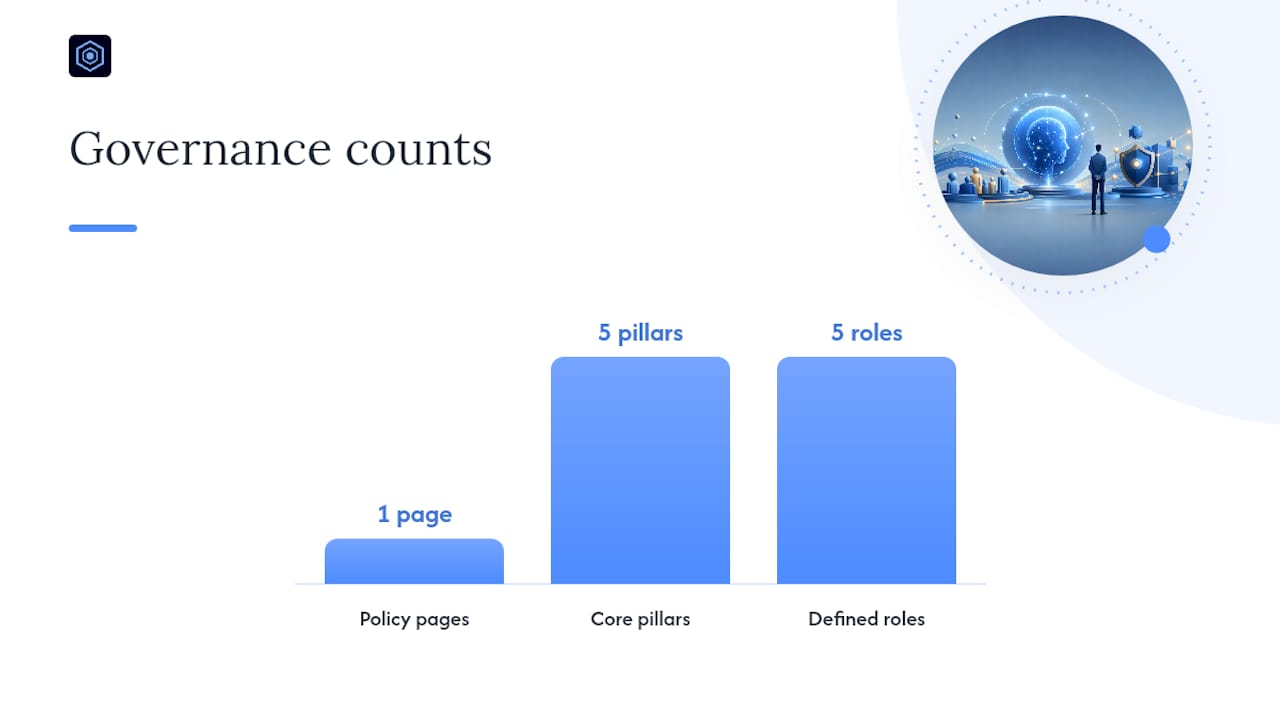
A one-page governance policy sounds modest, but it is the artifact regulators most consistently ask to see first. It should fit on a single page precisely because a document nobody reads in an audit is worse than no document at all.
Your one-page checklist needs five core pillars:
- PII boundaries: a written statement of exactly what data categories the oversight process may and may not touch, with metadata-only integration named explicitly where it applies.
- Approved model manifest: a current list of every AI agent and model version in production, with an owner assigned to each.
- Proof-drill process: a defined cadence for generating single-case evidence, not an ad hoc response to audit requests.
- Kill-switch ownership: a named individual, not a team, who can halt an agent's activity and the conditions under which they are authorized to do it.
- Incident escalation and reviewer roles: who gets notified, in what order, and within what time window.
Turning this into practice means integrating checks into your release gates rather than relying on periodic manual review. Treating governance as policy-as-code means a model that lacks a signed manifest entry, or an agent deployed without documented acceptance criteria, simply fails the CI/CD pipeline before it reaches production. This turns evidence generation into a byproduct of normal engineering work instead of a scramble before an audit.
The roles and responsibilities matrix that supports this typically breaks down as follows:
| Role | Responsibility |
|---|---|
| Model owner | Maintains manifest entry, initiates proof drills for their agent |
| Compliance reviewer | Signs off on acceptance criteria and reviews evidence packs |
| Engineering lead | Implements CI/CD policy checks and manages kill-switch mechanics |
| External evaluator liaison | Coordinates access requests, NDAs, and evaluator deliverables |
| Risk committee | Approves risk concentration thresholds and blast-radius limits |
Human oversight only works if the people in these roles actually have what researchers call epistemic access (they know what is happening), causal power (they can stop or change it), and fitting intentions (they have the right authority and incentives to act). A kill switch owned by nobody in particular is not a control. It is a checkbox that will fail the first time it is actually needed.
How Do Cryptographic Proofs Support External Oversight?
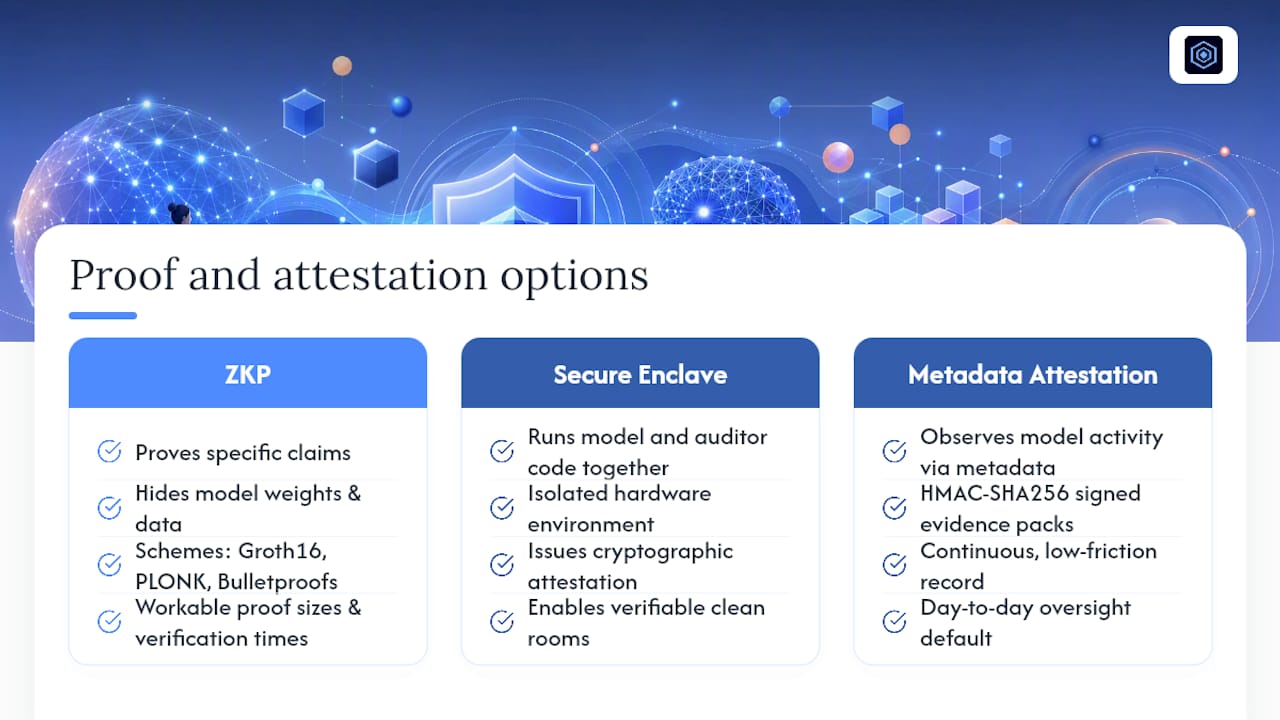
Zero-knowledge proofs let you prove a specific claim about a model, such as "this evaluation ran and passed" or "this output came from model version 4.2," without revealing the model's weights, training data, or internal architecture. Practical ZKP schemes like Groth16, PLONK, and Bulletproofs have matured to the point that proof sizes and verification times are workable for real ML auditing and compliance workflows, not just theoretical demonstrations.
Confidential computing extends the same logic through hardware. A secure enclave lets a vendor's model and an auditor's test code run together in an isolated environment where neither party can see the other's private material, and the enclave itself issues a cryptographic attestation that the computation happened as agreed. This is the mechanism behind verifiable clean rooms, and it solves a specific problem: two parties who do not trust each other can still produce a result both of them trust.
The core insight behind reasoning-faithfulness oversight is that humans do not need to understand a model's internal mechanics to meaningfully check, contest, and verify its outputs. What they need is a design that makes the model's stated reasoning verifiable against its actual behavior, which shifts the oversight burden from mechanistic transparency to external reasoning faithfulness.
This is where agentless, metadata-only attestation complements cryptographic proofs rather than competing with them. A platform that observes model activity through metadata and issues HMAC-SHA256 signed evidence packs gives you a continuous, low-friction record of what happened. A ZKP or enclave-based proof gives you a deeper, cryptographically airtight answer to a specific, narrower question when the stakes on one particular claim are high enough to justify the extra engineering. Most firms will use the metadata layer for day-to-day oversight and reserve heavier cryptographic proofs for the highest-risk model decisions or the toughest regulator requests.
Pro Tip: Cryptographic proofs buy you regulatory traction on very specific, narrow claims. They do not, by themselves, buy you a governance program. A firm with a perfect zero-knowledge proof for one model and no manifest, no kill switch, and no reviewer process still fails an audit on everything else.
How Do You Structure an External AI Evaluation Engagement?
A defensible external evaluator engagement needs a written scope before anyone starts testing anything. That scope should specify the access level (black-box, grey-box, or enclave-based), the acceptance criteria the model must meet, the format evidence will be delivered in, the rules governing what data can leave the environment, and the attestation requirements the evaluator must satisfy at handoff.
Timelines correlate directly with assurance level, and setting expectations up front avoids the common failure where a firm promises regulators a report on a schedule the access level cannot actually support:
| Access level | Typical timeframe | What it delivers |
|---|---|---|
| Black-box | 5 to 10 business days | Behavioral testing against known inputs, limited failure-mode coverage |
| Grey-box | 10 to 20 business days | Deeper testing with partial internals, better anomaly detection |
| Enclave-based / clean room | Variable, often longer setup, faster repeat runs | High assurance with IP protection, strong for recurring audits |
Evaluations exceeding 20 business days are not unusual for the deepest structured-access arrangements, and firms that budget for that upfront avoid the credibility damage of a rushed, thin report.
The deliverables checklist you should require back from any external evaluator:
- Proof-drill records for every case tested, not a summary.
- A signed evaluation script documenting exactly what was run and how.
- Reproducible steps another party could follow to get the same result.
- A cryptographic hash of every artifact delivered, so tampering after the fact is detectable.
- A written statement of acceptance criteria met, unmet, or inconclusive.
- Name a liaison internally who owns the relationship, not a rotating cast of engineers.
- Put NDA terms in place before scoping conversations start, not after.
- Build a sampling plan that covers your highest financial-blast-radius use cases first.
Where Does Oversight Without Production Access Fall Short?
None of this closes every gap, and pretending otherwise would set your compliance function up to fail in front of a regulator who knows better.
- Undetected backdoors are the hardest problem. Black-box and even grey-box testing can miss deliberately hidden behavior that only triggers under narrow, specific conditions nobody thought to test.
- Sampled probes carry lower statistical power than full production visibility. A synthetic canary catches what you designed it to catch, and nothing guarantees it catches the failure mode you did not anticipate.
- IP and contractual constraints often set a hard ceiling on how much access a vendor will grant, regardless of how much a compliance team would prefer.
- Cryptographic solutions carry real operational cost. Enclave setup, ZKP integration, and chained attestation infrastructure all take engineering time that a smaller firm may not have readily available.
The trade-off decision usually comes down to stakes. A safety-critical or systemic-risk model, one with genuine financial blast-radius exposure across a large customer base, justifies the cost of enclave-based or cryptographic assurance. A lower-stakes internal tool, run through metadata-only monitoring and periodic proof drills, is proportionate for the risk it actually carries.
Pro Tip: Do not build the same assurance level for every model in your inventory. Firms that try to apply enclave-grade rigor everywhere burn budget on low-risk agents and run out of runway before they reach the one model that actually needed it.
One last caveat worth stating plainly: regulators in specific jurisdictions, or for models classified as carrying systemic risk, may simply demand greater access than any of these methods provide. Structured, non-invasive oversight is a strong default position. It is not a legal argument against a regulator's statutory right to ask for more when the case genuinely warrants it, and firms should treat these methods as the floor of a defensible program, not a ceiling that can never be raised.
Why Governability Cannot Wait for Perfect Access
The instinct in most engineering organizations is to ship first and govern later, and there is a version of that instinct worth defending. Waiting for a perfect, fully negotiated production-access agreement before putting any oversight in place is how firms end up with zero evidence for the eighteen months it takes to get that agreement signed. The better approach is pragmatic layering: launch a small pilot under the one-page governance checklist described earlier, generate your first proof drill in week one, and add cryptographic or enclave-based assurance only as the stakes of a specific model justify the added cost.
What matters most is not the sophistication of the tooling but whether the three properties researchers call epistemic access, causal power, and fitting intentions are actually present. A reviewer who cannot see what a model did has no epistemic access. A kill switch nobody is authorized to use provides no causal power. A compliance officer with responsibility but no budget or authority has no fitting intention behind their role. Every method in this playbook, from proof drills to zero-knowledge attestation, is only as good as the human structure sitting underneath it. Get that structure right first, and the cryptography becomes a genuine multiplier rather than a expensive substitute for governance that was never really there.
How Aetherpulse Fits Into a Proof-Drill Workflow
Aetherpulse is built for exactly the gap this playbook maps out: producing defensible oversight evidence without ever touching customer data or inserting an agent into production.
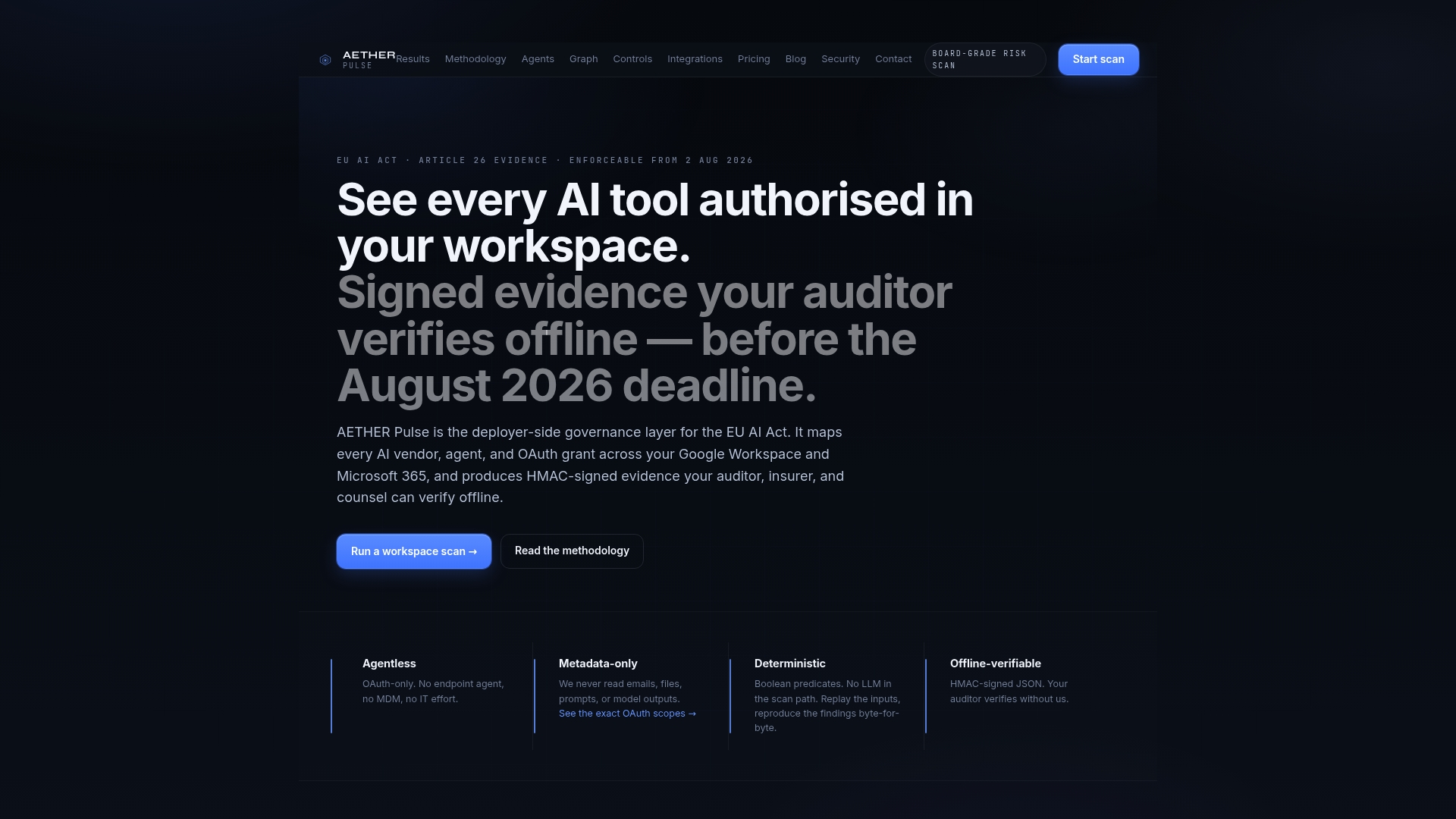
The platform connects through OAuth metadata only, which means it builds a complete inventory and identity graph of your organization's AI agents without reading a single customer record. From that inventory, Aetherpulse surfaces risk concentration and financial blast-radius exposure across your agent estate, then generates provenance-tracked, HMAC-SHA256 signed evidence packs on demand, the same tamper-evident structure a proof drill requires. Reporting is built around the frameworks this article has already touched on: EU AI Act Article 26, the FCA's SYSC and Consumer Duty requirements, the UK's Data (Use and Access) Act, and the ICO's developing code on automated decision-making.
For an external evaluator engagement, this means your liaison can hand over a signed evidence pack instead of negotiating raw access from scratch, cutting weeks off the timeline described in the evaluator playbook above. If your firm is trying to move from ad hoc audit scrambles to a repeatable governance operating model, a look at Aetherpulse's pricing is the natural next step.
Frequently Asked Questions
Is AI oversight without production access actually accepted by regulators?
Regulators increasingly focus on demonstrable evidence rather than the depth of access used to produce it. Frameworks like EU AI Act Article 26 and FCA SYSC emphasize documented oversight and audit trails, which structured, non-invasive methods can satisfy when the evidence is signed, reproducible, and tied to clear acceptance criteria.
What is the fastest way to start producing audit-ready evidence?
Run a single proof drill on your highest-risk use case first. One signed, reproducible record with defined acceptance criteria gives you more credibility with an auditor than a broad but shallow governance document with no concrete evidence behind it.
Do zero-knowledge proofs replace the need for external evaluators?
No. Zero-knowledge proofs verify a specific, narrow claim, such as confirming an evaluation ran or a model version matches expectations, without exposing internals. External evaluators still provide the broader judgment, sampling, and contextual review that a cryptographic proof alone cannot deliver.
How does metadata-only monitoring differ from grey-box access?
Metadata-only monitoring observes activity signals like timestamps, model versions, and decision categories without accessing content at all. Grey-box access goes deeper, exposing limited internals like logits or activation patterns, which typically requires a more formal, negotiated evaluator agreement.
When is production access genuinely unavoidable?
Production access becomes hard to avoid for systemic-risk models where regulators demand it explicitly, or when non-invasive methods have already surfaced an anomaly that structured or cryptographic evidence cannot fully explain. In those cases, escalating to deeper access is the defensible move, not a failure of the lighter-weight approach.
Sources
- Access taxonomy and external evaluator challenges
- External reasoning faithfulness as an oversight strategy
- Why AI governance fails and how policy-as-code fixes it
- Auditing a frontier model without seeing its weights (verifiable clean rooms)
Recommended
Working on Article 26 readiness, deployer-side governance evidence, or AI agent risk at a regulated firm? We'd value 15 minutes of your perspective.
Start a conversation