AI Regulatory Evidence on Demand: A Compliance Guide
AI Regulatory Evidence on Demand: A Compliance Guide

AI regulatory evidence on demand is defined as the continuous, automated generation of auditable proof that an AI system operates within its declared compliance boundaries, produced at the moment a regulator or auditor requests it. For compliance officers in regulated financial services, this capability is no longer optional. The EU AI Act, FCA Consumer Duty, and emerging US state AI laws all require firms to demonstrate oversight of automated decision-making, not merely assert it. Static policy documents no longer satisfy regulators who expect runtime evidence over declarative documentation. This guide explains the frameworks, documentation obligations, and tooling strategies that make audit-ready AI governance achievable.
What are the key AI regulatory evidence requirements?
The EU AI Act establishes the most detailed AI governance standards currently in force. Article 11 and Annex IV require providers of high-risk AI systems to maintain technical documentation for at least 10 years and retain event logs for a minimum of 6 months. Those retention windows are not administrative suggestions. They define the evidentiary floor regulators will check during audits.
Financial penalties for non-compliance are severe. High-risk violations carry fines up to €15 million or 3% of annual global turnover, whichever is higher. Prohibited AI practices reach €35 million or 7% of turnover. That scale of exposure makes AI compliance documentation a board-level risk issue, not a back-office task.

The US regulatory picture is more fragmented but converging. Federal agencies including the CFPB and OCC have issued AI guidance tied to existing fair lending and model risk management frameworks. State laws in Colorado, Illinois, and California impose additional automated decision-making disclosure and impact assessment requirements. One AI system deployed across jurisdictions can simultaneously trigger EU, federal, and multiple state obligations.
Key obligations compliance officers must track:
- Article 11 technical dossier: Nine Annex IV sections covering system description, design logic, risk management, data governance, accuracy metrics, human oversight measures, and cybersecurity controls.
- Event log retention: Minimum 6 months, with tamper-evident storage to satisfy audit integrity requirements.
- Technical documentation retention: 10 years from market placement or service provision.
- Risk classification: High-risk systems in Annex III (credit scoring, employment, critical infrastructure) face the full documentation burden.
- Prohibited practice identification: Biometric categorization and social scoring systems face outright bans with the highest penalty tier.
| Obligation | Requirement | Retention Period |
|---|---|---|
| Article 11 technical documentation | Annex IV nine-section dossier | 10 years |
| Event logs | Tamper-evident runtime records | 6 months minimum |
| Conformity assessment records | Risk management and testing evidence | 10 years |
| Incident reports | Serious incident notifications to authorities | Not publicly specified |
How to shift from paper compliance to operational controls
Paper compliance is the practice of writing policies that describe what an AI system should do and treating those documents as audit evidence. Regulators increasingly reject this approach. Operational controls bind AI system classifications to policy tiers and generate audit trails automatically at runtime, rather than requiring teams to manually compile documentation after the fact.
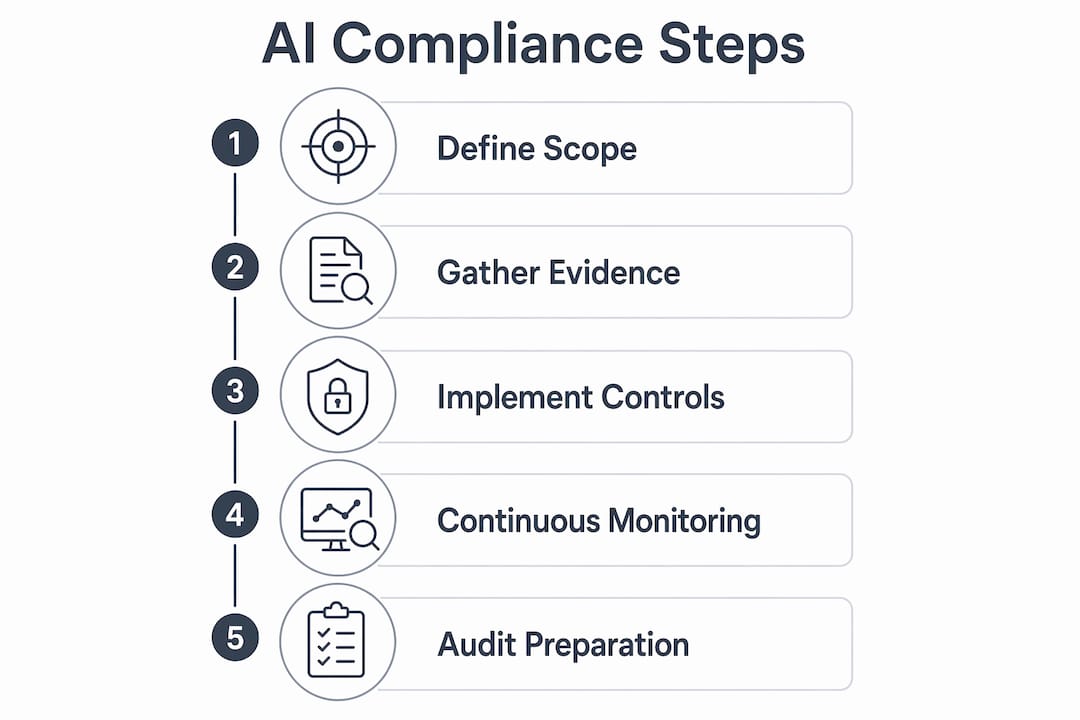
The distinction matters because of a failure mode called regulatory evidence drift. This occurs when compliance claims in policy documents diverge from what the system actually recorded during operation. Drift is almost inevitable when documentation is produced retrospectively. Runtime evidence generation closes that gap by capturing logs, configuration snapshots, and test results continuously.
Shifting to operational controls requires four steps:
- Build an AI system inventory. Classify every deployed AI agent by risk tier before assigning any compliance obligation. Without a complete inventory, enforcement is impossible.
- Bind classifications to policy controls. Each risk tier must map to specific technical controls: logging depth, human review thresholds, and data governance rules. This mapping must be machine-readable, not just documented in a Word file.
- Automate audit trail generation. Runtime logs, configuration snapshots, and automated test results must be captured continuously and stored in tamper-evident format. Manual compilation introduces gaps.
- Map controls across jurisdictions. Jurisdictional overlap requires compliance teams to classify AI systems once and reuse a single control set across EU, US federal, and state requirements. Duplicate control sets create inconsistency and audit risk.
Pro Tip: Treat your AI compliance program the same way identity and access governance teams treat user provisioning. Every AI agent should have a defined owner, a documented risk classification, and an automated deprovisioning trigger when it falls out of compliance.
What are the best practices for the Article 11 technical documentation dossier?
Article 11 technical documentation is the key compliance file that consolidates all Section 2 obligations into a single dossier. When a regulator requests evidence, this document is what they expect to receive. Its nine Annex IV sections cover system description, intended purpose, design specifications, training data, performance metrics, risk management records, human oversight mechanisms, cybersecurity measures, and post-market monitoring plans.
The most common gaps that cause audit failures are predictable. Generic system descriptions copied from marketing materials fail because they do not describe actual model behavior. Missing disaggregated performance data across demographic subgroups creates fair lending exposure. Outdated documentation that does not reflect the current production version is treated as an incomplete evidence trail.
| Common Gap | Risk | Fix |
|---|---|---|
| Generic system description | Regulator cannot verify actual behavior | Write to the deployed model version, not the product pitch |
| Missing subgroup performance data | Fair lending and bias exposure | Disaggregate accuracy metrics by protected characteristics |
| Outdated dossier version | Evidence trail breaks at audit | Implement version control with change timestamps |
| No failure mode analysis | Risk management section incomplete | Document known failure modes and mitigation controls |
| Disconnected quality management | Dossier not linked to QMS | Integrate documentation into existing change management workflows |
Ongoing change management is the discipline that prevents documentation from going stale. Every material change to a high-risk AI system, whether a model update, a data source change, or a threshold adjustment, must trigger a dossier update. Version control with timestamped change records provides the traceability auditors require.
Pro Tip: Rehearse dossier production before an audit arrives. Assign a named owner to each Annex IV section, set a 48-hour production SLA, and run a dry-run retrieval exercise quarterly. Compliance officers who have never assembled the dossier under time pressure consistently underestimate how long it takes.
Build the dossier in parallel with AI system development, not after deployment. Retrofitting documentation onto a live system produces the generic, incomplete records that regulators penalize.
Which tools and frameworks support on-demand evidence generation?
AI compliance auditing benefits from a six-level evidence taxonomy that moves from declared to demonstrated compliance. Level E0 represents absent evidence. Level E6 represents technically demonstrated compliance using runtime logs, automated test results, and configuration snapshots. Most firms currently operate at E1 or E2, relying on policy declarations and self-assessments. Regulators are moving their expectations toward E4 and above.
Cryptographically verifiable evidence chains are the technical mechanism that makes high-maturity compliance defensible. Hash-chained manifests using algorithms such as HMAC-SHA256 prove that a document has not been altered since it was generated. This matters because regulators and auditors cannot otherwise verify that a log file or configuration snapshot reflects the actual system state at the time of capture.
Practical tooling categories compliance officers should evaluate:
- Agentless governance layers: Read-only platforms that ingest AI agent metadata via OAuth, build an identity graph of deployed agents, and generate tamper-evident evidence packs without touching production systems or customer data. Aetherpulse operates in this category.
- Open-source Annex IV scaffolding: Tools such as the
aiact-conformity-packprovide structured templates for each Annex IV section with hash-chained manifest generation for version integrity. - Runtime monitoring integrations: Platforms that capture logs, configuration snapshots, and automated test results continuously and store them in tamper-evident format aligned to EU AI Act retention requirements.
- Governance and risk platforms: Enterprise GRC tools that map AI system classifications to policy controls and generate compliance reports across jurisdictions.
The critical requirement across all tooling categories is integration. Evidence gaps appear when compliance inventory and technical enforcement operate as separate teams using separate tools. The evidence path breaks before the audit begins.
What common mistakes cause AI evidence gaps at audit?
The most damaging mistake compliance officers make is treating a completed policy document as audit readiness. Regulators prioritize runtime evidence: logs, automated test results, and configuration records that prove the system behaved as declared. A policy that says "human review occurs for all high-risk decisions" means nothing without a log showing that reviews actually happened.
Five failure patterns appear consistently across AI compliance audits:
- Static documentation mistaken for evidence: Policy documents describe intent. Runtime logs prove execution. Auditors want the latter.
- Inventory and enforcement silos: When the team that classifies AI systems and the team that enforces technical controls do not share a common data source, the evidence chain breaks.
- Copy-paste Annex IV sections: Generic descriptions copied across multiple AI systems fail because they do not reflect the specific model, data, or risk profile of each deployment.
- Delayed dossier updates: A model update that is not reflected in the Article 11 dossier within a defined change window creates an incomplete evidence trail that auditors treat as a gap.
- No production rehearsal: Teams that have never assembled their full evidence package under time pressure consistently discover missing sections, broken links, and version conflicts during actual audits.
Pro Tip: Assign a named compliance owner to every AI system in your inventory, not just to the program overall. When ownership is diffuse, dossier updates fall through the cracks between model releases.
Key Takeaways
Audit-ready AI compliance requires operational controls that generate tamper-evident runtime evidence continuously, not static policy documents assembled after a regulator requests them.
| Point | Details |
|---|---|
| Retention obligations are non-negotiable | Article 11 dossiers require 10-year retention; event logs require a minimum of 6 months in tamper-evident storage. |
| Runtime evidence outranks policy documents | Regulators prioritize logs, automated tests, and configuration snapshots over declarative compliance claims. |
| Inventory before enforcement | A complete, classified AI agent inventory is the prerequisite for any defensible evidence program. |
| Cryptographic integrity is the standard | Hash-chained manifests using HMAC-SHA256 prove document integrity and prevent regulatory evidence drift. |
| Dossier gaps are predictable and preventable | Generic descriptions, missing subgroup data, and delayed updates are the three most common Annex IV failures. |
The compliance gap no one talks about
The conversation in most compliance teams centers on what to document. The harder question is how to prove the documentation reflects what the system actually did. I have watched firms spend months building detailed Annex IV dossiers only to discover, during a regulator inquiry, that the production system had been updated three times since the dossier was last touched. The document described a system that no longer existed.
The insight that changes how you approach this problem is recognizing that compliance is fundamentally a software engineering discipline. It requires the same version control, automated testing, and continuous integration practices that engineering teams apply to production code. A compliance program that relies on quarterly manual reviews will always lag behind a system that deploys updates weekly.
The firms that will perform best under the EU AI Act are not the ones with the thickest policy binders. They are the ones that have wired their governance layer directly into their deployment pipeline, so that every model update automatically triggers a dossier update, a log capture, and a cryptographically signed evidence pack. That is not a compliance aspiration. It is an engineering requirement that compliance officers need to own.
The practical implication for risk professionals is this: stop measuring compliance program maturity by the number of policies written. Measure it by the time it takes to produce a complete, verified evidence package when a regulator calls. If that number is more than 48 hours, the program has a structural gap.
— Eleye
How Aetherpulse delivers continuous AI governance evidence
Compliance officers who need to move from policy documentation to operational evidence generation have a specific tooling problem. The governance layer must be non-invasive, because inserting agents into production AI systems creates its own risk surface. It must produce cryptographically signed evidence, because unsigned logs do not satisfy high-maturity audit requirements. And it must cover the full agent inventory, not just the systems the compliance team already knows about.
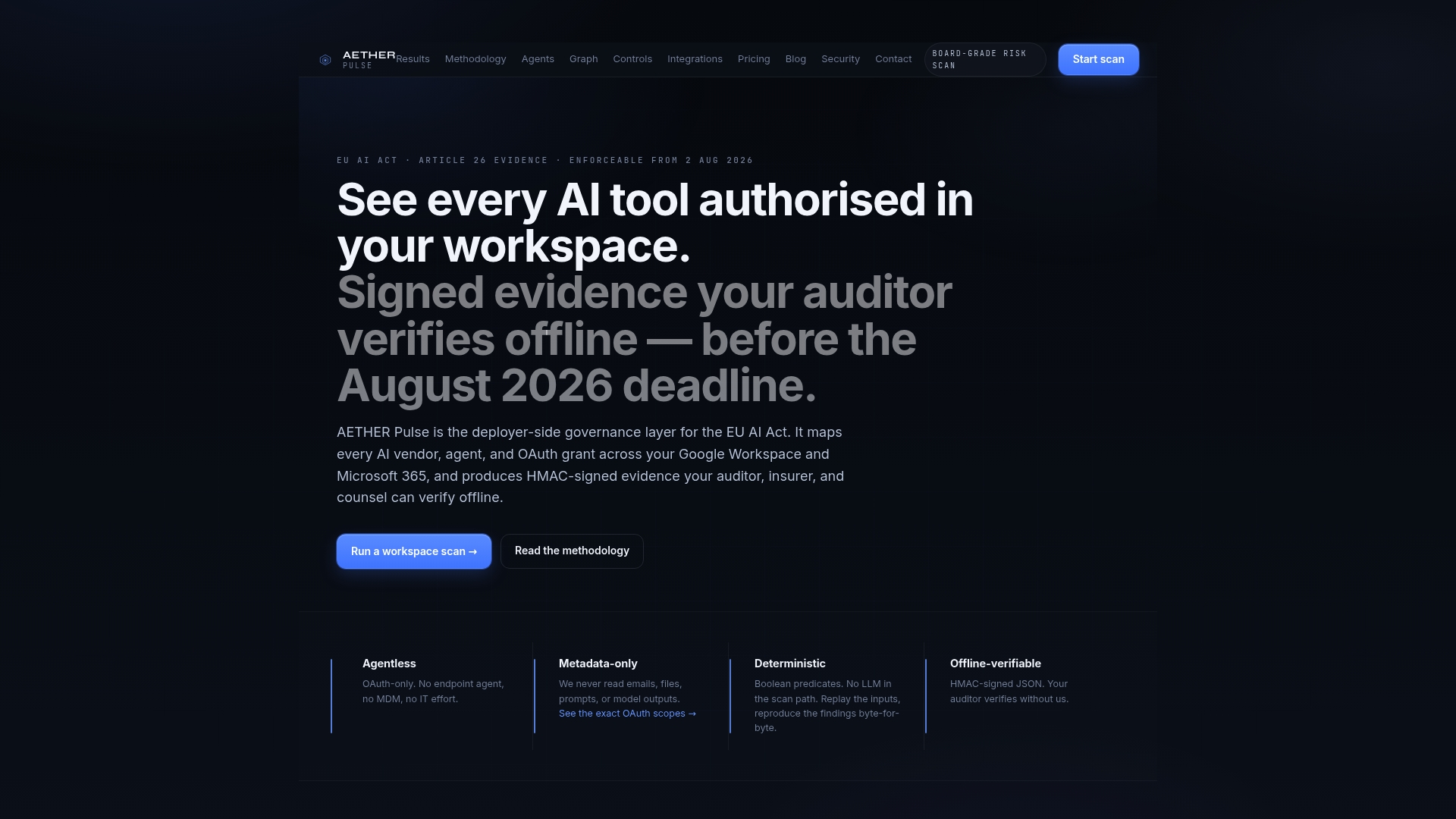
Aetherpulse addresses this directly. The platform connects via OAuth metadata only, builds a complete identity graph of deployed AI agents, surfaces risk concentration including financial blast-radius exposure, and generates HMAC-SHA256-signed evidence packs that compliance officers can present to auditors and regulators without preparation delay. It is built for the EU AI Act, FCA Consumer Duty, and SYSC frameworks, and it deploys without touching customer data or production systems.
FAQ
What is AI regulatory evidence on demand?
AI regulatory evidence on demand is the automated, continuous generation of auditable compliance proof for AI systems, produced at the moment a regulator or auditor requests it. It replaces manual documentation assembly with runtime-captured logs, configuration records, and cryptographically signed evidence packs.
How long must Article 11 technical documentation be retained?
Article 11 and Annex IV require providers to retain technical documentation and conformity records for at least 10 years. Event logs must be retained for a minimum of 6 months in tamper-evident storage.
What are the fines for EU AI Act non-compliance?
High-risk AI system violations carry fines up to €15 million or 3% of annual global turnover. Prohibited AI practices reach €35 million or 7% of turnover, whichever figure is higher in each case.
What is regulatory evidence drift?
Regulatory evidence drift occurs when compliance claims in policy documents diverge from what the AI system actually recorded during operation. Continuous runtime logging and cryptographically verifiable evidence chains are the standard controls used to prevent it.
How does an agentless governance layer differ from traditional compliance tools?
An agentless governance layer connects via metadata only, building an AI agent inventory and generating tamper-evident evidence without inserting itself into production systems or accessing customer data. Traditional compliance tools typically require agent installation or direct system access, which creates deployment friction and additional risk surface.
Recommended
Working on Article 26 readiness, deployer-side governance evidence, or AI agent risk at a regulated firm? We'd value 15 minutes of your perspective.
Start a conversation