8 Agentic Risks That Break Audits: AI Risk Taxonomy for Finance Teams
8 Agentic Risks That Break Audits: AI Risk Taxonomy for Finance Teams

An ai risk taxonomy built for agentic systems has to classify risk by what an agent does, not what a model predicts. For regulated financial firms, that means top-level categories like decision drift, tool chain escalation, fiduciary boundary violation, and concentration exposure, each mapped to an intervention architecture and a logging requirement. Get this mapping wrong, and audit evidence collapses under the first regulator question. Aetherpulse builds this evidence layer directly from agent metadata.
TL;DR:
- Classifying AI risk requires tracking agent actions like decision drift, tool chain escalation, and fiduciary breaches, not just model output accuracy.
- Governance must assign autonomy tiers before identifying risk owners to prevent misclassification and control gaps in autonomous systems.
- Evidence collection relies on metadata-based agent inventories, tamper-evident cryptographic logs, and mapping actions to specific risk categories for audit readiness.
- Containment controls are essential for boundary violations, concentration risks, and accountability voids, with continuous monitoring handling decision drift, state propagation, and evidence gaps.
- Implementing a unified, risk-based governance framework with precise logging, tiering, and oversight improves regulator compliance and proactive risk management.
Table of Contents
- What Makes an AI Risk Taxonomy for Agents Different?
- The Agentic Risk Categories Every Financial Firm Should Track
- Governance Controls Mapped to the Agentic Taxonomy
- How Do You Turn the Taxonomy Into Audit Evidence?
- What Should Governance Leaders Prioritize First?
- How Aetherpulse Maps Directly to This Taxonomy
- Sources
What Makes an AI Risk Taxonomy for Agents Different?
Model-level risk taxonomies ask whether an output is accurate. Agentic taxonomies ask whether an action was authorized, bounded, and reversible. That distinction sounds academic until an agent executes a trade, updates a customer record, or escalates a support ticket into a compliance filing without a human in the loop.
The threat model inverts. A model is an object you evaluate for bias, drift, or hallucination. An agent is an actor that reads state, makes a decision, and changes state somewhere else, often across systems the original risk assessment never anticipated. A technical governance framework for autonomous agents in regulated finance calls this the inverted threat model: incident onset becomes ambiguous, and the action space is effectively unbounded unless you gate it.
That framework also defines three autonomy tiers that should set your governance threshold:
- Assistive agents draft, summarize, or recommend, with a human approving every material action.
- Supervised autonomous agents execute routine actions independently but escalate exceptions, reversals, or anything above a materiality threshold.
- Fully autonomous agents act and adjust without a per-action human checkpoint, which demands the strongest pre-commitment controls and the most complete evidence trail.
Regulators increasingly expect firms to show which tier each agent occupies and why. The Financial Stability Board's consultation on responsible AI adoption flags agent-specific vulnerabilities and third-party concentration as governance priorities distinct from traditional model risk. A taxonomy that stops at "the model was validated" won't satisfy that expectation, and it won't survive contact with an auditor asking who approved a specific autonomous action. Tier assignment should also feed directly into your risk appetite statement. Our agent classification guide walks through mapping agent types to the controls each tier requires.
Pro Tip: Assign autonomy tiers before you assign risk owners. An agent misclassified as "assistive" when it's actually acting on live customer accounts will slip through every control gate downstream.
The Agentic Risk Categories Every Financial Firm Should Track
The taxonomy below groups agent behavior into eight categories, each drawn from how autonomous systems actually fail in production rather than how they fail in a lab.
- Autonomous decision drift. An agent's decision logic shifts gradually from its approved policy without triggering a retraining event. In onboarding, this looks like an agent quietly loosening its risk-scoring thresholds over months, approving customers a human underwriter would have flagged.
- Tool chain escalation. An agent invokes a permission or a downstream tool beyond its original scope, often by chaining API calls in a sequence nobody tested together. A support agent that gains write access to a ledger system through a misconfigured integration is a live example.
- Fiduciary boundary violation. The agent takes an action that breaches a duty of care or suitability obligation, such as recommending a product misaligned with a client's stated risk tolerance. This category requires immediate containment, not monitoring.
- Autonomous concentration and financial blast-radius. A single agent, or a small cluster of interconnected agents, holds authority over a disproportionate share of transaction volume or capital exposure. If it fails, the blast radius is systemic, not isolated.
- Cross-system state propagation. An error made by one agent replicates into other systems before anyone notices, because agents read each other's outputs as inputs.
- Accountability void. No individual or team can clearly answer who approved a given autonomous action, a governance gap FCA guidance on AI explicitly warns against.
- Evidence and provenance gap. Logs exist but can't prove what the agent knew, decided, and executed in sequence, which defeats the entire audit exercise.
- Amplified cyber and ICT risk. Agentic systems widen the attack surface for unauthorized actions, a risk the FSB explicitly names as requiring augmented detection capability.
Categories 3, 4, and 6 demand containment controls before deployment. Categories 1, 5, and 7 are best handled through continuous monitoring and periodic evidence review.
Governance Controls Mapped to the Agentic Taxonomy
Every taxonomy category above needs a corresponding control, or it's just a classification exercise with no teeth. The governance framework for regulated agentic systems proposes three architectures, collectively called Agent Oversight Architectures, that map directly onto autonomy tier and risk category.
- Pre-commitment gates require human or rules-based sign-off before an agent executes an action above a defined materiality threshold. These directly address fiduciary boundary violations and concentration risk, because they stop the action before it happens.
- Statistical process control with auto-halt monitors an agent's behavior against expected statistical bounds and forces a stop when it drifts outside them. This is the primary defense against autonomous decision drift and cross-system state propagation.
- Post-action audit and reversal captures every action in a reviewable, reversible format after execution, which closes the evidence and provenance gap and gives auditors a chain they can independently verify.
Each architecture produces a specific evidence artifact: sign-off logs for pre-commitment gates, statistical deviation reports for SPC, and reversal-capable action traces for post-action audit. Auditors will ask for all three, not just one.
Accountability has to sit somewhere specific. The board should own risk appetite and tier thresholds; senior management owns agent-level sign-off and escalation paths; first-line teams own day-to-day monitoring and exception handling. That structure mirrors what regulators already expect from model risk governance, extended to cover autonomous action.

Pro Tip: Set your board reporting cadence to match your fastest-moving agent tier. A quarterly board pack is useless if a fully autonomous agent can move material exposure in a single trading day.
Recommended cadence: monthly first-line reporting, quarterly senior management review, and a full taxonomy refresh at the board level twice a year. Our governance guide breaks this reporting structure down by firm size.
How Do You Turn the Taxonomy Into Audit Evidence?
A taxonomy on paper doesn't satisfy an auditor. Evidence does, and evidence starts with an accurate agent inventory.
Build the inventory through metadata, not intrusive access. An OAuth metadata ingestion pattern lets you capture what agent exists, who owns it, what systems it touches, and what tier it occupies, without your governance layer ever seeing customer data. That identity graph becomes the backbone of your risk register.
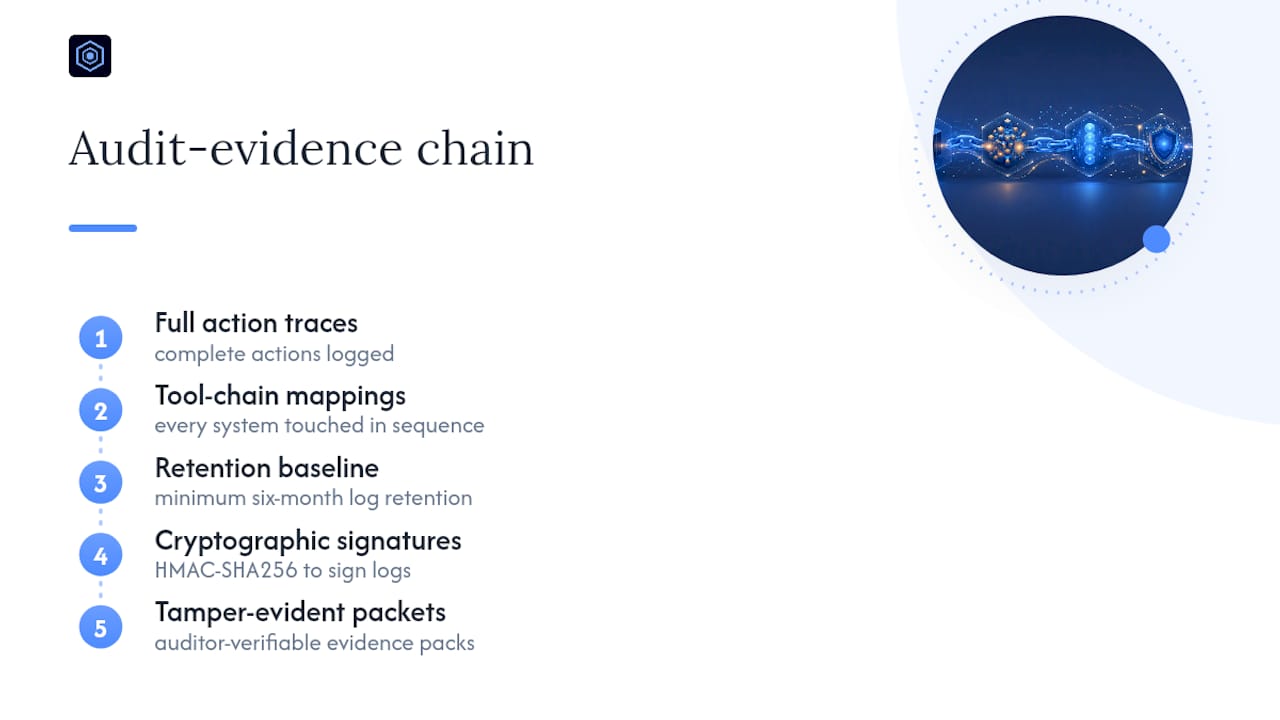
Logging needs three elements: full action traces, tool-chain mappings showing every system an agent touched in sequence, and a retention baseline. Article 26 of the EU AI Act sets a minimum six-month log retention for deployers of high-risk systems, adaptable through internal governance for financial institutions. Cryptographic signatures, such as HMAC-SHA256, turn those logs into tamper-evident evidence packets auditors can verify independently rather than take on trust.
Useful KRIs include: percentage of agents with an assigned autonomy tier, mean time to detect a tool-chain escalation, and count of pre-commitment gate overrides per quarter. Risk-register entries should map directly to taxonomy categories, for example: "Agent X, Tier: Supervised autonomous, Category: Concentration risk, Control: Pre-commitment gate, Evidence: HMAC-signed sign-off log." Our risk-register template covers both entry types in full.
The MAS Project MindForge handbook extends traditional risk-register practice to agentic AI and is worth benchmarking your KRI list against before your next audit cycle.
Audit-readiness checklist: complete agent inventory, tiered risk register, six-month minimum logs, signed evidence packs, and a named accountable owner per agent.
What Should Governance Leaders Prioritize First?
Sequence matters more than completeness on day one. Start with inventory, because you cannot tier, gate, or log an agent you haven't identified. Move next to materiality tiering, since that determines which controls are proportionate and which are overkill. Only then build out pre-commitment gates and SPC thresholds, followed by evidence automation, which is the piece most firms underinvest in until an auditor asks for proof rather than a policy document.
Integrate this taxonomy into your existing model risk framework rather than running it as a parallel program. Treating agentic risk as a silo, separate from the governance structures you already have for models and third parties, tends to create duplicate reporting and gaps at the seams. A unified quarterly cadence to the board, with monthly first-line detail underneath it, keeps the taxonomy alive rather than shelved.
— Eleye
How Aetherpulse Maps Directly to This Taxonomy
Aetherpulse is the audit-ready path to agentic governance that doesn't require inserting new software into your production systems. Where the taxonomy above calls for an accurate agent inventory, Aetherpulse builds it through metadata-only OAuth ingestion, mapping identity, ownership, and autonomy tier without ever touching customer data.
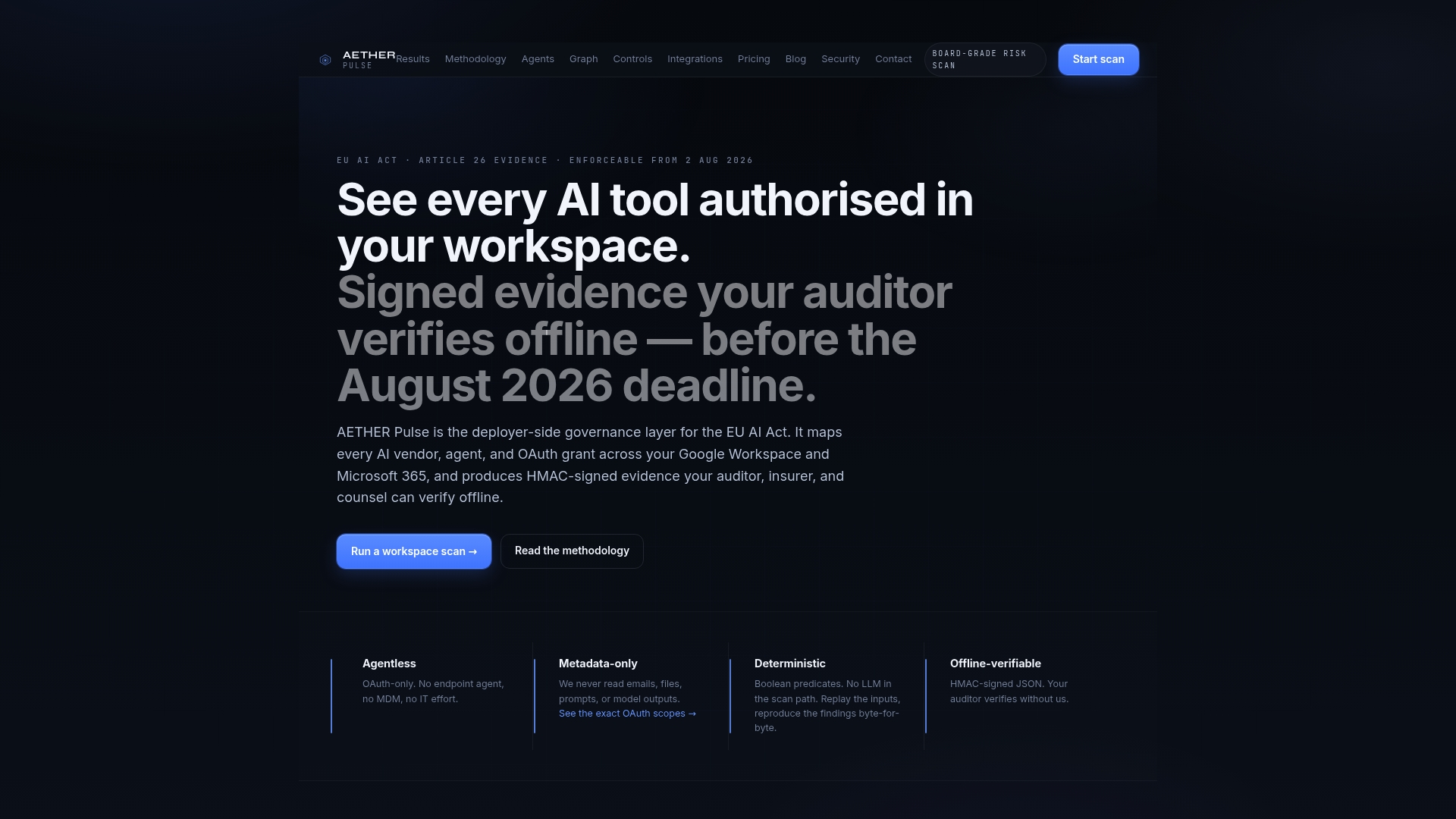
Where the taxonomy calls for tamper-evident evidence, Aetherpulse generates HMAC-SHA256 cryptographically signed evidence packs on demand, giving your risk and compliance teams a defensible packet to hand an auditor or regulator without weeks of manual log reconciliation. The platform also surfaces concentration exposure, so your board can see financial blast-radius risk before it materializes rather than after.
If your firm is still assembling agent evidence by hand, that gap gets more expensive with every regulatory cycle. Visit Aetherpulse to see the product, or check current plans to scope what an evidence-automation rollout looks like for your team.
Sources
Hand these to your audit team as reference points:
- Sound Practices for Financial Institutions' Responsible AI Adoption: Consultation Report
- Autonomous AI Agents in Regulated Financial Services — Governance Framework for Agentic Systems
- Article 26: Obligations of deployers of high-risk AI systems | AI Act Service Desk
- AI Risk Management: Executive Handbook
Recommended
Working on Article 26 readiness, deployer-side governance evidence, or AI agent risk at a regulated firm? We'd value 15 minutes of your perspective.
Start a conversation