AML Automation Compliance Means Governing the Agents, Not Just the Alerts
AML Automation Compliance Means Governing the Agents, Not Just the Alerts

AML automation compliance means proving, with independently verifiable evidence, that your firm governs the AI agents making or influencing anti-money laundering decisions. The recommended approach combines agentless metadata monitoring with cryptographically signed evidence packs, not manual sign-off sheets or trust-based attestations.
Two anchors matter here. The FINOS AI Governance Framework specifies tamper-evident logging and decision-reasoning capture as baseline mitigations for high-risk financial agents. AETHER Pulse operationalizes that standard through a metadata-only connection model.
What this requires in practice:
- Continuous, automated capture of agent decisions and context
- Tamper-evident logs, ideally hash-chained and cryptographically signed
- Evidence exportable in formats an examiner can independently verify
Key Takeaways
AML automation compliance depends on tamper-evident, independently verifiable evidence of AI agent decisions, not manual attestations of oversight.
| Point | Details |
|---|---|
| Define the scope correctly | This covers AI agent governance and audit evidence, not transaction-monitoring or KYC vendor selection. |
| Prioritize independent verifiability | Hash chaining and cryptographic signing move evidence from operator-asserted to independently auditable. |
| Capture the full decision context | Log inputs, model version, reasoning, timestamps, and actor identity for every material agent decision. |
| Choose agentless where possible | Metadata-only monitoring reduces PII exposure and deploys faster than invasive instrumentation. |
| AETHER Pulse as the practical option | AETHER Pulse offers agentless, HMAC-SHA256-signed evidence packs built for FCA and FINOS-aligned exam readiness. |
Table of Contents
- What AML Automation Compliance Covers (and What It Doesn't)
- Why Do Regulators Expect Tamper-Evident Audit Trails?
- What Controls Do You Need to Capture, Protect, and Export?
- Agentless Monitoring or Invasive Instrumentation: Which Fits?
- How Should You Score a Vendor or Internal Build?
- Where Should Compliance Teams Focus First?
- How AETHER Pulse Fits Into This Governance Model
- Sources
What AML Automation Compliance Covers (and What It Doesn't)
For this article, AML automation compliance refers strictly to governance of AI agents involved in AML decision-making, and the audit evidence a firm produces to demonstrate that oversight. It does not cover selecting transaction-monitoring engines, sanctions screening vendors, or KYC case-management software. Those are procurement decisions about detection tools; this is about proving control over the automated decisions those tools (or adjacent AI agents) make.
In scope, typically:
- Alert triage agents that auto-close or escalate suspicious activity alerts
- Automated name-matching and fuzzy-logic sanctions decisioning
- LLM-based summarization feeding investigator case files
- Agents that adjust risk scores or apply disposition codes
A representative scenario: an agent triages a large volume of monthly sanctions alerts, auto-clearing a majority as false positives. Without agentless, tamper-evident logging of each disposition and its rationale, that clearance rate becomes very hard to defend under FCA scrutiny.
Why Do Regulators Expect Tamper-Evident Audit Trails?
Regulators no longer accept "the model decided" as an answer. The FCA's guidance on AI in financial services makes clear that existing frameworks, including SYSC and SM&CR, still apply to automated decision-making. Firms must document governance, testing, and accountability for material AI applications, and a senior manager remains on the hook for outcomes an agent produces.
The operational problem is scale. A compliance analyst can annotate a handful of manual case decisions each day. An agent can generate thousands of dispositions per hour. Manual documentation was never built for that velocity, which is why AML programs relying on spreadsheet logs or after-the-fact narrative summaries tend to collapse under examiner questioning.
Cryptographic hash chaining and anchoring digests to append-only transparency logs raises log integrity from operator-asserted to independently auditable, according to FINOS.
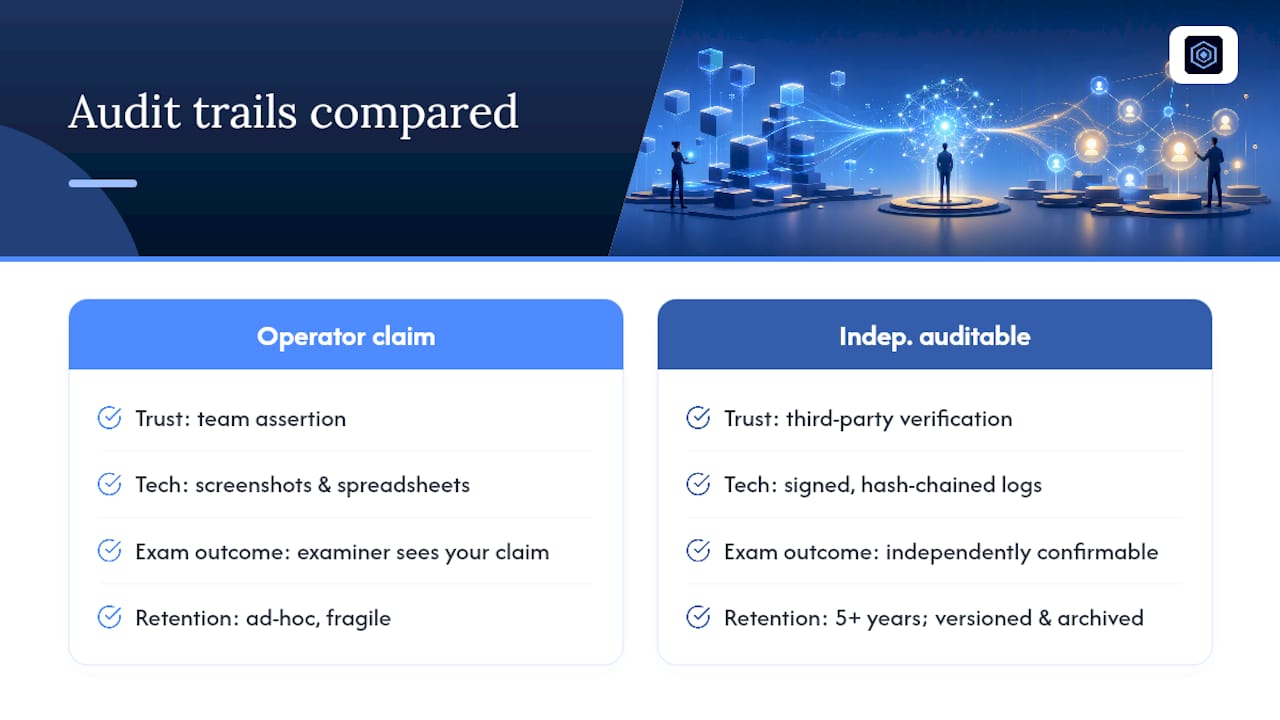
That distinction, independently auditable versus operator-asserted, is the one that matters in an exam room. A binder of screenshots tells an examiner what your team claims happened. A signed, hash-chained log with cryptographic protection, as FINOS's Tier 3 guidance describes for high-risk financial applications, tells them what a third party can independently confirm happened. The ADGM/Thomson Reuters rulebook reinforces this with a specific benchmark: retention, versioning, and archiving of AI audit logs for at least five years, with independent validation built in.
What Controls Do You Need to Capture, Protect, and Export?
Every AML agent governance program needs to answer three questions on demand: what did the agent see, what did it decide, and can you prove the record wasn't altered afterward. That breaks into four control categories.
1. Required data capture. Log the input data the agent received, the model version in use at the time, a plain-language explanation of the decision, surrounding case context, a precise timestamp, and the identity of the acting agent or credential.
2. Integrity controls. Apply hash chaining so each log entry cryptographically references the one before it, making silent edits detectable. Sign log segments using HMAC-SHA256 or an equivalent method. Where possible, anchor digests to an independent, append-only log, a technique FINOS specifically recommends for reaching independently auditable status.
3. Operational controls. Set a retention policy of at least five years, per ADGM/Thomson Reuters guidance, restrict log access on a need-to-know basis, separate the people who configure agents from those who audit them, and run ongoing anomaly detection on decision patterns.
4. Exportables. Produce audit-ready evidence packs, chain-of-custody metadata showing who touched what and when, and report formats an external auditor can read without a translation layer from your engineering team.
Pro Tip: Build your evidence pack template before your first exam, not during it. Retrofitting a chain-of-custody format under regulatory time pressure is how firms end up with gaps an examiner notices immediately.
Miss any one of these four categories and you have a governance program that looks complete internally but folds the moment someone outside your team asks to independently verify it.
Agentless Monitoring or Invasive Instrumentation: Which Fits?
Two architectures dominate AML agent governance, and the choice shapes your privacy exposure as much as your deployment timeline.
Agentless metadata monitoring connects through OAuth-based metadata hooks, pulling information about what an agent did, when, and under what model version, without touching the underlying customer data or transaction content itself. This is the approach AETHER Pulse uses: a metadata-only connection that still produces tamper-evident, HMAC-SHA256-signed evidence packs suitable for regulators. Because it never accesses sensitive customer records, it sidesteps a large share of the data-handling risk that governance tooling normally introduces.
Invasive instrumentation embeds hooks directly inside the application, giving full access to inputs, outputs, and internal state. It offers granular control but expands your PII exposure surface substantially, since the governance layer now sits inside the same data perimeter as customer information.
- Agentless: faster to deploy, lower privacy risk, weaker on capturing proprietary internal reasoning steps some model providers don't expose
- Invasive: deeper visibility, higher control, but adds a new system with direct access to regulated data that itself needs governing
Pro Tip: If your firm is mid-exam-cycle or working under a tight remediation deadline, agentless is almost always the faster path to audit-ready evidence, because it doesn't require months of in-application engineering work before it produces a usable log.
A practical deployment checklist: inventory every AI agent touching AML workflows, identify OAuth or metadata integration points for each, prioritize high-risk agents (auto-clearing or auto-escalating decisions) for first rollout, and confirm evidence pack formats match what your internal audit function already expects to see.
How Should You Score a Vendor or Internal Build?
Evaluating an AML agent governance solution means scoring it against the same criteria an examiner will eventually apply to your evidence, not against a features checklist a sales deck hands you.
Score each option on:
- Tamper-evidence method: hash chaining, cryptographic signing, or neither
- Independent verifiability: can a third party confirm integrity without trusting the vendor's word
- Export formats: does it produce auditor-readable evidence packs or just internal dashboards
- Retention and access controls: does it meet or exceed five-year retention with role-based access
- Integration model: agentless metadata or invasive instrumentation, and what that means for your data perimeter
- Deployment friction: weeks or quarters to a working audit trail
Automatic red flags: no cryptographic signing, no independent verification path, or retention under regulatory minimums.
For a request-for-proposal or proof-of-concept plan, ask vendors to produce a sample signed evidence pack, document their hash-chaining method, and confirm a maximum retention floor. Compare candidates using the same evaluation framework you'd apply to any AI control platform rather than vendor marketing claims alone.
Where Should Compliance Teams Focus First?
Start with your highest-risk agents, the ones auto-clearing alerts or making sanctions dispositions with no human review, and document why you chose that logging tier in a formal architecture decision record. Skipping that documentation step is the single most common gap I see in otherwise solid governance programs.
Watch for model-provider limitations: some vendors won't expose full internal reasoning traces, which caps how complete your explainability capture can be no matter how good your logging layer is. For agentless approaches that work within those constraints, AETHER Pulse's gap assessment guide is a reasonable starting reference.
How AETHER Pulse Fits Into This Governance Model
AETHER Pulse is built for exactly the gap this article describes: proving oversight of AML agents without adding another system that touches customer data. It connects through metadata only, never the underlying transaction or case content, and produces tamper-evident evidence packs signed with HMAC-SHA256, hash-chained so any alteration is detectable after the fact.
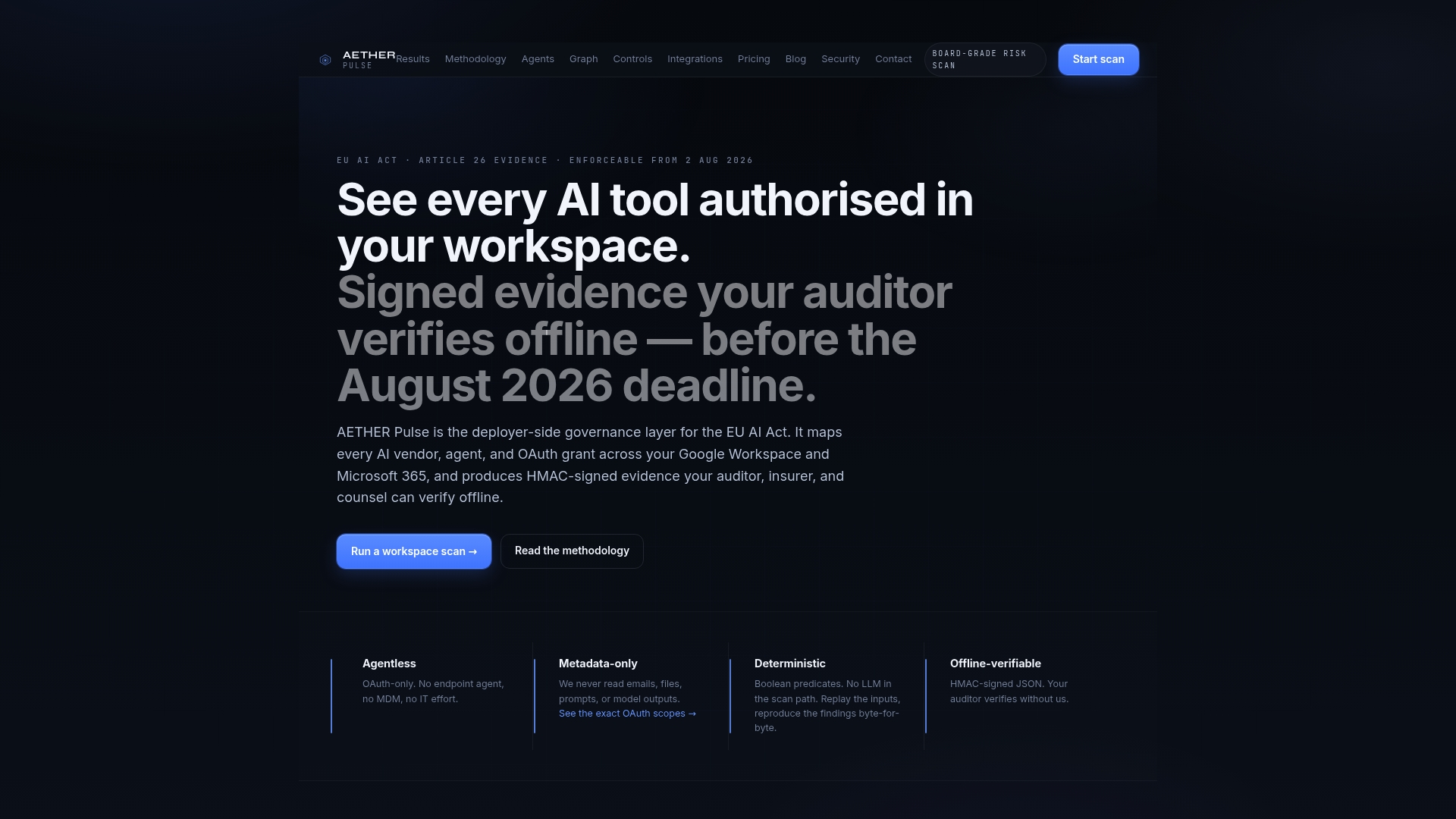
Where invasive instrumentation can take months to deploy and expands your data-handling footprint in the process, AETHER Pulse's agentless model is designed to get a working audit trail in place fast, without new PII exposure and without disrupting the AML agents already running in production. Evidence exports are built to match what auditors and examiners actually ask for, referencing frameworks including FINOS mitigations, FCA expectations, and the EU AI Act's Article 26 obligations.
If your team is heading into an exam cycle or building a business case for governance investment, review AETHER Pulse's security architecture and pricing on the pricing page, or book a demo to see a sample evidence pack generated from your own agent inventory.
Sources
- FINOS AI Governance Framework: Agent decision audit and explainability
- AI: artificial intelligence in financial services | FCA
- Entire Section | Rulebook (ADGM/Thomson Reuters)
This article is general information, not a substitute for advice from a qualified financial advisor. Consult a qualified financial professional about your own circumstances before acting on anything here.
Recommended
Working on Article 26 readiness, deployer-side governance evidence, or AI agent risk at a regulated firm? We'd value 15 minutes of your perspective.
Start a conversation