Bedrock Security: An Audit-Ready Playbook for AI Agents
Bedrock Security: An Audit-Ready Playbook for AI Agents

Bedrock security is a metadata-only, audit-ready governance layer that inventories every autonomous AI agent, maps its financial blast-radius, and emits tamper-evident, cryptographically signed evidence packs on demand. Platforms like AETHER Pulse implement this pattern directly, giving compliance teams a defensible answer when IOSCO or an internal audit team asks how AI agents are supervised. Your first move, inside the next 7 to 30 days:
- Confirm every deployed AI agent has an inventory entry, including undocumented ones running under EU AI Act Article 26.
- Require staged approval for any agent with payment access or external communication capability.
- Turn on a tamper-evident audit log before the next agent goes live.
Key Takeaways
Bedrock security succeeds when firms combine a complete AI agent inventory, proportionate runtime controls, and tamper-evident, cryptographically signed evidence that maps directly to regulatory expectations.
| Point | Details |
|---|---|
| Build the inventory first | Every agent needs a documented entry covering purpose, scope, and data dependencies before anything else. |
| Gate high-risk actions | Agents with payment or external communication access need runtime checkpoints and human-in-the-loop review. |
| Score risk by blast-radius | Combine access scope, reversibility, transaction value, and data sensitivity into one repeatable score. |
| Sign your evidence | Tamper-evident, cryptographically signed records hold up to audit scrutiny better than narrative reports. |
| Consider a metadata-only layer | AETHER Pulse builds agent inventories and signed evidence packs without accessing customer data. |
Table of Contents
- Why Foundational Agent Governance Is Urgent Now
- Core Components Of Bedrock Security You Need in Policy
- How To Build a 90-Day Roadmap for AI Governance
- What Evidence Will Auditors and Regulators Ask For?
- How Do You Score Agent Risk and Financial Blast-Radius?
- Can You Prove Oversight Without Touching Customer Data?
- What Should Boards and CROs Prioritize First?
- Where AETHER Pulse Fits Your Governance Roadmap
- Frequently Asked Questions
- Sources
Why Foundational Agent Governance Is Urgent Now
Supervisors already expect firms to run lifecycle governance over agentic AI, not just static models. IOSCO's supervisory toolkit calls for guardrails proportionate to materiality and risk across design, deployment, monitoring, and retirement. Article 26 pushes this further for deployers specifically: complete a Fundamental Rights Impact Assessment before deployment, monitor continuously, and be ready to suspend and notify the provider the moment risk emerges.
The operational stakes are concrete, not theoretical. An agent with unsupervised payment access can misroute funds before anyone notices. One with external messaging permissions can leak data simply by doing its job slightly wrong. Singapore's MAS frames this as a runtime problem, not just a policy one.
Agentic systems act faster than a quarterly control review can catch them. A runtime governance checkpoint between the agent's decision and its execution is what closes that gap, according to MAS's SAFR framework.
Senior management accountability sits at the center of every one of these expectations. Auditors will ask who owns the governance framework, not just whether one exists.
Core Components Of Bedrock Security You Need in Policy
Every regulator-facing control ultimately traces back to a small set of foundational elements. Miss one, and you create a gap an auditor will find before you do.
- AI inventory: a living record of every agent, its purpose, scope, data usage, and dependencies.
- Lifecycle controls: documented governance from design through retirement, matching IOSCO's lifecycle expectations.
- Staged approvals and supervised experimentation: no agent moves from sandbox to production without a documented sign-off.
- Runtime governance checkpoint: a gating layer that evaluates each proposed agent action before execution, per the SAFR model.
- Tamper-evident audit log: cryptographically protected records that cannot be quietly edited after the fact.
- Data quality and provenance controls: tracking where training and input data actually came from.
- Human oversight and escalation protocols: a defined reviewer population, not an informal "someone will notice."
- Third-party due diligence and audit access: contractual rights for auditors to reach vendor logs, not just your own.
- Incident response with suspension-and-notify: the ability to pull an agent offline and alert stakeholders within a defined window.
Pro Tip: Calibrate controls to materiality, not uniformly across every agent. A low-risk internal scheduling agent doesn't need the same staged-approval rigor as one with payment execution rights. IOSCO's toolkit explicitly supports streamlined processes for low-materiality use cases, which frees your review capacity for the agents that actually carry financial blast-radius.
Article 26 obligations map most directly onto your FRIA process and monitoring program. IOSCO's lifecycle expectations map onto your inventory and validation controls. SAFR's runtime concerns map onto the checkpoint layer. Build your policy language section by section against these three, and you'll have a document an auditor can actually trace claim by claim, as Legalithm's overview of AI Act documentation requirements suggests firms should plan for.
How To Build a 90-Day Roadmap for AI Governance
An initial compliance posture is achievable in 90 days. Full stabilization takes 6 to 12 months.
- Weeks 1 to 3: Run a gap analysis against current inventory, controls, and known agent deployments, including shadow AI.
- Weeks 4 to 6: Complete the AI inventory, recording purpose, scope, and data dependencies for every agent.
- Weeks 7 to 9: Deploy a runtime governance checkpoint for high-risk agents, starting with anything touching payments or external communication.
- Weeks 10 to 12: Configure tamper-evident logging export and complete FRIA documentation for high-risk agents.
Ownership needs to be explicit from day one:
- Board and senior management: sign off on the governance framework and accept accountability, as IOSCO's final report requires.
- CRO or Head of AI Governance: owns the operating model end to end.
- Model risk management team: runs validation and testing against documented methodology.
- Legal: negotiates vendor contracts for audit access and log retention rights.
- Security and operations: guarantee log integrity and tamper-evidence.
- Designated human reviewers: handle escalations from the runtime checkpoint.
Deliverables to track: FRIA templates, a controls repository, disposition engine rules, tamper-evident audit configuration, and vendor audit-access contract terms.
What Evidence Will Auditors and Regulators Ask For?
Auditors want deterministic, tamper-evident records tied directly to each agent's inventory entry, not a narrative summary written after the fact.
- A per-action governance record: timestamp, agent identity, proposed action, controls checked, disposition outcome.
- A signed evidence pack using HMAC-SHA256 or an equivalent cryptographic method.
- FRIA documentation and a change log for every material update to the agent.
- Test and validation results, including datasets and metrics used.
- Human-review audit trails showing who escalated what, and when.
- Vendor access logs and contractual audit rights on file.
- Monitoring KPIs and escalation events over time.
A runtime governance checkpoint that produces an independent, metadata-only, cryptographically signed audit trail is the architecture pattern regulators are converging on, per MAS's SAFR proposal.
Independence matters here. A checkpoint built into the agent's own logging stack is easier to dispute than one that sits outside it entirely.
How Do You Score Agent Risk and Financial Blast-Radius?
Use a repeatable score combining five factors: access scope, action reversibility, transaction value, external communication capability, and data sensitivity.
- Score each factor 1 to 5, with 5 representing the highest risk (irreversible actions, unlimited transaction value, open external messaging).
- Sum the five scores to produce a composite risk rating per agent.
- Set a threshold, for instance 15 out of 25, above which human-in-the-loop review becomes mandatory rather than optional.
Priority checklist for identifying your highest-risk agents:
- Any agent with payment execution authority.
- Any agent with account access beyond read-only.
- Any agent capable of external messaging or data transmission.
Agents scoring below your threshold can run with lighter, autonomous controls and periodic sampling. Agents above it need human-in-the-loop review or an outright block until validated, feeding directly into your monitoring KPIs and escalation triggers, an approach consistent with the layered governance architecture Strathclyde's agentic AI white paper recommends for avoiding advice drift.
Can You Prove Oversight Without Touching Customer Data?
An agentless metadata layer captures what an agent intended and which controls were applied, without ever ingesting the customer data behind the action.

This trades off two things against each other. You gain privacy preservation, faster deployment, and simpler audits since there's no sensitive data flowing through the governance layer. You lose the ability to reconstruct full transaction content after the fact, though sufficient metadata still proves the control check happened and what it decided.
A usable evidence pack should include: agent ID, mandate scope, a proposed action summary, controls evaluated, disposition outcome, reviewer ID if escalated, a cryptographic signature, and a pointer to redacted transaction identifiers for traceability.
Pro Tip: Don't treat metadata-only evidence as a lesser substitute for full data access. For most audit questions, the regulator wants proof a control fired correctly, not the underlying customer record, per the agentless governance approach that firms are increasingly adopting.
What Should Boards and CROs Prioritize First?
Boards and CROs should treat AI deployer obligations as a direct extension of existing model risk and third-party governance programs, not a separate initiative competing for budget.
Three priorities matter more than the rest right now:
- Complete AI inventory and FRIA coverage before adding new agent capability.
- Implement runtime governance for any agent carrying payment or external communication risk.
- Secure contractual audit rights and log access from every vendor supplying agent infrastructure.
Where AETHER Pulse Fits Your Governance Roadmap
AETHER Pulse provides a read-only, metadata-only governance layer that produces tamper-evident, cryptographically signed evidence packs without ever accessing customer data, built to align with FCA Consumer Duty and EU AI Act requirements.
That distinction matters when your board asks how you'll prove oversight without expanding your data exposure footprint. AETHER Pulse builds an agent inventory and identity graph that surfaces risk concentration and financial blast-radius exposure automatically, rather than requiring your team to hand-build a risk register from scratch. Evidence packs are signed with HMAC-SHA256, giving auditors a verifiable chain of custody rather than a spreadsheet someone could have edited last week.
If your firm is still assembling the inventory and runtime controls described above, a platform that already implements this pattern shortens the path considerably. Review the pricing and evidence infrastructure details to see which tier fits your firm's agent count and deployment scope, and request a walkthrough of how the evidence packs look when presented to an auditor.
Frequently Asked Questions
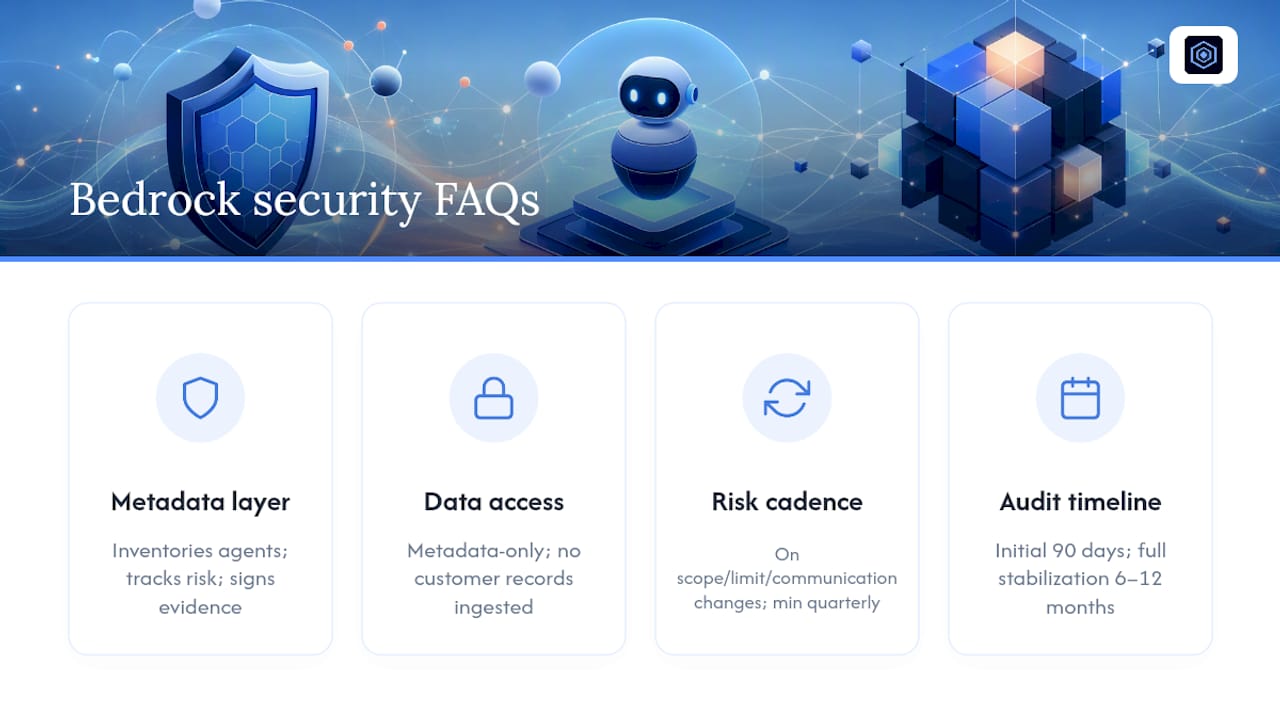
What does bedrock security mean for AI agents in financial services? It refers to a foundational, metadata-only governance layer that inventories agents, tracks their risk, and produces signed, tamper-evident evidence for auditors and regulators.
Does bedrock security require accessing customer data? No. A properly designed metadata-only layer captures what an agent intended and which controls applied, without ingesting the underlying customer records.
How often should agent risk scores be recalculated? Recalculate whenever an agent's access scope, transaction limits, or communication capability changes, and at minimum on a quarterly review cycle.
What's the difference between bedrock security and general AI governance? Bedrock security specifically emphasizes audit-ready, cryptographically verifiable evidence and financial blast-radius mapping, rather than broad policy statements alone.
How long does it take to reach an audit-ready posture? Most firms can reach an initial compliant posture in 90 days, with full stabilization across all agents taking 6 to 12 months.
This article is general information, not a substitute for advice from a qualified financial advisor. Consult a qualified financial professional about your own circumstances before acting on anything here.
Sources
- IOSCO final report on AI (supervisory expectations)
- Safeguards for Agentic Finance at Runtime (SAFR)
- Article 26 deployer obligations: what banks and insurers actually owe — EKM Global Consulting
- Agentic AI for Scaling Targeted Support: A governance framework (Strathclyde white paper)
Recommended
Working on Article 26 readiness, deployer-side governance evidence, or AI agent risk at a regulated firm? We'd value 15 minutes of your perspective.
Start a conversation