Compliant Agent: Governance Guide for Regulated Firms
Compliant Agent: Governance Guide for Regulated Firms

A compliant agent is any actor, human or automated, that operates under mapped regulatory controls, produces auditable evidence of its actions, and maintains documented human oversight at defined decision thresholds. For compliance leaders and AI governance specialists, success means one thing: the ability to present a regulator with a complete, tamper-evident evidence pack on demand, with no gaps in identity, provenance, or control mapping.
A program built around compliant agents succeeds when it delivers:
- Agent identity and inventory: every agent, human delegate, or automated system is named, registered, and role-bound
- Provenance tracking: each decision or action carries a traceable lineage back to its data source and triggering control
- Structured, immutable logging: timestamped records that cannot be altered after the fact
- Human-in-the-loop gating: defined thresholds at which automated action stops and human judgment takes over
- Signed evidence packs: cryptographically sealed artifacts that auditors and regulators can verify independently
Pro Tip: Before deploying any agent, human or AI, document the escalation threshold explicitly: what action type, risk score, or data sensitivity level triggers mandatory human review. That single decision prevents the most common audit failure mode.
Key Takeaways
A compliant agent program succeeds when evidence is continuous, signed, and pre-assembled before a regulator asks for it, not assembled under pressure after the request arrives.
| Point | Details |
|---|---|
| Define the agent inventory first | Every governance program starts with a complete, version-controlled register of all agents and their role bindings. |
| Choose the evidence model before integration | Metadata-only approaches deploy in days and minimize data risk; full-data instrumentation adds coverage but requires its own compliance controls. |
| Sign evidence at generation, not export | Cryptographic signing at the point of action is the only model that produces tamper-evident, regulator-defensible artifacts. |
| Human-in-loop thresholds must be documented | Automated gating alone does not satisfy EU AI Act Article 26 or FCA oversight requirements for high-risk decisions. |
| Aetherpulse delivers agentless signed evidence | Aetherpulse connects via OAuth metadata only and produces HMAC-SHA256 signed evidence packs mapped to UK and EU regulatory frameworks, deployable in days. |
Table of Contents
- What does "compliant agent" actually mean?
- Core responsibilities every compliant agent must cover
- What technical controls make an AI system genuinely compliant?
- Which regulatory frameworks govern compliant agent programs?
- How do implementation patterns differ in practice?
- How do vendors approach compliant agent capability?
- What does a regulator-ready evidence pack actually contain?
- What are the most common failure modes in compliant agent programs?
- How long does it take to implement a compliant agent program?
- What compliance teams actually learn after deployment
- Aetherpulse provides audit-ready AI governance without data access
- Editorial perspective: the evidence gap is the governance gap
- Sources
What does "compliant agent" actually mean?
The phrase carries two distinct meanings in practice, and conflating them creates real governance gaps.
The first meaning is the regulatory or human-agent role. In private security, financial services licensing, and delegated regulatory programs, a "compliance agent" is a licensed individual or designated entity authorized to act on behalf of an organization in regulatory matters. Organizations such as AMECA operate precisely in this space, acting as agents to perform compliance services on behalf of public authorities. This sense of the term is grounded in legal delegation, licensing requirements, and personal accountability under statute.
The second meaning is the AI-agent compliance sense: an autonomous or semi-autonomous software system designed to operate within a defined regulatory control framework, produce evidence of its behavior, and flag or halt actions that breach policy. This usage has accelerated as enterprises deploy AI agents across operations and regulators begin demanding documented oversight of automated decision-making.
Where the two meanings overlap is significant. Both require:
- Mapped controls tied to specific regulatory obligations
- Evidence of actions taken and decisions made
- Clear accountability chains, whether to a licensed individual or a governance policy
- Escalation paths when a situation exceeds the agent's authorized scope
Where they differ is equally important. A human compliance agent carries personal legal liability and operates under licensing regimes. An AI compliant agent carries no legal personhood; accountability flows to the firm and its governance function. The AI version also introduces unique risks around explainability, data access, and automated decision chains that human agents do not.
Pro Tip: When scoping a compliant-agent program, define which sense of the term governs each workstream. Mixing licensing obligations with AI governance requirements in a single policy document without clear separation is a common source of audit confusion.
Core responsibilities every compliant agent must cover
Whether the agent is a human delegate or an AI system, the core responsibility set is consistent enough to serve as an acceptance checklist for role profiles, statements of work, or AI system acceptance tests.
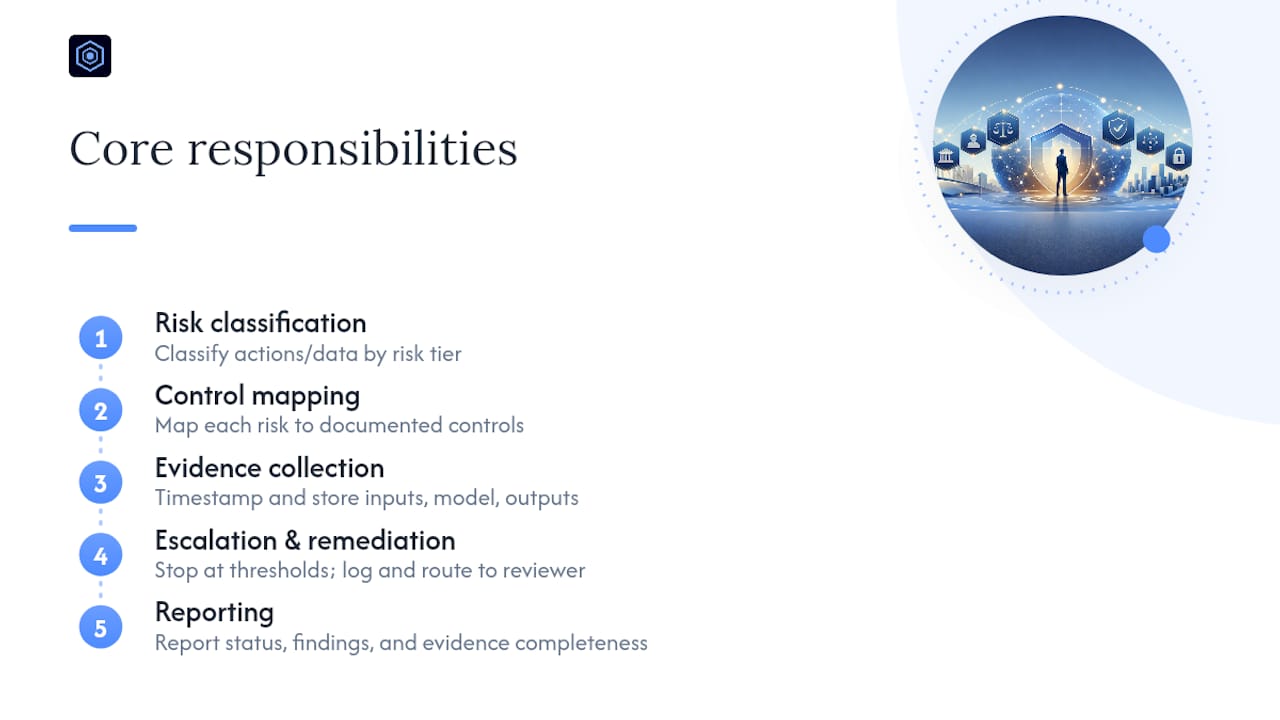
Risk classification sits at the top. The agent must categorize each action, data flow, or decision by risk tier before proceeding. For AI systems, this means a pre-execution classification step; for human agents, it means documented triage against a defined risk register.
Control mapping follows: each risk category must link to one or more specific regulatory controls, with the mapping documented and version-controlled. A gap in the mapping is a gap in the evidence chain.
Evidence collection is the operational core. The agent collects, timestamps, and stores records of every material action. For AI systems, this includes input data metadata, model version, decision output, and the policy rule applied.
Escalation and remediation define the boundaries of autonomous action. When a threshold is crossed, the agent stops, logs the escalation event, and routes to a human reviewer. Remediation records must capture what changed and why.
Reporting closes the loop: periodic and on-demand outputs that summarize control status, open findings, and evidence completeness for internal risk functions and external regulators.
The competency set that supports these responsibilities includes regulatory literacy across applicable frameworks, provenance and identity management, explainability of automated decisions, audit process knowledge, and security hygiene covering key management and access controls. A compliance gap assessment against these dimensions before deployment surfaces the gaps that will otherwise appear during an audit.
Harbor Compliance advisors caution against removing human auditors from the process entirely. The recommended model uses compliant agents to automate high-volume evidence collection so that human specialists can focus on nuanced judgment and governance decisions where automated systems lack the context to act reliably.
What technical controls make an AI system genuinely compliant?
Technical controls are where governance intent becomes verifiable fact. The controls below are the minimum set that compliance teams should require from any AI system claiming to operate as a compliant agent.
Identity and agent inventory
Every agent must have a strong, unique identity: a registered credential, a defined role binding, and a record in a central agent inventory. Without this, attribution of actions to a specific agent version is impossible. Agent discovery and inventory workflows are the practical starting point for any governance program.
Provenance and data lineage
Metadata-first approaches record what data was accessed, when, and under which authorization, without necessarily ingesting the data itself. Signed evidence artifacts attach a cryptographic signature to each provenance record, making tampering detectable. HMAC-SHA256 is a widely used signing scheme for this purpose.
Immutable, structured logging
Logs must be timestamped, structured (machine-readable), and written to an append-only store. Retroactive modification must be architecturally prevented, not merely policy-prohibited.
Human-in-the-loop gating
Automated gating enforces policy thresholds without human intervention for routine decisions. Manual approval gates hold execution until a human reviewer signs off, typically for high-risk or high-value actions. The design choice between these two models should be documented and justified in the control mapping.
Access and data minimization
Metadata-only integrations access no customer data; they read OAuth-scoped metadata to understand what agents are doing without touching the underlying records. Full-data integrations carry higher risk and require correspondingly stronger access controls, audit logging, and data-handling agreements.
Explainability controls
Each automated decision should carry a citation to the policy rule or regulatory obligation that governed it. For AI systems, this means structured output that includes the decision, the rule applied, and the evidence basis. Explainability requirements for compliance officers vary by framework but converge on the same core expectation: a regulator should be able to reconstruct why a decision was made.
The compliant-agent pattern on GitHub demonstrates one practical implementation: a compliance chain embedded in agent Chain-of-Thought reasoning that retrieves relevant regulations and flags noncompliant actions before execution. This design keeps the compliance check in-process and produces a structured log of every flag raised.
Cryptographic evidence is not optional in regulated environments. A tamper-evident, signed evidence pack is the difference between an audit that closes in days and one that runs for months while regulators request additional documentation. Separation of duties between the system generating evidence and the system storing it is equally critical: the agent that acts should not be the agent that certifies its own compliance.
| Control | Purpose | Evidence artifact |
|---|---|---|
| Agent identity registry | Attribute actions to a specific agent version | Identity graph export, role-binding records |
| Provenance signing (HMAC-SHA256) | Detect tampering in evidence chain | Signed metadata records per action |
| Append-only audit log | Prevent retroactive modification | Timestamped, structured log files |
| Human-in-loop gate | Enforce oversight at risk thresholds | Escalation event records with reviewer sign-off |
| Metadata-only data access | Minimize data exposure | OAuth scope records, no customer-data access logs |
| Explainability output | Justify automated decisions | Decision records citing policy rule and evidence basis |
Pro Tip: Separate the key used to sign evidence from the key used to authenticate the agent. If a single compromised credential can both act and certify, the evidence chain is not defensible.
Which regulatory frameworks govern compliant agent programs?
The frameworks below represent the primary obligations compliance teams must map when designing a compliant-agent program. The mapping example that follows shows how to translate a regulatory obligation into a control and an evidence artifact.
Applicable frameworks:
- EU AI Act (Article 26): Obligations for deployers of high-risk AI systems, including human oversight, logging, and transparency. Practical guidance for financial firms covers the specific Article 26 requirements in detail.
- NIST AI RMF: A risk management framework covering govern, map, measure, and manage functions for AI systems; widely adopted in US federal and regulated-industry contexts.
- ISO 42001: The international management system standard for AI, requiring documented risk assessments, control objectives, and continual improvement processes.
- GDPR / Data (Use and Access) Act: Data minimization, purpose limitation, and the right to explanation for automated decisions affecting individuals.
- HIPAA: HHS HIPAA laws and regulations require technical and procedural controls for protected health information, including audit controls, access management, and transmission security.
- FDA 21 CFR Part 11: Electronic records and signatures requirements for systems used in FDA-regulated manufacturing and clinical contexts. The FDA Office of Compliance coordinates risk-based enforcement and sets expectations for audit-ready evidence in regulated industries.
- FCA SYSC / Consumer Duty: UK requirements for systems and controls, including governance of automated decision-making in financial services.
- WCAG / ICO accessibility guidance: W3C WCAG conformance is relevant where agent-generated outputs or explainability artifacts must meet accessibility standards for regulators or affected individuals.
Short mapping example:
| Regulation | Obligation | Control | Evidence artifact |
|---|---|---|---|
| EU AI Act Art. 26 | Human oversight of high-risk AI | Human-in-loop gate at defined risk threshold | Escalation log with reviewer identity and timestamp |
| HIPAA Security Rule | Audit controls for ePHI access | Append-only access log, role-based access control | Structured access log, role-binding record |
| GDPR | Explanation for automated decisions | Explainability output citing policy rule | Decision record with rule citation and evidence basis |
| FCA SYSC | Operational risk controls for systems | Agent inventory, control mapping documentation | Agent registry export, control mapping version history |
How do implementation patterns differ in practice?
The choice of implementation pattern determines integration friction, evidence quality, and the risk surface the governance layer itself introduces.
Agentless, metadata-only governance
This pattern connects to existing systems via OAuth or API metadata endpoints, reads what agents are doing without accessing underlying data, and builds an inventory and identity graph from that metadata. The evidence layer sits outside the production system, so it cannot interfere with operations and does not introduce a new data-access risk. Deployment is typically measured in days rather than months. The trade-off is coverage depth: metadata-only approaches may miss fine-grained decision-level evidence that requires in-process instrumentation.
Instrumented agent controls
Full-data integration places compliance controls inside the agent's execution environment. This enables decision-level logging, in-process policy enforcement, and richer evidence artifacts. The cost is integration complexity, a larger attack surface, and the need for data-handling agreements that cover the compliance layer itself. Low-code platforms have accelerated adoption of instrumented patterns, but they also increase integration variability and demand stronger identity and provenance controls to compensate.
Orchestration and multi-agent patterns
When multiple agents compose a workflow, accountability must be distributed across the chain. Each agent in the orchestration must log its own actions, and the orchestration layer must produce a composite evidence record that traces the full decision path. Gaps in any single agent's logging create gaps in the composite audit trail.
Sandboxing and simulated audits
Before production deployment, running the agent against a sandboxed environment with synthetic data allows validation of control behavior, evidence output format, and escalation logic. Simulated audits, where a test regulator request is issued and the evidence pack is assembled and reviewed, surface gaps before they become audit findings.
The most common implementation failure is treating the evidence layer as a post-deployment concern. Evidence architecture must be designed before the first agent action is taken in production. Retrofitting provenance tracking onto an already-running system is significantly more expensive and produces lower-quality evidence than building it in from the start.
| Pattern | Data access | Evidence depth | Integration time | Best fit |
|---|---|---|---|---|
| Agentless metadata-only | Metadata only | Inventory and identity level | Days | Fast-to-deploy governance layer, regulated firms with data sensitivity constraints |
| Instrumented agent controls | Full data integration | Decision-level, in-process | Weeks to months | High-risk AI systems requiring granular decision logging |
| Orchestration layer | Composite metadata and logs | Workflow-level composite | Weeks | Multi-agent workflows requiring end-to-end audit trails |
| Sandboxed validation | Synthetic data only | Test evidence artifacts | Days (pre-production) | Pre-deployment validation and simulated audit exercises |
Pro Tip: Run a simulated audit before go-live: issue a mock regulator request, assemble the evidence pack, and have an internal reviewer assess it against the actual regulatory checklist. The gaps you find cost nothing to fix at this stage.
How do vendors approach compliant agent capability?
Vendor approaches to compliant-agent capability cluster into four recognizable patterns, each with different trade-offs across integration depth, evidence quality, and deployment speed.
Pre-built agent stacks bundle compliance workflows, control mappings, and reporting into a single platform. Some, like ibl.ai's compliance agent, describe autonomous agents that ingest HR, LMS, and ITSM data, map controls across frameworks, generate audit-ready reports, and can operate in air-gapped or private-cloud environments for customers with strict data-residency requirements. These stacks offer breadth but typically require significant configuration to align with a specific firm's regulatory scope.
Regulatory intelligence plus mapping platforms, such as Regology (part of Bloomberg Industry Group), focus on tracking regulatory change and mapping obligations to internal controls. The compliance-agent capability here is primarily about keeping the control library current as regulations evolve, rather than producing operational evidence of agent behavior.
Managed compliance services package human-staffed workflows alongside tooling. ACCEL Compliance illustrates this model: specialist vendors handle licensing, regulatory filings, and compliance workflows on behalf of regulated businesses. The evidence model relies on human-generated documentation rather than automated signed artifacts.
Agent-readable compliance APIs, exemplified by Complyant, provide structured, fast compliance checks with citations back to the underlying legal text. This design reduces hallucination risk in AI systems and speeds regulator-facing responses by grounding every compliance determination in a citable source.
Agentless signed-evidence layers sit outside production systems, connect via metadata-only integrations, and produce cryptographically signed evidence packs. This pattern prioritizes audit-readiness and data minimization over decision-level instrumentation.
| Approach | Data-access model | Evidence model | Time to deploy | Audit-readiness | Oversight model |
|---|---|---|---|---|---|
| Agentless evidence layer | Metadata only | Tamper-evident signed packs | Days | High, regulator-exportable | Automated inventory gating, human review of evidence |
| Instrumented control plane | Full data integration | Conventional logs plus in-process records | Weeks to months | Medium, depends on log structure | Human-in-loop at decision gates |
| Regulatory intelligence platform | Metadata and control library | Obligation mapping records | Weeks | Medium, control-mapping focused | Human review of mapping changes |
| Managed compliance service | Human-staffed, varies | Human-generated documentation | Variable | Medium, documentation-dependent | Human throughout |
| Agent-readable compliance API | API call per decision | Cited regulation records | Days (API integration) | Medium, decision-level citations | Automated flag, human escalation |
Pro Tip: In any proof-of-concept, require the vendor to produce a sample evidence pack for a named regulatory obligation before signing a contract. The format, completeness, and verifiability of that pack tells you more about audit-readiness than any feature list.
What does a regulator-ready evidence pack actually contain?
Auditors and regulators expect a structured, verifiable package, not a folder of screenshots. The artifacts below represent the standard set that demonstrating AI oversight to regulators requires.
Required artifacts:
- Agent inventory: a complete, timestamped register of all agents in scope, including version, role binding, and deployment context
- Identity graph: a map of agent-to-system and agent-to-data relationships, showing what each agent can access and under which authorization
- Control mappings: documented links between each regulatory obligation and the technical or procedural control that satisfies it, version-controlled with change history
- Signed evidence packs: cryptographically sealed collections of action records, decision logs, and provenance metadata, verifiable without access to the originating system
- Timestamped audit logs: append-only records covering the full period under review, structured for machine parsing and human readability
- Test results: outputs from pre-deployment validation and any simulated audit exercises, including pass/fail status against the regulatory checklist
- Change history: a record of every material change to agent configuration, control mappings, or evidence architecture during the review period
Packaging expectations:
- Sign the evidence pack at the point of generation, not at the point of export. Post-hoc signing does not provide the same tamper-evidence guarantees.
- Provide both a human-readable summary (PDF or structured HTML) and a machine-readable evidence file (JSON or equivalent) in every pack.
- Export formats should be regulator-agnostic: avoid proprietary formats that require the vendor's own tooling to read.
- Include a manifest that lists every artifact in the pack, its hash, and its generation timestamp.
- Retain evidence packs for the full retention period required by the applicable framework, with access controls that prevent modification.
Pro Tip: When a regulator requests evidence during a review, respond with the signed pack plus a one-page index that maps each artifact to the specific regulatory obligation it satisfies. This single step reduces follow-up requests significantly and signals a mature governance program.
What are the most common failure modes in compliant agent programs?
The failure modes below appear repeatedly in post-audit reviews and are almost always preventable with controls designed before deployment.
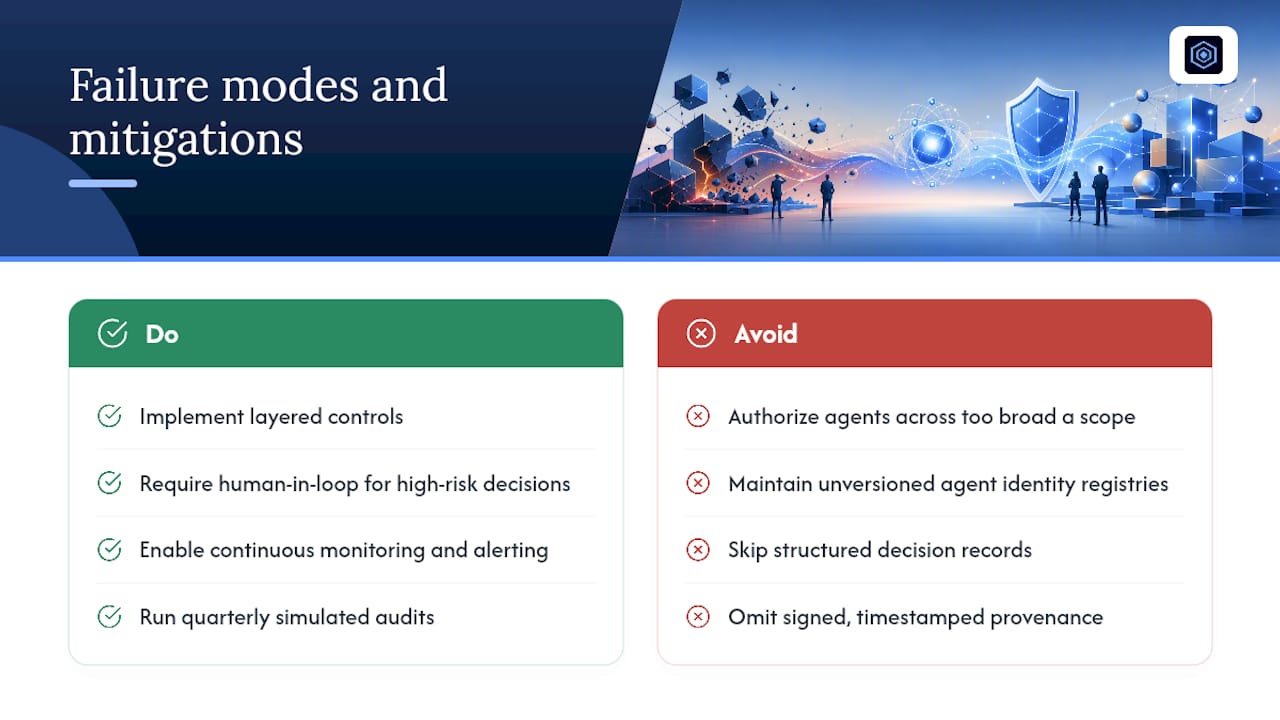
Over-automation is the most cited risk. When an agent is authorized to act across too broad a scope without human checkpoints, a single misconfiguration or model drift event can propagate across hundreds of decisions before anyone notices. The Harbor Compliance guidance is direct: use agents to augment human auditors, not replace them.
Weak agent identity means actions cannot be reliably attributed to a specific agent version. If the identity registry is incomplete or not version-controlled, an audit finding cannot be traced to its source, and remediation cannot be verified.
Opaque decision chains occur when an agent produces an output without a structured record of the inputs, the rule applied, and the policy basis. This is the explainability gap that regulators are increasingly targeting.
Missing provenance is the evidence equivalent of a broken chain of custody. If any step in the data-to-decision path lacks a signed, timestamped record, the entire evidence chain is weakened.
Insufficient human oversight at high-risk decision points is both a governance failure and, under frameworks like EU AI Act Article 26, a regulatory violation. Automated gating alone is not sufficient for decisions that materially affect individuals or carry significant financial exposure.
The governance programs that fail audits are rarely the ones with the wrong controls. They are the ones with the right controls on paper and no verifiable evidence that those controls operated as designed. Evidence generation must be continuous, not assembled retroactively when a regulator requests it.
Best-practice mitigations include layered controls (no single point of failure in the evidence chain), human-in-loop thresholds calibrated to risk tier, continuous monitoring with automated alerting on evidence gaps, regular validation tests against the regulatory checklist, and red-team exercises that simulate a regulator request and measure response time and evidence completeness.
Pro Tip: Set a calendar trigger for a quarterly internal simulated audit. Treat it as a fire drill: issue the mock request, assemble the pack, and measure how long it takes and what is missing. The AI incident response workflow for financial services is a useful template for structuring these exercises.
How long does it take to implement a compliant agent program?
Implementation timelines depend primarily on integration depth, regulatory scope, and the number of agents or systems in scope. The phases below represent a realistic staging for a mid-sized regulated firm.
- Discovery and inventory (2–4 weeks): Map all AI agents and automated systems in scope. Identify data flows, access patterns, and existing logging. This phase is faster with a metadata-only approach because it requires no production-system changes.
- Control mapping and gap assessment (3–6 weeks): Map each in-scope regulatory obligation to a technical or procedural control. Document gaps. Prioritize by risk tier.
- Integration and evidence architecture (4–12 weeks): Deploy the governance layer, configure signing and logging, and validate evidence output format. Metadata-only integrations sit at the lower end of this range; full-data instrumentation sits at the upper end.
- Validation and simulated audit (2–4 weeks): Run the agent against the regulatory checklist in a sandboxed environment. Assemble a test evidence pack and review it against regulator expectations.
- Audit-pack readiness and go-live (1–2 weeks): Finalize retention policies, export formats, and the evidence manifest. Confirm human-in-loop thresholds are documented and tested.
Primary cost drivers:
- Integration depth: metadata-only is significantly lower cost than full-data instrumentation
- Regulatory scope: each additional framework adds control-mapping and evidence-format work
- Number of agents and systems in scope: inventory and identity-graph complexity scales with agent count
- Customization of control mappings: bespoke mappings for firm-specific policies add time and cost
- Testing and validation: simulated audits and red-team exercises add cost but reduce audit risk
Staging the rollout by risk tier, starting with the highest-risk agents and expanding to lower-risk systems, allows the governance program to demonstrate value to regulators before full deployment is complete.
What compliance teams actually learn after deployment
The gap between what vendor materials describe and what compliance teams experience in production is consistent enough to be worth stating plainly.
The most common lesson is that the evidence architecture decision made in week one determines the audit experience in year two. Teams that chose metadata-only integration for speed found that their evidence packs were ready within days of a regulator request. Teams that chose full-data instrumentation for coverage depth found themselves managing a second compliance surface: the governance layer itself required its own access controls, audit logs, and data-handling agreements.
Practical observations from deployed programs:
- Do define escalation thresholds before the first production action, not after the first audit finding
- Do require a signed evidence pack format from any vendor before procurement, not as a post-contract deliverable
- Do run a simulated audit in the first 90 days; the gaps it surfaces are always cheaper to fix then than later
- Don't treat the agent inventory as a one-time exercise; agents proliferate faster than most governance teams expect
- Don't conflate logging with evidence; a log that can be modified is not a defensible audit artifact
One outcome that consistently surprises teams is how much audit friction disappears when evidence packs are pre-assembled and signed. Regulators who previously required weeks of back-and-forth to gather documentation can be answered in hours when the evidence is already structured, signed, and indexed against the regulatory obligation it satisfies.
Aetherpulse provides audit-ready AI governance without data access

Aetherpulse is built for exactly the governance gap this guide describes: regulated financial services firms that need to demonstrate AI agent oversight to auditors and regulators, without inserting a new data-access risk into their production environment.
The platform connects via OAuth metadata only, touching no customer data, and builds an agent inventory and identity graph from that metadata. Risk concentration, including financial blast-radius exposure across agent deployments, is surfaced automatically. Every evidence artifact is cryptographically signed using HMAC-SHA256 and packaged into regulator-exportable evidence packs that map directly to EU AI Act Article 26, FCA SYSC, Consumer Duty, and ICO framework obligations.
A pilot deployment typically reaches evidence-pack readiness within days, not months, because there are no production-system changes and no data-handling agreements to negotiate for the governance layer itself. For compliance and governance teams under pressure to demonstrate oversight before the next regulatory review, that timeline matters.
Review Aetherpulse's pricing and deployment model to scope a pilot for your firm.
Editorial perspective: the evidence gap is the governance gap
Most compliance programs treat evidence as a deliverable. The ones that survive regulatory scrutiny treat it as infrastructure.
The distinction sounds subtle but it changes every architectural decision. A deliverable is assembled when needed. Infrastructure is always running, always current, always signed. When a regulator arrives, the difference between these two approaches is measured in weeks of response time and, in some cases, in enforcement outcomes.
What the vendor market has been slow to acknowledge is that the governance layer itself is a compliance surface. A full-data instrumentation approach that requires its own access controls, data-handling agreements, and audit logs has not solved the evidence problem; it has replicated it one layer up. The agentless, metadata-only pattern is not a compromise on coverage. For most regulated firms, it is the architecturally correct choice precisely because it does not introduce a new risk surface while providing the inventory, identity, and provenance evidence that regulators actually request.
The other underappreciated reality is that human-in-loop design is not a fallback for when AI fails. It is a regulatory requirement under EU AI Act Article 26 and a governance expectation under FCA SYSC for high-risk automated decisions. Firms that treat human oversight as optional until a regulator asks about it are not running a compliant-agent program. They are running an automated program with a compliance label attached.
The practical implication: design the evidence architecture and the human oversight thresholds before the first agent action in production. Everything else can be iterated. Those two decisions cannot be retrofitted without significant cost and evidence-quality loss.
Sources
Primary regulatory references:
Aetherpulse resources for deeper reading:
Recommended
Working on Article 26 readiness, deployer-side governance evidence, or AI agent risk at a regulated firm? We'd value 15 minutes of your perspective.
Start a conversation