Demonstrate Consumer Duty AI Compliance: A Risk Team Guide
Demonstrate Consumer Duty AI Compliance: A Risk Team Guide

To demonstrate consumer duty AI compliance, your firm needs one deliverable above all others: an audit-ready evidence pack containing a pre-deployment Consumer Duty impact assessment, named SMCR sign-off, continuous monitoring logs with intervention records, a 100% retrievable interaction audit trail, and third-party oversight documentation. The single action your compliance team should take this week is to inventory every material AI surface and assign a named senior accountable owner to each one.
TL;DR — the five mandatory evidence categories:
- Pre-deployment impact assessment: a signed risk assessment mapping each AI system to the four Consumer Duty outcomes before go-live
- Named SMCR accountability: a documented, named senior manager responsible for each material AI deployment
- Continuous monitoring and intervention logs: real-time outcome data with records of every threshold breach and the remediation taken
- Interaction-level audit trail: a complete, retrievable log of AI-driven customer interactions, not a quarterly sample
- Third-party and operational resilience records: exercised audit rights, due diligence documentation, and business continuity evidence for AI supplied by third parties
The five mandatory evidence areas articulated by industry analysts reflect what FCA supervisors are already asking for in firm visits. Start this week by pulling your AI system register, identifying which systems touch customer outcomes, and assigning a named owner to each. Everything else in this guide builds from that foundation.
Table of Contents
- What are Consumer Duty AI governance tools and what do they do?
- Why do regulators expect AI evidence, and what triggers scrutiny?
- How does AI monitoring support each Consumer Duty outcome?
- What technical capabilities should you require from AI governance tooling?
- What does a practical implementation roadmap look like?
- Why agentless, metadata-only governance is the right architecture
- What should your compliance team do this week and in the first quarter?
- Key Takeaways
- The evidence gap is wider than most firms realize
- Aetherpulse gives you audit-ready AI evidence without production risk
- Authoritative sources and further reading
What are Consumer Duty AI governance tools and what do they do?
Consumer Duty AI tools are governance, monitoring, and evidence-generation platforms designed specifically for regulated firms deploying AI in customer-facing processes. They are not model trainers, data science notebooks, or general analytics dashboards. Their job is to produce the documented, defensible evidence that supervisors and auditors require when they ask how a firm knows its AI is delivering good outcomes.
The scope boundary matters. A model development environment like a Jupyter notebook or an MLflow experiment tracker records training runs but does not generate the interaction-level audit trails or outcome scorecards that Consumer Duty requires. An analytics platform may surface aggregate metrics but cannot produce a tamper-evident, signed evidence pack tied to a named SMCR accountable. Consumer Duty AI governance tooling sits between production AI systems and the compliance function, capturing what those systems do to customers and packaging that evidence in a form regulators can interrogate.
Core feature checklist for vendor evaluation
When evaluating platforms, compliance teams should verify each of the following capabilities before procurement:
- Explainability traces: — per-decision reasoning records that answer the FCA's "how do you know?" question at the interaction level
| Capability | Must-Have | Nice-to-Have |
|---|---|---|
| Interaction-level audit trail | Yes | |
| Tamper-evident evidence signing | Yes | |
| Named SMCR accountability mapping | Yes | |
| Outcome scorecards with tolerances | Yes | |
| Drift and performance monitoring | Yes | |
| Explainability traces | Yes | |
| Vulnerability detection and routing | Yes | |
| Third-party audit-rights tracking | Yes | |
| Real-time alerting and intervention workflows | Yes | |
| Board-pack and regulatory reporting templates | Yes | |
| Agentless, metadata-only collection | Yes | |
| EU AI Act Article 26 reporting alignment | Yes |
Why do regulators expect AI evidence, and what triggers scrutiny?
The FCA's position is clear: existing outcomes-based regulation, including Consumer Duty and SMCR, provides the framework for supervising AI. The Mills Review confirmed that governance, monitoring, and auditability are central to safe AI adoption, and that agentic AI introduces specific risks around accountability and traceability that firms must address proactively.
Consumer Duty maps directly onto AI system behavior. Each of the four outcomes creates a specific evidence obligation:
| Regulator / Framework | What They Expect from AI Deployments |
|---|---|
| FCA Consumer Duty | Outcome monitoring per the four outcomes; vulnerability handling; intervention records |
| FCA SMCR | Named senior manager accountable for each material AI system |
| FCA Operational Resilience | AI systems supporting important business services mapped and tested |
| ICO (AI and ADM Code) | Transparency, explainability, and data minimization in automated decision-making |
| PRA (where applicable) | Model risk governance; validation documentation; third-party model oversight |
Three conditions tend to trigger supervisory scrutiny most quickly. First, evidence of consumer harm linked to AI-driven decisions, particularly for vulnerable customers. Second, high-velocity automated decisioning (credit, claims, pricing) without demonstrable interaction-level monitoring. Third, insufficient auditability: firms that can produce governance policies but cannot show exercised controls or preserved interaction traces. The FCA's AI support services, including its AI lab and testing support, exist precisely to help firms build the governance structures that prevent those triggers from materializing.
The GOV.UK guidance on AI agents and consumer law reinforces this: firms remain legally responsible for AI agent actions and must train, test, monitor, and label AI appropriately. The same consumer protection rules apply whether a human or an AI agent handles the interaction. That legal continuity means your evidence obligations do not diminish because a process is automated; if anything, they intensify.
For a detailed mapping of how SYSC 8 and Consumer Duty intersect for AI deployers, the FCA AI governance overview from Aetherpulse provides a practical reference.
How does AI monitoring support each Consumer Duty outcome?
Products and services
AI systems used in product design, eligibility screening, or recommendation engines must demonstrably deliver products that meet customers' needs. The evidence supervisors expect includes pre-deployment outcome assessments showing which customer segments the AI serves, post-deployment outcome scorecards tracking whether those segments receive suitable products, and records of any model adjustments triggered by adverse outcome data.
A common failure mode is deploying a recommendation model trained on historical data that systematically underserves newer customer segments. The evidence artifact that addresses this is a cohort-level outcome scorecard, updated at a frequency proportionate to the velocity of decisions the model makes.
Price and value
Pricing AI, including dynamic pricing engines and fee calculators, must not produce outcomes where customers pay prices that represent poor value relative to the benefits received. Disparity metrics comparing outcomes across customer cohorts are the primary evidence artifact here. Firms should also retain records of any pricing interventions triggered by monitoring alerts, including the rationale and the outcome of the intervention.
Consumer understanding
AI systems that generate customer communications, disclosures, or product explanations carry a specific obligation: customers must be able to understand what they are being told. Monitoring evidence for this outcome includes readability scores for AI-generated content, A/B test results comparing comprehension across customer groups, and transcript audits showing that AI-generated explanations are accurate and not misleading.
Mapping each material AI system to the four Consumer Duty outcomes, including vulnerability impact assessments and monitoring frequency aligned to risk, is the recommended approach for embedding AI governance inside Consumer Duty MI.
Consumer support
AI-powered customer service, including chatbots, virtual assistants, and automated triage systems, must provide support that meets the standard a reasonable customer would expect. The evidence required includes interaction transcripts with model reasoning traces, escalation logs showing how the AI routed vulnerable or distressed customers to human agents, and intervention records where the AI's behavior was corrected.
Vulnerable customers require specific evidence. Firms must show that vulnerability indicators are detected, that routing to appropriate support is documented, and that outcomes for vulnerable customers are monitored separately. Critically, this monitoring must be designed to avoid creating new privacy or discrimination risks: vulnerability flags should inform routing and monitoring without being used to price or restrict access to products.
What technical capabilities should you require from AI governance tooling?
The capabilities below are not aspirational features. Each maps to a specific evidence requirement that supervisors will test.
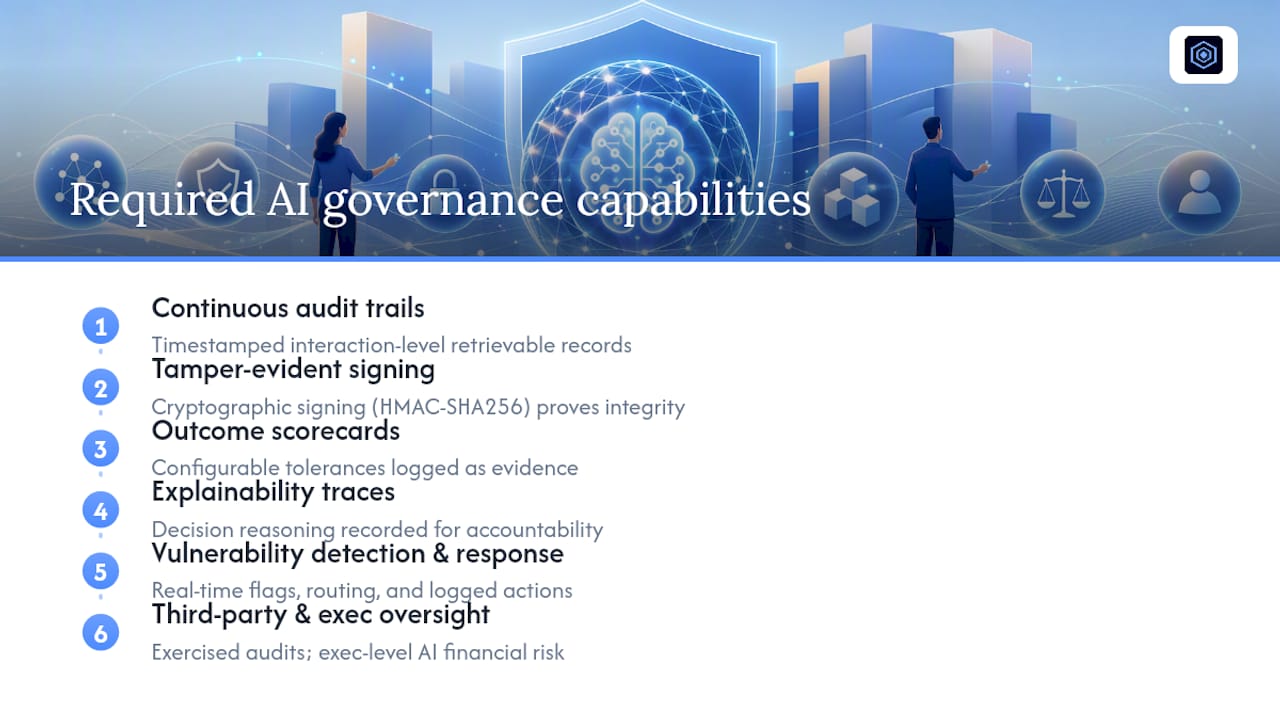
Continuous interaction-level audit trails are the foundation. Post-hoc sampling, even at high rates, leaves gaps that supervisors can identify. Industry analysis confirms that continuous, interaction-level monitoring is required for high-velocity AI decisions and that sampling is often insufficient to demonstrate compliance. Every AI-driven customer interaction should generate a retrievable, timestamped record.
Tamper-evident evidence signing converts audit logs into defensible evidence. Cryptographic signing, using standards such as HMAC-SHA256, ensures that a log presented to a supervisor is provably unaltered since it was generated. Without this, a firm cannot demonstrate chain of custody from the AI interaction to the evidence pack.
Outcome scorecards with configurable tolerances allow compliance teams to set thresholds for acceptable performance per Consumer Duty outcome and receive alerts when those thresholds are breached. The tolerance configuration itself is an evidence artifact: it shows the firm made a deliberate, documented judgment about acceptable risk.
Explainability traces record the reasoning behind individual AI decisions in a form that compliance teams and supervisors can interrogate. For AI explainability requirements, the standard is not academic interpretability but operational accountability: can you show why the AI made this decision for this customer at this moment?
Vulnerability detection and routing must be built into the monitoring layer, not bolted on after the fact. The system should flag vulnerability indicators in real time, route interactions appropriately, and log both the flag and the routing decision as evidence artifacts.
Real-time alerting and intervention workflows close the loop between monitoring and remediation. An alert that is logged but not acted upon is not evidence of control; it is evidence of a gap. The workflow must record the alert, the investigation, the decision, and the outcome.
Third-party controls and exercised audit rights are frequently the weakest link. Firms commonly hold contractual audit rights over AI suppliers but have never exercised them. Supervisors expect to see records of actual due diligence visits, data requests fulfilled, and remediation actions taken following third-party reviews.
Understanding AI financial risk at the executive level provides useful framing for prioritizing which capabilities to deploy first based on the firm's specific risk concentration.
What does a practical implementation roadmap look like?
The five phases below represent the minimum viable path from an unstructured AI deployment to a demonstrable Consumer Duty evidence posture. Each phase has a named owner and a minimum deliverable.
-
Materiality and inventory (Weeks 1–4): Identify all AI systems that touch customer outcomes. Classify each by materiality (volume of decisions, financial impact, vulnerability exposure). Assign a named SMCR accountable to each material system. Minimum deliverable: a signed AI system register with materiality classifications and named owners.
-
Pre-deployment Consumer Duty impact assessment (Weeks 3–8): For each material system, complete a structured impact assessment mapping the system to the four Consumer Duty outcomes. Include a vulnerability impact assessment. Obtain named SMCR sign-off before go-live or, for live systems, before the next material change. Minimum deliverable: signed impact assessments per system, filed in the evidence repository.
-
Instrument monitoring and set thresholds (Weeks 6–12): Deploy interaction-level monitoring for each material system. Configure outcome scorecards with documented tolerance thresholds. Establish alerting and intervention workflows. Minimum deliverable: live monitoring dashboards with documented threshold rationale and alert routing.
-
Remediation and intervention workflows (Ongoing from Week 10): Establish a documented process for investigating threshold breaches, recording remediation decisions, and closing the loop with updated monitoring. Minimum deliverable: a remediation log with at least one completed cycle per material system.
-
Reporting and audit pack generation (Quarter 2 onward): Generate periodic outcome reports for the board and compliance function. Produce on-demand audit packs for supervisory requests. Minimum deliverable: a board-ready Consumer Duty AI outcome report and at least one complete, signed audit pack per material system.
| Phase | Duration | Owner | Minimum Deliverable |
|---|---|---|---|
| Materiality and inventory | Weeks 1–4 | Chief Compliance Officer | Signed AI system register |
| Pre-deployment impact assessment | Weeks 3–8 | SMCR Senior Manager | Signed impact assessments |
| Instrument monitoring | Weeks 6–12 | Head of Model Risk / Technology | Live dashboards with thresholds |
| Remediation workflows | Ongoing from Week 10 | First-line Risk | Completed remediation log |
| Reporting and audit packs | Quarter 2 onward | Compliance / Governance | Board report and signed audit packs |
Success metrics to track: percentage of material AI systems with a named SMCR accountable (target: 100%); percentage with live interaction-level monitoring (target: 100% for high-materiality systems); number of threshold breaches with completed remediation records; time from supervisory request to audit pack delivery (target: under 48 hours).
The AI compliance gap assessment guide from Aetherpulse provides a structured methodology for the inventory and materiality classification phases.
Preservation and tamper-evidence
Evidence must be preserved in a form that demonstrates it has not been altered since creation. Cryptographic signing, WORM (write-once, read-many) storage, and immutable metadata ledgers are the standard approaches. The chain of evidence runs from the business decision (for example, a credit approval) through the AI interaction that produced it, to the signed log entry, to the audit pack. Each link in that chain must be traceable and unbroken.
Pro Tip: Agentless, metadata-only collection is a low-friction strategy for building this chain. By capturing interaction metadata through OAuth grants rather than inserting agents into production systems, firms can generate provenance-tracked evidence without touching customer data or introducing production risk.
The AI regulatory disclosure obligations guide covers how to structure reporting outputs so they meet both Consumer Duty and broader disclosure expectations.
Sampling versus continuous monitoring
Sampling is acceptable for periodic validation cycles and model performance reviews. For high-velocity AI decisions, such as real-time credit scoring, dynamic pricing, or automated claims triage, sampling is not sufficient to demonstrate compliance. The interaction-level monitoring requirement means that every decision must be retrievable, even if only a sample is actively reviewed in each reporting period. The distinction matters: a firm can sample its review process but cannot sample its audit trail.
Reporting template fields to retain:
- Model name, version, and deployment date
- Test type and methodology
- Cohorts tested and sample sizes
- Pass/fail results against documented tolerances
- Identified issues and remediation actions
- Sign-off by named model risk owner
- Retention period and storage location
Outcome scorecards for board reporting should include: overall outcome metric per Consumer Duty outcome, trend over the reporting period, number of threshold breaches and remediation status, vulnerability cohort outcomes, and a forward-looking risk assessment. The AI adoption oversight guide provides a practical governance checklist that maps well to these reporting requirements.
Why agentless, metadata-only governance is the right architecture
The core principle of agentless governance is that a firm can build a complete, defensible evidence chain without inserting monitoring agents into production AI systems. Instead of deploying code that intercepts AI decisions at runtime, an agentless layer captures interaction metadata through existing integration points, such as OAuth grants, and assembles that metadata into signed, provenance-tracked evidence artifacts.
This architecture reduces risk in three ways. It preserves production stability by removing the possibility that a monitoring agent introduces latency, errors, or security vulnerabilities into live systems. It preserves PII boundaries by touching metadata rather than customer data. And it reduces integration effort, allowing firms to achieve audit readiness in weeks rather than months.
An agentless evidence layer captures what AI systems do at the metadata level, signs each record cryptographically, and assembles on-demand audit packs that supervisors can interrogate without requiring access to production systems or customer data. The chain of custody runs from the AI interaction to the signed artifact, with no gaps and no manual assembly.
Example evidence flow:
- An AI-driven customer interaction occurs in a regulated process (for example, a chatbot handling a mortgage inquiry)
- The agentless layer captures interaction metadata via OAuth: timestamp, model version, decision output, reasoning trace reference, vulnerability flag status
- The metadata record is cryptographically signed (HMAC-SHA256) and written to an immutable log
- When a supervisor requests evidence, the platform assembles the relevant signed records into an audit pack, with provenance tracking showing the unbroken chain from interaction to export
Practical limitations to acknowledge: agentless metadata collection does not capture the full content of AI-generated responses unless the system is configured to log output text as metadata. For interactions where the content of the AI's response is itself the evidence (for example, a specific disclosure statement), deeper integration may be required to capture the verbatim output alongside the metadata record. Firms should assess this gap during the inventory phase and document their approach.
Aetherpulse implements this architecture as a read-only, non-invasive governance layer aligned to Consumer Duty, SYSC, and EU AI Act Article 26 reporting expectations.
What should your compliance team do this week and in the first quarter?
The gap between reading a compliance guide and producing evidence that satisfies a supervisor is almost always an execution gap, not a knowledge gap. The following checklist and stakeholder roster are designed to close it.
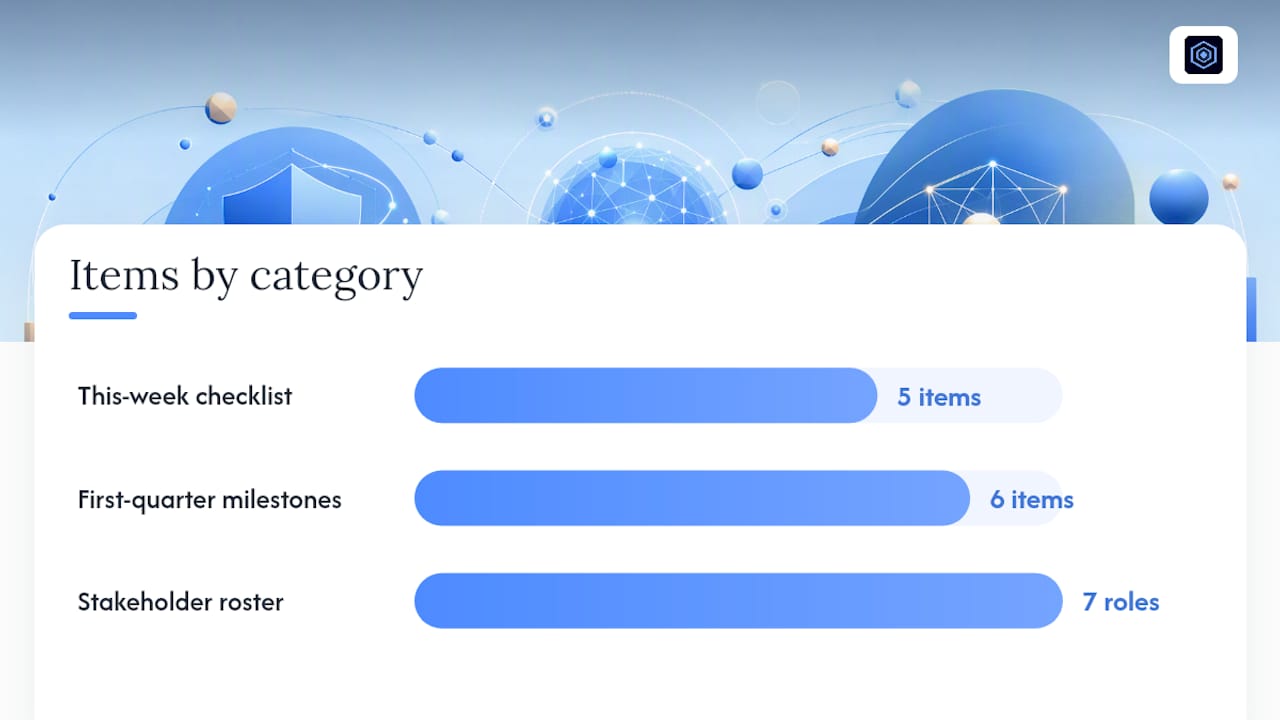
This-week checklist:
- Pull your current AI system register (or create one if it does not exist); list every AI system that touches a customer outcome
- Classify each system by materiality: volume of decisions per day, financial impact per decision, vulnerability exposure
- Assign a named SMCR accountable to each material system; document the assignment in writing
- Request access to audit logs for the three highest-materiality systems; assess whether interaction-level logs exist and are retrievable
- Draft initial monitoring tolerances for each high-materiality system, even if provisional; document the rationale
First-quarter milestones:
- Complete pre-deployment impact assessments for all material systems (or retrospective assessments for live systems)
- Deploy interaction-level monitoring for all high-materiality systems
- Complete at least one cycle of remediation workflow documentation
- Produce a draft board-pack Consumer Duty AI outcome report
- Exercise audit rights with at least one material third-party AI supplier
Stakeholder roster:
- Chief Compliance Officer: overall program ownership; SMCR accountability mapping
- Head of Model Risk: validation methodology; testing documentation; drift monitoring
- First-line Risk Managers: day-to-day monitoring; threshold breach investigation; remediation logging
- Legal Counsel: third-party contract review; audit-rights exercise; regulatory correspondence
- Procurement: supplier due diligence; contract amendments to include audit rights
- Engineering and Data Teams: monitoring instrumentation; log access; metadata integration
- Data Protection Officer: vulnerability data handling; PII boundaries in monitoring design
If your inventory reveals material AI systems with no named SMCR accountable, no interaction-level monitoring, and no exercised third-party audit rights, treat that combination as a Section 166 risk indicator. The escalation path is direct: brief the Chief Compliance Officer and the relevant SMCR Senior Manager within five business days, document the gap and the remediation plan, and set a 30-day milestone for the first evidence artifact per system. Supervisors who find this gap during a visit will expect to see that the firm identified it, escalated it, and acted on it.
For a structured gap-assessment methodology, the AI compliance gap assessment guide provides a step-by-step framework compliance teams can adapt directly.
Key Takeaways
Demonstrating AI compliance under Consumer Duty requires a complete, signed evidence pack per material AI system, with named SMCR accountability and continuous interaction-level monitoring as non-negotiable foundations.
| Point | Details |
|---|---|
| Five mandatory evidence categories | Pre-deployment impact assessment, SMCR sign-off, monitoring logs, interaction audit trail, and third-party oversight records are all required. |
| Continuous monitoring is the standard | Sampling is insufficient for high-velocity AI decisions; every interaction must be retrievable for supervisory review. |
| Exercised controls, not written policies | Supervisors expect evidence of controls that actually operated, including remediation logs and exercised audit rights. |
| SMCR accountability is non-negotiable | Every material AI system must have a named senior manager accountable before go-live or before the next material change. |
| Aetherpulse as an agentless evidence pattern | Aetherpulse provides read-only, metadata-based, cryptographically signed evidence packs aligned to Consumer Duty and SYSC requirements. |
The evidence gap is wider than most firms realize
The most consistent pattern in Consumer Duty AI governance is a firm that has done the thinking but not the recording. Governance committees have discussed AI risk. Model risk teams have run validation cycles. Compliance functions have drafted policies. But when a supervisor asks for the interaction-level log from a specific customer complaint, or for evidence that the firm exercised its audit rights with a third-party AI supplier last quarter, the answer is often silence.
That silence is the gap. And it is not a gap that more documentation closes. It is closed by instrumentation: by building the technical infrastructure that captures evidence continuously, signs it cryptographically, and makes it retrievable on demand. The firms that will fare best in supervisory visits are not the ones with the most comprehensive governance frameworks. They are the ones that can produce a signed, timestamped, complete evidence pack within 48 hours of a request.
One practical tip that is rarely discussed: when logging model reasoning traces, store the trace as a reference hash linked to the model version and input parameters, rather than storing the full reasoning output inline with the interaction record. This approach preserves explainability without exposing training data or creating a data minimization problem under the ICO's AI code. The hash is sufficient to reconstruct the reasoning in a controlled environment; the inline record is sufficient to prove the trace existed at the time of the decision.
Aetherpulse gives you audit-ready AI evidence without production risk
Compliance teams that have completed the inventory and gap assessment described in this guide typically face the same next problem: how to instrument monitoring and generate signed evidence packs without inserting agents into production AI systems or touching customer data.

Aetherpulse is built for exactly that constraint. The platform connects through OAuth metadata only, builds an inventory and identity graph of your AI agents, and generates tamper-evident, HMAC-SHA256-signed evidence packs aligned to Consumer Duty, SYSC, and EU AI Act Article 26 reporting expectations. No agents in production. No customer data accessed.
What compliance teams get from day one:
- Audit-ready evidence packs with cryptographic signing and provenance tracking, ready for supervisory requests
- SMCR sign-off traceability mapped to each material AI system in the inventory
- Vulnerability-aware monitoring with documented escalation routing and intervention logs
Aetherpulse deploys in days, not months, and is designed for regulated financial services firms that need audit readiness without the integration overhead of invasive tooling. See pricing and evaluation options to understand how the platform fits your firm's size and deployment scope.
Authoritative sources and further reading
The sources below are the primary references for the regulatory expectations and evidence standards covered in this guide.
-
AI: artificial intelligence in financial services | FCA — The FCA's central page on AI in financial services, covering supervisory expectations, the AI lab, and testing support available to firms. Start here for the regulator's current position.
-
Complying with consumer law when using AI agents | GOV.UK — Legal expectations for firms using AI agents, including training, testing, monitoring, and disclosure obligations. Directly relevant to the interaction-level evidence requirement.
-
The Mills Review: AI and the future of retail financial services | FCA — The FCA-commissioned review confirming that Consumer Duty and SMCR provide the framework for AI oversight, with governance and auditability as central requirements.
-
How to evidence AI agent compliance: 5 expectations from the FCA | Aveni — The clearest articulation of the five mandatory evidence categories for AI agent deployments. Use this as a checklist against your current evidence posture.
-
FCA Consumer Duty and AI in financial services | The AI Consultancy — Practical guidance on mapping AI systems to the four Consumer Duty outcomes, including vulnerability impact assessments and monitoring frequency recommendations.
-
Consumer Duty Complications: AI and Continuous Compliance | Planet Compliance — Industry analysis on why sampling is insufficient for high-velocity AI decisions and what continuous monitoring requires in practice.
-
Consumer Duty and AI: The Gap Between What Firms Think and What They Must Do | LinkedIn — Practitioner commentary on the persistent gap between governance documentation and exercised evidence. Useful for framing the evidence-versus-policy distinction for senior stakeholders.
-
AETHER Pulse: The agentless, metadata-only governance platform referenced throughout this guide, providing tamper-evident evidence packs aligned to Consumer Duty, SYSC, and EU AI Act Article 26.
Recommended
Working on Article 26 readiness, deployer-side governance evidence, or AI agent risk at a regulated firm? We'd value 15 minutes of your perspective.
Start a conversation