Reconstruction First: Evidence Retention Policy for AI in Finance
Reconstruction First: Evidence Retention Policy for AI in Finance

Keep AI audit evidence for the longest statutory or audit clock that applies whenever an AI output materially supports a financial, regulatory, or supervisory conclusion. In practice that means a retention period generally retention commonly set near seven years under SOX Section 802, a retention period around six years under SEC Rule 17a-4 with the early portion in WORM format, and shorter windows for routine communications. Everything else falls to a documented firm-policy window. The record must also be immutable, cryptographically signed, and reconstructible, or the retention period is academic.
TL;DR:
- Retain AI-generated evidence for the applicable statutory period, typically seven years under SOX or six years under SEC Rule 17a-4, depending on regulation.
- Record preservation must include cryptographic signatures, immutability, and reconstructibility, especially for evidence supporting material decisions.
- Ensure evidence policies specify the retention periods for different record types, enforce legal holds, and include procedures for third-party vendor evidence availability.
- Implement technical controls like signing, WORM storage, and version pinning to make evidence tamper-evident and reliably reconstructable.
- Regularly test evidence reassembly processes and monitor access and retention compliance in real time to ensure audit readiness.
Table of Contents
- What Is an Evidence Retention Policy for AI Systems?
- How Long Do You Need to Retain Different Types of AI Evidence?
- What Should an Evidence Retention Policy Document Include?
- What Technical Controls Make Retained AI Evidence Defensible?
- How Do You Govern Access to Retained Evidence?
- How Do You Test That Retained Evidence Actually Works?
- How Do You Roll Out an Evidence Retention Policy in 90 Days?
- How Do You Balance Retention Duration with GDPR and CCPA Obligations?
- How Do You Train Staff on Evidence Retention Requirements?
- How Does Evidence Retention Connect to E-Discovery and Litigation?
- What Does Evidence Escalation Look Like During an Incident?
- How Do You Monitor and Enforce the Retention Policy Day to Day?
- Why Reconstruction, Not Retention Length, Determines Exam Outcomes
- How Aetherpulse Builds Audit-Ready Evidence Without Touching Customer Data
- Sources
- FAQ
What Is an Evidence Retention Policy for AI Systems?
An evidence retention policy is the written control that tells your organization, your auditors, and your regulators exactly how long AI-generated audit evidence, logs, and provenance metadata must be preserved, and under what conditions. It is distinct from a general data retention schedule because AI systems generate a layer of evidence, prompts, model versions, retrieval context, and human overrides, that standard log retention tools were never built to capture.
The policy exists because regulators have stopped accepting raw application logs as sufficient proof of oversight. The Journal of Computational Law and Legal Technology's framework for regulatory-grade evidence describes this shift plainly: examiners now expect "audit replay," meaning a third party should be able to reconstruct exactly how an AI system reached a conclusion using only what was retained. That is a materially higher bar than most firms' current AI record keeping requirements meet.
The core test for how long to retain evidence is a materiality standard borrowed from federal records guidance. NARA Bulletin 24-02 establishes that AI-generated content becomes a record requiring formal retention only when it is used as evidence of business activity, not merely because a model produced it. An AI draft that never influenced a decision can sit in a short firm-policy bucket. An AI output that shaped a credit decision, a suitability determination, or a disclosure inherits the full statutory retention clock tied to that conclusion. Getting this distinction wrong is the single most common design flaw in early AI record keeping requirements.
How Long Do You Need to Retain Different Types of AI Evidence?
Retention periods vary by record type, and the biggest mistake compliance teams make is applying one blanket window to every AI-touched artifact. The right approach maps each record type to its governing regulation, then takes the longest applicable window when more than one regime applies.
An AI agent's routine correspondence with a customer, for instance, usually falls under communications retention. But if that same agent's output altered a ledger entry or supported a disclosure, it becomes an accounting record with a much longer clock. Retention schedules for evidence need to account for that shift explicitly, not assume a single classification per system.
| Record type | Minimum retention | Primary regulation(s) | Access / immutability requirement |
|---|---|---|---|
| Audit workpapers (AI-assisted) | around seven years | SOX Section 802 | WORM storage, restricted write access |
| Broker-dealer records | about six years with the first two preserved in a WORM-equivalent format | SEC Rule 17a-4 | Non-rewritable, non-erasable format |
| Agent communications logs | approximately three years with the first part easily accessible | SEC Rule 17a-4(b)(4) | Read-only after closure |
| AI model technical documentation | up to a decade | EU AI Act Article 19 | Version-pinned, signed |
| AI operational logs | a minimum of several months, scaled to risk | EU AI Act Article 12 | Tamper-evident storage |
| Healthcare-adjacent administrative records | about six years | HIPAA | Access-controlled, encrypted |
When multiple regimes attach to one record, the longest window wins. An AI system supporting both a US broker-dealer function and an EU customer relationship should retain under the SEC's six-year floor at minimum, and longer if Article 19's documentation requirements apply to the underlying model. Cross-referencing these floors against your own EU AI Act compliance obligations is worth doing before you finalize the matrix, not after an examiner asks why two systems have different clocks for the same customer interaction.
What Should an Evidence Retention Policy Document Include?
A retention policy that survives an exam walks through five components auditors specifically look for, and most draft policies are missing at least two of them.
Core clauses to include:
- A retention schedule broken out by record type and risk tier, each tied to the regulation that justifies the number
- A legal-hold mechanism that suspends automated deletion the moment litigation or investigation is reasonably anticipated
- Defined deletion workflows, including who authorizes deletion and how it is logged
- Sign-off requirements naming Compliance, Legal, and the Data Protection Officer
- An annual review cadence documented with dated sign-off, not an undated "policy owner" line
Building the actual workflow generally follows this sequence:
- Classify every AI-touched record type against the retention matrix and assign a risk tier
- Configure automated deletion at the end of each record's retention window, with a legal-hold override that suspends the timer
- Route legal-hold triggers through Legal, not Compliance alone, since litigation triggers often surface there first
- Require Compliance, Legal, and DPO sign-off before any retention period is shortened, even for a single record class
- Extend the schedule contractually to third-party AI providers, requiring evidence availability for the full retention window, not just the provider's own storage window
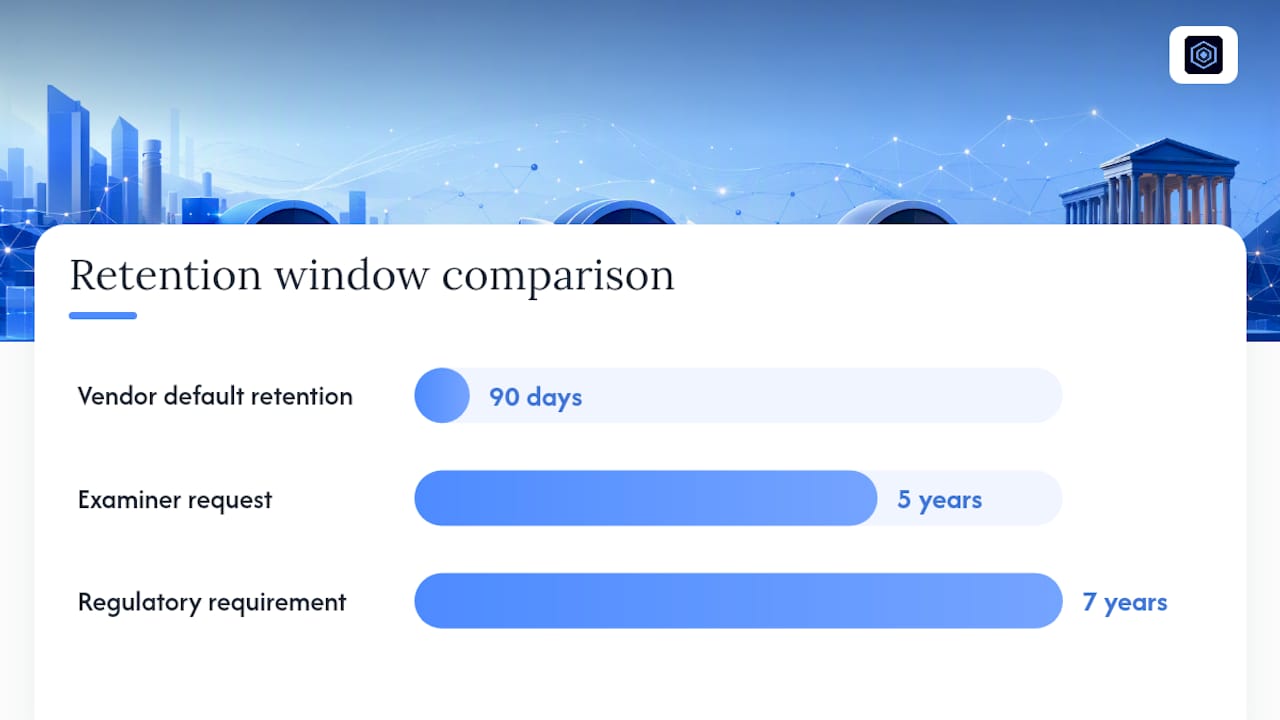
That last point catches firms off guard more than any other clause. A vendor's default log retention is frequently 90 days, far short of a seven-year audit workpaper requirement, and the mismatch does not surface until an examiner asks for a five-year-old evidence pack the vendor already purged. Industry control guidance recommends writing evidence-availability terms directly into vendor contracts rather than assuming the platform's default settings will match your regulatory floor.
What Technical Controls Make Retained AI Evidence Defensible?
Retention length means nothing if the record itself cannot be trusted. Auditors increasingly test for tamper evidence, not just presence, and that requires system-level controls built in at the point of capture.
The controls that matter most:
- Pin the exact model version and dataset version used for each output, and capture the fully assembled prompt, system instructions, few-shot examples, tool definitions, and retrieval hashes included
- Sign every record at write time using HSM-backed keys (AWS KMS or Azure Key Vault), then chain those signatures into a Merkle tree with daily root verification logs
- Store evidence bundles in WORM-equivalent storage, such as AWS S3 Object Lock in compliance mode or Azure Immutable Blob Storage, with the configuration itself documented for examiners
- Separate key custody duties so the person who can sign records is not the person who can alter storage policy
- Maintain an audit API that lets regulators pull integrity verification records without touching production systems
One inspection pattern shows up again and again: teams treat generic application logs as if they were audit evidence, without capturing the assembled prompt or recording model version at all. That single gap accounts for a disproportionate share of the documented deficiencies financial auditors flag in AI-assisted audit work. Model version alone should be treated as evidence, not metadata, because a decision produced by model version 3.1 is not reproducible against version 3.2's weights. Firms managing frequent model updates benefit from a formal change management process that timestamps every version transition against the evidence store.
How Do You Govern Access to Retained Evidence?
Technical controls only hold up if the people around them are governed just as tightly. Evidence stores need a different access model than the operational systems that generate the underlying activity.
Start with a current, centralized inventory of every AI agent in production, mapped to a risk tier. An inventory that is six months stale is functionally useless during an exam, because examiners will ask about agents deployed after your last update. Each agent's supervisory review path needs documentation showing exactly who reviewed which decision and when that review was logged into the working paper, not reconstructed after the fact from memory.
Access controls to enforce:
- Role-based access control that separates who can write to operational logs from who can write to the evidence store
- Read-only access for Compliance and Legal to the evidence repository, with no exceptions for "urgent" retrieval requests
- A documented procedure for regulator data requests, specifying exactly which extract format and fields get produced
- Physical or logical separation between audit evidence and day-to-day operational logs, so a systems outage affecting one does not touch the other
Chain-of-custody documentation for these access events matters as much as the access rule itself. An examiner who cannot see who touched a record, and when, treats the record as unverified regardless of how well it was signed at creation.
How Do You Test That Retained Evidence Actually Works?
The only real proof that a retention policy functions is trying to break it before an examiner does. That means running the reconstruction the policy claims is possible, on a schedule, with the failures documented.
- Select a random sample of AI-assisted decisions each quarter and attempt to reproduce the output using only retained records, no live system access
- Run hash verification and Merkle root checks against the same sample, confirming no silent tampering occurred since capture
- Log every reconstruction attempt, including failures, in an integrity-check report attached to the quarterly compliance file
- Assign remediation owners for any gap found and track it to closure with a documented deadline
Regulators treat a failed reconstruction as a substantive deficiency regardless of how long the underlying record was retained, because retention without reconstructibility proves nothing about oversight.
Pro Tip: Keep a reconstruction workbook that links every evidence ID directly to its corresponding audit engagement workpaper number. When an examiner asks for proof on a specific finding, you want a two-minute lookup, not a half-day search across systems.
How Do You Roll Out an Evidence Retention Policy in 90 Days?
Most firms overbuild this. A working policy can go live in one quarter if the sequencing is right.
- Weeks 1 to 3: Draft the retention matrix with Legal and Compliance, mapping every AI record type to its governing regulation and risk tier
- Weeks 4 to 7: Instrument model calls to capture assembled prompts and model versions, then implement signing and WORM storage for new evidence bundles
- Weeks 8 to 10: Deploy legal-hold automation and lock down role-based access controls on the evidence repository
- Weeks 11 to 13: Run the first reconstruction exercise against a live sample, document results, and schedule the recurring quarterly cadence
Firms that try to retrofit signing and WORM storage onto years of historical logs usually stall. Start the technical controls on new evidence going forward, then backfill historical records only where the retention clock still has meaningful time left on it.
How Do You Balance Retention Duration with GDPR and CCPA Obligations?
Retention and privacy law pull in opposite directions, and an evidence retention policy has to reconcile both without quietly violating one. GDPR's storage limitation principle and the erasure right seem to conflict directly with a seven-year audit workpaper requirement, but the conflict is usually solvable through design rather than exception.
The fix is separating pseudonymous identifiers from the substantive decision record. DeepInspect's analysis of cross-regime retention notes that structuring the evidence chain this way lets a firm honor an erasure request against the identity mapping while preserving the decision logic and audit trail intact for the full statutory window. The customer's name and account number can be tokenized; the reasoning, model version, and outcome stay retained and reconstructible.
CCPA's deletion-request provisions carry similar carve-outs for records a business needs to maintain for legal compliance, but that exception only holds if the retention is tied to a specific, documented statutory basis, not a vague "we might need this later" justification. Build the mapping table into the policy itself, showing which retention floor overrides which erasure request, so the exception is defensible rather than asserted.
One practical detail firms miss: the pseudonymization key itself needs its own retention and access rules. If that key is deleted the same day as the erasure request, you have destroyed your ability to reconcile the record later, defeating the purpose of tokenizing rather than deleting in the first place. Keep the key under the same access restrictions as the evidence store, with its own documented retention window.
How Do You Train Staff on Evidence Retention Requirements?
A retention policy that lives only in a compliance manual fails the first time a front-line team encounters an edge case. Training needs to reach three distinct audiences with three different depths of detail.
Compliance and audit staff need the full retention matrix, the legal-hold trigger criteria, and hands-on practice with the reconstruction exercise format, ideally by walking through a past quarterly test case together. Engineering and platform teams need narrower but deeper training on the technical capture requirements: what counts as an assembled prompt, why model version is evidence, and how signing keys are custodied. Business users deploying or supervising AI agents need the simplest layer: which of their agent's outputs trigger long retention because they materially influenced a conclusion, versus which fall into the short firm-policy window.
Annual refreshers should track regulatory changes directly. A firm operating in both the UK/EU and US markets needs staff aware when EU AI Act Article 12 obligations shift the retention floor for a system that also touches SEC-regulated activity. New hires handling AI-supervised decisions should complete this training before they have unsupervised sign-off authority, not during their first annual cycle after the fact.
The training record itself is evidence. Auditors have started asking not just whether a retention policy exists, but whether staff can demonstrate they understand when the long-retention clock applies to their own work. A training log with dated completion records is now a documented control point.
How Does Evidence Retention Connect to E-Discovery and Litigation?
Retention policy and litigation readiness are the same discipline wearing different hats. An evidence retention schedule that cannot be queried, exported, and produced under a discovery deadline is only theoretically compliant.
The critical design choice is making sure legal hold and litigation discovery draw from the identical evidence store that audit and regulatory requests use. Firms that maintain separate systems for "compliance evidence" and "litigation evidence" inevitably discover gaps between them right when a subpoena lands. One unified evidence layer, with role-based access separating who can query it for what purpose, avoids that split entirely.
E-discovery counsel typically needs three things fast: a defensible date range, proof the records have not been altered since capture, and a production format that preserves metadata rather than flattening it into a static export. The Merkle-chained, HSM-signed evidence bundles described earlier serve all three purposes simultaneously; the same signature that proves audit integrity to a regulator proves chain of custody to opposing counsel. That dual purpose is exactly why regulatory-grade evidence design treats audit replay and litigation readiness as the same architecture problem, not two separate systems bolted together after the fact.
Legal-hold automation earns its keep here directly. The moment litigation is reasonably anticipated, the hold needs to suspend deletion across every system touching the relevant AI agent, not just the primary evidence store. A hold that misses a secondary log system is a hold that fails in discovery.
What Does Evidence Escalation Look Like During an Incident?
An AI-related incident, a model producing a materially wrong output, a supervisory override that gets flagged, a suspected data integrity issue, needs its own evidence path distinct from routine retention.
The first step is freezing the relevant evidence bundle immediately, before any remediation work begins. Remediation activity itself generates new logs, and those new logs must not overwrite or obscure the original record of what happened. A short, written escalation procedure should specify who has authority to trigger that freeze, typically Compliance or the incident response lead, and how quickly it must happen once an issue is identified.
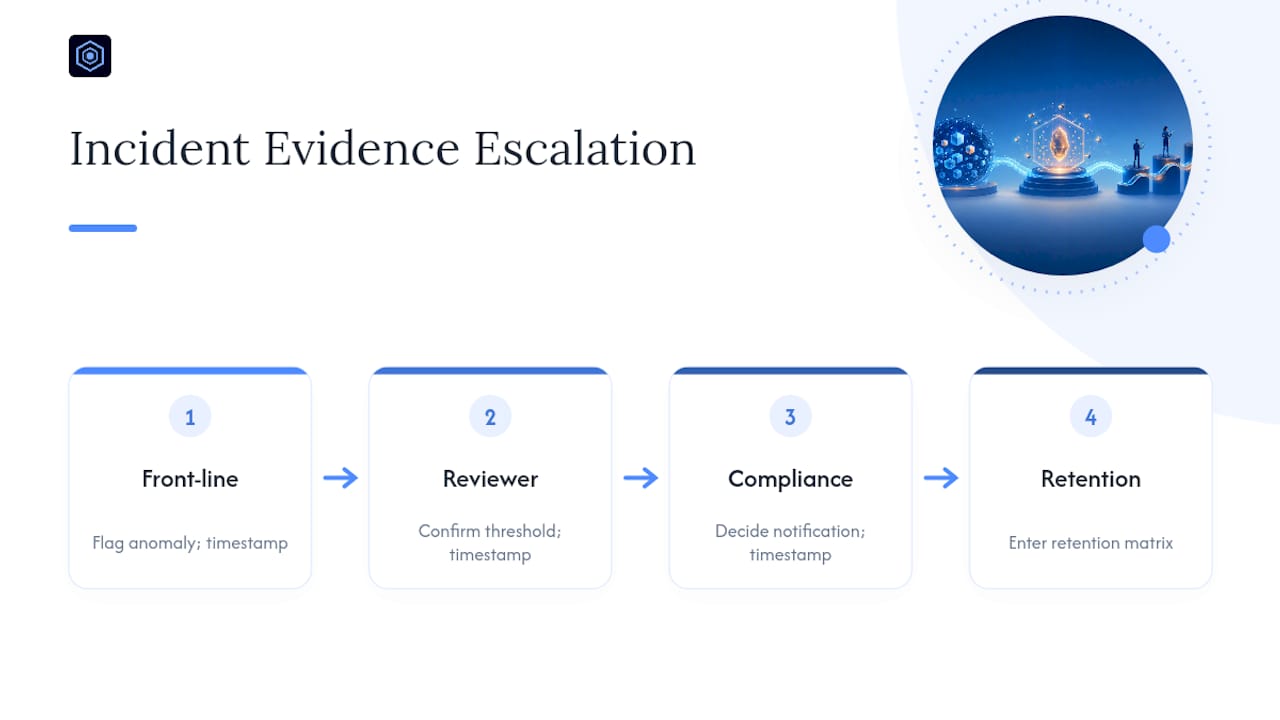
Escalation workflows generally follow a tiered structure: the front-line team flags the anomaly, a designated reviewer confirms it meets the incident threshold within a defined window, and Compliance or Legal makes the call on whether the incident triggers regulatory notification. Each of those steps needs its own timestamp in the evidence trail, because regulators reviewing an incident response will ask how long each stage took, not just what the final resolution was.
The evidence gathered during escalation should feed directly into the same retention matrix governing routine records. An incident tied to a decision that materially influenced a customer outcome inherits the long retention window automatically. Treating incident evidence as a separate, shorter-lived category is the kind of inconsistency examiners specifically probe for during a deficiency review.
How Do You Monitor and Enforce the Retention Policy Day to Day?
A policy document is not a control. Enforcement requires ongoing monitoring that catches drift before an exam does, not during one.
Automated monitoring should flag any evidence bundle approaching its retention deadline without a legal hold attached, any access attempt to the evidence store outside the approved role list, and any gap between agent inventory and actual production deployments. That last check matters more than it sounds: agents get deployed by business units faster than governance teams can track them, and an agent missing from inventory is an agent with no retention schedule applied at all.
Compliance monitoring reports should roll up quarterly, covering reconstruction test results, integrity-check pass rates, and any deletion exceptions granted outside the standard schedule. Each exception needs a named approver and a documented reason, reviewed by the same Compliance, Legal, and DPO signatories who approved the original policy. A monitoring program that only checks technical controls while ignoring procedural drift, like an approval role that quietly changed hands without updating the policy document, will miss exactly the gaps examiners find first.
Why Reconstruction, Not Retention Length, Determines Exam Outcomes
Firms fixate on retention periods because they are easy to write into policy. Examiners fixate on reconstruction because it is the only test that actually proves oversight happened. A seven-year retained record that cannot be reassembled into a coherent decision trail is worse than no record at all, because it creates the appearance of compliance without the substance.
The pattern across inspection findings is consistent: firms that treated application logs as evidence, rather than capturing the assembled prompt and model version at the point of decision, fail reconstruction even when their retention periods were technically correct. That gap is design, not duration. Get the capture right at write time, and the retention clock becomes a formality rather than a risk.
— Eleye
How Aetherpulse Builds Audit-Ready Evidence Without Touching Customer Data
Most firms trying to meet these retention and reconstruction requirements end up bolting governance tooling directly into production systems, adding friction and risk exactly where they were trying to reduce it. Aetherpulse takes the opposite approach: it connects through metadata only, never touching customer data, and builds a live inventory and identity graph of every AI agent running across your organization.
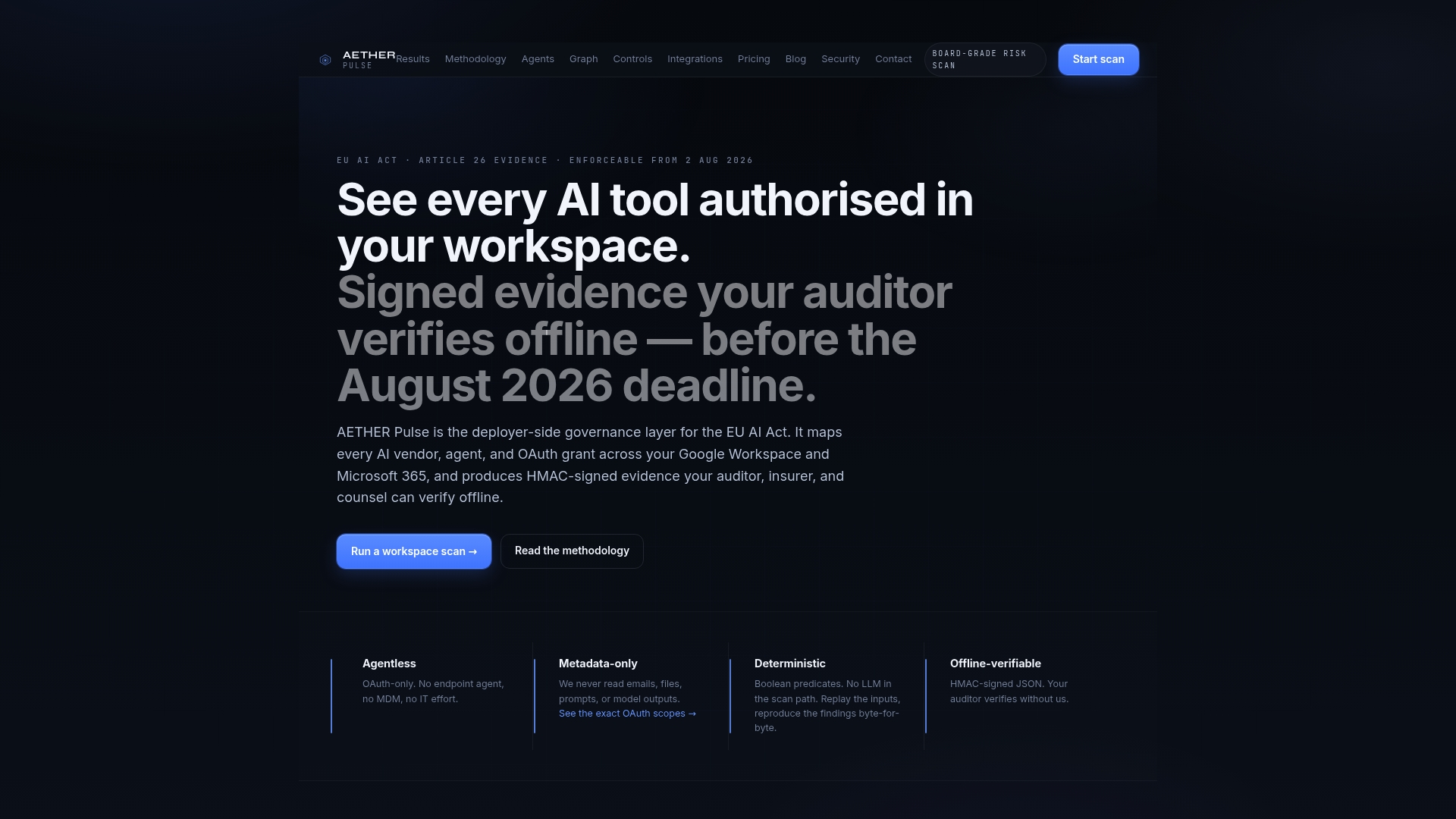
From that inventory, Aetherpulse generates tamper-evident, HMAC-SHA256 signed evidence packs on demand, mapped to the frameworks your regulators actually reference, including EU AI Act Article 26, the Data (Use and Access) Act, FCA SYSC, and Consumer Duty. It surfaces risk concentration across your agent fleet, including financial blast-radius exposure, so you know which agents warrant the longest retention window before an examiner asks. If your team is still assembling evidence bundles manually from scattered logs, a demo of the platform shows how a read-only, agentless layer produces provenance-tracked evidence exports without inserting itself into a single production workflow.
Sources
Before locking your retention matrix, cross-check it against the FSI-AgentGov regulatory mappings and ISMS Calculator's comparison of US financial data security standards, then review DiliCheck's coverage of evidence completeness for provenance design patterns.
This article is general information, not a substitute for advice from a qualified financial advisor. Consult a qualified financial professional about your own circumstances before acting on anything here.
- Regulatory-Grade Evidence for AI in FinTech: A Control-Mapped Framework and Blockchain-Anchored Architecture for Audit Replay | Journal of Computational Law and Legal Technology
- Financialauditexpert
- AI Log Retention Policy — Audit & Logging AI Governance Control | AI Governance Institute
- AI audit log retention: how long EU AI Act, HIPAA, and DORA expect you to keep per-decision records | DeepInspect
FAQ
How Long Should AI Audit Logs Be Retained?
Retain AI audit logs for the longest applicable statutory window: seven years for SOX-covered audit workpapers, six years under SEC Rule 17a-4 with the first two in WORM storage, or three years for routine agent communications, whichever governs the specific record.
What Triggers the Long Retention Clock for an AI Output?
The clock starts when an AI output materially supports a financial, regulatory, or supervisory conclusion, not simply because a model generated it; outputs with no bearing on a decision can follow a shorter firm-policy window.
Does an Evidence Retention Policy Need to Cover Third-Party AI Vendors?
Yes. Vendor contracts should guarantee evidence availability for your full retention window, since most AI providers default to log retention far shorter than a seven-year audit requirement.
Can Aetherpulse Help Produce Retention-Ready Evidence Packs?
Aetherpulse generates signed, tamper-evident evidence packs from metadata alone, giving compliance teams provenance-tracked exports mapped to their retention schedule without accessing underlying customer data.
How Does GDPR's Erasure Right Interact with a Seven-Year Retention Requirement?
Firms reconcile the two by separating pseudonymous identity mappings from the underlying decision record, allowing erasure of identity data while the audit trail and decision logic remain retained for the full statutory window.
Recommended
Working on Article 26 readiness, deployer-side governance evidence, or AI agent risk at a regulated firm? We'd value 15 minutes of your perspective.
Start a conversation