5 Audit Ready Controls for GDPR Automated Decisions and Evidence
5 Audit Ready Controls for GDPR Automated Decisions and Evidence

GDPR does not ban automated decision-making outright, but Article 22 does prohibit any decision "based solely on automated processing" that produces legal or similarly significant effects, unless one of three narrow exceptions applies. Those exceptions are contractual necessity, authorization under law, and explicit consent. When any exception applies, controllers must still implement safeguards, including human intervention and contestation rights, and document the whole arrangement well enough to survive a regulator's scrutiny.
TL;DR:
- Automated decisions are permitted only when necessary for a contract, authorized by law with safeguards, or based on explicit consent, each requiring documented compliance.
- Human involvement must be meaningful; token reviews, profiling, and automated decisions with significant effects like credit denial or job rejection trigger Article 22 restrictions.
- Safeguards include human intervention, contestation rights, and clear explanations of decision logic, with compliance verified through continuous, tamper-evident auditing and documentation.
- Using metadata-driven oversight and automated evidence collection simplifies ongoing governance and ensures regulator-ready traceability of decision inputs and outputs.
- Organizations should conduct regular DPIAs, maintain immutable logs, and implement model governance to effectively demonstrate GDPR compliance in automated decision-making.
Table of Contents
- What Does Article 22 Say About Automated Decisions?
- What Counts as "Solely Automated" and "Significant Effect"?
- When Do the Article 22 Exceptions Actually Apply?
- What Safeguards and Rights Apply to Automated Decisions?
- How Should You Document and Audit Automated Decisions?
- Why Metadata-Driven Oversight Beats Spreadsheet Audits
- See How AETHER Pulse Supports Article 22 Compliance
- Where to Verify These Rules Yourself
- Sources
What Does Article 22 Say About Automated Decisions?
Article 22(1) gives data subjects "the right not to be subject to a decision based solely on automated processing, including profiling, which produces legal effects concerning him or her or similarly significantly affects him or her." That single sentence is the anchor for every GDPR automated decisions compliance program in existence, and the Article 29 Working Party guidance treats it as a general prohibition, not a right the data subject has to actively invoke. In practice, that means controllers cannot wait for a complaint before checking whether a system falls under Article 22. They need to classify the system before it goes live.
Article 22(2) then carves out three exceptions. A solely automated decision is permitted when it is:
- Necessary for entering into or performing a contract between the data subject and the controller.
- Authorized by Union or member state law that also lays down suitable measures to safeguard the person's rights.
- Based on the data subject's explicit consent.
Article 22(3) attaches a condition to the first and third exceptions: the controller must implement suitable measures to safeguard the data subject's rights, freedoms, and legitimate interests, including at minimum the right to obtain human intervention, to express a point of view, and to contest the decision. The full text of Article 22 is short, but its operational consequences are not. Every automated decision making GDPR program has to work backward from these three paragraphs to figure out what documentation, review process, and technical logging a given system actually needs.
What Counts as "Solely Automated" and "Significant Effect"?
Classifying a system correctly is the single most common failure point in GDPR data processing rules for automated systems, mostly because the terms sound intuitive but carry precise legal weight.
"Based solely on automated processing" means there is no meaningful human involvement in the outcome. A human who rubber-stamps an algorithm's recommendation without the authority, competence, or information to actually challenge it does not count as meaningful involvement. The WP251 guidance is explicit that token human review, where a person clicks "approve" on 200 decisions an hour without examining the underlying data, still falls inside Article 22's scope.
Profiling is any automated processing of personal data used to evaluate certain personal aspects, particularly to analyze or predict things like performance at work, economic situation, health, personal preferences, reliability, or behavior. Profiling itself is not banned. It becomes a problem under Article 22 only when it feeds a solely automated decision with a legal or similarly significant effect.
Legal or similarly significant effects cover a wide band of outcomes:
- Denial of a loan, credit line, or insurance policy application.
- Automatic rejection of a job application before a recruiter reviews it.
- Algorithmic pricing that meaningfully changes what a consumer pays.
- Automated fraud flags that freeze an account or restrict access to a service.
- Eligibility determinations for government benefits or public services.
Behavioral advertising that merely shows a different banner ad usually falls short of "similarly significant," but the threshold moves depending on the vulnerability of the person and the durability of the consequence.
When Do the Article 22 Exceptions Actually Apply?
Understanding GDPR regulations at this level of detail means treating each exception as a distinct legal test with its own documentation burden, not a checkbox.
- Contract necessity. The automated decision has to be genuinely necessary to perform the contract, not merely convenient. A lender using an automated credit scoring model to decide whether to extend a loan usually qualifies, because manual underwriting at that scale is not a realistic substitute in the specific relationship. A retailer using automated profiling to "personalize" pricing without any contractual necessity generally does not.
- Authorization by law. Member state or Union law must both permit the automated decision and specify safeguards. Tax fraud detection systems authorized under national legislation are a common example, but the authorizing statute has to actually name the safeguards, not just permit the automation.
- Explicit consent. This is a higher bar than ordinary consent under Article 6. It must be a freestanding, specific, informed, and unambiguous statement, not bundled into general terms of service. Where the processing also touches special category data under Article 9, explicit consent (or another Article 9 condition) is required on top of the Article 22 basis, which means two separate legal tests have to pass, not one.
A hiring platform that lets an automated system reject candidates outright, with no recourse, is a textbook prohibited scenario. The same platform becomes permitted with safeguards if rejection triggers a human reviewer with authority to overturn the outcome, and the candidate consented explicitly or the processing was contractually necessary for the role.
What Safeguards and Rights Apply to Automated Decisions?
Once an exception applies, Article 22(3) requires specific safeguards, and ICO guidance is the most detailed public source for operationalizing them. The three statutory minimums are:
- The right to obtain human intervention. The reviewer needs the authority, competence, and time to change the outcome, not merely acknowledge it.
- The right to express a point of view. The data subject must have a real channel to submit context the automated system did not capture.
- The right to contest the decision. Contestation has to lead to a documented re-assessment with actual reasoning, not an automated re-run of the same model on the same inputs.
Transparency obligations under Articles 13, 14, and 15 layer on top of these rights: controllers must give "meaningful information about the logic involved," along with the significance and envisaged consequences of the processing for the data subject. That does not require disclosing source code or trade secrets, but it does require plain-language explanation of what factors drive the outcome and what the outcome means for the person.
In practice, these rights only hold up if the UI actually surfaces a contestation path, the SLA for human review is fast enough to matter, and every review is logged with a timestamp and a named reviewer.

Pro Tip: Test your contestation workflow by walking a real case through it end to end. If the "human review" step takes less time than reading the file would require, it is not meaningful intervention, and a regulator will treat it that way.
How Should You Document and Audit Automated Decisions?
Practical GDPR compliance for automated processes comes down to five things: a defensible DPIA, immutable logs, model governance, packaged evidence, and a clear line between what automation can and cannot cover.
A Data Protection Impact Assessment for profiling and automated decisions should scope the specific decision types in play, score the risk to data subjects (not just the organization), document mitigations tied to each Article 22 exception claimed, and carry a named sign-off from someone with real authority to halt deployment. A DPIA written once at launch and never revisited is a liability, not a control, especially once the underlying model is retrained.
Audit-ready logging needs to capture, at minimum:
- The specific input data used for each decision (or a reproducible snapshot of it).
- The model or rule-set version that produced the output.
- The output itself and the reasoning or score attached to it.
- The timestamp of the decision and of any human review.
- The identity and conclusion of the reviewer, where human intervention applied.
Auditors expect these data points to be reproducible, not reconstructed after the fact. Model governance closes the gap between deployment and drift: version control on every model change, drift detection against the baseline the DPIA assessed, fairness monitoring across protected characteristics, and an approval gate before any retrained model goes live on decisions with legal effect.
Peer-reviewed implementation work suggests automation can validate GDPR compliance verification against real-world use cases in sectors like insurance, but the same research is clear that legal interpretation and exceptional cases still need a human sign-off. Separately, automated compliance workflows tend to handle evidence collection and reporting well, while contextual judgment calls remain manual by design.
Evidence packaging is where most programs fall apart under actual regulator questioning. A defensible pack includes the model identifier, a hash or snapshot of the training data where feasible, the deterministic inputs for the decision in question, and a signed chain of custody linking every artifact together. Tamper-evident packaging, not just a spreadsheet export, is what separates a documentation exercise from evidence a regulator will actually accept. Firms building this internally can lean on guidance like this regulator audit compliance playbook for what the evidence actually needs to demonstrate, and on resources addressing AI explainability requirements for the transparency side specifically.
Why Metadata-Driven Oversight Beats Spreadsheet Audits
Most compliance failures under Article 22 do not come from a missing policy document. They come from a governance process that cannot keep pace with how many automated systems a firm is actually running, and spreadsheets tracking model versions and human reviews go stale within weeks of being built.
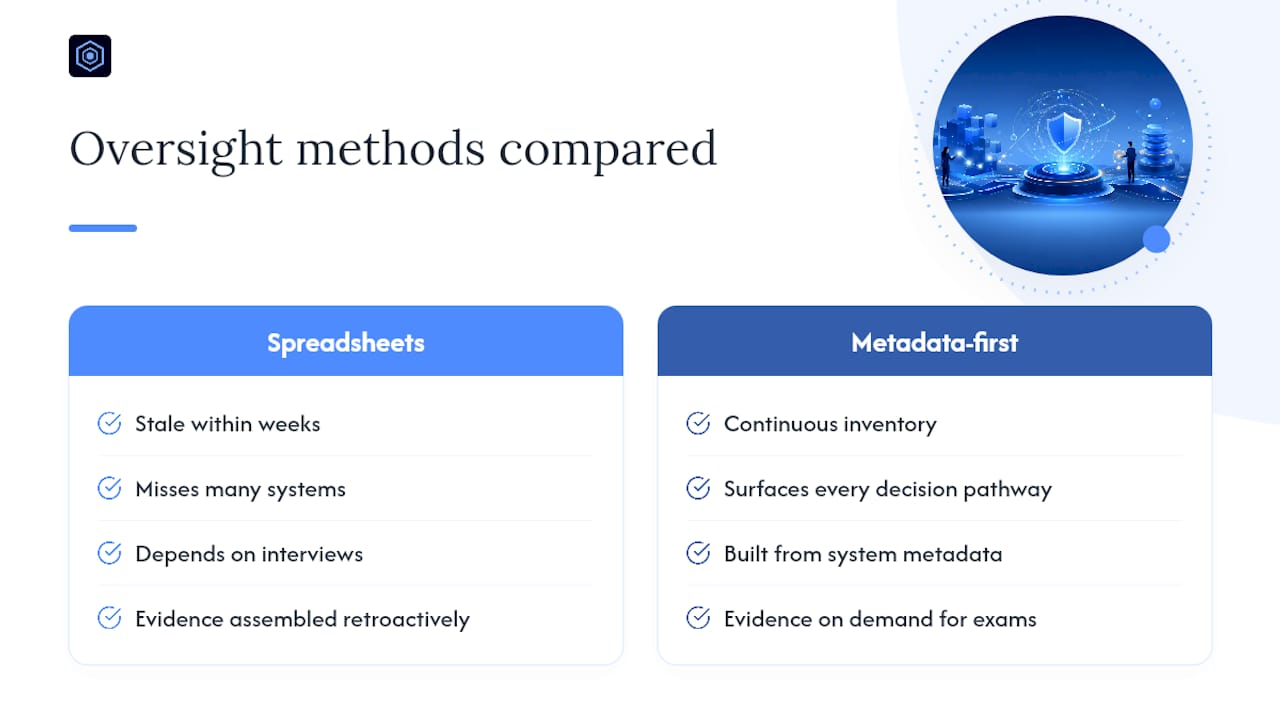
Metadata-first agent discovery changes that math. Instead of interviewing every team about which models touch customer-facing decisions, a continuous inventory built from system metadata can surface every automated decision pathway in an organization, including the ones nobody remembered to log. That inventory becomes the backbone for provenance: every model version, every human review, every contestation outcome tied together in a record that does not depend on someone remembering to update a document. Continuous, metadata-driven oversight is increasingly the operational model regulators expect, because it produces evidence on demand rather than evidence assembled retroactively when an examiner calls. The playbook for demonstrating oversight to regulators reflects that shift toward continuous evidence over point-in-time audits.
Provenance matters just as much for the underlying data feeding these decisions. Traceability practices used in regulatory research and data provenance apply directly here: if you cannot trace an input back to its source and timestamp, you cannot defend the decision it produced.
— Eleye
See How AETHER Pulse Supports Article 22 Compliance
A solution exists as an alternative to building this evidence infrastructure from scratch with spreadsheets and manual audits, connecting through metadata only, touching no customer data, and building a live inventory and identity graph of AI agents operating across a regulated firm.

That inventory maps directly onto the practitioner checklist above: agent discovery replaces guesswork about which systems make solely automated decisions, risk concentration mapping surfaces financial blast-radius exposure before a regulator asks about it, and tamper-evident, cryptographically signed evidence packs give compliance teams the deterministic artifacts auditors expect without weeks of manual assembly. The platform is built around UK and EU frameworks including EU AI Act Article 26, the Data (Use and Access) Act, FCA SYSC, and Consumer Duty. Firms wanting the same continuous oversight described in this article, without inserting new tooling into production systems, can Aetherpulse and request a demo.
Where to Verify These Rules Yourself
The primary legal text for Article 22 is available in full at gdpr-info.eu, and the definitive regulatory interpretation sits in the Article 29 Working Party guidelines (WP251rev.01), which supplies the sector examples for "legal" and "similarly significant" effects. The ICO's guidance on automated decision-making offers the most usable checklists for building safeguards, and readers evaluating how consent capture fits into a broader evidence trail can review this GDPR-compliant data export guide for practical implementation detail.
This article is general information, not a substitute for advice from a qualified lawyer. Consult a qualified legal professional about your own circumstances before acting on anything here.
Sources
- Automated individual decision-making, including profiling — GDPR text
- Guidelines on Automated individual decision-making and Profiling (WP251rev.01)
- Rights related to automated decision making including profiling — ICO
Recommended
Working on Article 26 readiness, deployer-side governance evidence, or AI agent risk at a regulated firm? We'd value 15 minutes of your perspective.
Start a conversation