How to Build a Defensible AI Compliance Record
How to Build a Defensible AI Compliance Record

A defensible AI compliance record is defined as a body of tamper-evident, provenance-tracked evidence that proves your AI systems made decisions within authorized, documented parameters. This is not a policy binder or a retrospective summary. Regulators and auditors now expect operational truth: real-time capture of what your AI systems actually did, not a reconstruction of what you think they did. The EU AI Act sets the stakes clearly, with penalties reaching €35 million or 7% of global annual turnover for high-risk AI violations. For compliance officers in regulated financial services, the deadline of august 2, 2026 is not theoretical. Building AI compliance that holds up under scrutiny requires evidentiary infrastructure, not just policy documents.
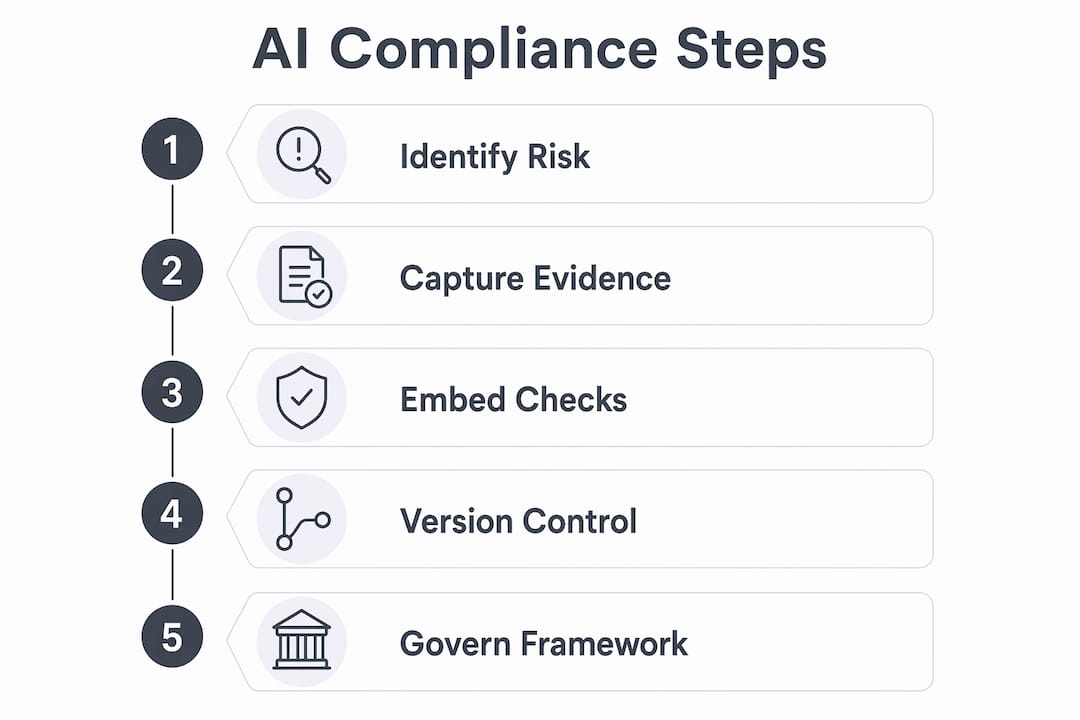
What does a defensible AI compliance record actually require?
The phrase "defensible AI compliance record" is the working term compliance professionals use. The formal industry concept is AI governance documentation, and both terms describe the same obligation: producing verifiable, structured evidence of AI system behavior that satisfies regulators, auditors, and procurement reviewers. ISO 42001 defines the management system requirements for AI governance. The NIST AI Risk Management Framework provides the risk methodology. The EU AI Act supplies the prescriptive documentation requirements. A compliance record that draws from all three is far harder to challenge than one built on a single framework.
The core distinction that separates defensible records from ordinary documentation is operational truth. Operational truth means capturing the actual inputs, reasoning steps, and outputs of AI decisions at the moment they occur. Reconstructing that chain after the fact is less credible and, under some regulatory interpretations, insufficient. Compliance officers who understand this distinction build systems that generate evidence automatically, rather than scrambling to assemble it before an audit.

What core artifacts form the foundation of AI compliance documentation?
Three core artifacts satisfy the baseline expectations of both procurement reviewers and regulators heading into 2026: the system card, the Acceptable Use Policy (AUP), and the incident response plan. Each serves a distinct evidentiary function.
- System card: Documents the model description, training datasets, known limitations, risk assessment findings, and intended deployment scope. A system card answers the auditor's first question: what is this AI system, and what was it designed to do?
- Acceptable Use Policy: Defines permitted and prohibited uses of each AI system, with version control showing when the policy was updated and who approved the change. AUPs must be treated as living documents, not one-time publications.
- Incident response plan: A one-page, immediately actionable document that specifies who is notified, what evidence is preserved, and what remediation steps are taken when an AI system produces an unexpected or harmful output.
Beyond these three, a complete compliance record captures model weights, prompt templates, and version identifiers. These details establish model provenance: the ability to prove that a specific model version, running a specific prompt, produced a specific output on a specific date. Without provenance, a system card is a description, not evidence.
Pro Tip: Version-control your prompt templates the same way engineers version-control code. A prompt change that shifts model behavior is a material change to your AI system and must appear in your compliance record.
| Artifact | Primary evidentiary function |
|---|---|
| System card | Describes model identity, scope, and risk profile |
| Acceptable Use Policy | Documents authorized use boundaries and approval history |
| Incident response plan | Establishes breach containment and evidence preservation protocol |
| Model provenance record | Links specific outputs to specific model versions and prompts |
How can organizations embed operational truth into AI workflows?
Automated evidence capture is the technical foundation of a defensible AI framework. Manual logging fails under audit pressure because it is incomplete, inconsistent, and easy to challenge. Immutable evidence recorded at decision time, not rebuilt retrospectively, is what audit processes now demand.
The engineering approach that produces this evidence follows a clear sequence:
- Log at runtime. Capture AI inputs, outputs, reasoning steps, and signal correlations at the moment of execution. Do not rely on application-layer logs that can be modified or deleted.
- Sign cryptographically. Apply HMAC-SHA256 or equivalent signing to each evidence record. Cryptographic signing proves that a record has not been altered since it was created.
- Write to an append-only ledger. Store signed records in a system that prevents deletion or modification. Append-only architecture is the technical equivalent of a court-admissible chain of custody.
- Track provenance end-to-end. Link each decision record to the model version, prompt template, data inputs, and the identity of the AI agent that executed the decision.
- Generate evidence packs on demand. Structure your logging infrastructure so that a complete, auditor-ready evidence pack can be produced without manual assembly.
"Defensible compliance depends on capturing full lineage: model weights, prompt templates, and deterministic verifiers, rather than just output logs. A neuro-symbolic system with cryptographically signed knowledge graphs, symbolic verifiers, and append-only ledgers provides verifiable provenance for AI decisions."
The concept of "compliance seams" describes the practice of embedding these checkpoints directly into AI lifecycle engineering. Every model deployment, every prompt update, and every integration change triggers an automatic evidence capture event. Compliance officers who work with engineering teams to define these seams early avoid the far more expensive process of retrofitting governance onto production systems.
Pro Tip: Treat your AI evidence infrastructure the same way you treat your financial audit trail. If a regulator asked you to reconstruct every AI decision made in the last 90 days, could you do it in 48 hours? If the answer is no, your logging architecture needs redesign.
Which governance frameworks unify AI compliance efforts most efficiently?
A unified governance model that integrates ISO 42001, the NIST AI Risk Management Framework, and the EU AI Act reduces audit burden by 20–30% compared to running separate compliance tracks for each framework. That reduction comes from eliminating duplicative documentation and aligning evidence artifacts to serve multiple frameworks simultaneously.
ISO 42001 functions as the management system layer. It defines how an organization governs AI across its lifecycle, from procurement through decommissioning, using a flexible structure that adapts to different sectors and use case types. The NIST AI Risk Management Framework adds the risk methodology layer, providing structured processes for identifying, measuring, and mitigating AI-specific risks. The EU AI Act supplies the prescriptive requirements: technical files, model cards, impact assessments, and incident response plans, all with defined content standards and retention periods.
The practical benefit of integration is that a single system card, properly structured, satisfies ISO 42001 documentation requirements, NIST RMF risk identification inputs, and EU AI Act technical file obligations at the same time. Siloed compliance tracks produce three separate documents that say the same thing in different formats. That duplication wastes resources and creates inconsistency risk when documents diverge.
- Map each AI system to all applicable frameworks before drafting documentation.
- Use a single evidence artifact template that includes fields required by ISO 42001, NIST AI RMF, and the EU AI Act simultaneously.
- Assign one owner per AI system who is responsible for keeping all framework-aligned records current.
- Schedule quarterly reviews to catch framework updates before they create compliance gaps.
How to apply a risk-tiered approach to AI compliance documentation
Risk tiering is the practice of concentrating detailed compliance documentation on AI systems with the highest potential for harm, while applying lighter, automated monitoring to lower-risk tools. Risk-tier governance rigorously allocates resources, ensuring high-impact AI systems undergo comprehensive evaluation while automated monitoring covers low-risk use cases efficiently.
Tier classification depends on three factors: the impact of an incorrect AI decision on customers or markets, the sensitivity of the data the system processes, and the degree to which the system operates autonomously without human review.
- High-risk tier: AI systems making credit decisions, fraud determinations, or customer eligibility assessments. These require full impact assessments, red-team testing reports, human oversight logs, and complete model provenance records.
- Medium-risk tier: AI systems that assist human decisions but do not make final determinations. These require system cards, AUPs, and periodic output audits, but not full impact assessments.
- Low-risk tier: AI tools used for internal productivity, drafting, or summarization with no customer-facing output. These require documented exclusion rationales and basic usage logs.
Documenting the rationale for each tier assignment is as important as the controls themselves. Defensibility stems from showing your homework: a regulator who disagrees with your tier classification will accept a well-reasoned, documented decision far more readily than an undocumented one.
Pro Tip: Build your tier classification into your AI procurement process. Before any new AI tool goes live, require the requesting team to complete a one-page tier assessment. This creates a compliance record before the system is deployed, not after.
What common pitfalls undermine a defensible AI compliance record?
The most damaging mistake compliance officers make is treating AI governance policy as a static document. Static AI governance policies quickly become obsolete as organizational use cases and underlying technologies change. A policy written for a specific model version becomes misleading when that model is updated or replaced.
- Failing to capture ephemeral reasoning: Many AI systems generate intermediate reasoning steps that are not preserved in standard application logs. If those steps are not captured at runtime, they are gone. Reconstructing them later is not possible and attempting to do so undermines credibility.
- Manual reconstruction: Assembling compliance evidence manually after an audit request is slower, less complete, and easier to challenge than automated, timestamped records.
- Siloed documentation: Legal, compliance, IT, and business units each maintaining separate records of the same AI system creates version conflicts and gaps that regulators will find.
- Ignoring model updates: Every time a model is updated, fine-tuned, or replaced, the compliance record must be updated to reflect the change. Treating a model update as a purely technical event with no compliance implications is a common and costly error.
"AI governance requires continuous alignment with evolving technology and use cases. Static policies lead to decay in compliance effectiveness. Dynamic, updateable guidance with flexible approval workflows is the only approach that keeps pace with how AI systems actually change."
Cross-functional alignment is the structural fix for most of these pitfalls. Compliance officers who establish a standing AI governance committee, with representation from legal, IT, risk, and the business units deploying AI, catch policy gaps before they become audit findings.
Key Takeaways
A defensible AI compliance record requires automated, cryptographically signed evidence captured at runtime, aligned to ISO 42001, the NIST AI Risk Management Framework, and the EU AI Act, and organized by risk tier to concentrate documentation effort where it matters most.
| Point | Details |
|---|---|
| Operational truth is non-negotiable | Capture AI decision lineage at runtime; retrospective reconstruction is insufficient under current regulatory standards. |
| Three artifacts are the baseline | System cards, Acceptable Use Policies, and incident response plans satisfy procurement and regulatory baseline expectations for 2026. |
| Unified frameworks cut audit burden | Integrating ISO 42001, NIST AI RMF, and the EU AI Act into a single evidence structure reduces audit effort by 20–30%. |
| Risk tiering allocates effort correctly | High-risk AI systems require full impact assessments; low-risk tools need documented exclusion rationales and basic logs. |
| Static policies decay | AI governance documentation must be updated every time a model, use case, or regulatory requirement changes. |
The compliance officer's real challenge in 2026
The honest reality is that most compliance teams are still treating AI governance as a documentation exercise rather than an engineering discipline. I have seen firms produce impressive policy libraries that bear almost no relationship to what their AI systems actually do in production. That gap is exactly what regulators are trained to find.
The shift that matters is from reactive to proactive evidence generation. Compliance officers who embed governance checkpoints into AI deployment pipelines, rather than auditing systems after the fact, produce records that are genuinely defensible. The ones who wait until an audit request arrives spend weeks assembling incomplete evidence and hoping the gaps are not material.
The other underappreciated factor is cross-functional trust. A compliance officer who speaks the engineering team's language, who understands what a model weight is and why a prompt template change matters, gets compliance seams built into systems from day one. One who treats AI as a black box gets a policy document and a prayer.
The regulatory environment will keep tightening. The EU AI Act's august 2026 deadline is a floor, not a ceiling. Firms that build evidence infrastructure now will adapt to future requirements with far less disruption than those who are still catching up to 2026 obligations.
— Eleye
Aetherpulse: audit-ready AI governance without the overhead
Compliance teams in regulated financial services face a specific problem: they need to produce defensible AI evidence without inserting governance tooling into production systems or touching customer data. Aetherpulse is built for exactly that constraint.
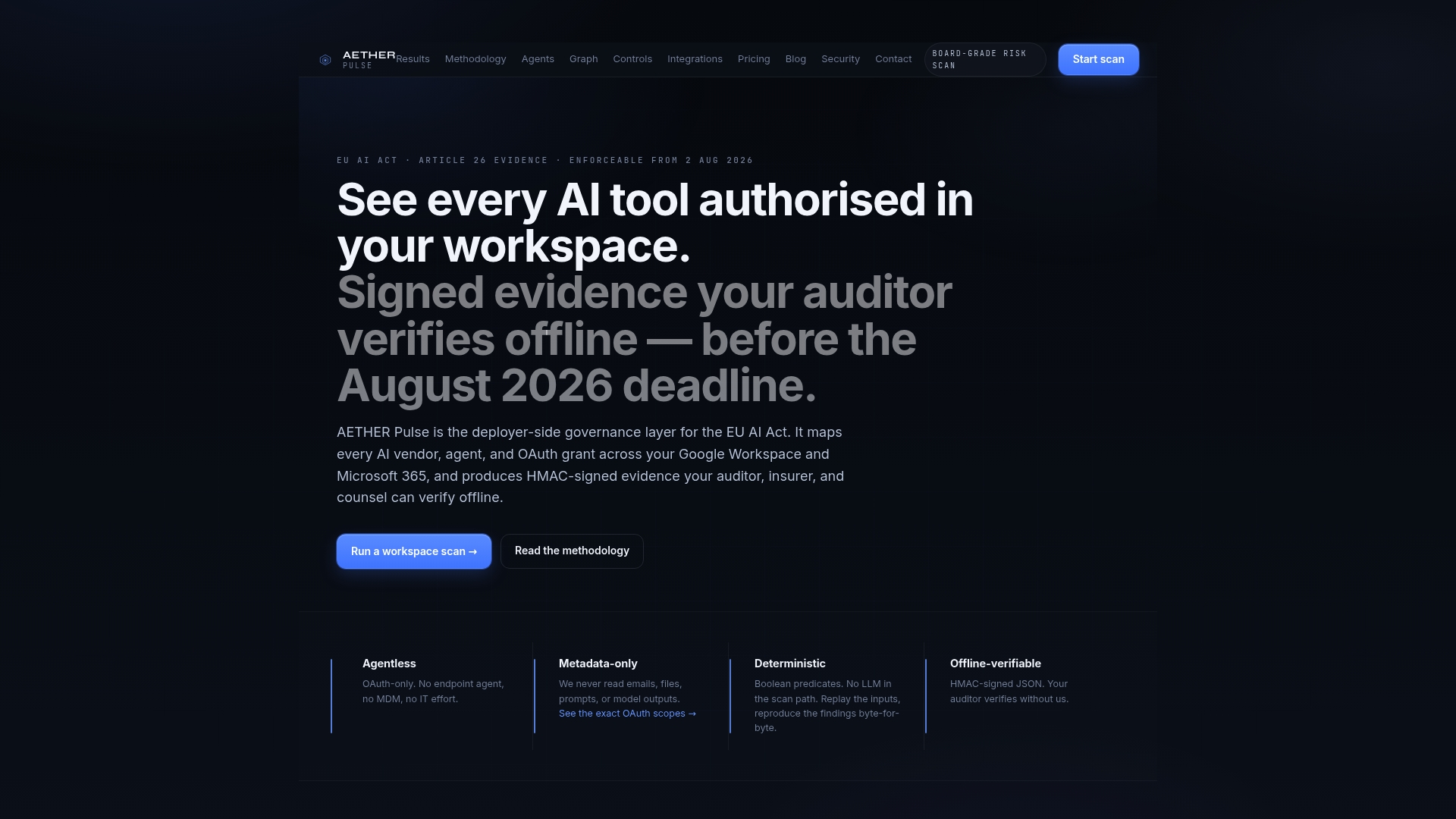
Aetherpulse connects via OAuth metadata only, builds an inventory and identity graph of your AI agents, and generates cryptographically signed (HMAC-SHA256) evidence packs on demand. No agents deployed. No customer data accessed. The platform aligns directly with EU AI Act Article 26, FCA Consumer Duty, SYSC requirements, and ISO 42001, so the evidence it produces maps to the frameworks your auditors already expect. If your team is building toward 2026 regulatory readiness and needs audit-ready AI compliance records without the engineering overhead, Aetherpulse is worth a close look.
FAQ
What is a defensible AI compliance record?
A defensible AI compliance record is a structured body of tamper-evident, provenance-tracked evidence that proves an AI system operated within documented, authorized parameters. It includes system cards, model provenance data, cryptographically signed decision logs, and incident response records.
What are the EU AI Act documentation requirements for high-risk AI?
The EU AI Act requires technical files, model cards, impact assessments, and incident response plans for high-risk AI systems, with penalties up to €35 million or 7% of global turnover for non-compliance. The compliance deadline is august 2, 2026.
Why is manual reconstruction of AI compliance evidence a problem?
Manual reconstruction is less credible than automated audit trails because it is incomplete, inconsistent, and cannot prove that evidence was not altered after the fact. Regulators now expect cryptographically signed, provenance-tracked records generated at decision time.
How does ISO 42001 relate to EU AI Act compliance?
ISO 42001 provides the management system structure for AI governance, while the EU AI Act supplies prescriptive documentation requirements. Aligning both frameworks around a single set of evidence artifacts eliminates duplicative documentation and reduces overall audit preparation effort.
What is risk tiering in AI compliance documentation?
Risk tiering is the practice of assigning AI systems to compliance tiers based on their potential impact, data sensitivity, and autonomy level. High-risk systems require full impact assessments and red-team reports; low-risk systems require documented exclusion rationales and basic usage logs.
Recommended
Working on Article 26 readiness, deployer-side governance evidence, or AI agent risk at a regulated firm? We'd value 15 minutes of your perspective.
Start a conversation