30/60/90-Day ICO AI Checklist for UK Compliance Leads
30/60/90-Day ICO AI Checklist for UK Compliance Leads

The ICO expects organizations using AI to demonstrate clear governance, a documented lawful basis, explainable decisions, tested accuracy, and active bias mitigation. Recent Data (Use and Access) Act changes to automated decision-making make audit-ready evidence urgent, not optional. The immediate priorities: build an AI inventory, run DPIAs and equality impact assessments on high-risk systems, log decisions and performance, and be ready to produce an evidence pack on request.
TL;DR:
- Organizations must build and maintain an AI register, document risk tiers, and log decisions and model changes to ensure audit readiness.
- Transparency requires clear communication about AI processing purpose, logic, impact, and how individuals can challenge decisions, with layered explanations and decision traces.
- High-risk AI systems handling special or biometric data require explicit lawful bases, detailed DPIAs, and periodic legitimate interests assessments.
- Continuous fairness testing, subgroup analysis, and trigger points for equality impact assessments are essential for trustworthy AI deployment.
- Using metadata-only governance tools can meet ICO evidence requirements without exposing sensitive customer data, enabling scalable compliance.
Table of Contents
- Where Does ICO AI Guidance Sit, and What Should You Read First?
- Who Owns AI Governance, and What Evidence Proves It?
- What Must You Disclose About Automated Decisions?
- Which Lawful Basis Applies to AI Processing, and When Do Special Categories Trigger Extra Steps?
- How Do You Test for Fairness and Know When an EqIA Is Needed?
- How Do You Validate Accuracy and Prove It Over Time?
- When Does an Automated Decision Trigger Article 22 Protections?
- Which ICO Toolkits Actually Help, and How Do You Use Them?
- What Should You Do in the Next 30, 60, and 90 Days?
- Can Metadata-Only Governance Satisfy These Evidence Requirements?
- Why Speed Beats Perfection in AI Compliance Right Now
- Get Audit-Ready Evidence Without Touching Customer Data
- Sources
Where Does ICO AI Guidance Sit, and What Should You Read First?
The ICO's guidance on AI and data protection covers the full AI lifecycle, from design decisions through deployment, ongoing monitoring, and eventual decommissioning. It was reorganized around the core UK GDPR principles rather than around specific technologies, which is why it holds up as AI systems evolve.
For a compliance team building a reading list, start here:
- The main AI and data protection guidance, which sets out governance, transparency, lawfulness, accuracy, and fairness chapters.
- The Artificial Intelligence resource hub, which links to the AI risk toolkit and the explainability guidance.
- The 2026 ADM consultation page, tracking how DUAA reshapes automated decision-making rules.
Treat the consultation as live. Draft ADM guidance is open for comment until late May 2026, and organizations relying on solely automated decisions should watch it closely rather than freeze policy around the pre-DUAA text.
Who Owns AI Governance, and What Evidence Proves It?
Accountability under ICO guidance is not a written policy sitting in a shared drive. It is a chain of named ownership, from board-level sign-off down to the person who can explain why a specific model made a specific decision.
- Assign a named owner per AI system. A DPO or delegated compliance lead should be identifiable for every deployed model, not just for AI generally.
- Build and maintain an AI register. List every system, its purpose, data inputs, risk tier, and review date.
- Tier projects by risk. High-risk systems, those touching special category data or making significant decisions about people, need tighter review cycles than low-risk internal tools.
- Log changes and decisions. Version history, retraining events, and decision overrides all belong in a change log auditors can read chronologically.
Pro Tip: Do not wait for an ICO inquiry to build your AI register. Start with whatever systems finance, marketing, or underwriting teams are already using, even ones procurement never formally approved. Shadow AI adoption is the single biggest gap between what compliance thinks it governs and what actually runs in production.
What Must You Disclose About Automated Decisions?
Transparency and explainability are related but distinct obligations. Transparency is what you tell the person affected. Explainability is the technical ability to reconstruct why a model produced a given output. A firm can satisfy one without the other, and the ICO expects both.
Privacy and decision notices should cover:
- The purpose of the processing and why AI is used for it.
- A plain-language summary of the logic involved, not the underlying math.
- The likely impact on the individual, including what changes if the decision goes against them.
- How to request human review or challenge the outcome.
Practically, layered explanations work best: a short notice for the general reader, with a deeper technical explanation available on request. Pair that with decision traces (a record of the inputs and model version behind a specific outcome) and documented evidence that a human reviewer actually looked at contested cases. Aetherpulse's guidance on explainability for compliance officers walks through building that layered notice structure in more detail.
Which Lawful Basis Applies to AI Processing, and When Do Special Categories Trigger Extra Steps?
Most AI processing under UK GDPR runs on legitimate interests, contract necessity, or consent, and the ICO expects a documented reason for whichever one you pick, not just a checkbox. Legitimate interests requires a written balancing test weighing the business need against the individual's rights. Consent must be genuinely freely given, which is difficult when the AI decision affects access to a service.
Special category and biometric data raise the bar further. Facial recognition, health inferences, or any biometric identifier processed by an AI system typically needs an explicit condition under Article 9 on top of your Article 6 basis, plus enhanced safeguards.
Keep these records on file and ready to produce:
- Completed DPIAs for any AI system likely to result in high risk to individuals.
- Legitimate interests balancing tests, dated and reviewed periodically.
- Retention schedules specific to AI training data and model outputs, not just general customer records.
How Do You Test for Fairness and Know When an EqIA Is Needed?
The ICO treats fairness as distinct from bias. Bias is a measurable statistical pattern in a model's outputs; fairness is the broader judgment about whether that pattern produces discriminatory or unjustifiable outcomes. Annex A of the ICO's AI guidance frames fairness as a lifecycle responsibility, meaning it needs continuous measurement, not a one-time sign-off before launch.
- Test at each lifecycle stage, from training data composition through post-deployment monitoring, not just at build time.
- Run subgroup analyses across protected characteristics where data allows, comparing outcome rates and error rates between groups.
- Trigger an EqIA whenever a system could plausibly disadvantage a protected group, recording the assessment method, findings, and mitigation chosen using the ICO's equality impact assessment materials.
How Do You Validate Accuracy and Prove It Over Time?
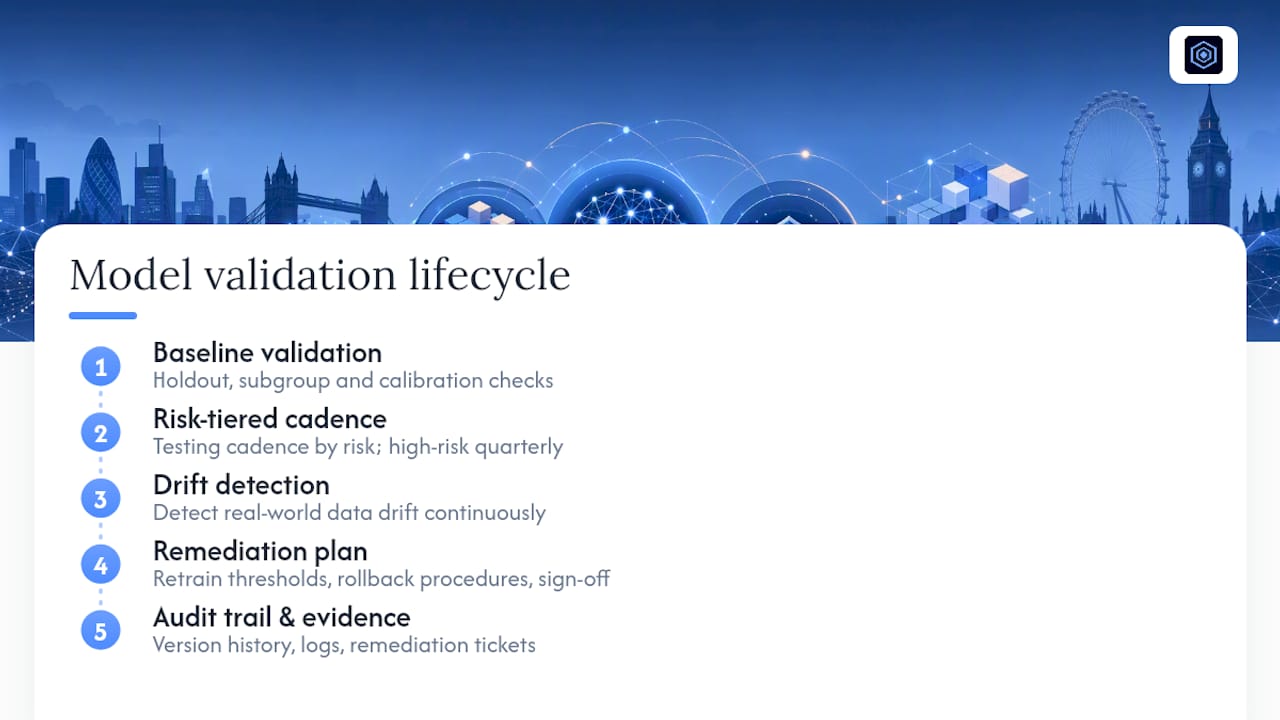
Accuracy under ICO guidance means both the technical performance of the model and the correctness of the personal data it relies on. Holdout test sets, subgroup accuracy metrics, and calibration checks (confirming a model's confidence scores actually match real-world outcomes) form the baseline validation kit.
Drift monitoring matters more than most teams budget for. A model that performed well at launch can degrade quietly as real-world data shifts away from training assumptions. Set a testing cadence tied to risk tier, quarterly for high-risk systems, and define a remediation plan before you need one: retraining thresholds, rollback procedures, and who signs off. Keep model version history, performance logs, and remediation tickets together so an auditor can trace one decision back to the exact model version that produced it. Aetherpulse's audit readiness guidance covers how to structure that record trail.
When Does an Automated Decision Trigger Article 22 Protections?
Article 22 protections apply when a decision is made solely by automated means and produces a legal or similarly significant effect, think credit decisions, recruitment screening, or benefit eligibility. Human-in-the-loop review that is genuine, not rubber-stamped, can move a system outside that category, but only if the reviewer has real authority to change the outcome.
The DUAA 2025 reforms adjusted the conditions under which solely automated decision-making is permitted, and the ICO's 2026 consultation is refining how those changes apply in practice. Until that guidance finalizes, treat the following as minimum safeguards:
- Meaningful human review available on request, with documented reviewer authority.
- A clear appeals or challenge mechanism communicated to the affected individual.
- Transparency about the fact that automation was involved in the decision.
When a regulator asks for proof, the ICO's page on rights related to automated decision-making is the benchmark your documentation needs to match.
Which ICO Toolkits Actually Help, and How Do You Use Them?
The ICO's AI hub hosts the AI and data protection risk toolkit alongside DPIA templates, and both are built to produce documentation, not just checklists to tick.
- Use the risk toolkit to score each AI system against defined risk criteria, then attach that score directly to your AI register entry.
- Use DPIA templates as a starting structure, but expand the logic and mitigation sections with system-specific detail an auditor can follow.
- Convert every toolkit output into a dated, version-controlled document, not a live spreadsheet that changes without a trail.
- Check the consultation responses and the ICO's "plans for new and updated guidance" page periodically, since toolkit content shifts as guidance evolves.
What Should You Do in the Next 30, 60, and 90 Days?
- Days 1 to 30: Build the AI inventory across every department, then triage with quick DPIAs on anything touching special category data or significant decisions.
- Days 31 to 60: Stand up subgroup performance monitoring on high-risk systems and update customer-facing notices to reflect actual current processing.
- Days 61 to 90: Complete outstanding EqIAs and assemble a full audit pack, decision logs, validation reports, and governance policies, ready for review.
Pro Tip: Do not build the audit pack from scratch at day 90. Structure your logging from day one so the pack assembles itself from records you're already keeping. Aetherpulse's gap assessment guide offers a starting framework for the day 1 triage.
Can Metadata-Only Governance Satisfy These Evidence Requirements?
A read-only, metadata-only approach maps closely to what ICO guidance asks for without requiring access to the underlying customer data itself. By building an inventory and identity graph from OAuth metadata, this method produces the AI register, risk tiering, and decision logging the ICO expects, without touching sensitive processing. Cryptographically signed evidence packs (HMAC-SHA256) give auditors tamper-evident proof rather than a spreadsheet someone edited last week.
Why Speed Beats Perfection in AI Compliance Right Now
Most compliance teams treat ICO guidance as a document to satisfy once and file away. That is the wrong instinct. Fairness, in particular, is a lifecycle obligation, not a launch gate, which means your evidence has to be continuous or it is worthless the moment a regulator asks a follow-up question.
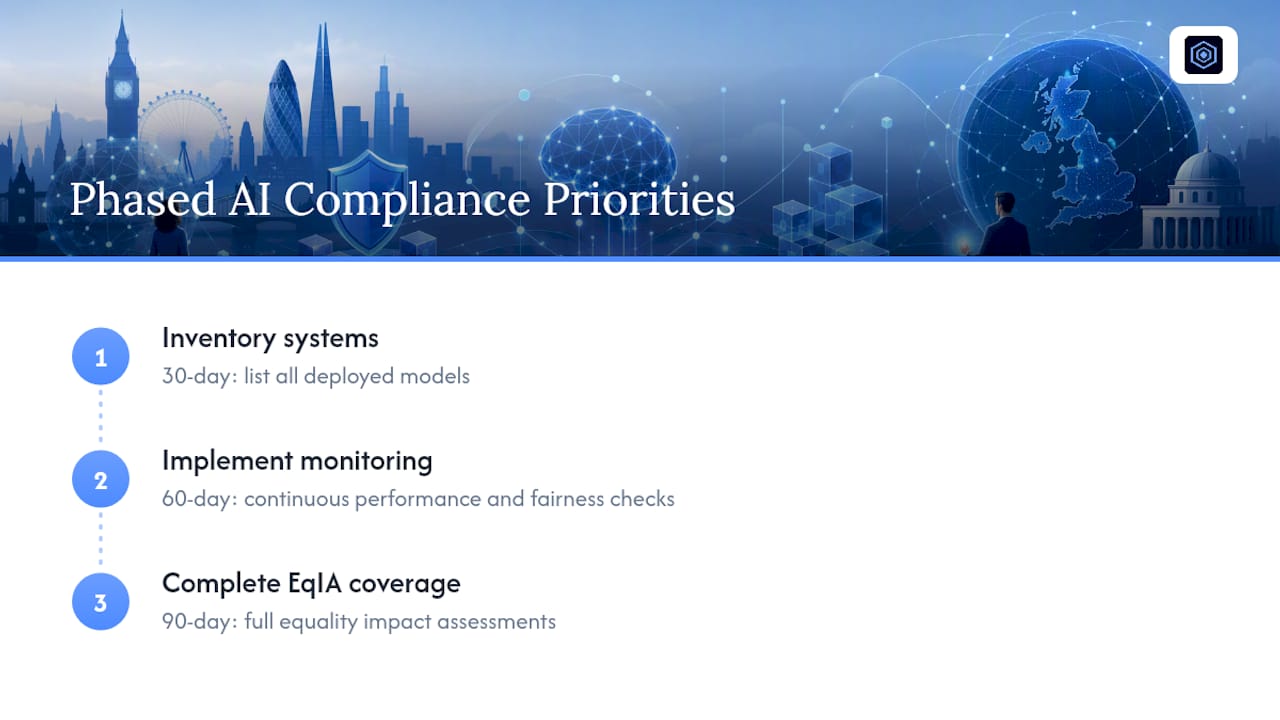
The real trade-off is not between speed and control. It is between building governance that scales with the number of AI systems you deploy, versus governance that only works for the three models someone remembered to document. Firms that phase this in, inventory first, monitoring second, full EqIA coverage third, tend to end up with evidence that holds up under scrutiny. Firms that try to do everything at once usually produce documentation nobody can defend under questioning.
Start with the 30/60/90 checklist above outlined in the Token Launch Compliance Checklist for Founders. If your gap is producing defensible evidence at scale rather than deciding what evidence you need, that is a tooling problem worth solving directly.
— Eleye
Get Audit-Ready Evidence Without Touching Customer Data
Most governance tools ask you to choose between visibility and intrusion, either you deploy agents deep into production systems, or you settle for a policy document nobody can prove is being followed. Aetherpulse takes a third route: a read-only, metadata-only layer that builds your AI inventory and produces tamper-evident evidence packs without ever accessing the data your AI systems actually process.
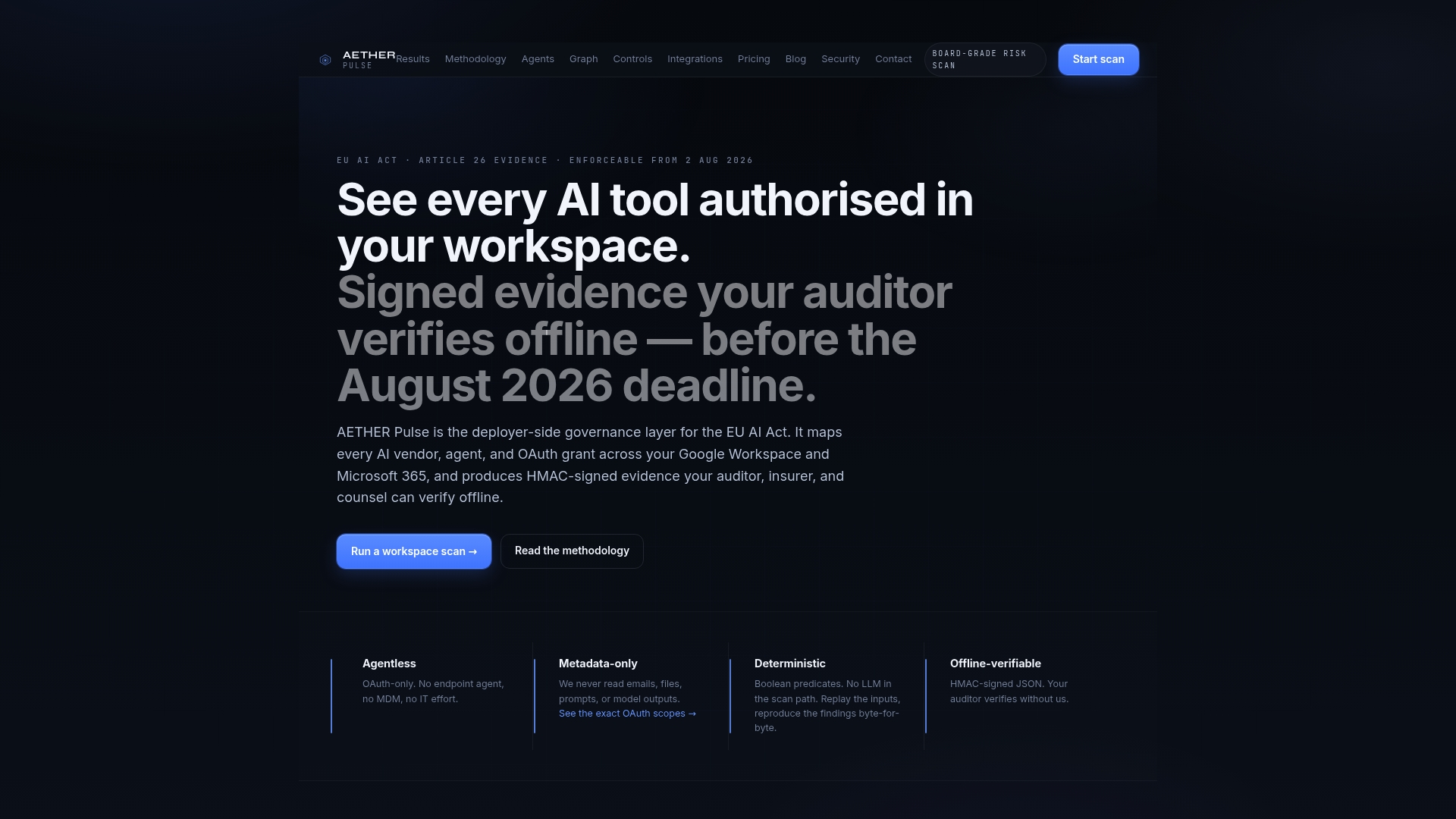
That distinction matters for exactly the tasks covered above. Aetherpulse maps automated decision-making activity for Article 22 reviews, generates DPIA-ready documentation, and maintains a cryptographically signed (HMAC-SHA256) archive of explainability records regulators and internal risk teams can both trust. Because it connects through metadata rather than direct data access, deployment doesn't require the lengthy security review a traditional monitoring agent would trigger. Review the security and evidence architecture or visit Aetherpulse to request a demo and see how your own AI inventory would map to an audit pack.
This article is general information, not a substitute for advice from a qualified lawyer. Consult a qualified legal professional about your own circumstances before acting on anything here.
Sources
Recommended
Working on Article 26 readiness, deployer-side governance evidence, or AI agent risk at a regulated firm? We'd value 15 minutes of your perspective.
Start a conversation