Model Cards Compliance: Why Documentation Alone Falls Short
Model Cards Compliance: Why Documentation Alone Falls Short

Model cards are the canonical documentation your auditors will ask for, but alone they are only a snapshot. Model cards compliance requires pairing that snapshot with lineage tracking and an append-only evidence trail. Regulators expect proof of oversight, not just a description of intended use.
Three immediate tasks close the gap:
- Create a canonical model card record for every production model, including high-risk ones subject to the EU AI Act.
- Attach lineage pointers and checksums so the card can be verified against the model artifact it describes.
- Enforce an append-only audit trail so cards cannot be quietly edited after an incident.
Pro Tip: Map every card field to a specific regulatory clause (EU AI Act Article 13/26, NIST AI RMF, or sector rules like HIPAA and ECOA) before an auditor asks you to.
Key Takeaways
Model cards compliance succeeds when canonical card fields are paired with append-only lineage evidence, checksum verification, and promotion workflows that regulators can query directly.
| Point | Details |
|---|---|
| Cards alone are insufficient | A model card documents claims; lineage and checksums prove those claims held true in production. |
| Assign clear ownership | Split responsibility across a model owner, compliance custodian, and registry owner. |
| Build for machine validation | Store cards as JSON or YAML so policy checks run automatically, not through manual review. |
| Map fields to frameworks | Tag each card field to EU AI Act, NIST AI RMF, or sector rules before an audit forces the mapping. |
| Aetherpulse fits the evidence gap | Its metadata-only integration generates HMAC-SHA256-signed evidence packs that pair with model card fields without touching customer data. |
Table of Contents
- What a Model Card Is and Who Should Own It
- Why Model Cards Matter for Compliance Frameworks
- Canonical Model-Card Fields Compliance Teams Must Capture
- Turning Model Cards Into Audit Evidence
- Common Pitfalls in Model Card Programs
- A Copyable Model Card Skeleton for Your Registry
- What Vetted Governance Evidence Actually Looks Like
- Where to Read Further on Model Card Standards
- What the Conventional Advice on Model Cards Gets Wrong
- Getting Audit-Ready Without Touching Customer Data
- Frequently Asked Questions
- Sources
What a Model Card Is and Who Should Own It
A model card is a short, structured document describing a model's intended use, evaluation results, and limitations. Mitchell et al. proposed the format specifically so that engineers, auditors, and end users could all read the same artifact and understand what a model does and where it fails. That dual audience makes the model card a "boundary object": something technical enough for a data scientist and clear enough for a risk officer.
Model cards differ from adjacent artifacts. A datasheet documents a dataset's origins and collection methods. A system card describes an entire product built from multiple models working together. A model card sits at the individual model level, in between.
Ownership should not default to whichever engineer trained the model. Effective programs assign:
- A model owner accountable for accuracy of technical content.
- A compliance custodian who verifies regulatory fields are complete.
- A registry owner who controls where the card lives and who can edit it.
Why Model Cards Matter for Compliance Frameworks
Model cards address a specific set of transparency obligations: what the model is for, who it should not be used on, its known limitations, and instructions for downstream users. Those are exactly the disclosure elements regulators keep asking for.

The mapping to formal frameworks is direct. The EU AI Act's documentation requirements for high-risk systems echo the same fields Mitchell's team defined: intended purpose, performance metrics across relevant groups, and known limitations. The NIST AI Risk Management Framework treats similar documentation as a core input to program-level risk mapping rather than a one-time compliance checkbox.
Where model cards fall short is evidentiary weight. A card tells an auditor what a team claims about a model. It does not prove the model in production today matches the model the card describes, and it does not show that oversight actually happened on a given date. Regulators increasingly want:
- Immutable logs showing when a model was promoted, retired, or retrained.
- Monitoring records demonstrating ongoing performance checks, not just a launch-day snapshot.
- Evidence that a human reviewed and approved the model card before deployment.
A card without those supporting artifacts is a well-written claim. It is not proof.
Canonical Model-Card Fields Compliance Teams Must Capture
A compliance-ready card needs specific, verifiable fields rather than free-text description. Build the schema around these six categories.
- Identity and versioning. Capture a unique modelId, an artifact checksum, createdAt timestamp, and createdBy identity. Without these, you cannot prove which model a card actually describes.
- Intended use and scope. State the target population, the decision the model informs, and explicit out-of-scope uses. AWS SageMaker's documentation treats this as a mandatory field, not an optional narrative.
- Training and evaluation data provenance. Record dataset IDs, versions, and hashes rather than a plain-language description of "internal customer data."
- Performance metrics. Include subgroup breakdowns, not just an aggregate accuracy figure, along with a short rationale for why each metric was chosen.
- Risk classification and framework tags. Tag the model against your internal risk tiers and the external frameworks it falls under, plus the human oversight and monitoring plan attached to it.
- Lineage pointers. Record the parent model ID, the training run ID, and the artifact checksum linking the card to a specific, reproducible build.
Pro Tip: If a field cannot be filled with a verifiable value, don't leave it blank. Mark it "not yet available" so auditors see a gap was acknowledged, not missed.
Turning Model Cards Into Audit Evidence
A model card sitting in a shared drive is a document. A model card connected to a registry, a promotion workflow, and an audit log is evidence. The distinction matters because auditors query systems, not folders.
Start with a dedicated model registry, separate from your experiment tracking tools, that is queryable and versioned by schema. Every schema change should be tracked, so a card written under v1.2 of your template doesn't get silently compared against a card written under v2.0.
Promotion into production should pass through gates: an expiry date on the approval, a shadow-testing period, and quorum-based sign-off rather than a single approver. Append-only audit logs record every promotion, retirement, and edit, and checksum verification at serving time confirms the deployed artifact still matches the card on file.
Machine-readable cards, stored as JSON or YAML, allow automated validation against policy rules rather than manual review of prose. Tools like ModelLedger show how dataset hashes, experiment history, and automated risk flags can feed directly into a compliance report mapped to the EU AI Act and NIST AI RMF.
| Control | What it proves |
|---|---|
| Schema-versioned registry | Which template version generated a given card |
| Promotion gates with quorum approval | A human reviewed and approved deployment |
| Append-only audit log | No retroactive edits after an incident |
| Checksum verification at serving time | The live model matches the documented one |
Lineage graphs and experiment trackers should be linked by pointer, not by copying artifacts into the card itself. This keeps the compliance record thin and auditable, an approach detailed in the operating model guidance for regulated financial services firms.
Common Pitfalls in Model Card Programs
Most model-card programs fail quietly, not dramatically. The card gets written, then drifts out of sync with reality.
- Artifact drift. The deployed model changes but the card doesn't. Mitigate with checksums verified at both promotion and serving time, not just at initial sign-off.
- Missing provenance. Teams describe training data in prose instead of recording dataset hashes and code commit references. Make both fields mandatory, not optional, for any model above your minimum risk threshold.
- Overly technical cards. A card written for engineers is unreadable to a risk committee. Maintain a plain-language summary alongside the machine-readable schema, following the two-layer structure Hugging Face's guidance recommends.
- Budget and time constraints. Not every model needs a full schema. Define a minimal viable card for low-risk models and reserve the complete schema for high-risk ones.
Pro Tip: Run a pre-release audit-readiness check that asks one question per field: "Could I produce evidence for this claim in the next hour?" If the answer is no, the card isn't done.
A Copyable Model Card Skeleton for Your Registry
A minimal schema needs only a handful of keys to be useful, but each key carries different verification requirements.
| Field | Type | Verification need |
|---|---|---|
| modelId | string | Unique, immutable identifier |
| version | string | Tied to schema version, not just model version |
| intendedUse | text | Human-reviewed, plain language |
| datasets[] | array of pointers + hashes | Hash required, artifact stored elsewhere |
| metrics[] | array with subgroup breakdowns | Machine-validated against policy thresholds |
| lineage[] | array of pointers (parent model, training run) | Pointer only, never a copied artifact |
- Fields like
datasets[]andlineage[]should carry hashes or checksums, never raw data. - Narrative fields like
intendedUseand known limitations stay human-written and reviewed. - Host the schema in a versioned registry with access controls scoped by role, so only the compliance custodian can approve schema changes.
What Vetted Governance Evidence Actually Looks Like
A model card is a claim about a model. Auditors want proof the claim held true on the day the model made a decision that mattered. That gap is where most compliance programs get exposed, usually during the audit itself rather than beforehand.
Metadata-only integration is one credible pattern for closing it without adding new privacy exposure. Rather than touching customer data or inserting an agent into production systems, a governance layer can connect through OAuth metadata alone, building an inventory and lineage graph from what already exists in system logs.
The evidence that survives audit scrutiny is not the card itself. It is the cryptographically signed record proving the card, the model, and the deployment decision all lined up on a specific date.
When evaluating vendors for this layer, ask about three concrete things:
- Whether evidence packs are signed with HMAC-SHA256 or an equivalent tamper-evident method.
- Whether the schema is versioned so old evidence remains interpretable after an update.
- Whether integration is read-only, avoiding any need to expose customer data to a third party.
Where to Read Further on Model Card Standards
For teams building out a full compliance schema, these sources go deeper than any single article can:
- Model Cards for Model Reporting — the original Mitchell et al. framework.
- Model Card Guidebook — Hugging Face's practitioner guide.
- NIST AI Risk Management Framework — the program-level mapping reference.
- Model Card Regulatory Check — OECD's automated field-matching tool.
- Amazon SageMaker model cards documentation — a concrete implementation reference.
What the Conventional Advice on Model Cards Gets Wrong
Most guidance on model cards compliance treats the card as the deliverable. Write it well, fill in every field, and the compliance box is checked. That advice is not wrong so much as incomplete, and the gap it leaves is exactly where audits go badly.
The card is a claim. Auditors have learned to ask for the receipt behind the claim: the checksum proving the deployed artifact matches what's documented, the log showing when a human actually approved promotion, the timestamp proving monitoring happened rather than getting described after the fact. Teams that pour their effort into prose quality and skip the lineage infrastructure end up with beautifully written documentation and no defensible answer when asked to prove any of it.
The priority order matters here. Build the minimal schema first, wire it to checksums and an append-only log second, and only then invest in making the plain-language summary polished. A rough card backed by real evidence beats a polished card backed by nothing every time a regulator actually looks.
Getting Audit-Ready Without Touching Customer Data
Aetherpulse gives compliance teams a faster path to the evidence auditors actually ask for, without adding another invasive tool to the stack. Rather than inserting an agent into production or requiring access to customer data, Aetherpulse connects through metadata only and builds an inventory and identity graph of your organization's AI agents automatically.
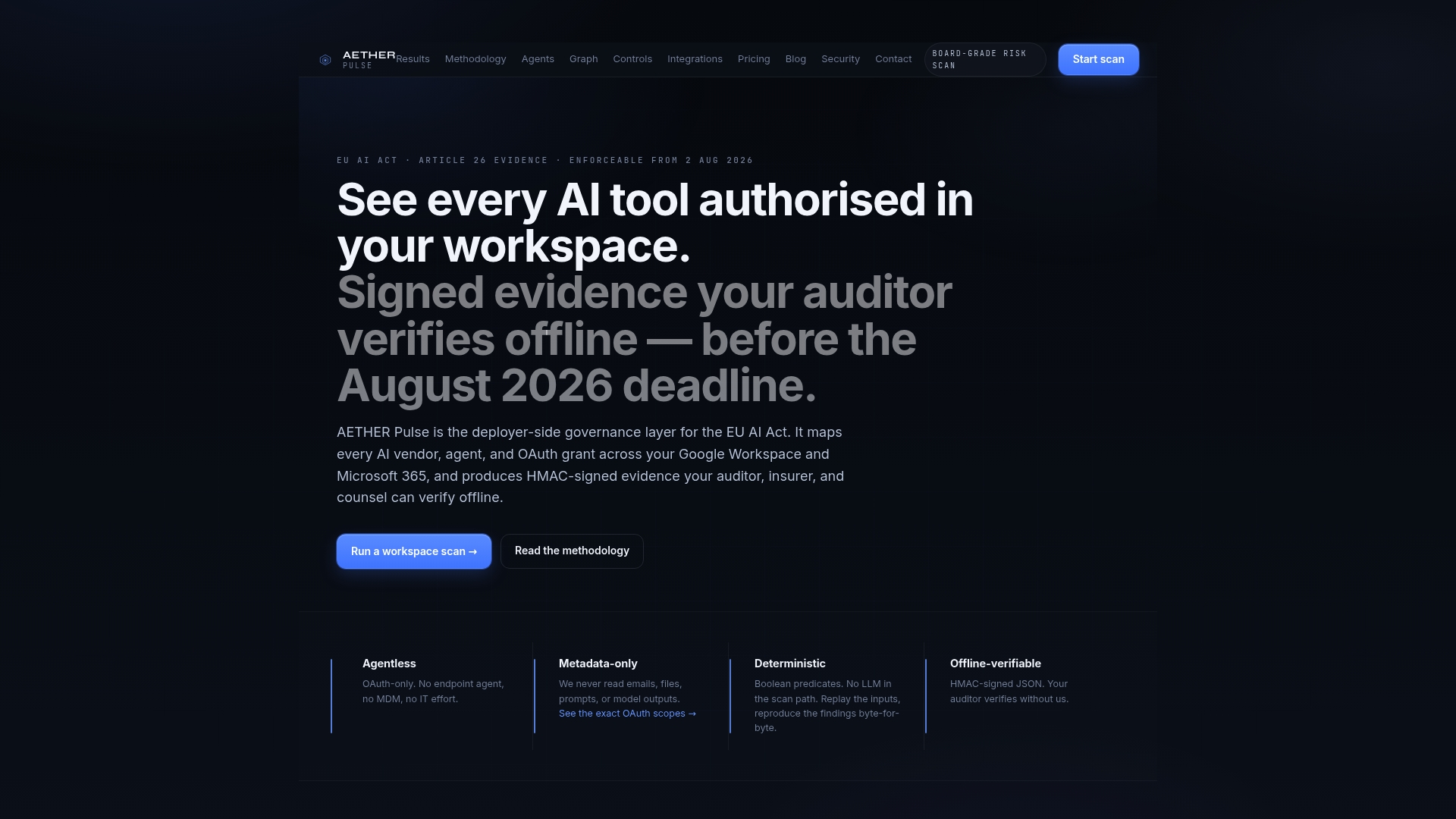
That inventory maps directly onto the audit-readiness checklist covered above: lineage pointers, risk concentration, and monitoring evidence, packaged into HMAC-SHA256-signed evidence packs that hold up under scrutiny. The platform tracks risk concentration, including financial blast-radius exposure, and generates deterministic, provenance-tracked evidence on demand rather than reconstructing it after an incident. For teams that want the underlying pattern explained in more depth, the guide to governance without data access walks through how metadata-only integration works in practice, and the security team playbook on agent governance covers complementary controls worth reviewing alongside it.
Visit the Aetherpulse pricing page to see tiered options by firm size, or explore the product overview to request a demo.
Frequently Asked Questions
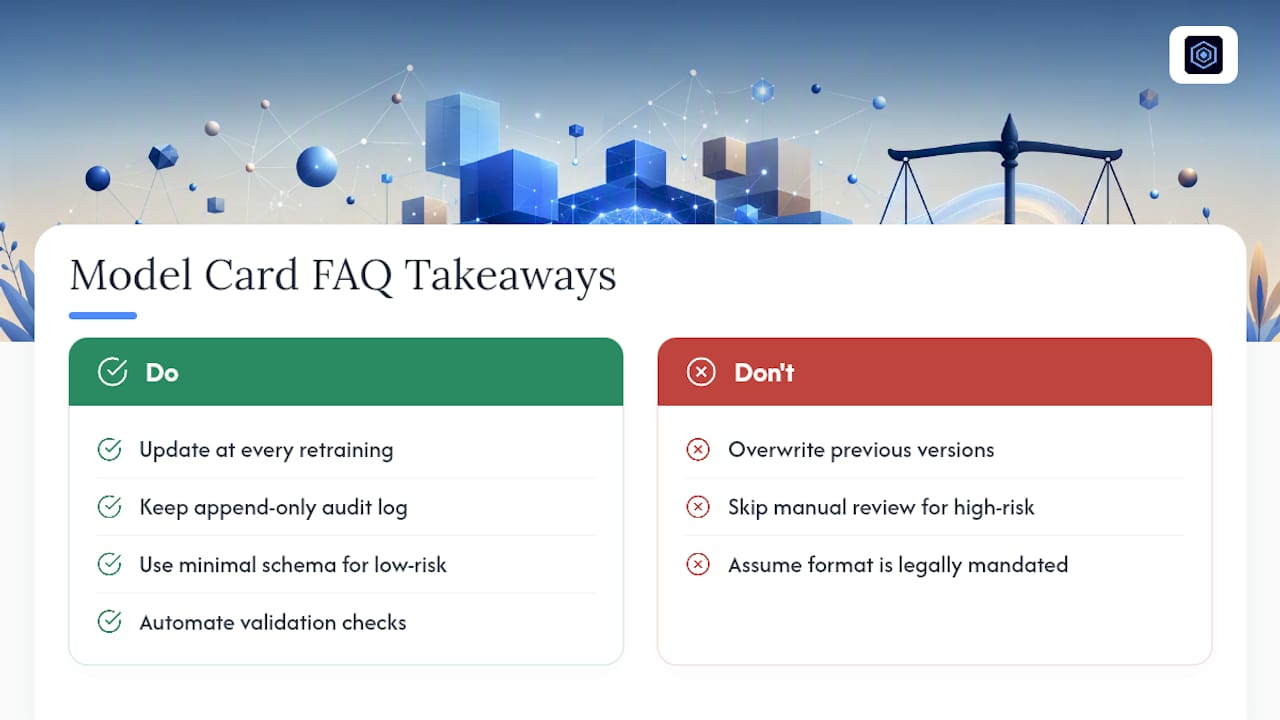
Are model cards legally required under the EU AI Act? High-risk AI systems under the EU AI Act carry documentation obligations that closely mirror standard model card fields, including intended use, performance data, and limitations. The exact format isn't mandated, but the substance largely overlaps with the canonical model card structure.
How often should a model card be updated? Update the card at every retraining event, every material change to the training data, and at minimum on a scheduled review cycle for high-risk models. An append-only audit log should record each update rather than overwriting the previous version.
Can a small compliance team realistically maintain model cards for dozens of models? Yes, if the schema is minimal for low-risk models and automated validation checks handle routine field completeness. Reserve manual review time for high-risk models where subgroup metrics and human oversight plans need real scrutiny.
What's the difference between a model card and a system card? A model card documents one model. A system card documents an entire product or pipeline that may combine several models, third-party components, and business logic. Regulated firms typically need both when a production system involves multiple models feeding a single decision.
Sources
- Model Cards for Model Reporting (Mitchell et al., 2019)
- Model Card Guidebook · Hugging Face
- Amazon SageMaker model cards documentation
- NIST AI Risk Management Framework
- Oecd
Recommended
Working on Article 26 readiness, deployer-side governance evidence, or AI agent risk at a regulated firm? We'd value 15 minutes of your perspective.
Start a conversation