Make AI Model Risk Audit Ready: Map NIST's 4 Functions for Banks
Make AI Model Risk Audit Ready: Map NIST's 4 Functions for Banks

Good AI model risk management delivers one thing above all: audit-ready evidence, sized to each model's actual risk. That means a documented framework, a complete inventory with risk tiering, pre-deployment validation, continuous post-deployment monitoring, and oversight of vendor and third-party models. Supervisors expect this oversight to be risk-based and proportionate, not uniform across every use case. Firms that skip straight to tools before establishing these fundamentals build governance that looks credible until an examiner asks for evidence.
TL;DR:
- A comprehensive AI model inventory must include details like purpose, data sources, dependencies, and materiality to enable proper validation scope.
- Risk tiering relies on impact, model complexity, and reliance to determine validation, monitoring, and reporting requirements for each AI system.
- Effective validation combines multiple tests, documented methodology, and independent challenge to satisfy audits and ensure model robustness.
- Continuous monitoring should track performance, data drift, fairness, and KPIs, with predefined actions for drift detection thresholds to manage model risks.
- Governance must produce tamper-proof, versioned evidence packages aligned with model tiers to facilitate audit readiness and demonstrate compliance efforts.
Table of Contents
- What Frameworks Should Anchor Model Risk Management AI Programs?
- How Should Financial Firms Build an AI Model Inventory and Risk Tiering?
- What Validation and Testing Satisfies Auditors Before Deployment?
- How Do You Monitor AI Models After They Go Live?
- How Should Banks Oversee Vendor and Third-Party AI Models?
- What Governance Structure Makes AI Model Risk Audit-Ready?
- A Practitioner's View on Evidence-First AI Governance
- Where to Read More on AI Model Risk Management
- See How Aetherpulse Turns AI Governance Into Audit Evidence
- Sources
What Frameworks Should Anchor Model Risk Management AI Programs?
Most risk teams building an ai model risk management framework start with too many reference documents and no clear hierarchy. Pick one primary framework, then map every other standard to it as a supplement, not a competitor.
The NIST AI Risk Management Framework is the strongest anchor for U.S. financial institutions because it organizes AI governance into four functions that translate directly into audit deliverables:
- Govern: policies, roles, escalation paths, and accountability structures for AI risk decisions.
- Map: context, intended use, and risk factors for each AI system before deployment.
- Measure: quantitative and qualitative testing of performance, bias, and robustness.
- Manage: ongoing risk response, prioritization, and resource allocation as models operate in production.
Layer U.S. supervisory expectations on top of that structure. Federal Reserve, OCC, and FDIC guidance on model risk management has long emphasized a risk-based approach built on materiality assessment and effective challenge, meaning validation performed by someone with the authority and incentive to disagree with the model owner. A 2026 OCC bulletin makes clear that generative and agentic AI systems fall under these same principles even when they sit outside older, narrower model definitions.
International references add pragmatic texture. The MAS information paper on AI model risk management documents lifecycle governance practices worth borrowing even for U.S.-only firms, while the Cloud Security Alliance's AI MRM framework contributes concrete artifacts like Model Cards and Risk Cards that turn abstract policy language into documents an auditor can actually review.
How Should Financial Firms Build an AI Model Inventory and Risk Tiering?
You cannot govern what you cannot find. A model inventory is the foundation of any regulatory compliance AI program, and it needs more fields than most spreadsheets currently track.
A minimal inventory entry should record: purpose and business use, inputs and data sources, outputs and downstream consumers, the accountable owner, upstream and downstream dependencies, and a materiality rating. Miss any one of these and validation scope becomes guesswork.
Risk tiering turns that inventory into a prioritization engine. Three criteria do most of the work: potential impact (financial, customer, or regulatory harm if the model fails), model complexity (a simple rules engine versus a deep learning system with opaque internals), and reliance (how much human review still sits between the model's output and the final decision). A credit-decisioning model with no human override sits in a different tier than an internal document-summarization tool, and each deserves a different validation and monitoring cadence.
- Catalog every AI system, including shadow deployments built outside formal IT channels.
- Score each system against impact, complexity, and reliance.
- Assign a tier that dictates validation depth, monitoring frequency, and reporting obligations.
- Reassess the tier whenever the model's purpose, data, or deployment context changes.
Shadow AI is where most inventories break down first, since tools adopted informally by business units rarely get logged before an audit forces the question. Aetherpulse's own research into the hidden cost of shadow AI in regulated financial services covers why discovery, not documentation, is usually the harder problem.
Pro Tip: Tier by reliance before impact. A high-impact model with a strong human veto point often needs lighter validation than a moderate-impact model running fully automated.
What Validation and Testing Satisfies Auditors Before Deployment?
Pre-deployment validation for AI needs to answer six questions an examiner will eventually ask: Is the model conceptually sound? Is the training data reliable? Does performance hold up under stress? Is the output fair across relevant subgroups? Can the model's logic be explained? Is it secure against manipulation?
Model validation techniques that answer these questions in combination, rather than individually, tend to hold up best under review:
- Unit and integration tests confirming the model behaves as specified on known inputs.
- Holdout and out-of-time testing to check performance on data the model never saw during training.
- Adversarial and stress testing to probe behavior at the edges, including deliberately manipulated inputs.
- Scenario planning that walks through plausible failure modes and their business consequences.
- Explainability checks, using techniques appropriate to the model type, to confirm outputs can be traced to specific inputs.
Documentation is where validation either becomes evidence or evaporates. Every test needs a recorded methodology, a dated result, a named reviewer, and a version tag tied to the exact model build tested. That last point matters more than most teams realize: a validation report disconnected from a specific model version is close to worthless once retraining happens.
Effective challenge requires genuine independence. For high-tier models, that means a validator who reports outside the model owner's chain and has the standing to block deployment. Lower-tier models can often justify internal peer review instead of full independent validation, provided the tiering rationale is documented.

How Do You Monitor AI Models After They Go Live?
Static validation tells you almost nothing about how a model behaves six months into production. Practitioners consistently identify continuous monitoring as the biggest gap when traditional MRM methods meet probabilistic AI systems that drift in ways static tests never anticipated.
Track four categories of metrics on an ongoing basis:
- Accuracy and performance against the original validation baseline.
- Data-distribution drift, meaning statistical changes in the inputs the model now sees versus what it trained on.
- Fairness metrics across the subgroups most relevant to the use case.
- Latency, availability, and downstream business KPIs that tell you whether the model still delivers the outcome it was built for.
Detection techniques range from statistical drift detectors running automatically in production to shadow-mode deployments that test a new model version against live traffic without acting on its output. Data quality monitoring guidance for production AI systems covers the operational side of catching these signals before they become customer-facing failures.
When a drift threshold triggers, the response needs a predefined path: apply an overlay, schedule retraining, roll back to a prior version, or escalate to the risk committee. Automated risk assessment tools can flag the trigger, but the escalation decision itself should stay with a named accountable owner, logged with a timestamp. Risk committees typically want a monthly summary; audit and regulators generally want the full trail on demand.
How Should Banks Oversee Vendor and Third-Party AI Models?
Vendor models create a validation gap: you cannot run internal-logic tests on a system you cannot see inside. Supervisory guidance still holds firms accountable for outcomes regardless of who built the model, which means oversight has to happen at the boundary you can control, the inputs and outputs.
- Run due diligence on provenance, training data summary, documented performance claims, and any available model card before signing.
- Negotiate contractual clauses covering audit access, advance change notice, and remediation support obligations.
- Where internals stay opaque, validate through output testing, monitoring, and whatever risk documentation the vendor will provide.
- Log every review and monitoring result the same way you would for an internally built model, since auditors will ask for it regardless of who owns the code.
Agentic vendor tools raise the stakes further, since an AI agent that takes actions rather than just producing outputs needs oversight at multiple points, not one. Guidance on layered security for AI agents makes the case that a single control point is never enough for autonomous systems acting across systems and workflows.
What Governance Structure Makes AI Model Risk Audit-Ready?
Governance is the layer that turns individual controls into a demonstrable program. It needs a written policy proportionate to model risk tiers, clearly assigned model owners, independent validators, and an escalation path that reaches the board when materiality warrants it.
Audit-ready evidence has a specific look: tamper-evident logs that cannot be quietly edited after the fact, versioned documentation tied to exact model builds, dated validation reports, live monitoring dashboards, and a complete change log for every retraining or reconfiguration event.
- Policy should scale control intensity to tier, not apply one rulebook to every model regardless of impact.
- Roles need documented separation between the person who builds the model and the person who challenges it.
- Evidence needs to be retrievable on demand, not reconstructed under deadline pressure when an examiner calls.
Pro Tip: If your CRO can't produce a single model's full evidence package inside a business day, your governance structure has a documentation gap, not a monitoring gap.
Aetherpulse's guide on building an AI governance operating model works through how to structure these roles at scale without duplicating headcount for every new model deployed.
A Practitioner's View on Evidence-First AI Governance
The gap between having an AI governance policy and being able to prove it in front of an examiner is where most programs actually fail. A metadata-only evidence layer, one that ingests inventory and activity data without touching customer records, can generate tamper-evident evidence packs on demand, closing that gap without adding another invasive tool to the stack. Firms should consider this kind of layer once their model count outpaces their ability to manually assemble evidence for an audit request. For more on operationalizing that pattern, see Aetherpulse's guide on AI governance without data access.
— Eleye
Where to Read More on AI Model Risk Management
- NIST AI RMF resources: the four-function framework underlying most U.S. programs.
- Federal Reserve model risk guidance: core supervisory expectations for validation and challenge.
- SR 26-2 attachment: detail on inventory, documentation, and monitoring.
- CSA AI MRM framework: practical Model Card and Risk Card tools.
See How Aetherpulse Turns AI Governance Into Audit Evidence
Building the inventory, tiering, and monitoring described above is only half the job. The other half is producing evidence an examiner accepts without a scramble, and that's where most compliance teams lose weeks every audit cycle. Aetherpulse connects through metadata only, touching no customer data, and builds an identity graph of every AI agent running across your organization, then generates cryptographically signed evidence packs on demand.
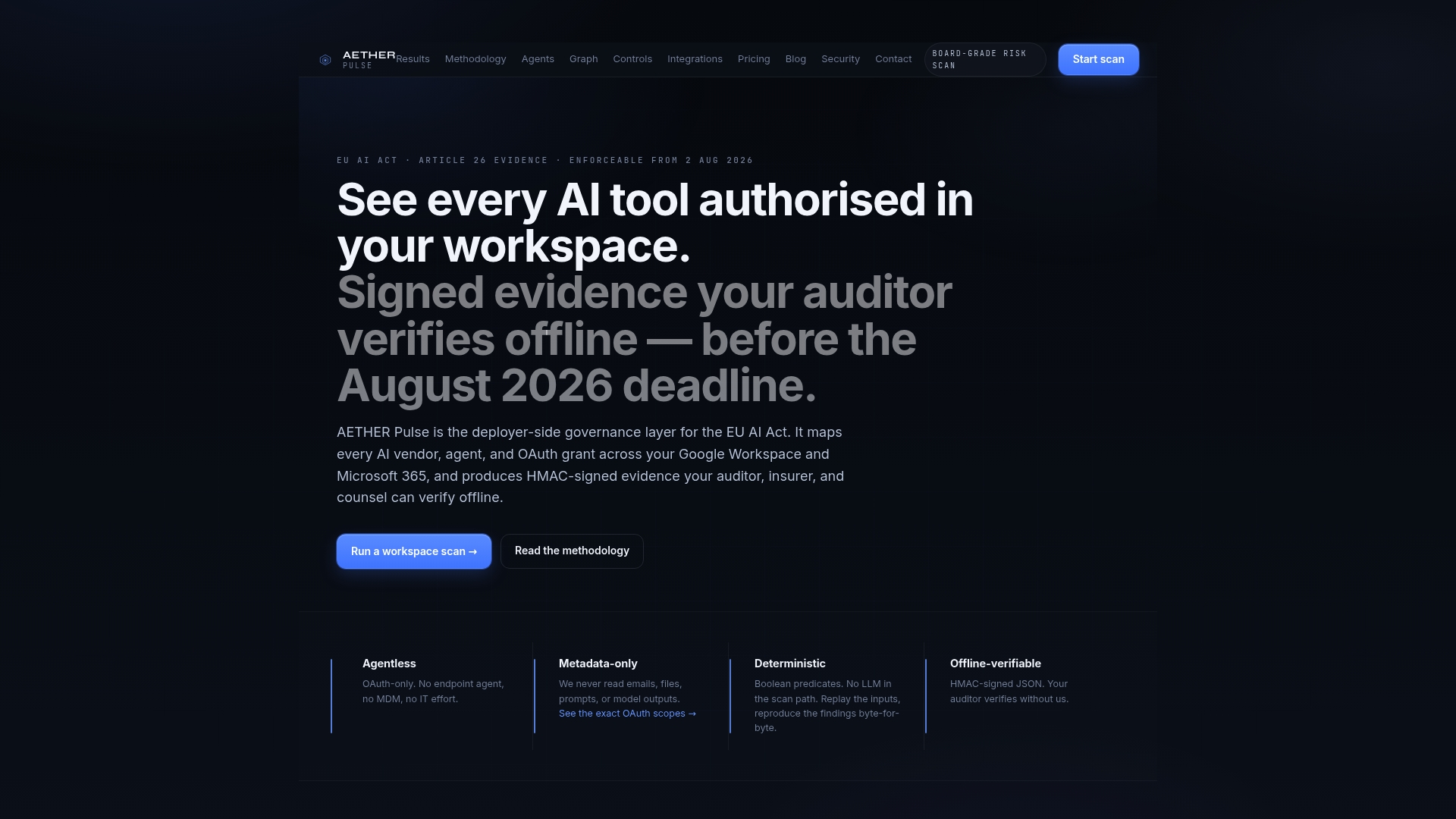
For risk and compliance leaders at regulated financial firms, that means the inventory and tiering work described here stops living in spreadsheets nobody trusts and starts producing evidence Article 26, SYSC, and Consumer Duty reviewers can actually verify. If your model count has outgrown manual audit prep, see how Aetherpulse works and request a walkthrough of what an evidence pack looks like for your own agent inventory.
Sources
- NIST AI Risk Management Framework resources
- Supervisory Guidance on Model Risk Management (Federal Reserve / interagency)
- SR 26-2 attachment: Supervisory Guidance on Model Risk Management
- OCC bulletin on AI and model risk oversight (2026)
Recommended
Working on Article 26 readiness, deployer-side governance evidence, or AI agent risk at a regulated firm? We'd value 15 minutes of your perspective.
Start a conversation