The Seven OAuth Audit Metadata Fields You Cannot Skip
The Seven OAuth Audit Metadata Fields You Cannot Skip

At minimum, every OAuth audit record needs seven fields: audit_id, event_type, timestamp, event_outcome, endpoint_uri, source, and client_id. These fields exist to let you correlate a single transaction across the authorization server, the resource server, and the client, which is the only way to reconstruct what happened during an incident or prove compliance during an audit. Add grant_type, requested_scopes, granted_scopes, token_status, redirect_uri, and state where your risk profile justifies it.
That base set comes directly from the draft-tsitkov-oauth-audit specification, which frames OAuth audit metadata as a correlation problem first and a compliance checkbox second.
- audit_id — the thread that ties AS, RS, and client logs together
- event_type — what happened (authorization, token exchange, revocation, etc.)
- timestamp — UTC, ISO 8601, no exceptions
- event_outcome — success, failure, or denied
- endpoint_uri — which endpoint handled the event
- source — which system emitted the log entry
- client_id — which registered client was involved
Key Takeaways
Effective OAuth audit logging depends on capturing seven mandatory fields consistently across every system in the flow, then protecting that data with hashing, encryption, and access controls.
| Point | Details |
|---|---|
| Seven fields are non-negotiable | audit_id, event_type, timestamp, event_outcome, endpoint_uri, source, and client_id form the correlation baseline. |
| Log revocation and introspection | These two event categories carry the highest security value and are the most commonly skipped. |
| Never log raw tokens | Use HMAC-based token references to preserve correlation without creating a brute-force risk. |
| Signed evidence beats raw logs | Cryptographically signed evidence packs give regulators tamper-evident proof, not just a database export. |
| Aetherpulse applies this via metadata-only ingestion | It ingests OAuth metadata read-only and produces HMAC-SHA256 signed evidence packs for regulated firms. |
Table of Contents
- Which OAuth Events Should You Actually Record?
- What Belongs in Your OAuth Audit Metadata Fields?
- How Does Audit Metadata Catch OAuth Integration Flaws?
- How Do You Log OAuth Data Without Leaking Secrets?
- Turning Audit Metadata Into Incident Response and Compliance Evidence
- What Does a Production-Ready OAuth Audit Approach Look Like?
- OAuth Audit Logging Checklist and Sample Schema
- Specs and Reports Worth Bookmarking
- What Engineers Get Wrong About OAuth Audit Logging
- See Your OAuth Audit Metadata as Regulator-Ready Evidence
- Sources
Which OAuth Events Should You Actually Record?
Not every OAuth interaction deserves a permanent audit trail entry, but six event categories consistently matter for reconstruction and detection.
- Client registration — capture client_id, timestamp, and registrant identity. This is your baseline for detecting rogue or duplicate client registrations later.
- Authorization requests — log the requested scopes, redirect_uri, and state parameter alongside the standard fields. This is where consent capture lives, which matters as much for compliance as for security.
- Redirection events — record the actual redirect_uri used versus the registered value. Mismatches here are an early warning sign.
- Token exchange — log grant_type, granted_scopes, and token_status. This is the highest-volume event category and the one most compliance frameworks scrutinize first.
- Revocation — a high-value security event; missing revocation logs make it impossible to prove a compromised token was actually invalidated.
- Introspection — equally high-value, since introspection calls often precede or follow suspicious token use.
Skipping revocation and introspection logging is the single most common gap security teams find during OAuth audits.
What Belongs in Your OAuth Audit Metadata Fields?
Field precision matters more than field volume. Here's how to define each one so it holds up under audit scrutiny.
audit_id should be short, opaque, and non-sensitive. Practitioner guidance from draft-tsitkov-oauth-audit-02 recommends letting the authorization server generate it whenever possible, and normalizing any client- or resource-server-supplied correlator into the same format so cross-system queries stay fast. Index it. You will query on it constantly during incident response.
timestamp must be UTC in ISO 8601 format (2026-03-12T14:22:03Z), never local time. Local timestamps are the number one reason forensic timelines fall apart across distributed systems.
event_type, event_outcome, endpoint_uri, source, and client_id round out the mandatory set, each answering a distinct question: what happened, did it succeed, where did it happen, who logged it, and which client triggered it.
Optional fields earn their place under specific conditions:
- requested_scopes and granted_scopes — include whenever scope mismatches are a realistic risk, particularly for third-party clients
- token_status — track active, revoked, or expired states for any token involved in a security-relevant event
- redirect_uri and state — mandatory for authorization and redirection events specifically, optional elsewhere
Pro Tip: Store requested and granted scopes as separate fields, not one merged value. The delta between them is often the fastest signal of scope escalation attempts.
How Does Audit Metadata Catch OAuth Integration Flaws?
The client-to-identity-provider integration layer is where most exploitable OAuth misconfigurations live, not the authorization server itself. The PortSwigger OAuth security research identifies missing PKCE, improper redirect_uri validation, state omissions, and insecure token storage as recurring root causes across real-world OAuth deployments.
Your audit metadata is what catches these before they become breaches:
- redirect_uri validation failures show up as a mismatch between the registered redirect_uri and the one logged during redirection. Flag any deviation, not just outright rejections.
- Missing PKCE leaves authorization code interception possible. If your logs show authorization code exchanges without a corresponding code_challenge, that's a gap worth closing immediately.
- State parameter omissions open the door to cross-site request forgery against the OAuth flow. Log whether state was present and whether it matched on return.
- Audience injection and mix-up attacks exploit clients that fail to validate the issuer. Reliable endpoint_uri logging, cross-referenced against RFC 8414 authorization server metadata, lets you confirm which issuer actually handled each request rather than trusting an assumption baked into client code.
Heuristics worth building into your alerting: unexpected token_endpoint values, scope escalation between requested and granted scopes, and repeated authorization attempts from the same client_id with varying redirect_uri values.
How Do You Log OAuth Data Without Leaking Secrets?
Audit logs are only useful if they don't become a liability themselves. Never log access tokens, refresh tokens, or client secrets in cleartext, full stop.
The practical alternative is HMAC-based token referencing. A security audit of OAuth server implementations recommends computing token_id = HMAC(secret, token_value) rather than hashing the raw token, because HMAC resists offline brute-forcing while still letting you correlate the same token across multiple log entries.
Beyond token references:
- Encrypt audit logs at rest, separate from your primary data stores
- Restrict read access to the audit store with its own access control list, not inherited application permissions
- Use deterministic references for any identifier that needs cross-system matching, never the raw value
- Set retention periods that satisfy your compliance obligations without holding data longer than necessary, since minimization and retention are frequently in tension and need an explicit policy, not a default
Turning Audit Metadata Into Incident Response and Compliance Evidence
audit_id is the field that makes forensic reconstruction possible at all. A single OAuth transaction touches the authorization server, one or more resource servers, and the client application, each emitting its own log entry. Without a shared audit_id, correlating those entries into one timeline is close to impossible.
A typical forensic reconstruction follows this pattern:
- Pull every log entry matching the disputed audit_id across all three systems
- Order entries by timestamp, confirming all values are UTC before comparison
- Check event_outcome at each step to identify exactly where the flow diverged from expected behavior
- Cross-reference client_id and endpoint_uri to confirm which registered client and which endpoint were actually involved
For regulatory submissions, raw logs alone often aren't persuasive enough.
Provenance and tamper-evidence are becoming baseline expectations in regulated environments. A log entry that anyone with database access could have altered after the fact carries little weight with an auditor or regulator, no matter how complete its fields are.
Cryptographically signed evidence packs solve this by proving the record hasn't changed since it was generated, a distinction explored further here.
What Does a Production-Ready OAuth Audit Approach Look Like?
Specs describe the fields. Production systems have to actually populate them without creating new risk in the process. That's where the ingestion method matters as much as the schema.
A metadata-only approach connects through OAuth to read audit and configuration data without ever touching the underlying customer data those tokens protect. AETHER Pulse builds its agent inventory this way: it ingests via OAuth metadata alone, then generates evidence packs signed with HMAC-SHA256 so the resulting audit trail is tamper-evident by construction, not just by policy.
This matters most in regulated financial services, where firms need to show regulators an inventory of automated decision-making systems without granting a governance tool access to the sensitive data those systems process.
- Read-only ingestion avoids the write-access risk that invasive agent-based monitoring introduces
- Cryptographic signing gives auditors a way to verify the evidence pack hasn't been altered post-generation
- Metadata-only scope means the governance layer itself never becomes a new data exposure risk
OAuth Audit Logging Checklist and Sample Schema
Before shipping OAuth audit logging to production, work through this checklist:
- Generate a unique audit_id at the authorization server, normalized across all downstream logs
- Confirm every timestamp is UTC in ISO 8601 format, no local time exceptions
- Redact or HMAC every token value before it touches a log store
- Set retention periods and access control lists before the first record is written, not after
- Index audit_id and client_id for fast cross-system query performance
| Field | Example Value |
|---|---|
| audit_id | a1b2c3d4e5f6 |
| event_type | token_exchange |
| timestamp | 2026-03-12T14:22:03Z |
| event_outcome | success |
| client_id | client_7f3a9 |
| token_status | active |
Query patterns worth building alerting rules around: repeated failed event_outcome values for a single client_id, granted_scopes exceeding requested_scopes, and token_status transitions that skip expected states.
Specs and Reports Worth Bookmarking
- draft-tsitkov-oauth-audit — the core field definitions used throughout this piece
- draft-liu-oauth-authorization-evidence — authorization evidence objects for stronger provenance
- RFC 8414 — authorization server metadata for reliable endpoint identification
- PortSwigger's OAuth security research — documented integration-layer failure patterns
- Least Authority's OAuth security audit report — key handling and token storage recommendations
What Engineers Get Wrong About OAuth Audit Logging
Most teams treat OAuth audit logging as a compliance checkbox they bolt on after the integration ships. That's backward. The specs, particularly draft-tsitkov-oauth-audit, frame it as a correlation and forensics problem first, with compliance as a downstream benefit, not the starting point.
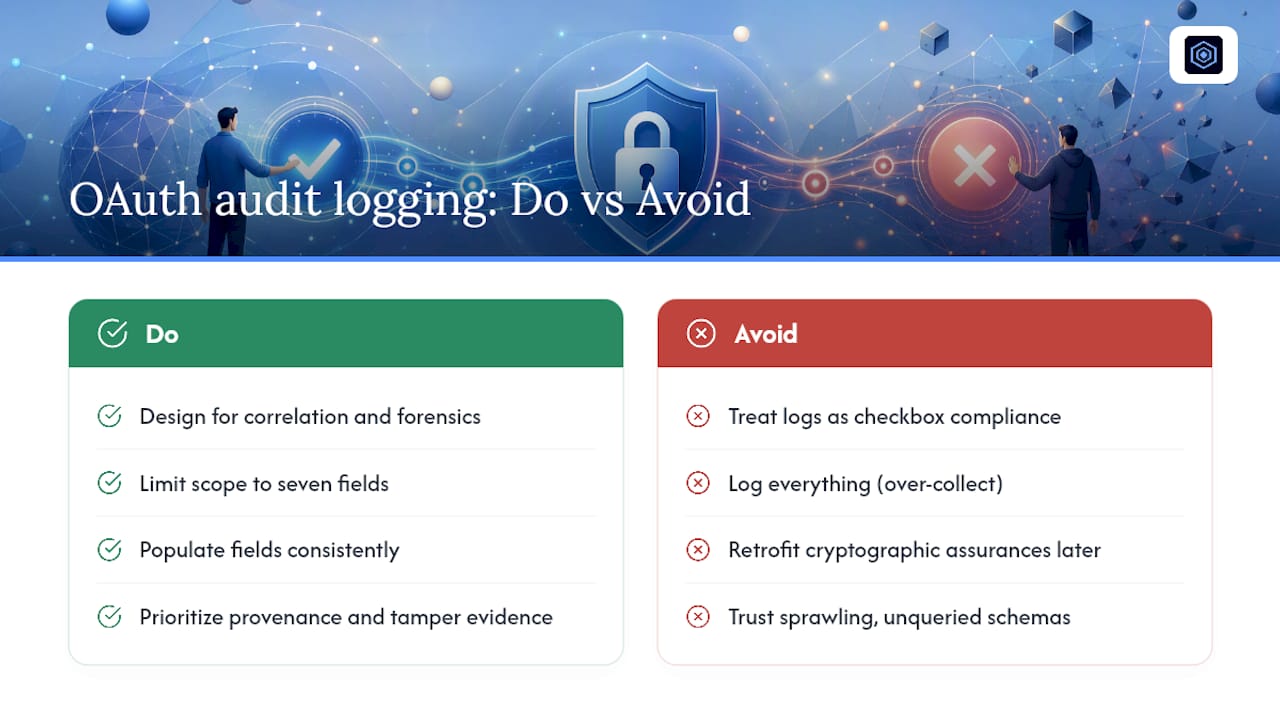
The conventional advice, log everything, is also wrong. Over-collection buries the signals you actually need under noise, which slows down incident response exactly when speed matters most. A tightly scoped set of seven mandatory fields, populated consistently, beats a sprawling log schema that nobody trusts enough to query under pressure.
Where I'd push back hardest: teams underestimate how much tamper-evidence matters until a regulator or auditor asks a pointed question about log integrity. A complete field set with no cryptographic assurance behind it is still just a database table someone could have edited. Prioritize provenance early, not as a retrofit once an examiner asks for it.
— Eleye
See Your OAuth Audit Metadata as Regulator-Ready Evidence
Building the field schema described above is the engineering half of the problem. Turning it into something a regulator or internal risk function will actually accept is the harder half, and it's the one most teams underinvest in.
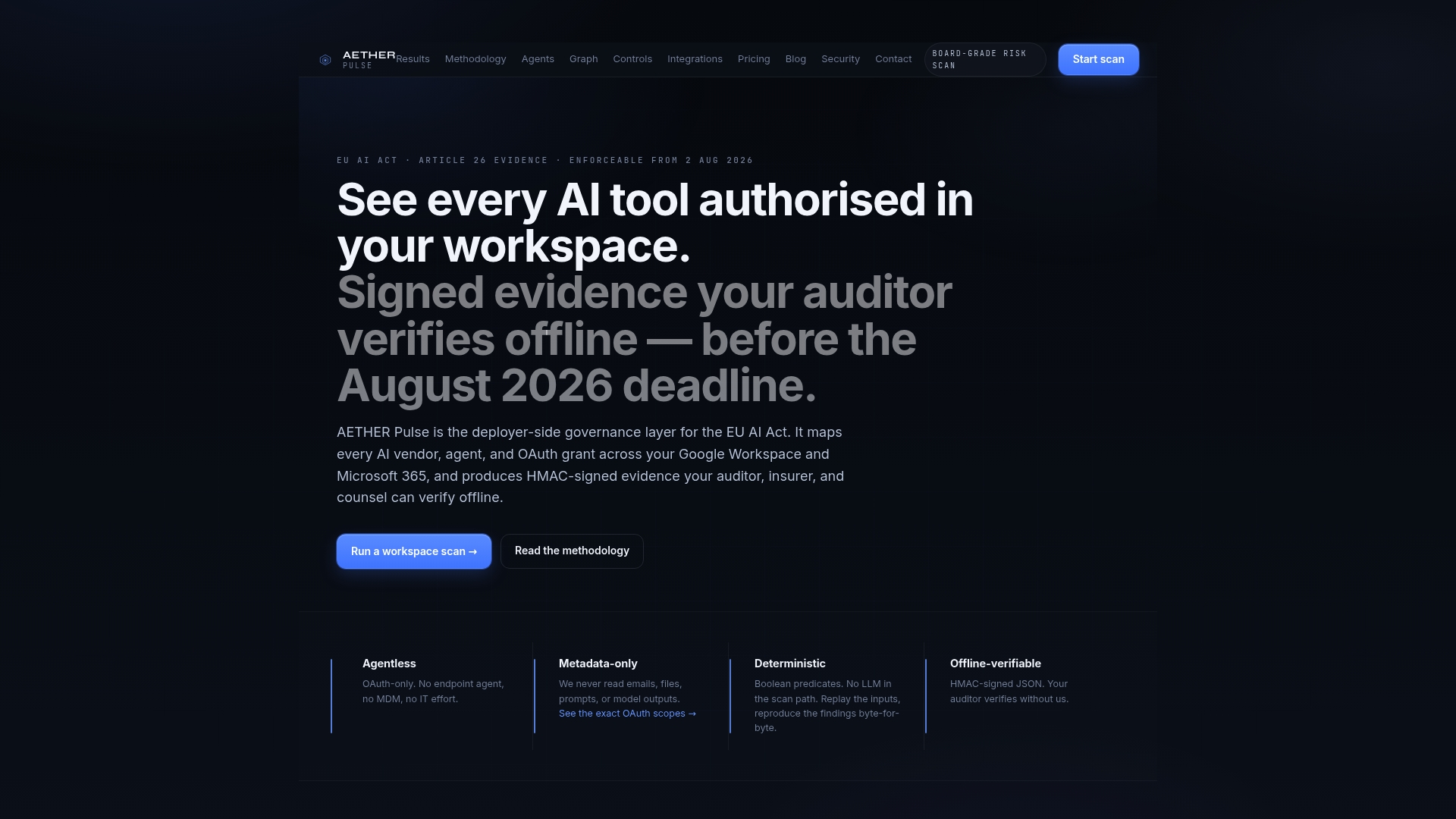
AETHER Pulse was built specifically for that gap. It ingests via OAuth metadata only, meaning it never touches the customer data your tokens protect, then produces cryptographically signed evidence packs from the same field-level discipline this article walks through: audit_id correlation, UTC timestamps, and tamper-evident provenance. For UK and EU regulated financial firms facing EU AI Act Article 26 or FCA SYSC obligations, that's the difference between a raw log export and a submission an auditor can actually verify. Automating that evidence-pack generation is also covered in more depth in this guide to AI audit automation.
If your team is preparing to demonstrate AI oversight to regulators, start by checking your current audit fields against the schema above, then see how AETHER Pulse turns that metadata into a signed evidence pack you can hand an examiner directly.
Sources
- draft-tsitkov-oauth-audit
- draft-liu-oauth-authorization-evidence
- RFC 8414 — OAuth 2.0 Authorization Server Metadata
- OAuth — PortSwigger Web Security Labs
Recommended
Working on Article 26 readiness, deployer-side governance evidence, or AI agent risk at a regulated firm? We'd value 15 minutes of your perspective.
Start a conversation