AI-Agent Security Startup Guide for Regulated U.S. Firms
AI-Agent Security Startup Guide for Regulated U.S. Firms

A read-only, non-invasive AI-agent governance startup is an appropriate, auditable choice for regulated U.S. financial firms — provided it maps controls to FINRA Rule 3110 and SEC Rule 17a-4 and produces cryptographically signed, examiner-ready evidence. The verdict is conditional, not categorical. Before any production trial, require two things:
- A tamper-evident evidence pack signed with HMAC-SHA256, verifiable by your own security team
- A metadata-only pilot that touches no customer data and requires no revalidation of core systems
If a vendor cannot deliver both within a scoped pilot, stop the evaluation. Request a demo and a sample signed evidence export from every vendor currently in procurement.
Table of Contents
- What "security startup" means in this article (and what it does not)
- Why regulated U.S. financial firms need this vendor class now
- Minimum controls and evidence you must demand for autonomous agents
- Why metadata-only integration is the preferred deployment pattern
- Procurement checklist: exact questions and acceptance criteria for RFPs
- How Aetherpulse maps to these requirements
- Typical enterprise timeline and pricing cues
- Exactly what to hand an examiner: artifacts and provenance script
- Vendor red flags and procurement traps to avoid
- Key Takeaways
- The gap most procurement teams miss
- Aetherpulse: audit-ready agent governance without system access
- Regulatory and technical references for procurement and audit conversations
What "security startup" means in this article (and what it does not)
The phrase security startup carries a specific meaning here. It refers to a SaaS provider that adds a read-only, metadata-first oversight layer for autonomous AI agents, producing tamper-evident evidence packs, an agent identity graph, and retention exports suitable for examiner review. This is AI-agent governance infrastructure, not a cyberdefense product.
Core features to expect from this vendor class:
- Agent identity graph: a structured inventory of every agent, its human sponsor, and its scoped API permissions
- Per-decision provenance: capture of intermediate reasoning chains, model state, and prompt metadata, not just final outputs
- Model-version tracking: immutable records tying each decision to the exact model version that produced it
- Evidence signing: HMAC-SHA256 or equivalent cryptographic signature on every exported evidence pack
- Retention exports: WORM-compatible archives formatted for examiner review under SEC Rule 17a-4(f)
This article excludes traditional cyberdefense startups, including SIEM platforms, EDR tools, and cloud workload protection products. Those address a different problem for a different buyer.
Why regulated U.S. financial firms need this vendor class now
The binding regulatory obligations are already in place. SR 26-2 carved agentic AI out of some model risk guidance, but that carve-out is not a safe harbor. UDAP/UDAAP, fair lending rules, and third-party risk obligations still apply in full. Firms deploying autonomous agents without mapped governance controls carry live exam exposure today.
The U.S. Treasury's AI in Financial Services report recommends that firms prioritize compliance review of AI use cases before deployment and notes that NIST AI RMF concepts function as the practical vocabulary regulators and firms use to structure supervisory conversations, even though the framework itself is voluntary. Treating NIST AI RMF as optional background reading is the wrong posture; examiners are already using its language.

| Regulatory pillar | Governing rule | Agent governance implication |
|---|---|---|
| Supervision | FINRA Rule 3110 | Reviewer logs, HITL checkpoints, designated human sponsor per agent |
| Recordkeeping | SEC Rule 17a-4 | WORM-compatible retention, signed exports, defined retention periods |
| Operational risk | OCC/Fed/FDIC guidance | Kill-switch documentation, blast-radius analysis, third-party change notices |
| Consumer protection | UDAP/UDAAP, fair lending | Decision audit chain for any agent touching customer outcomes |
The U.S. GAO has also flagged that federal financial regulators are actively developing AI oversight tools and that supervisory gaps in AI governance are a priority concern. Waiting for a formal AI-specific rule before building governance infrastructure is a procurement mistake with real exam consequences.
Minimum controls and evidence you must demand for autonomous agents
Practitioners map these controls directly to FINRA and SEC recordkeeping rules rather than treating agent governance as a separate R&D workstream. Your RFP must require all of the following:
- Human-in-the-loop (HITL) gating: configurable checkpoints that route decisions above a defined risk threshold to a named human reviewer before execution
- Kill-switch / sovereign veto: a documented, tested mechanism to halt agent execution immediately, with a log of every invocation
- Tamper-detecting audit chain: a hash-chained ledger of decisions, combined with an external witness (such as Rekor or OpenTimestamps) for stronger chain-of-custody assertions
- Model-version tying: every decision record must reference the exact model version, prompt template version, and configuration state at the time of execution
- Scoped agent identities: each agent carries a distinct service identity with least-privilege API permissions and a named human sponsor, separate from human IGA
- Deterministic decision engines: for any regulated outcome, the decision path must be replayable and reconstructable, not probabilistic or opaque
Evidence auditors will ask to see: per-decision provenance records (agent ID, model version, inputs, intermediate reasoning chain, reviewer decision, timestamps), HITL checkpoint exports, WORM or 17a-4(f)-compliant retention records, and cryptographically signed evidence packs. Capturing intermediate reasoning chains and prompt metadata is not optional — regulators view final-output-only monitoring as insufficient for examination purposes.
Pro Tip: Insist on metadata-only, read-only connectors. A vendor that requires write access to core banking systems will trigger revalidation requirements and potential downtime. Metadata-first integration, via OAuth connectors or webhook headers, avoids both.
Why metadata-only integration is the preferred deployment pattern
Non-invasive metadata connectors enable continuous monitoring without modifying production banking systems, which is the critical distinction for legacy environments. The governance layer ingests agent request/response headers, OAuth grant metadata, and webhook payloads. It never writes to, transforms, or sits inline with core systems.
This matters for three operational reasons. First, it eliminates the revalidation burden that would otherwise apply when a new component is inserted into a validated production environment. Second, it reduces blast-radius: if the governance layer experiences an incident, core systems are unaffected. Third, it preserves auditability without downtime, because the evidence collection path is entirely separate from the execution path.
Deterministic decision engines should sit at the boundary between the generative interface and the regulated action. Monitoring and automatic throttles wire to the metadata stream, not to the agent's internal state. This architecture is also what makes AI agent monitoring for enterprise teams feasible in high-stakes legacy environments without disrupting existing infrastructure.
Pro Tip: Run the governance layer in shadow mode for the first two weeks of a pilot. Compare its evidence output against your existing manual review logs before enabling HITL routing. This validates reconstruction accuracy before any live gating occurs.
Procurement checklist: exact questions and acceptance criteria for RFPs
Structure your RFP around these numbered requirements:
- Evidence signing: Confirm the signing method (HMAC-SHA256 or equivalent) and provide a sample signed export verifiable with an open-source tool.
- WORM-compatible exports: Specify the export format, retention period options, and whether the vendor supports 17a-4(f)-compliant archival directly or via a named third-party storage partner.
- Identity graphing: Require a demonstration of agent inventory, human sponsor assignment, and scoped permission mapping for at least ten synthetic agent identities.
- Minimum metadata fields per decision: Require agent ID, model version, prompt hash, input summary, intermediate chain, output, reviewer ID (if HITL triggered), timestamp, and signature.
- Third-party dependencies: Require a full list of sub-processors, model providers, and infrastructure dependencies, plus a contractual commitment to 30-day change notices for any model or provider update.
- Pilot plan: Shadow mode for weeks 1–2, live HITL routing for weeks 3–6, with a minimum sample of 500 decisions across at least one Zone 3 workflow and one Zone 1 workflow.
- Acceptance criteria: Replayable decision reconstruction for 100% of sampled decisions; successful HITL routing in all configured test cases; signed evidence export verifiable by your internal security team within 24 hours of request.
How Aetherpulse maps to these requirements
Aetherpulse's AETHER Pulse platform addresses the procurement checklist above through its core architecture. The platform connects via OAuth metadata connectors, builds an agent identity graph with human sponsor assignments, and generates tamper-evident evidence packs signed with HMAC-SHA256. No customer data is accessed; the integration is read-only by design.
What you can request from Aetherpulse in a procurement conversation:
- A sample signed evidence export from a controlled pilot environment, verifiable with a standard HMAC tool
- Connector attestations confirming read-only, metadata-only access for each integration point
- A demo of per-decision reconstruction, showing the full chain from metadata ingestion through agent identity resolution, model version, decision rationale, and reviewer action
- A pilot scope proposal using your real metadata feed, scoped to one high-value workflow
The recommended next step is a pilot that uses your actual metadata and produces a signed evidence pack you can present to internal audit within 30 days. That output is the acceptance test.
For additional context on what good AI governance looks like in a regulated firm, Aetherpulse's published guidance covers artifact design and operating model structure in detail.
Typical enterprise timeline and pricing cues
| Phase | Duration | Primary cost drivers |
|---|---|---|
| Metadata-only pilot | 4 weeks | Connector setup, agent identity count, shadow-mode evidence volume |
| Production rollout | 3–6 months | Zone classification scope, HITL routing configuration, SLA commitments |
| Audit-ready state | End of production phase | WORM storage, signed export frequency, examiner-facing reporting |
Primary cost drivers in enterprise pricing are the number of distinct agent identities under governance, WORM-compatible archival storage volume, the number of integration connectors, and SLA terms for signed evidence export turnaround. During pilot negotiations, push for a time-boxed retention commitment (90 days) and a limited production scope capped at one or two workflows. This keeps the pilot commercially contained while generating the evidence artifacts your audit team needs to assess the vendor.
Exactly what to hand an examiner: artifacts and provenance script
Prepare the following artifacts before any examination:
- Signed per-decision records: agent ID, model version, input summary, intermediate reasoning chain, reviewer decision (identity, timestamp, rationale), and HMAC-SHA256 signature
- HITL checkpoint exports: timestamped logs of every human review event, including the reviewer's identity and the decision outcome
- Configuration exports: supervisory workflow settings, HITL threshold configurations, and kill-switch test logs
- Vendor change-notice logs: documented notifications of any model, provider, or infrastructure change, with dates and your firm's acknowledgment
When presenting to an examiner, walk the chain explicitly: metadata ingestion → agent identity resolution → model version → decision rationale → reviewer action → cryptographic signature → WORM retention. Then demonstrate signature verification live. Examiners respond to concrete reconstruction, not policy documents.
A short script for compliance officers: "Evidence was collected via read-only metadata connectors that access no customer data. Each decision record captures the full reasoning chain and is signed with HMAC-SHA256 at the point of export. Records are retained in WORM-compatible storage consistent with SEC Rule 17a-4(f) and are available for reconstruction on demand. Reviewer decisions are logged with identity, timestamp, and rationale, consistent with FINRA Rule 3110 supervisory requirements."
Vendor red flags and procurement traps to avoid
Disqualify a vendor immediately if any of the following apply:
- Requires write access to core banking systems as a condition of deployment
- Cannot produce a signed, verifiable evidence export on demand during the pilot
- Uses opaque telemetry that prevents decision replay or reconstruction
- Refuses a contractual change-notice commitment for model or provider updates
- Cannot map its controls to FINRA Rule 3110 and SEC Rule 17a-4 in writing
Procurement traps are subtler. Accepting vendor attestations without testing the export yourself is the most common. Ignoring third-party supply-chain drift (a model provider update that changes decision behavior without notice) is the second. Signing long retention SLAs before testing kill-switch functionality is the third.
Pro Tip: If you cannot reconstruct a specific decision from the pilot evidence pack, stop the pilot. A vendor that cannot produce a signed, verifiable artifact on demand during evaluation will not produce one under exam pressure either.
Key Takeaways
Regulated U.S. financial firms must demand metadata-only integration, HMAC-SHA256-signed evidence packs, and explicit mapping to FINRA Rule 3110 and SEC Rule 17a-4 from any AI-agent governance vendor before production deployment.
| Point | Details |
|---|---|
| Regulatory mapping is mandatory | Map agent controls to FINRA Rule 3110 (supervision) and SEC Rule 17a-4 (recordkeeping) before any production deployment. |
| Metadata-only integration reduces risk | Read-only OAuth connectors avoid system revalidation, reduce blast-radius, and preserve auditability without downtime. |
| Signed evidence packs are the audit deliverable | Require HMAC-SHA256-signed exports with full reasoning chain, reviewer logs, and WORM-compatible retention. |
| Pilot before production | Run a 4 week shadow-mode pilot scoped to one Zone 3 workflow; use the signed output as your acceptance test. |
| Aetherpulse delivers this architecture | AETHER Pulse provides metadata-only connectors, agent identity graphing, and signed evidence packs; request a demo and sample export. |
The gap most procurement teams miss
The most consequential mistake in AI-agent governance procurement is treating the evidence pack as a deliverable for a future audit rather than as the primary acceptance criterion for the pilot itself. Firms that defer evidence validation until an examiner asks for it discover the gap at the worst possible moment.
The second mistake is scoping the pilot too broadly. A pilot that covers ten workflows simultaneously produces evidence that is difficult to validate and impossible to present cleanly. Starting with a single, high-value Zone 3 workflow, one where a wrong decision carries material financial or consumer harm, forces the vendor to demonstrate reconstruction under realistic conditions. If the signed evidence pack from that one workflow is clean, replayable, and verifiable within 30 days, you have a defensible basis for production expansion. If it is not, you have learned what you needed to know before signing an enterprise contract.
The governance gap between existing MRM tooling and agentic systems is real and documented. Procurement teams that treat agent governance as an extension of model risk management will find that the evidence formats, identity requirements, and HITL documentation standards do not transfer cleanly. The vendor class described in this article exists precisely because that gap is not covered by existing tooling.
Aetherpulse: audit-ready agent governance without system access
Aetherpulse built AETHER Pulse for exactly this procurement scenario: a regulated firm that needs examiner-ready evidence for autonomous agents without inserting a new component into validated production systems. The platform connects via read-only OAuth metadata connectors, builds a live agent identity graph with human sponsor assignments, and generates HMAC-SHA256-signed evidence packs on demand.
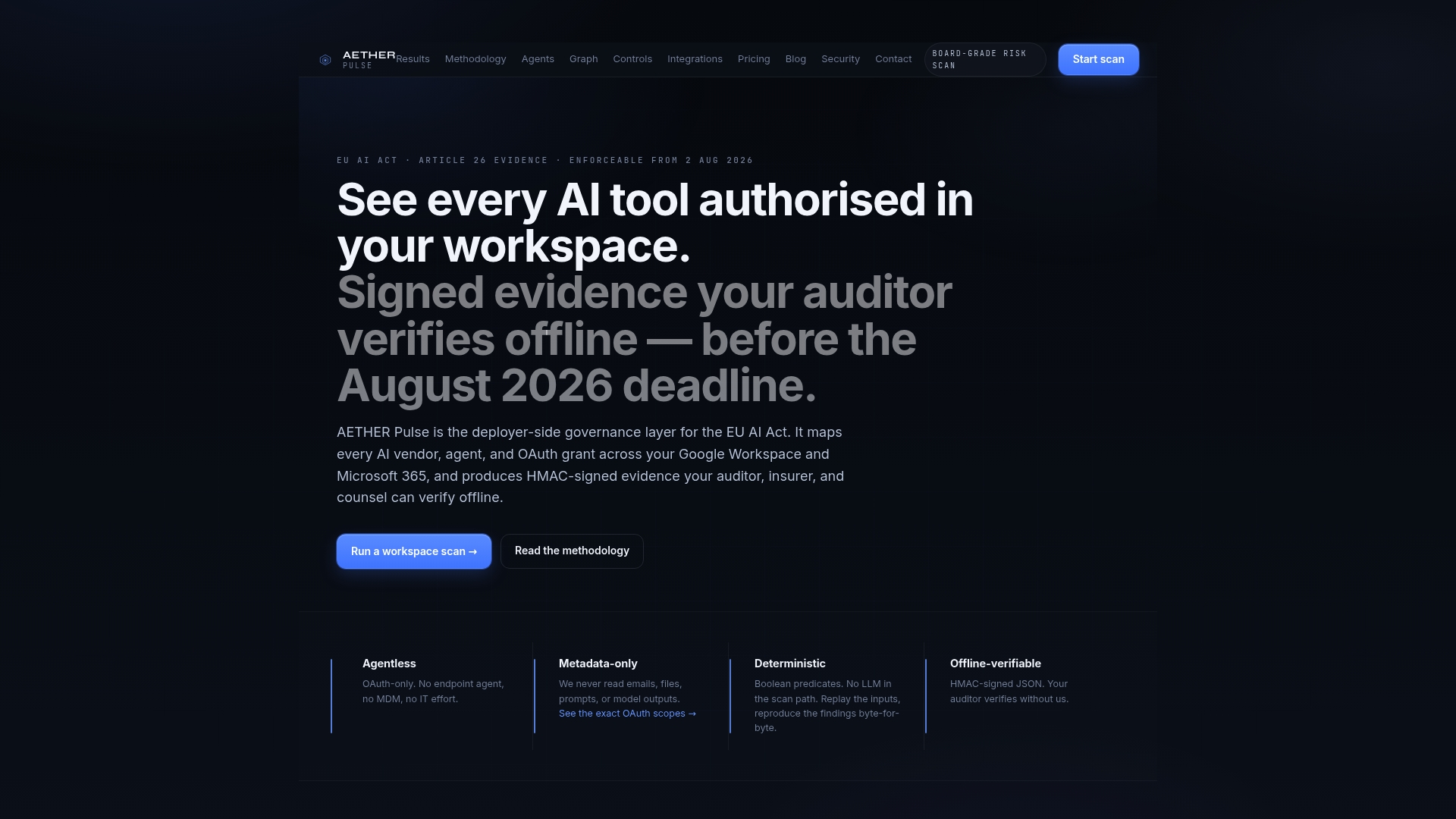
For procurement teams currently evaluating vendors, the concrete ask is straightforward: request a signed evidence export from a controlled pilot and a live walkthrough of per-decision reconstruction using your metadata feed. That demonstration either meets your acceptance criteria or it does not. Review AETHER Pulse pricing and enterprise pilot options to scope a time-boxed engagement, or visit aetherpulse.app to request a demo directly.
Regulatory and technical references for procurement and audit conversations
- FINRA Rule 3110 — Supervision: maps HITL configuration, principal designation, and reviewer log requirements to supervisory obligations. Cite this rule in RFP language when specifying evidence formats.
- U.S. Treasury — AI in Financial Services: recommends compliance review before deployment and positions NIST AI RMF as the supervisory conversation framework. Attach when requesting vendor supervisory rationale.
- U.S. GAO — AI Use and Oversight in Financial Services: documents active regulatory development of AI oversight tools and supervisory gaps. Use to justify urgency in internal governance investment proposals.
- FSI Agent Governance Framework — regulatory mapping: maps 79 controls to FINRA, SEC, SOX, GLBA, OCC, and Federal Reserve requirements. Use to prioritize control implementation by regulatory profile.
- Aetherpulse — AI governance without data access: practical guide to running compliance oversight with read-only metadata connectors. Share with IT and legal during vendor due diligence.
Recommended
Working on Article 26 readiness, deployer-side governance evidence, or AI agent risk at a regulated firm? We'd value 15 minutes of your perspective.
Start a conversation