AI Agent Types: Classical and Modern Categories Explained
AI Agent Types: Classical and Modern Categories Explained

An AI agent is a software system that perceives its environment, reasons over that input, and takes actions to achieve a defined goal, with varying degrees of autonomy. Before diving into the technical depth, here is the compact taxonomy you should hold in mind:
Primary agent types covered in this article:
- Simple reflex agents — condition-action rules, no memory
- Model-based reflex agents — internal world state, reactive planning
- Goal-based agents — explicit goal representation and search
- Utility-based agents — optimization over a utility function
- Learning agents — performance improvement from experience
- Tool-using / LLM agents — a large language model core with external tool calls
- Retrieval-augmented (RAG) agents — grounded in external knowledge stores
- Multi-agent systems (MAS) and hierarchical agents — coordinated networks of specialized agents
If your goal is conceptual study or exam preparation, the classical five types in Section 3 are your priority. If you are designing or governing a production system, jump to Sections 4 through 7, then return to Section 8 for the hybrid architecture checklist.
Key Takeaways
The most important principle across all agent types is this: match the agent's autonomy level and architectural complexity to the actual observability, stakes, and auditability requirements of the environment, not to what is technically possible.
| Point | Details |
|---|---|
| Classical five types remain foundational | Simple reflex, model-based, goal-based, utility-based, and learning agents map directly to modern systems and enterprise automation patterns. |
| Modern agents extend, not replace, the taxonomy | Tool-using LLM agents and multi-agent systems are goal-based or utility-based in structure, with learned planning and external tool access added on top. |
| Hybrid architectures dominate production | Classical supervisors governing LLM specialist agents deliver the best balance of capability, auditability, and regulatory defensibility. |
| Autonomy increases governance cost | Every step up the autonomy scale multiplies the audit surface area and the risk of undetected failure; governance must scale with autonomy. |
| Regulated deployments need evidence capture | Teams building agents under FCA, EU AI Act, or ICO frameworks should instrument decision boundaries and capture signed audit evidence from day one. |
Table of Contents
- What is an AI agent, and how does it differ from a bot or assistant?
- The five classical types of AI agents you need to know
- Modern agent categories and architectural variants worth understanding
- How do the main agent types compare across key dimensions?
- How to choose the right agent type for your requirements
- Operational limits, failure modes, and governance risks
- What does current research say about hybrid agent architectures?
- The taxonomy debate misses the point that actually matters
- Sources
What is an AI agent, and how does it differ from a bot or assistant?
An AI agent is a system that senses its environment through perception inputs, maintains some representation of state, selects actions through reasoning or planning, and executes those actions via actuators or tool calls to move toward a goal. Google Cloud and Microsoft Copilot both anchor their definitions on this same architecture: perception, reasoning, action, and goal-directedness as the four non-negotiable properties.
The five core components map directly onto agent behavior:
- Sensors / perception — the inputs an agent reads (API data, text, images, sensor streams)
- World model / state — an internal representation of the environment, present in some types and absent in others
- Planner / reasoner — the decision logic, ranging from a lookup table to a full LLM inference call
- Memory / statefulness — short-term context within a session or persistent memory across sessions
- Actuators / tools — the outputs: API calls, database writes, UI interactions, code execution
Autonomy levels vary significantly across agent designs. Fully autonomous agents select and execute actions without human approval. Semi-autonomous agents operate independently within defined boundaries but escalate edge cases. Human-in-the-loop agents pause at decision points and require explicit approval before proceeding. Regulated environments almost always require at least semi-autonomous or human-in-the-loop designs.
| Dimension | AI Agent | AI Assistant | Bot |
|---|---|---|---|
| Primary purpose | Pursue multi-step goals autonomously | Respond to user prompts on demand | Execute a fixed, scripted task |
| Autonomy | Medium to high | Low (user-driven) | Very low (rule-driven) |
| Typical capabilities | Planning, tool use, memory, learning | NLU, generation, retrieval | Pattern matching, form filling |
| Interaction style | Proactive, goal-directed | Reactive, conversational | Reactive, transactional |
The distinction matters in practice. A chatbot answering FAQ queries is reactive and stateless. An AI assistant like a copilot generates responses on demand but does not independently pursue goals. An AI agent, by contrast, can receive a high-level objective, decompose it into subtasks, call external tools, monitor progress, and self-correct across multiple steps without a human prompt at each stage.
The five classical types of AI agents you need to know
Google Cloud's taxonomy confirms that the classical five agent types, first formalized by Russell and Norvig in Artificial Intelligence: A Modern Approach, remain the foundational vocabulary for describing agent decision behavior and still map directly to modern systems.
Simple reflex agents
A simple reflex agent selects actions based solely on the current percept, using a fixed set of condition-action rules with no memory of past states.
The mechanism is a direct lookup: if condition then action. There is no world model, no planning, and no learning. The agent is fast and predictable, but it fails immediately in partially observable environments where the current percept alone is insufficient to determine the correct action.
# Pseudocode: simple reflex agent
def agent(percept):
    for condition, action in rules:
        if condition(percept):
            return action
- Best for: Deterministic, fully observable environments with stable input-output mappings (e.g., thermostat control, spam filters with fixed rules)
- Key advantages: Low latency, fully auditable, zero training cost
- Common failure modes: Brittleness under novel inputs; no recovery from state changes that alter the meaning of a percept
Model-based reflex agents
A model-based reflex agent maintains an internal state that tracks aspects of the world not directly visible in the current percept, making it functional in partially observable environments.
The agent updates its internal model on each step using transition knowledge ("how the world changes") and sensor knowledge ("what percepts mean"). Decision logic still follows condition-action rules, but those rules now operate over the enriched internal state rather than the raw percept alone.
- Best for: Partially observable environments where context accumulates over time (e.g., stateful conversational services, process control with sensor lag)
- Key advantages: Handles partial observability; more robust than simple reflex under noisy inputs
- Common failure modes: Model drift when the world changes faster than the agent's update logic; state explosion in high-dimensional environments
Goal-based agents
A goal-based agent holds an explicit representation of a desired end state and uses search or planning algorithms to find action sequences that achieve it.
Rather than reacting to the current state, the agent asks: "What sequence of actions leads from here to the goal?" This requires a transition model of the environment and a search procedure, such as A* or BFS. The agent can handle novel situations by replanning, which makes it far more flexible than reflex designs.
- Best for: Navigation, scheduling, and workflow automation where the goal is explicit and the environment model is reasonably accurate
- Key advantages: Flexible replanning; can handle novel paths to a goal
- Common failure modes: Computational cost of search in large state spaces; brittleness when the environment model is inaccurate
Utility-based agents
A utility-based agent replaces the binary goal (achieved / not achieved) with a utility function that scores states, allowing the agent to select actions that maximize expected utility across competing objectives.
# Pseudocode: utility-based action selection
def agent(state, possible_actions):
    return max(possible_actions,
               key=lambda a: expected_utility(result(state, a)))
This design handles trade-offs explicitly. An agent balancing speed, cost, and accuracy in a document-processing pipeline is utility-based in structure, even if the utility function is implicit. The challenge is that utility functions are difficult to specify correctly, and misspecified functions produce reward hacking.
- Best for: Multi-objective optimization, resource allocation, recommendation systems
- Key advantages: Principled trade-off handling; can express nuanced preferences
- Common failure modes: Utility misspecification; reward hacking; computationally expensive in large action spaces
Learning agents
A learning agent improves its performance over time by updating its behavior based on feedback from the environment, typically through a performance element, a critic, a learning element, and a problem generator.
The learning element modifies the performance element based on critic feedback, which evaluates outcomes against a performance standard. This is the architecture underlying reinforcement learning systems, fine-tuned language models, and adaptive recommendation engines.
Pro Tip: When deploying learning agents in regulated environments, treat the critic and performance standard as governance artifacts. Documenting what the agent optimizes for, and how that standard was set, is often the first thing an auditor will ask for.
- Best for: Environments where optimal behavior cannot be pre-specified, such as dynamic pricing, fraud detection, and personalized content ranking
- Key advantages: Adapts to changing environments; can discover non-obvious strategies
- Common failure modes: Distributional shift; reward hacking; opaque learned policies that resist audit
Modern agent categories and architectural variants worth understanding
The classical five types describe decision behavior in the abstract. Modern engineering adds a second layer of categorization based on how agents are built and how they coordinate.
Tool-using and LLM-based agents
A tool-using agent wraps a large language model with a set of callable tools (search APIs, code interpreters, calculators, database connectors) and operates in a Reason-Act (ReAct) loop: reason over the current context, select a tool call, observe the result, then iterate. AgentsIndex identifies this as the dominant pattern for LLM agent tool use in production systems. The LLM functions as the planning and reasoning core, while the tools extend its reach into the real world.
In classical terms, a tool-using LLM agent most closely resembles a goal-based or utility-based agent: it holds an objective, plans a sequence of tool calls, and updates its plan based on observations. The difference is that the planning logic is learned rather than hand-coded.
Retrieval-augmented (RAG) agents
A RAG agent grounds its reasoning in an external knowledge store, retrieving relevant documents or records before generating a response or taking an action. This pattern reduces hallucination and keeps the agent's knowledge current without retraining. RAG agents map most closely to model-based reflex agents: the retrieved context functions as a dynamically updated world model.
Hierarchical agents and multi-agent systems
Coursera's taxonomy describes hierarchical agents as systems that decompose large workflows into subtasks and delegate those subtasks to specialized subordinate agents. An orchestrator agent holds the high-level plan and assigns work; specialist agents execute narrow, well-defined tasks and return results upward.
Architecture description for visual assets: Picture a three-tier structure. At the top sits an orchestrator that receives the user goal and maintains the task plan. In the middle tier, specialist agents handle discrete domains (document retrieval, code execution, data validation). At the base, tool connectors and memory stores provide grounding and persistence. Arrows flow downward as task assignments and upward as results and observations.
Multi-agent systems (MAS) extend this further: multiple agents with potentially different architectures operate in a shared environment, communicate via message passing, and may negotiate or compete to achieve collective or individual goals. MAS designs are well-suited to large-scale simulations, supply chain optimization, and financial market modeling.
Key insight: LLMs are best understood as the learning and performance element within a larger agent architecture, not as agents in their own right. The governance patterns that matter most sit at the boundaries: supervisor agents that validate LLM outputs, guardrail layers that enforce policy constraints, and audit evidence layers that capture decision provenance. Stripping those boundary layers away in the name of simplicity is where most enterprise deployments run into regulatory trouble.
Is ChatGPT an agent? In its standard interface, ChatGPT is an AI assistant, not an agent. It responds to prompts but does not pursue goals across sessions, does not call tools autonomously, and does not maintain persistent memory by default. When extended with tool-calling capabilities and a persistent task context (as in some API configurations), it can function as the reasoning core of a tool-using agent, but the agent architecture must be built around it.
How do the main agent types compare across key dimensions?
| Agent Type | Autonomy Level | Learning Capability | Memory / Statefulness | Planning Complexity | Best For | Implementation Complexity |
|---|---|---|---|---|---|---|
| Simple reflex | Very low | None | Stateless | None | Deterministic, fully observable tasks | Low |
| Model-based reflex | Low-medium | None | Short-term internal state | Minimal | Partially observable, reactive tasks | Low-medium |
| Goal-based | Medium | None (typically) | State + goal representation | Search / planning | Navigation, scheduling, workflow | Medium |
| Utility-based | Medium-high | None (typically) | State + utility model | Optimization | Multi-objective decisions | Medium-high |
| Learning | High | Continuous | State + learned policy | Adaptive | Dynamic, data-rich environments | High |
| Tool-using / LLM | High | Pre-trained + in-context | Session or persistent | LLM-driven planning | Knowledge work, research, automation | High |
| Multi-agent / hierarchical | Very high | Mixed | Distributed + persistent | Orchestrated multi-step | Complex, multi-domain workflows | Very high |
A few clarifications on cells that deserve attention:
- Autonomy increases governance cost. Moving from simple reflex to multi-agent systems does not just add capability; it multiplies the surface area that requires monitoring, audit evidence, and human oversight.
- Learning agents are not always the most capable choice. In environments where behavior must be fully auditable, a well-specified utility-based agent with a documented utility function is often preferable to a learned policy that resists inspection.
- Tool-using LLM agents carry session-level memory by default, but persistent memory plus long-horizon planning is what distinguishes truly autonomous agents from short-session tool-use patterns.
- Multi-agent complexity is non-linear. Adding a second specialist agent does not double complexity; coordination overhead, failure propagation, and audit surface area grow faster than the agent count.
- Implementation complexity labels (low / medium / high) reflect engineering effort, not operational risk. A simple reflex agent is low effort to build but can carry high operational risk if deployed in an environment it was not designed for.
How to choose the right agent type for your requirements
Match the agent's autonomy level and architectural complexity to the actual complexity of the environment and the stakes of failure. Overengineering is as costly as underengineering: practitioners consistently report that teams choose multi-agent or autonomous designs for problems where a model-based or goal-based agent would be more reliable and auditable.
Work through this checklist before selecting an architecture:
- Is the environment fully observable and deterministic? If yes, a simple reflex or model-based agent is likely sufficient. Reserve goal-based and utility-based designs for environments with genuine uncertainty or competing objectives.
- Does the task require real-time response under strict latency constraints? Reflex agents and lightweight model-based agents outperform planning-heavy designs here.
- Is auditability or regulatory compliance a hard requirement? Prefer agents with explicit, inspectable decision logic (rule-based, goal-based with logged plans) over learned policies. Build AI regulatory disclosure obligations into the architecture from day one.
- Does the task span multiple sessions or require long-horizon planning? Tool-using agents with persistent memory or hierarchical MAS designs are appropriate; short-session LLM agents are not.
- What is the cost of a wrong action? High-stakes, irreversible actions (financial transactions, medical decisions) require human-in-the-loop checkpoints regardless of agent type.
- What is the available engineering capacity? Multi-agent and learning agent architectures require substantially more infrastructure, monitoring, and maintenance than classical designs.
Example mappings:
- Deterministic control task (e.g., rule-based alert routing): Simple reflex agent. Fast, auditable, zero training cost.
- Regulated financial automation (e.g., transaction flagging with partial observability): Model-based agent with a documented state model and human-in-the-loop escalation. See why regulators audit AI agents for the compliance framing.
- Long-horizon research assistant (e.g., multi-step due diligence): Tool-using LLM agent with persistent memory, guardrail supervisors, and an audit evidence layer.
Environment design variables shift the choice significantly. Deterministic environments (same input always produces same output) favor reflex and goal-based designs. Stochastic environments require utility-based or learning agents that handle uncertainty explicitly. Episodic tasks (each decision is independent) suit stateless agents; sequential tasks (current decisions affect future states) require statefulness. Static environments allow offline planning; dynamic environments demand real-time adaptation.
Pro Tip: Before selecting an agent architecture, write down the environment type (deterministic vs. stochastic, episodic vs. sequential, static vs. dynamic) and the auditability requirement. Those two parameters alone will eliminate most of the wrong choices.
Operational limits, failure modes, and governance risks
Every agent type carries characteristic failure modes, and the more autonomous the design, the harder those failures are to detect and contain.
Failure modes by agent class:
- Simple reflex: Brittle under novel or adversarial inputs; no recovery mechanism when the environment violates design assumptions
- Model-based: Model drift when the world changes faster than the update logic; state explosion in high-dimensional environments
- Goal-based: Computationally expensive search in large state spaces; catastrophic replanning when the environment model is wrong
- Utility-based: Utility misspecification leading to reward hacking; difficulty specifying utility functions that capture all relevant values
- Learning: Distributional shift; reward hacking; opaque learned policies; catastrophic forgetting
- Tool-using / LLM: Hallucination in reasoning steps; prompt injection via tool outputs; uncontrolled tool call chains; session context overflow
- Multi-agent / hierarchical: Coordination failures; failure propagation across agent boundaries; emergent behaviors not present in individual agents
Governance and safety risks intensify with autonomy. The "agentic gap" refers to the growing mismatch between what adaptive agents can do and what governance frameworks can observe and audit. An LLM agent that modifies its own tool-calling strategy based on in-context learning is, in practice, a moving target for any static audit procedure. Closing that gap requires architectural choices, not just monitoring.
Mitigation checklist:
- Define and document the agent's decision scope and tool permissions before deployment (least-privilege tool access)
- Instrument every tool call and reasoning step for logging; treat logs as tamper-evident audit evidence
- Place human-in-the-loop checkpoints at high-stakes, irreversible actions
- Deploy supervisor or guardrail agents that validate LLM outputs against policy constraints before execution
- Run regular adversarial testing (prompt injection, out-of-distribution inputs, edge-case environment states)
- Maintain an AI agent inventory so every deployed agent is known, classified, and assigned an owner
A concrete governance failure pattern: an LLM-based financial analysis agent, deployed without output validation, generates a plausible but hallucinated regulatory citation and passes it downstream to a compliance report. No single tool call failed; the failure was in the absence of a critic layer that checked factual grounding. A hybrid supervisor pattern, where a rule-based critic validates all regulatory references against a curated knowledge store before they leave the agent boundary, would have caught this before it reached the report. For teams building AI explainability requirements into their governance stack, this critic-layer pattern is the most direct mitigation.
Gartner predicted that a substantial share of agentic AI projects are expected to be canceled or retrenched within the next few years, citing governance failures and inadequate oversight as primary drivers.
What does current research say about hybrid agent architectures?
Current research and industry analysts converge on a single recommendation for enterprise deployments: hybrid architectures that pair classical, rule-based supervisors with LLM-based specialist agents outperform purely reactive or purely autonomous designs on the dimensions that matter most in regulated environments, namely reliability, auditability, and controllability.
AgentsIndex and Databricks both document that the most successful production deployments combine reflex behavior for speed and safety, planning for flexibility, and limited learning for adaptability, with strict monitoring and evidence capture at each layer. Gartner's 2025 analysis predicted that 40% of enterprise applications will feature task-specific AI agents by 2026, up from less than 5% in 2025, with governance and task-scoped design identified as the critical success factors.
Practical hybrid architecture sketch:
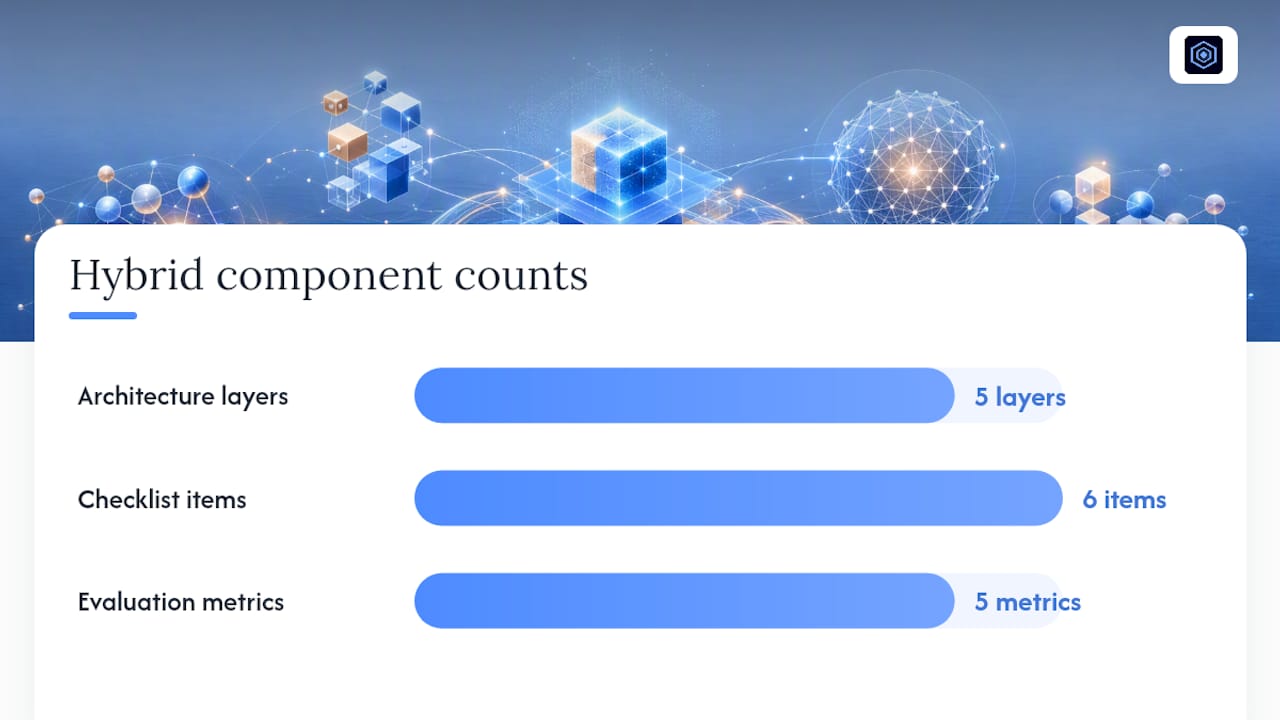
The recommended pattern for regulated enterprise deployments has five layers:
- Orchestrator / supervisor agent (classical, rule-based): receives the high-level goal, enforces policy constraints, validates outputs before they cross system boundaries
- Specialist LLM agents: handle knowledge-intensive subtasks (document analysis, reasoning, generation) within scoped tool permissions
- Retrieval tools and knowledge stores: ground LLM reasoning in verified, current data to reduce hallucination
- Persistent memory layer: maintains task context across sessions for long-horizon workflows
- Audit evidence layer: captures tamper-evident, provenance-tracked records of every decision, tool call, and state transition
Six-point checklist for architects building hybrid systems:
- Assign governance ownership to the orchestrator layer; never distribute policy enforcement across specialist agents
- Apply least-privilege tool permissions: each specialist agent accesses only the tools its task requires
- Ground all factual outputs in retrieval tools connected to authoritative data sources
- Capture cryptographically signed evidence at every decision boundary, not just at task completion
- Test the full agent graph under adversarial inputs, not just individual agents in isolation
- Define measurable evaluation metrics before deployment: task success rate, factual correctness, hallucination rate, cost-per-task, and audit readiness score
Evaluation metrics for agent systems should be defined at the architecture stage. Task success rate measures whether the agent achieves its stated goal. Factual correctness (grounding rate) measures how often outputs are traceable to verified sources. Hallucination rate tracks unsupported claims in generated outputs. Cost-per-task captures compute and API costs per completed workflow. Audit readiness, increasingly a regulatory expectation, measures whether the evidence layer can produce a complete, defensible decision trail on demand. Rigorous multi-agent evaluation frameworks, including those formalized in arXiv:2210.03629, provide structured methodologies for benchmarking these dimensions across different environment assumptions.
For teams designing agents under EU AI Act Article 26 or FCA SYSC requirements, the EU AI Act compliance guide for financial firms provides the regulatory framing for each of these architecture decisions. For enterprise teams concerned about agentic AI security at the endpoint and network level, the hybrid supervisor pattern is the most direct architectural mitigation available.
The taxonomy debate misses the point that actually matters
The conventional advice on AI agent classification tends to treat the classical five types as a ladder: start simple, add complexity as needed, and eventually arrive at a learning or autonomous agent as the "most capable" design. That framing is wrong in a way that causes real harm in production.
The classical types are not a capability ladder. They are a decision framework. A simple reflex agent is not a primitive version of a learning agent; it is the correct choice for a specific class of problems. Choosing a utility-based agent for a deterministic, fully observable task does not make the system more capable; it makes it harder to audit, slower to execute, and more expensive to maintain.
The more consequential gap in most taxonomy discussions is the absence of governance as a first-class design variable. Every agent architecture decision carries an implicit governance cost: how observable is the decision logic, how defensible is the audit trail, and how controllable is the agent's behavior under adversarial or out-of-distribution conditions? Those questions are not afterthoughts for compliance teams to handle post-deployment. They are architectural constraints that should shape the choice of agent type from the first design session.
The hybrid supervisor pattern, classical rule-based governance over LLM specialist agents, is not a compromise between capability and safety. It is the architecture that takes both seriously. The supervisor layer is where policy lives. The LLM layer is where capability lives. Conflating the two, or eliminating the supervisor in the name of simplicity, is the single most common source of agentic governance failures in regulated deployments.
For technically minded designers, the practical implication is this: before selecting an agent type, write down the auditability requirement and the regulatory constraint. If you cannot produce a defensible decision trail for the agent's actions, the architecture is not finished yet.
Sources
- Types of AI Agents | Coursera
- What are AI agents? | Google Cloud
- arXiv:2405.06643
- Types of AI Agents and Their Use Cases | Microsoft Copilot
Recommended
- The Accountability Gap: Why AI Governance Frameworks Were Not Built for Agents - AETHER Pulse
- The AI Agent Governance Gap: Why Existing Tools Are Not Enough - AETHER Pulse
- AI Agent Discovery Enterprise Workflow: A Compliance Guide - AETHER Pulse
- AETHER Pulse — Signed AI Governance Evidence Infrastructure
Working on Article 26 readiness, deployer-side governance evidence, or AI agent risk at a regulated firm? We'd value 15 minutes of your perspective.
Start a conversation