AI Scrutiny Types in 2026: A Compliance Team's Guide
AI Scrutiny Types in 2026: A Compliance Team's Guide

In 2026, compliance, legal, and risk teams face scrutiny of AI systems from at least seven U.S. federal agencies, a growing coalition of state attorneys general, and extraterritorial regimes including the EU AI Act. The five dominant types of regulatory scrutiny are: transparency and explainability, safety and robustness (including agentic AI risks), bias and discrimination, privacy, data protection, and cybersecurity, and market conduct and consumer protection. Forty-seven countries have now introduced AI-specific legislation, yet only 12 have established operational enforcement mechanisms, creating an eightfold compliance cost gap between strict and permissive jurisdictions. The divergence between the EU's rights-based framework and the U.S. sectoral model means a single global compliance program will not hold.
Your immediate 2026 priorities:
- Complete a model inventory and designate accountable owners before enforcement letters arrive.
- Conduct algorithmic impact assessments (AIAs) for high-risk and consumer-facing models.
- Establish incident reporting channels and escalation playbooks aligned to the NIST AI RMF.
- Map vendor contracts for AI-specific audit rights, indemnities, and data-lineage obligations.
- Confirm which state laws (California, Texas, Illinois, Colorado) apply to your product lines as of January 1, 2026.
The EU AI Act's General Purpose AI (GPAI) obligations have been operational since August 2, 2025, and high-risk system obligations are delayed via the Digital Omnibus process. U.S. sectoral regulators are not waiting for federal AI legislation: the FTC, SEC, FDA, EEOC, CFPB, and DOJ are all applying existing statutory authority to AI conduct now.
Table of Contents
- Which U.S. federal agencies will scrutinize AI in 2026?
- What types of regulatory scrutiny will regulators apply in 2026?
- How do state attorneys general change your AI enforcement risk?
- Which international regimes affect U.S. firms' AI risk in 2026?
- What are the 2026 enforcement timelines and likely cost outcomes?
- Your 2026 AI compliance checklist: prioritized by urgency
- What does an audit-ready, agentless evidence layer look like in practice?
- Enforcement examples that set the precedent for 2026 scrutiny
- Key Takeaways
- Why the compliance instinct to "wait for federal law" is the wrong call
- Aetherpulse: audit-ready AI governance without the production risk
- Primary sources to bookmark for 2026 AI enforcement monitoring
Which U.S. federal agencies will scrutinize AI in 2026?
The U.S. has no single AI regulator. Instead, authority is distributed across agencies that each apply existing statutory powers to AI conduct within their domain. For compliance teams, this means routing responsibility correctly across legal, product, and risk functions.

FTC: deceptive claims and AI-washing
The Federal Trade Commission is the most active AI enforcer in the consumer space. Its authority under Section 5 of the FTC Act covers unfair or deceptive acts, which it applies to AI chatbot harms and misleading capability claims. "AI-washing" — overstating what a model can do — is a live enforcement target. The FTC also scrutinizes algorithmic pricing and recommendation systems that may harm consumers. Owner: Legal/Regulatory Affairs, with Product input on capability claims.
DOJ: antitrust and criminal misuse
The Department of Justice focuses on AI's role in anticompetitive conduct (algorithmic collusion, market foreclosure) and criminal misuse such as deepfake fraud. The Antitrust Division has signaled interest in AI-enabled price coordination across platforms. Owner: Antitrust counsel and General Counsel's office.
SEC: disclosure and investment-model governance
The Securities and Exchange Commission includes AI on its annual examination agenda. Its focus is on material disclosure of AI use in investment advice, model governance for algorithmic trading, and conflicts of interest where AI recommendations favor the firm. Owner: Chief Compliance Officer and Legal.
FDA: AI-enabled medical devices
The FDA has cleared over 950 AI-enabled medical devices under existing pathways and continues to review Software as a Medical Device (SaMD) submissions. For clinical decision-support tools, the agency expects pre-market documentation of training data, performance metrics, and post-market monitoring plans. Owner: Regulatory Affairs and Quality.
EEOC: employment discrimination
The Equal Employment Opportunity Commission focuses on automated hiring, promotion, and performance-management tools that produce disparate impact on protected classes. Its technical assistance guidance on AI and employment discrimination sets expectations for bias testing and documentation. Owner: HR Legal and People Operations.
CFPB: credit and consumer-facing decisioning
The Consumer Financial Protection Bureau scrutinizes AI-driven credit underwriting, loan pricing, and adverse-action explanations. Models that cannot produce plain-language explanations for adverse decisions face heightened risk under the Equal Credit Opportunity Act and Fair Credit Reporting Act. Owner: Fair Lending Compliance and Model Risk Management.
FCC: communications and synthetic-content labeling
The Federal Communications Commission has moved on AI-generated robocalls and synthetic voice content in political advertising. For firms in media, telecom, or political communications, FCC labeling requirements for AI-generated content are a live obligation. Owner: Regulatory Affairs.
Pro Tip: Build a one-page agency routing matrix that maps each AI system in your inventory to the primary regulator and the internal owner. When an enforcement letter arrives, you need a pre-assigned response lead, not a committee.
What types of regulatory scrutiny will regulators apply in 2026?
The types of AI scrutiny regulators apply in 2026 cluster into five operational themes. Each theme has distinct documentation requirements, measurable tests, and triggering conditions.
Transparency and explainability
Regulators expect firms to disclose that AI is being used, explain how consequential decisions are made, and label synthetic content. California's AI Transparency Act (SB 942) and the GenAI Training Data Transparency Act (AB 2013) require watermarking and training-data disclosure for AI-generated content distributed in the state. Model cards and technical specifications are the primary documentation deliverable.
Safety and robustness
This theme covers adversarial testing, stress testing, concept drift monitoring, and, increasingly, containment of autonomous AI agents. NIST's 2026 initiative on autonomous agents addresses identity verification, action logging, and containment protocols. Red-team results and robustness test reports are the expected evidence artifacts.
Bias and fairness
Statistical parity, disparate impact ratios, and equalized odds are the metrics regulators reference. The EEOC and CFPB both expect pre-deployment bias testing and ongoing monitoring. A disparate impact ratio below 0.8 (the four-fifths rule) in hiring or credit decisions is a standard trigger for investigation.
Privacy, data protection, and cybersecurity
Training-data provenance, PII handling in inference pipelines, and synthetic-data labeling are the core controls. State privacy laws (California Consumer Privacy Act, Colorado Privacy Act) add data subject rights that interact with AI model outputs. Cybersecurity expectations include adversarial input testing and access controls on model endpoints.
Market conduct and consumer protection
Misleading AI capability claims, algorithmic pricing that harms consumers, and AI-enabled competitive foreclosure all fall here. The FTC and state AGs are the primary enforcers. Chatbot harms to minors have already triggered multistate AG investigations.
| Scrutiny Theme | Primary Regulators | Example Tests / Documentation |
|---|---|---|
| Transparency / Explainability | FTC, state AGs, CA/TX | Model cards, synthetic-content labels, training-data disclosures |
| Safety / Robustness | FDA, NIST (standards), sector supervisors | Adversarial tests, red-team reports, agent containment logs |
| Bias / Fairness | EEOC, CFPB, DOJ | Disparate impact ratios, fairness audits, pre-deployment test results |
| Privacy / Cybersecurity | FTC, state AGs, sector regulators | PII handling logs, data-lineage records, access-control audits |
| Market Conduct / Consumer Protection | FTC, DOJ Antitrust, state AGs | Pricing algorithm documentation, complaint logs, capability-claim reviews |
How do state attorneys general change your AI enforcement risk?
State-level enforcement is not a secondary concern. Several U.S. states enacted AI laws effective January 1, 2026, and attorneys general are using investigatory tools aggressively, often ahead of federal action.
Key state laws in force:
- California: AI Transparency Act (SB 942) requires labeling of AI-generated content; AB 2013 requires training-data disclosure for generative AI products.
- Texas: Responsible AI Governance Act imposes cross-sector deployer obligations including transparency and impact assessment requirements.
- Illinois: The Artificial Intelligence Video Interview Act has been in force since 2020 and continues to generate enforcement activity around automated hiring tools.
- Colorado: The Colorado AI Act (SB 205) requires developers and deployers of high-risk AI systems to use reasonable care to protect consumers from algorithmic discrimination, with a phased implementation timeline.
State AGs operate differently from federal agencies. They issue investigatory letters and civil investigative demands with short response windows, form multistate coalitions that amplify pressure, and pursue civil enforcement with penalties that can reach $200,000 per violation under some state statutes. For a mid-size firm, a multistate AG action involving dozens of violations can produce aggregate exposure that exceeds most federal administrative fines.
The practical step is a state-mapping exercise: for each product line, identify which states' residents it reaches, which state laws apply, and which AG office has jurisdiction. A national deployer of a consumer-facing AI product likely has exposure in California, Texas, Illinois, and Colorado at minimum. Multistate letters, like the bipartisan AI task force launched by state AGs, signal coordinated enforcement is accelerating.
Which international regimes affect U.S. firms' AI risk in 2026?
Cross-border AI obligations are no longer theoretical for U.S. firms with EU customers or EU-based data subjects. The EU AI Act (Regulation 2024/1689) follows a risk-based classification model: prohibited practices, high-risk systems, and limited/minimal risk systems each carry different obligations.
EU AI Act milestones:
- GPAI model obligations have been in force since August 2, 2025. U.S. firms providing foundation models or GPAI-based products into the EU must comply now.
- High-risk system obligations (Article 9–15 requirements: risk management, data governance, technical documentation, human oversight) were originally scheduled for August 2026 but are under delay via the EU Digital Omnibus legislative process. Monitor the European Commission's Digital Omnibus progress for the revised effective date.
- Conformity assessments for high-risk systems can cost between €5,000 and €50,000 per system, with mandatory third-party review for certain categories.
Pro Tip: If your firm has already mapped systems under the NIST AI RMF, use that inventory as the starting point for EU AI Act Article 26 deployer obligations. The NIST "Govern," "Map," and "Measure" functions map reasonably well to the EU Act's risk management and documentation requirements.
Other regimes with extraterritorial reach:
- South Korea: The AI Basic Act entered into force in January 2026, establishing a risk-tiered framework with binding obligations for high-impact AI systems.
- China: Content generation and algorithmic recommendation regulations impose labeling and registration requirements for AI-generated content, relevant for any firm operating or distributing content in China.
- Singapore: The Monetary Authority of Singapore and IMDA have issued agentic AI governance guidance, including the concept of "agent identity cards" for autonomous AI agents operating in financial services.
Cross-border obligations checklist:
- Confirm whether any product qualifies as a GPAI model or high-risk system under the EU AI Act.
- Verify data localization requirements for training data and inference logs in each jurisdiction.
- Assess synthetic-content labeling obligations under California, EU, and South Korean rules.
- Determine whether conformity assessment triggers apply and budget accordingly.
- Map voluntary standards (NIST AI RMF, ISO/IEC 42001) against binding requirements to identify gaps.
What are the 2026 enforcement timelines and likely cost outcomes?
The enforcement calendar for 2026 is front-loaded. Several obligations are already in force, and the window for proactive compliance is narrowing.
Key 2026 milestones:
- August 2, 2025 (already passed): EU AI Act GPAI obligations operational.
- January 1, 2026 (already in effect): California AI Transparency Act, Texas Responsible AI Governance Act, and South Korea AI Basic Act.
- 2026 (ongoing): NIST initiative on autonomous AI agent standards (identity, logging, containment) publishing guidance throughout the year.
- August 2026 (subject to delay): EU high-risk system obligations originally scheduled; Digital Omnibus process may push this date. Monitor EUR-Lex for the revised timeline.
- 2026 (ongoing): SEC examination cycle includes AI governance; FTC enforcement actions against deceptive AI claims expected to continue.
Enforcement signals to watch: agency guidance releases and staff bulletins, OIG and OMB memos on federal AI use, multistate AG letters targeting specific AI product categories, congressional hearings that generate press scrutiny and accelerate agency action, and supervisory exam findings from banking regulators (OCC, FDIC, Federal Reserve) on model risk management.
| Enforcement Category | Illustrative Cost Range | Notes |
|---|---|---|
| EU AI Act: conformity assessment | €5,000–€50,000 per system | Third-party review required for some high-risk categories |
| EU AI Act: administrative fines (prohibited practices) | Up to 7% of global annual turnover | Per Regulation 2024/1689; applies to EU-market conduct |
| State AG penalties (U.S.) | Up to $200,000 per violation | Some state statutes; aggregate exposure in multistate actions |
| FTC civil penalties | Varies by statute and violation count | Repeat violations under FTC Act carry higher per-day penalties |
| Remediation (audit trail, governance rebuild) | Varies widely | Consent orders typically require 12 months of monitored compliance |
The typical investigatory sequence runs: consumer complaint or adverse event → agency inquiry letter → civil investigative demand or subpoena → document production → remediation consent order. Companies that cannot produce audit trails and governance documentation at the inquiry stage face significantly longer and more expensive remediation processes.
Your 2026 AI compliance checklist: prioritized by urgency
The following checklist is sequenced by urgency. The first four weeks close the largest exposure gaps; later phases build the durable governance infrastructure regulators will expect to see in supervisory exams.
Weeks 0–4: immediate actions
- Complete a model inventory: catalog every AI system in production, including third-party and vendor-supplied models, with system name, use case, data inputs, and output type.
- Designate accountable owners for each system (business owner, technical owner, compliance lead).
- Triage high-impact models: identify systems that affect credit, employment, healthcare, or consumer safety decisions.
- Confirm state law applicability: map each product line against California, Texas, Illinois, and Colorado obligations.
Month 1–3: near-term actions
- Conduct algorithmic impact assessments for high-risk and consumer-facing models.
- Produce model cards or technical specifications for each inventoried system.
- Review and update vendor contracts to include AI-specific audit rights, data-lineage obligations, and incident notification requirements.
- Build incident and escalation playbooks with defined reporting timelines for each relevant regulator.
Month 3–9: medium-term actions
- Implement ongoing monitoring for model drift and performance degradation.
- Commission third-party audits or independent reviews for the highest-risk systems.
- Conduct privacy and security testing on inference pipelines and model endpoints.
- Establish remediation workflows tied to monitoring outputs and business KPIs.
| Task | Owner | Minimum Evidence Required | Time to Complete |
|---|---|---|---|
| Model inventory | Compliance / IT | Inventory spreadsheet with system metadata | Weeks 1–2 |
| Accountable owner designation | Legal / Compliance | Documented RACI or governance charter | Week 2 |
| Algorithmic impact assessment | Compliance / Product | AIA report per system | Month 1–2 |
| Model cards / tech specs | Product / Engineering | Published model card per system | Month 2–3 |
| Vendor contract review | Legal | Redlined contracts with AI clauses | Month 1–3 |
| Third-party audit | Compliance / Risk | Audit report and remediation log | Month 4–9 |
Pro Tip: When reviewing vendor contracts, require vendors to provide evidence packs that include training-data provenance, bias test results, and incident logs. A vendor who cannot produce this documentation is itself a compliance liability. Chain those artifacts into your own audit record so you can demonstrate end-to-end accountability to a regulator.
What does an audit-ready, agentless evidence layer look like in practice?
The practical challenge for most compliance teams is not knowing what to document but producing documentation that is tamper-evident, provenance-tracked, and defensible under supervisory examination. A metadata-first, agentless evidence model addresses this without inserting tooling into production systems or touching customer data.
The architecture works in four layers:
- Metadata capture: Ingest model identifiers, OAuth grant records, action logs, and training-data hash references via read-only API connections. No customer data, no inference payloads.
- Tamper-evident evidence pack: Cryptographically sign captured metadata using HMAC-SHA256 to produce a signed evidence pack. Any post-hoc alteration is detectable.
- Immutable audit log: Append evidence packs to an immutable log with timestamps and provenance references. This is the artifact a regulator or auditor reviews.
- Reviewer interface: A read-only interface surfaces the inventory, risk concentration, and evidence packs for compliance, legal, and internal audit teams.
Pro Tip: Regulators conducting supervisory exams increasingly ask for "show me the evidence" rather than "show me the policy." A cryptographically signed evidence pack with a clear chain of custody answers that question in minutes. A policy document alone does not.
Where agentless approaches have limits: for high-risk EU AI Act conformity assessments and FDA pre-market submissions, metadata alone is insufficient. These require red-team test results, performance benchmarks, and post-market monitoring data that must be generated through active testing. The agentless evidence layer complements, rather than replaces, those testing programs.
Enforcement examples that set the precedent for 2026 scrutiny
The following cases illustrate how regulators have applied AI scrutiny in practice and what compliance teams should learn from each.
-
FTC chatbot inquiry (2025): The FTC launched a formal inquiry into AI chatbots acting as companions, focusing on potential harms to minors and vulnerable users. The triggering signal was consumer complaints and press reporting. Lesson: consumer complaint volume is an early warning indicator; monitor it as a leading governance metric.
-
Massachusetts AG: $2.5 million AI settlement: The Massachusetts AG reached a $2.5 million settlement with a student loan lender for unlawful practices involving AI use and other consumer protection violations. The case demonstrates that AI-assisted consumer harm, even where AI is not the sole actor, triggers full consumer protection enforcement. Lesson: AI involvement in a consumer harm does not reduce liability; it often increases scrutiny.
-
Pennsylvania AG: AI property management settlement: The Pennsylvania AG reached a settlement with a property management company over an AI-based platform that caused maintenance delays. The action was grounded in consumer protection law, not AI-specific statute. Lesson: existing consumer protection statutes are sufficient for AG enforcement; firms do not need to wait for AI-specific laws to face liability.
-
Bipartisan AG AI task force: A nationwide bipartisan coalition of state AGs launched a dedicated AI task force, signaling coordinated multistate enforcement capacity. Lesson: a multistate AG letter is not a one-off; it is the opening move of a coordinated enforcement campaign.
-
SEC AI examination findings: The SEC's examination program has flagged inadequate disclosure of AI use in investment advisory relationships and insufficient documentation of model governance. Lesson: disclosure gaps are the most common finding; model cards and governance documentation are the primary remediation items.
The pattern across these cases is consistent: enforcement is triggered by consumer harm or complaint, not by proactive regulator audits. Firms that build complaint-monitoring and incident-escalation pipelines catch these signals before regulators do.
Key Takeaways
In 2026, AI regulatory scrutiny is distributed across at least seven U.S. federal agencies, active state attorneys general coalitions, and binding international regimes, requiring compliance teams to maintain a model inventory, produce tamper-evident documentation, and route accountability to designated owners before enforcement letters arrive.
| Point | Details |
|---|---|
| Seven federal agencies are active | FTC, DOJ, SEC, FDA, EEOC, CFPB, and FCC each apply existing authority to AI conduct in their domain. |
| State AG penalties can reach substantial amounts per violation | Multistate coalitions amplify risk; map state law exposure for every consumer-facing product line this quarter. |
| EU GPAI obligations are already in force | GPAI obligations became operational August 2, 2025; high-risk system obligations are delayed via Digital Omnibus. |
| Conformity assessment costs are material | EU conformity assessments range from €5,000 to €50,000 per system; budget this before high-risk obligations take effect. |
| Aetherpulse provides agentless audit evidence | Aetherpulse's metadata-first, cryptographically signed evidence packs give compliance teams defensible audit artifacts without touching production data. |
Why the compliance instinct to "wait for federal law" is the wrong call
The conventional wisdom in enterprise compliance circles is to wait for a comprehensive federal AI law before investing heavily in AI governance infrastructure. That instinct is understandable, and it is wrong for at least three reasons.
First, enforcement is already happening under existing law. The FTC, state AGs, and sector regulators do not need new AI statutes to act. The Massachusetts and Pennsylvania AG settlements, the FTC chatbot inquiry, and the SEC examination findings all occurred under existing consumer protection, securities, and administrative law. Waiting for a federal AI act does not pause that enforcement clock.
Second, the documentation gap is the most common finding in every enforcement action reviewed. Firms that cannot produce model cards, bias test results, incident logs, and governance charters face longer and more expensive remediation than firms that can. Building that documentation infrastructure now costs far less than rebuilding it under a consent order.
Third, the divergence between jurisdictions means a "wait and see" posture produces a compliance debt that compounds. Regulatory philosophies diverge sharply between the EU's rights-based model and the U.S. sectoral approach, and state laws add a third layer. A firm that defers governance work until a single federal standard emerges will find itself simultaneously out of compliance with state laws, EU GPAI obligations, and sector-specific requirements.
The practical counter to internal pushback on AI governance investment is straightforward: the cost of a proactive model inventory and evidence-pack program is a fraction of the cost of a single multistate AG investigation. Frame the governance ask to the board as risk capital, not overhead.
Aetherpulse: audit-ready AI governance without the production risk
Regulated financial services firms deploying AI agents face a specific version of the compliance gap described in this article: regulators expect demonstrable oversight of automated decision-making, but most governance tooling either requires invasive agent deployment or cannot produce the cryptographically signed, tamper-evident evidence packs that supervisory exams demand.
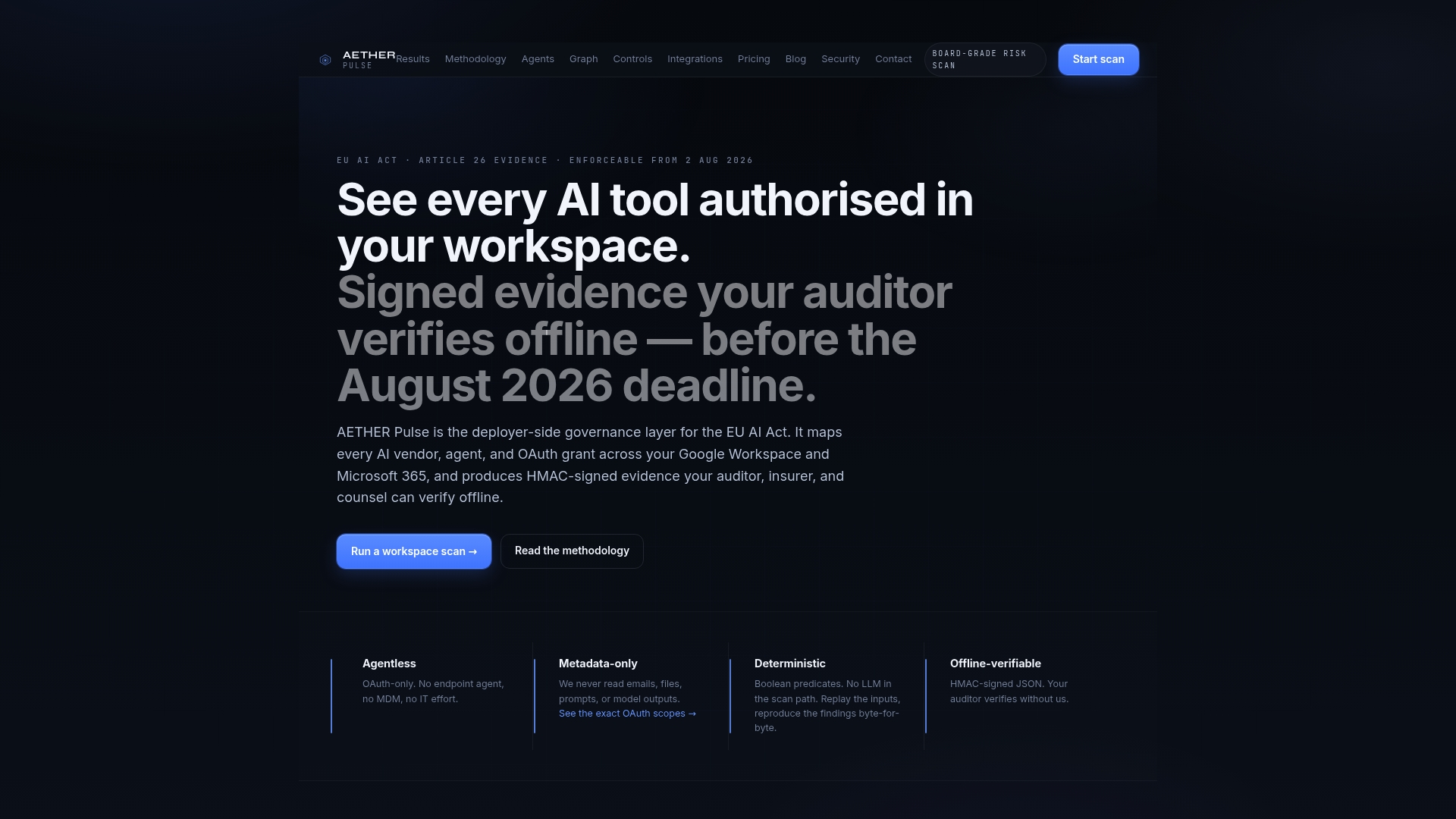
Aetherpulse connects through OAuth metadata only, touching no customer data, and produces HMAC-SHA256 signed evidence packs on demand. It builds an inventory and identity graph of your organization's AI agents, surfaces risk concentration including financial blast-radius exposure, and generates provenance-tracked evidence aligned to EU AI Act Article 26, FCA Consumer Duty, and NIST AI RMF requirements. Deployment is read-only and non-invasive: no agents installed in production, no sensitive data ingested. For compliance teams that need to demonstrate AI oversight to auditors and regulators this year, Aetherpulse provides the evidence layer without the operational risk. Visit aetherpulse.app to see how the platform maps to your regulatory obligations and request a demonstration.
Primary sources to bookmark for 2026 AI enforcement monitoring
The following primary sources are the authoritative references for tracking AI regulatory developments in 2026. Check each on the cadence noted.
-
EU AI Act (Regulation 2024/1689) on EUR-Lex: The full text of the EU AI Act, including Annexes defining high-risk system categories. Monitor for implementing acts and Digital Omnibus amendments. Check monthly.
-
NIST AI RMF: The operational standard for U.S. AI risk management. The 2026 autonomous agent initiative will publish supplementary guidance here. Check monthly.
-
FTC AI guidance and press releases: The FTC publishes enforcement actions, guidance documents, and inquiry announcements. Check weekly for enforcement actions.
-
California Legislative Information (SB 942, AB 2013): Track implementation regulations and AG enforcement guidance for California's AI transparency and training-data disclosure laws. Check monthly.
-
Skadden 2026 AI Insights: Law-firm analysis of federal and state AI enforcement trends, updated periodically. Useful for tracking AG activity and penalty ranges. Check monthly.
-
State AG portals (NC, Iowa, MA, PA): Individual AG offices publish enforcement actions, investigatory letters, and task force updates. For national deployers, monitor the AGs of California, Texas, New York, Illinois, and North Carolina at minimum. Check weekly.
-
Iowa AG AI guidance: An example of state-level AG guidance on AI use and consumer protection obligations. Check quarterly.
-
SEC examination priorities: The SEC publishes annual examination priorities that include AI governance expectations for investment advisers and broker-dealers. Check annually and after major guidance releases.
Recommended
Working on Article 26 readiness, deployer-side governance evidence, or AI agent risk at a regulated firm? We'd value 15 minutes of your perspective.
Start a conversation