AI Model Change Management: An Audit-Ready Guide for Banks
AI Model Change Management: An Audit-Ready Guide for Banks

AI model change management is the governance discipline of recording, classifying, approving, and producing tamper-evident evidence for every change made to an AI model or autonomous agent, so that US banking regulators can verify oversight at any point in the model's lifecycle. For regulated financial services firms, this is not optional process hygiene. It is the operational mechanism that demonstrates model risk management (MRM) to OCC, Federal Reserve, and FDIC examiners.
Every defensible program rests on three evidentiary elements:
- An immutable change log capturing who changed what, when, and why
- An outcomes analysis report showing whether the change affected model performance or risk exposure
- A tamper-evident evidence pack, cryptographically sealed to prevent post-hoc alteration
Pro Tip: Start with your most material models. Examiners will go there first, and a complete evidence pack for even one high-exposure model signals program maturity faster than a partial inventory of twenty.
Key Takeaways
AI model change management is a required governance discipline for US regulated financial services firms, and the quality of your tamper-evident evidence determines your examiner outcome.
| Point | Details |
|---|---|
| Definition and scope | AI model change management covers versioning, provenance, approvals, and tamper-evident audit evidence for every model and agent change. |
| Regulatory basis | OCC, Federal Reserve, and FDIC Revised Guidance (April 2026) requires risk-based validation and monitoring aligned to model materiality. |
| Classification drives revalidation | Data refreshes may require no revalidation; feature set or architecture changes require full revalidation before deployment. |
| Evidence artifacts are non-negotiable | Immutable change logs, outcomes-analysis reports, and HMAC-signed evidence packs are the minimum for exam readiness. |
| Aetherpulse | AETHER Pulse provides agentless, metadata-only evidence generation with HMAC-SHA256 signing, covering inventory, change logs, and on-demand audit packs. |
Table of Contents
- Why AI model change management matters to US regulated financial firms
- Core components of an audit-ready AI model change management program
- How to classify model changes and when revalidation is required
- Roles, segregation of duties, and how lines of defense apply
- Managing changes to vendor or third-party models
- Practical implementation checklist: phases, timeline, and cost drivers
- What evidence artifacts do examiners actually expect?
- Agentless metadata governance vs. invasive instrumentation
- How internal audit assesses AI model change management
- The first priorities for first-line risk owners
- AETHER Pulse delivers tamper-evident AI governance evidence
- Editorial perspective: what most firms get wrong about change evidence
- Sources
Why AI model change management matters to US regulated financial firms
Examiners care about model change controls because unmanaged changes are the primary vector for model deterioration, unexpected loss exposure, and audit gaps. A model that performs well at deployment can degrade silently after a data refresh or parameter adjustment, and without documented change controls, neither the firm nor its examiner can reconstruct what changed or when.
The Revised Interagency Guidance on Model Risk Management issued by the OCC, Federal Reserve, and FDIC in April 2026 establishes that validation timing, nature, and frequency should align with model purpose and materiality, and that outcomes analysis is central to detecting deterioration. The Federal Reserve transmitted this guidance through SR 26-2, which reinforces a risk-based, tailored approach: validation must assess model reliability and limitations, and monitoring must detect performance deviations before they become losses.
The FDIC's revised guidance adds a specific caution about vendor and proprietary models, where limited visibility into underlying code makes documentation and oversight controls even more critical. The practical consequence of weak change controls is direct: an examiner who cannot find tamper-evident evidence of a change, its approval, and its post-deployment monitoring will treat the gap as a governance deficiency, triggering remediation requirements and heightened supervisory attention. The Treasury's Financial Services AI Risk Management Framework reinforces this by adapting the NIST AI RMF for financial services, emphasizing lifecycle risk management and shared terminology across risk, technology, legal, and audit functions.
Core components of an audit-ready AI model change management program
A complete program covers seven functional areas: model inventory and versioning, change classification, change request and approval workflows, validation triggers, deployment gating, ongoing monitoring, and audit evidence packaging. Each area must produce documented artifacts, not just process descriptions.
The minimum metadata captured for each change event should include:
- Model identifier, version number, and environment (development, staging, production)
- Change type (data refresh, parameter update, algorithm modification, feature set change, agent behavior update)
- Requestor identity, approver identity, and timestamp
- Pre- and post-change performance metrics
- Linked outcomes analysis or monitoring report
Ownership follows a clear pattern. The model owner initiates and documents the change request. Model Risk Management (MRM) or validation assesses materiality and determines whether revalidation is required. IT/change control executes deployment through a gated pipeline. Internal audit provides independent assurance that the process was followed and evidence is complete.
Pro Tip: Capturing change events through metadata ingestion rather than direct instrumentation produces audit evidence without touching production data. This approach, described in FSI-AgentGov practitioner guidance, preserves evidentiary integrity while minimizing production risk.
How to classify model changes and when revalidation is required
Materiality drives classification. The question is not what changed technically, but what the change means for business impact, customer exposure, and financial blast-radius.
- Data-only refresh with no structural change: No revalidation required. Confirm monitoring thresholds remain valid and document the refresh event.
- Parameter tuning or recalibration within existing architecture: Light revalidation. Run outcomes analysis, confirm performance metrics are within tolerance, and document approval.
- Feature set addition or removal: Full revalidation. Feature changes alter the model's decision boundary and require independent validation before deployment.
- Algorithm or architecture replacement: Full revalidation plus updated model documentation. Treat as a new model for governance purposes.
- Emergent agent behavior or autonomous decision scope change: Full revalidation and escalation to senior risk governance. Agentic scope changes carry the highest blast-radius risk.
The OCC's Revised Guidance is explicit that validation cadence and rigor should align with model materiality. A low-materiality model with a minor data refresh does not require the same validation depth as a high-exposure credit decisioning model with a feature set change.
Pro Tip: Document your classification rationale in the change record itself. An examiner who sees a "no revalidation" decision without a written materiality assessment will question the control.
Roles, segregation of duties, and how lines of defense apply
The governance principle is straightforward: clear role assignment, maker/checker separation, and documented accountability at every stage. Without segregation of duties, an examiner cannot confirm that the person who requested a change did not also approve it.
For a standard change event, the accountability map looks like this:
- Request: Model owner initiates; documents business rationale and proposed change scope
- Materiality assessment: MRM/validation classifies the change and determines revalidation requirement
- Testing: Model owner or development team, with MRM oversight
- Approval: Senior risk officer or model governance committee, independent of the requestor
- Deployment: IT/change control, through a gated pipeline that requires approval evidence before release
- Monitoring: Model owner, with MRM oversight and escalation triggers
- Documentation and evidence packaging: Compliance or MRM, with internal audit access
When validation or monitoring is delegated to a third party, the firm must retain documented oversight of that delegation, including the scope of work, the third party's findings, and the firm's own review and sign-off. Delegation does not transfer accountability.
The OCC Comptroller's Handbook on Model Risk Management is clear that internal audit's role is independent assurance, not a duplication of validation. Audit tests whether the process was followed and evidence is credible. It does not re-run the model.
Pro Tip: For a practical AI governance operating model that maps these roles to your organizational structure, the design principles translate directly to change management accountability.
Managing changes to vendor or third-party models
Regulators expect firms to validate and monitor vendor models and to document their limitations, even when the underlying code is proprietary. "We don't have access to the model" is not an acceptable substitute for oversight evidence.
Contract terms should address:
- Developmental evidence: Require vendors to provide model documentation, validation summaries, and performance benchmarks at onboarding and after material changes
- Change notification: Contractual obligation for vendors to notify the firm before deploying changes that could affect model outputs or risk exposure
- Explainability and output SLAs: Minimum standards for output interpretability and vendor response times for anomaly investigation
- Audit access or attestations: Right to audit or receive third-party attestations covering model governance and change controls
Provenance metadata — version identifiers, change timestamps, vendor attestation records — can be captured without requiring vendors to hand over proprietary code. When a vendor deploys a change that alters model behavior materially, that event triggers the firm's own revalidation process, regardless of the vendor's internal testing.
Pro Tip: Treat vendor change notifications as formal change requests in your own system. Log them, classify them, and apply the same materiality assessment you would for an internal change.
Practical implementation checklist: phases, timeline, and cost drivers
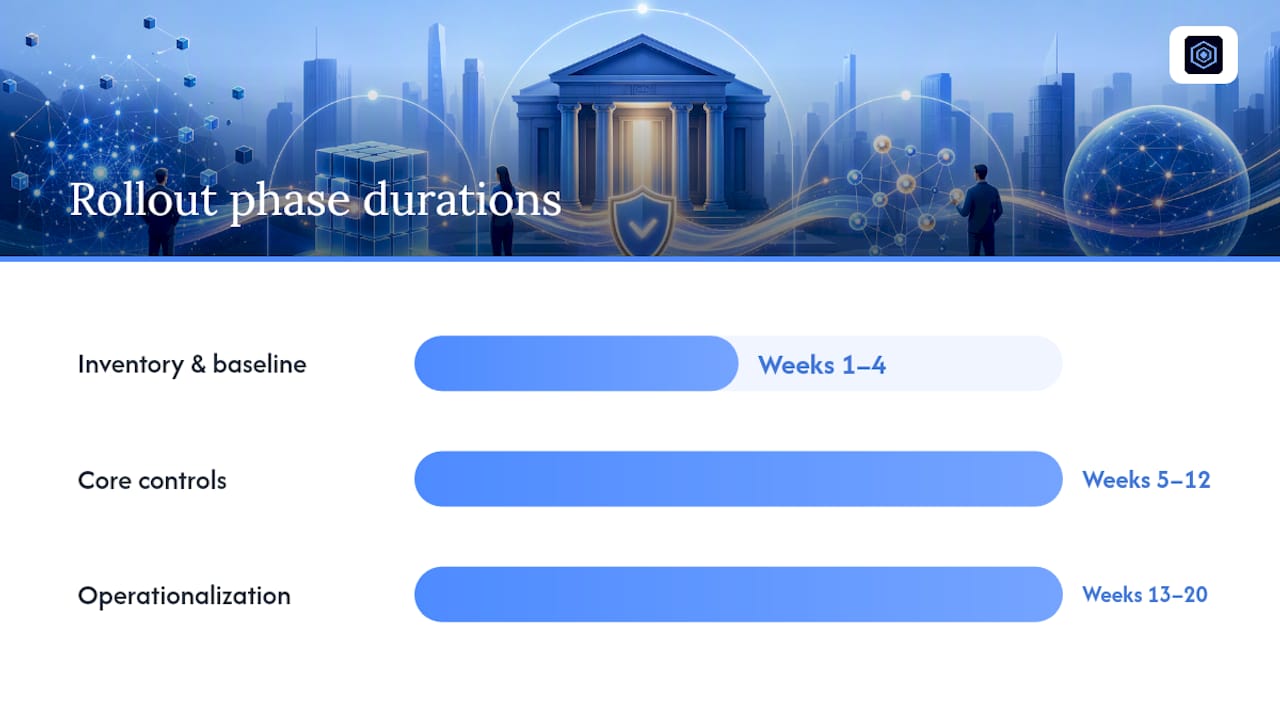
The rollout follows three phases. Quick wins in weeks one through four establish the inventory and evidentiary baseline. Core controls in weeks five through twelve implement classification, gating, and approval workflows. Operationalization in weeks thirteen through twenty-four automates monitoring, evidence packaging, and audit reporting.
| Phase | Duration | Critical Milestone |
|---|---|---|
| Inventory and baseline | Weeks 1–4 | Complete model inventory with materiality tiers; initial evidence packs for top-5 material models |
| Core controls | Weeks 5–12 | Classification framework live; deployment gates enforced; change log operational |
| Operationalization | Weeks 13–20 | Automated monitoring alerts; tamper-evident evidence packs on demand; audit reporting integrated |
Major cost drivers concentrate in four areas: inventory effort (cataloging models and agents across business lines), validation labor (MRM staff time for classification and revalidation), tooling and integration (change log infrastructure, metadata ingestion, evidence generation), and legal/contract remediation for vendor agreements that lack change-notification clauses.
Sequence by materiality. The models with the highest credit, market, or operational exposure carry the most examiner scrutiny. Getting those under documented change control in the first four weeks reduces supervisory exposure faster than a broad but shallow inventory.
Pro Tip: An AI governance maturity model assessment before phase one helps you identify which controls already exist informally and which require net-new investment.
What evidence artifacts do examiners actually expect?
The primary artifacts are: an immutable change log, a versioned model package with provenance metadata, change request and approval records, outcomes-analysis reports, monitoring dashboards, and deployment gate records.
A complete change record should contain: model ID and version, change type and description, requestor and approver identities with timestamps, materiality classification rationale, pre- and post-change performance metrics, validation findings (or documented rationale for waiver), and deployment confirmation.
Cryptographic sealing using HMAC-SHA256 makes evidence tamper-evident without requiring access to production data. The FSI-AgentGov practitioner framework recommends non-invasive metadata capture combined with cryptographic seals as the standard approach for audit-ready evidence. Broker-dealers should note that SEC Rule 17a-4 drives a a regulatory retention requirement for audit trail records.
When presenting an evidence pack to an examiner, structure it as: an index page listing all artifacts, a one-page summary of the change event and its classification, the raw artifacts in chronological order, and context notes explaining any deviations from standard process.
Pro Tip: For a detailed compliance playbook on demonstrating AI oversight to regulators, the evidence structuring guidance maps directly to exam response preparation.
Agentless metadata governance vs. invasive instrumentation
Two architecture patterns dominate practical deployments. Agentless, metadata-only evidence layers connect through OAuth grants or API metadata endpoints, capturing change events and provenance without touching production data or inserting agents into model pipelines. Instrumented pipelines embed controls directly into model serving infrastructure, capturing richer telemetry but requiring deeper integration and broader data access.
| Dimension | Agentless metadata layer | Instrumented pipeline |
|---|---|---|
| Deployment friction | Low — OAuth metadata only, no production access | High — requires pipeline integration and testing |
| Data exposure | None — metadata only, no customer data | Potentially significant depending on telemetry scope |
| Tamper resistance | High — cryptographic sealing at ingestion | Varies — depends on implementation |
| Auditability | High for governance events; limited for model internals | High for model internals; depends on logging design |
| Time to first evidence | Days | Weeks to months |
For most regulated financial services firms, the agentless approach delivers exam-ready evidence faster and with lower operational risk. Governance without data access is achievable at the metadata layer for the majority of change-management use cases examiners actually test.
Aetherpulse's AETHER Pulse platform follows the agentless pattern: it ingests via OAuth metadata only, builds a provenance-tracked agent inventory, and generates HMAC-SHA256-signed evidence packs on demand without inserting itself into production systems.
Pro Tip: Cryptographic signatures on evidence packs serve a dual purpose: they satisfy tamper-evidence requirements and they demonstrate to examiners that your governance layer is architecturally independent from the systems it monitors.
How internal audit assesses AI model change management
Internal audit provides independent assurance that change-management policies are implemented as written and that evidence is credible and complete. Auditors do not re-run validation; they test whether validation was performed, documented, and acted on.
A standard audit checklist covers:
- Policy adherence: are change requests classified and approved per the documented framework?
- Inventory completeness: does the model inventory reflect all production models and agents, including vendor-supplied components?
- Timeliness of validation: were revalidation triggers acted on within the required timeframe?
- Segregation of duties: is there documented evidence that requestors and approvers are different individuals?
- Vendor oversight: are vendor change notifications logged and assessed?
- Evidence packaging: are change records complete, tamper-evident, and retrievable on demand?
Audit findings on model change management should be reported to the audit committee with specific remediation timelines. Findings that remain open at the next examination cycle are treated as repeat observations, which carry significantly higher supervisory weight.
The first priorities for first-line risk owners
The single highest-priority action is to produce a complete, tamper-evident evidence pack for your most material models before the next examination cycle. Everything else builds on that baseline.
A practical 30/60/90-day sequence:
- Days 1–30: Complete a model and agent inventory. Assign materiality tiers. Identify the top five models by exposure and confirm whether current change records would survive examiner scrutiny.
- Days 31–60: Implement a formal change classification framework. Establish deployment gating for material models. Begin capturing tamper-evident change logs.
- Days 61–90: Produce outcomes-analysis reports for any changes made in the prior twelve months. Remediate vendor contracts lacking change-notification clauses. Conduct a dry-run evidence pack review with internal audit.
Pro Tip: Make evidence reviewer-friendly by structuring packs with an index and a one-page summary before the raw artifacts. An examiner who can navigate your evidence pack without asking questions is an examiner who moves on quickly.
AETHER Pulse delivers tamper-evident AI governance evidence
Firms that have completed the inventory and classification work described above still face a production challenge: generating tamper-evident, provenance-tracked evidence packs at exam speed without exposing customer data or disrupting live systems. AETHER Pulse addresses this directly.

AETHER Pulse connects through OAuth metadata only, builds a live inventory and identity graph of your AI agents, maps financial blast-radius exposure across your model portfolio, and generates HMAC-SHA256-signed evidence packs on demand. No agents are installed in production. No customer data is accessed. The evidence layer is architecturally independent from the systems it monitors, which is exactly the separation examiners look for when assessing governance credibility.
Capabilities that map directly to the controls in this article include immutable change logs, versioned model provenance tracking, vendor oversight documentation support, and on-demand audit pack generation. Review pricing and deployment options or visit Aetherpulse to request a demonstration.
Editorial perspective: what most firms get wrong about change evidence
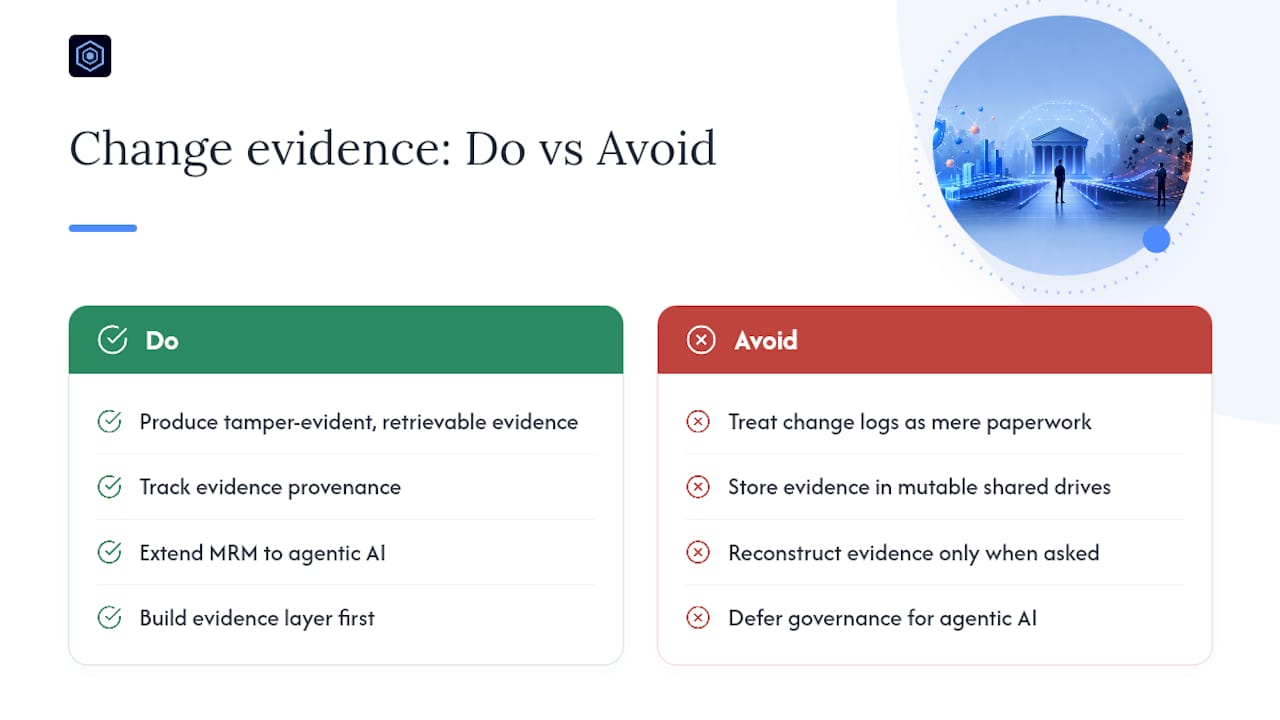
Most firms treat AI model change management as a documentation exercise. They build a change log, run a validation, and file the paperwork. What examiners actually test is whether the evidence is credible, tamper-evident, and retrievable on demand, not whether it exists somewhere in a shared drive.
The distinction matters because documentation that can be altered after the fact, or that requires three days to assemble for an examiner, signals a governance program that was built for appearance rather than control. Examiners are experienced at recognizing the difference between a program that produces evidence as a natural output of its controls and one that reconstructs evidence when asked.
The second underestimated risk is agentic AI. The Revised Guidance explicitly excludes generative and agentic AI from its formal scope, which some compliance teams have read as permission to defer governance; the opposite reading is correct. Regulators have signaled clearly that firms should extend MRM principles to these technologies. An autonomous agent making credit or operational decisions without documented change controls and blast-radius mapping is a supervisory finding waiting to happen. The hidden cost of shadow AI in regulated firms is precisely this: unmanaged agents accumulating exposure that no one has classified or evidenced.
Build the evidence layer first. Classification frameworks and validation workflows are easier to defend when the underlying evidence is already tamper-evident and provenance-tracked.
This article is general information, not a substitute for advice from a qualified financial advisor. Consult a qualified financial professional about your own circumstances before acting on anything here.
Sources
The sources below directly support program design and exam response preparation:
- Model Risk Management - Revised Guidance
- FRB: Supervisory Letter SR 26-2 on Revised Guidance on Model Risk Management -- April 17, 2026
- Treasury Releases Two New Resources to Guide AI Use in the Financial Sector | U.S. Department of the Treasury
- Model Risk Management, Revised Guidance (FDIC)
The April 2026 Revised Guidance supersedes prior supervisory guidance on model risk management. Firms that mapped their programs to SR 11-7 should review their change-management controls against the updated materiality and validation expectations before their next examination cycle.
Recommended
Working on Article 26 readiness, deployer-side governance evidence, or AI agent risk at a regulated firm? We'd value 15 minutes of your perspective.
Start a conversation