What Is an AI Model Inventory for Governance Teams?
What Is an AI Model Inventory for Governance Teams?

An AI model inventory is the enterprise system-of-record that lists every AI system in use, its owner, risk tier, lifecycle state, and the evidence needed to prove oversight. That single record is what lets governance teams see across model inventory sprawl, answer regulators under frameworks like the EU AI Act, FCA SYSC, and the ICO's automated decision-making guidance, and produce audit evidence without scrambling. Most firms cannot currently name every model touching customer outcomes, which is exactly the visibility gap tools like AETHER Pulse were built to close.
Key Takeaways
An AI model inventory works because it links ownership, risk, lineage, and decision evidence into one record auditors and regulators can actually use.
| Point | Details |
|---|---|
| Definition matters | An inventory is the governance system-of-record, not just a list of model names. |
| Capture the right fields | Owner, risk tier, lifecycle state, data access, and provenance are non-negotiable fields. |
| Inventory differs from a registry | Registries track versions; inventories link models to owners, approvals, and audit evidence. |
| Start small and prove it | Build one defensible evidence pack for a high-risk model before scaling the program. |
| Retirement needs archival | Governance records must survive decommissioning for the full retention period. |
| Aetherpulse fits regulated firms | AETHER Pulse offers agentless, metadata-only inventory and identity graphing with signed evidence packs mapped to EU AI Act, FCA SYSC, and ICO requirements. |
Table of Contents
- Understanding AI Model Inventory: What Belongs In It
- What Capabilities Does an Effective AI Model Inventory Need?
- Why AI Model Inventory Matters for Governance and Risk
- AI Model Inventory vs. Model Catalog: What's the Difference?
- How to Build an AI Model Inventory: A Six-Step Checklist
- Implementation Considerations: Integrations and Discovery Methods
- Retention and Archival: What Governance Evidence Requires
- Why the Inventory Comes Before Any Governance Tooling Debate
- How AETHER Pulse Maps to Your Inventory Requirements
- Frequently Asked Questions
- Sources
Understanding AI Model Inventory: What Belongs In It
Understanding AI model inventory starts with knowing what to catalog. A usable inventory record captures the model name or alias, the accountable owner, its intended use, an assigned risk tier, current lifecycle state, active endpoints, the data classes it touches, and whether it's homegrown, third-party, or an embedded vendor capability. Add the current release version, provenance and lineage pointers, links to approval decisions, and retention status.
Scope is a judgment call, but a pragmatic starting point for regulated firms is production systems first, then prototypes and third-party endpoints once the base layer is stable. Trying to catalog everything on day one usually stalls the project entirely.
Two categories get missed constantly:
- Agentic systems that take autonomous actions, not just generate text
- Tool-enabled models that call external functions or APIs
- Embedded third-party capabilities, where a vendor's AI feature creates governance obligations even though your firm never trained it
That last point trips up more compliance teams than any other. A procurement-approved SaaS tool with an embedded AI feature is still your governance exposure.
What Capabilities Does an Effective AI Model Inventory Need?
A model inventory earns its keep through eight core capabilities: a centralized registry, automated discovery and classification, lifecycle status tracking, linked decision logs, provenance and lineage pointers, packaged evidence artifacts, role-based access controls, and audit-ready reporting.
- Centralized registry covering every model, agent, and embedded AI feature
- Automated discovery that flags new deployments without manual submission
- Lifecycle status fields (preview, staging, production, retired)
- Decision logs linked directly to each model record
- Provenance and lineage pointers back to training data and configuration
- Signed or tamper-evident evidence packages for audit requests
- Role-based access so sensitive risk data stays restricted
- Reporting views built for regulators, not just engineers
A signed configuration snapshot captured at the moment a model is promoted to production is a concrete example of a strong evidence artifact. If an auditor later asks how a specific decision was made, that snapshot plus the linked decision log reconstructs the full picture without guesswork.
Pro Tip: Don't treat the inventory as a standalone list. Effective lifecycle management preserves three connected records together: the inventory itself, technical lineage, and a decision log capturing evaluations, approvals, incidents, and retirements. One without the others leaves gaps auditors will find.
Why AI Model Inventory Matters for Governance and Risk
Governance teams that lack a working inventory can't manage risk for systems they haven't identified in the first place. That's the core problem an inventory solves, and it cascades into several concrete benefits:
- Reduces shadow AI by surfacing models nobody formally approved
- Enables faster audits and regulatory reporting on demand
- Supports consistent risk classification and control assignment
- Lowers operational cost tied to unmanaged, duplicated, or abandoned models
- Maps blast radius so high-consequence models get scrutiny proportional to their impact
Consider an incident scenario: a customer-facing agent makes an erroneous decision. With an inventory linked to lineage and decision logs, a governance team can reconstruct exactly which version was live, who approved it, and what data it accessed within minutes rather than weeks. Without that link, the same reconstruction becomes a forensic exercise involving multiple teams and incomplete records.
The visibility gap is the real risk. Firms that can't produce a complete model list can't demonstrate oversight, and demonstrating oversight is precisely what regulators are now asking for.
AI Model Inventory vs. Model Catalog: What's the Difference?
A model catalog or registry tracks artifacts and versions from an engineering point of view: what was built, which version is live, how it was trained. An inventory is the governance system-of-record: it links those same models to owners, risk tiers, approvals, and audit evidence.
- Use a registry to manage technical versioning and CI/CD promotion
- Use an inventory to answer "who owns this, what's its risk tier, and can we prove it was approved"
- Link registry entries into inventory records rather than duplicating data entry across both
Firms managing both engineering and compliance stakeholders should integrate, not choose one over the other. Most production failures trace back to lifecycle gaps, not missing artifacts, and a registry alone rarely fills those gaps because it lacks governance metadata like approval status and deprecation dates.
How to Build an AI Model Inventory: A Six-Step Checklist
Building an inventory is less about tooling and more about sequencing. Follow this order:
- Define scope and lifecycle stages. Decide what counts as in-scope (production first) and name your lifecycle states. Complete when stages are documented and agreed with risk leadership.
- Assign ownership and governance roles. Every model needs a named accountable owner. Complete when each production model has an owner recorded, not a team name.
- Catalog initial production assets. Start with the highest-risk, customer-facing systems. Complete when risk tiers are assigned to every cataloged model.
- Automate discovery and intake. Manual spreadsheets go stale within weeks. Complete when new deployments trigger an automatic flag rather than a manual submission.
- Connect lineage and decision logs. Link each inventory record to its technical lineage and approval history. Complete when a sample audit request can be answered from the linked records alone.
- Implement retention and decommissioning procedures. Define what happens when a model retires. Complete when a signed archival record exists for at least one retired model.
Pro Tip: Automate discovery before you automate reporting. Teams that build slick dashboards on top of manually maintained data end up presenting stale numbers to auditors, which is worse than admitting the gap exists.
Onboarding matters as much as the build itself. Engineering teams need a lightweight intake form, not a compliance questionnaire, or the inventory falls out of date the moment the initial project ends.
Implementation Considerations: Integrations and Discovery Methods
An inventory is only as good as its data sources. Common integrations include model registries, CI/CD pipelines, experiment trackers, artifact stores, runtime endpoints, orchestration layers, and security logs. Some vendor platforms, such as Azure HorizonDB's AI Model Management feature, bundle a managed registry directly into deployment, which simplifies capture for models provisioned inside that ecosystem but still needs to feed into a broader governance inventory.
Discovery method matters. Agentless, metadata-only discovery reads configuration and access data without touching production systems or customer data, which reduces friction and deployment risk. Active or agented scanning can capture deeper runtime detail but often requires code changes and raises its own data-handling questions.
Lifecycle events worth recording include preview-to-staging promotion, staging-to-production promotion, capability updates, re-assessment triggers, incidents, deprecation, and retirement. Each event needs its own timestamp and approver because audit trails depend on reconstructing not just what changed, but who signed off. On privacy, the safest default is least-privilege access paired with metadata-only evidence wherever the standard allows it.
Retention and Archival: What Governance Evidence Requires
Governance documentation, including risk classification and re-assessment history, must be archived for the full retention period required by applicable regulations, even after a model is retired. Retirement itself demands deleting production weights and archiving governance records as auditable proof the system is fully decommissioned, not just switched off.
A practical archival workflow looks like this: capture the decision log at each lifecycle event, generate a signed evidence pack summarizing risk tier and approvals, then store that pack in an immutable archive tagged with its retention deadline. Retirement is the stage most often skipped in practice, which means it's also the stage most likely to surprise a firm during an audit.
Why the Inventory Comes Before Any Governance Tooling Debate
Before you evaluate platforms, prove you can see what you have. Start with one high-risk model, secure a named owner, and produce a defensible evidence pack for it. That single proof point does more for governance credibility than a sprawling maturity roadmap with no completed cases behind it.
How AETHER Pulse Maps to Your Inventory Requirements
Regulated firms don't need another agent-based tool poking into production systems to build an inventory. AETHER Pulse connects through OAuth metadata only, touching no customer data, and builds the identity graph and risk concentration mapping that turns a static asset list into a living governance record.
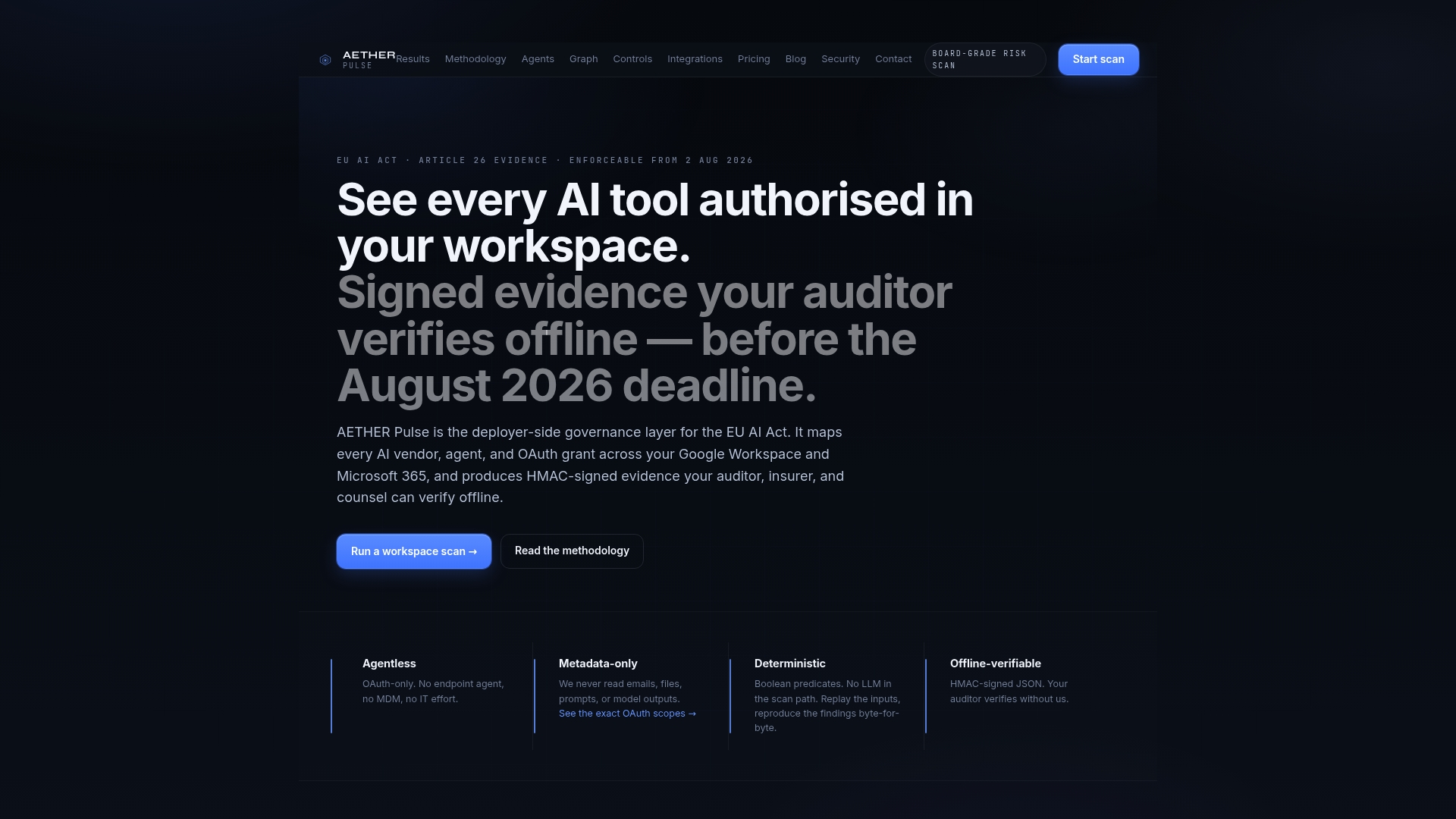
That agentless approach maps directly to the capabilities outlined above: a centralized registry, automated discovery, lifecycle tracking, and tamper-evident evidence packs signed with HMAC-SHA256, ready to hand an auditor without weeks of reconstruction. AETHER Pulse builds in hooks for EU AI Act Article 26, FCA SYSC, Consumer Duty, and the ICO's automated decision-making guidance, so evidence generation isn't a separate project bolted onto compliance work. Firms building an agent inventory for FCA and ICO supervision can see the full mapping between product capability and regulatory requirement, including how security and data handling are structured around a metadata-only model. Check the pricing page to see which tier fits your firm's deployment scope and request a demo to see the evidence pack format firsthand.
Frequently Asked Questions
What is an AI model inventory in simple terms? It's a governed record listing every AI system a firm deploys, along with its owner, risk tier, lifecycle stage, and audit evidence.
Is an AI model inventory the same as an AI model catalog? No. A catalog or registry tracks technical versions and artifacts; an inventory links those same models to compliance ownership, approvals, and evidence.
How does an AI model inventory support regulatory compliance? It gives risk teams a single source of truth to answer regulator requests under frameworks like the EU AI Act, FCA SYSC, and ICO guidance without reconstructing records manually.
What's the biggest mistake firms make with AI model inventories? Treating them as a one-time spreadsheet exercise instead of a continuously updated, automated system tied to discovery and decision logs.
Does an inventory need to cover third-party or embedded AI tools? Yes. Vendor-embedded AI features create the same governance obligations as internally built models, even though the firm never trained them.
This article is general information, not a substitute for advice from a qualified lawyer. Consult a qualified legal professional about your own circumstances before acting on anything here.
Sources
- How do we govern AI models from preview release through retirement? | AI Governance Institute
- What Is Model Inventory? Definition & Examples
- AI model lifecycle management: 7 stages and tools | Arize AI
- AI Model Lifecycle Guide 2026: Management, Versioning & Retirement
Recommended
- AI Inventory vs CMDB: Why Your Configuration Management Database Is Not Your AI Governance Answer - AETHER Pulse
- The AI Inventory Crisis Nobody Is Talking About - AETHER Pulse
- How to Build an AI Agent Inventory for FCA and ICO Supervision - AETHER Pulse
- Building an AI Governance Operating Model for Regulated Financial Services - AETHER Pulse
Working on Article 26 readiness, deployer-side governance evidence, or AI agent risk at a regulated firm? We'd value 15 minutes of your perspective.
Start a conversation