Algorithmic Accountability: A Governance Guide for 2026
Algorithmic Accountability: A Governance Guide for 2026

Algorithmic accountability is the governance function that assigns responsibility for the consequences of automated decision-making to the organizations and people who design, deploy, and oversee those systems — not to the machine itself. As research published in Business & Information Systems Engineering establishes, accountability requires three interlocking mechanisms: justification (documented rationale for decisions), oversight (human governance structures and escalation paths), and redress (complaint, correction, and remediation pathways available to affected individuals).
- Scope and core components: Algorithmic accountability applies wherever automated systems make or materially influence high-stakes decisions — credit, hiring, housing, public benefits, criminal justice, and healthcare. It covers technical controls, organizational governance, documentation practices, and legal obligations simultaneously.
- Expected outcomes: Organizations that implement accountability functions proactively reduce regulatory exposure, satisfy auditor expectations, and create defensible remedial pathways when systems cause harm.
Key Takeaways
Algorithmic accountability is a governance function, not a technical fix: it requires named human owners, documented justification, continuous oversight, and enforceable redress pathways to be meaningful.
| Point | Details |
|---|---|
| Accountability requires three mechanisms | Justification, oversight, and redress must all be present; any one missing creates a governance gap. |
| Transparency is necessary but not sufficient | Explainability tells you why a decision was made; accountability determines who must act when that decision causes harm. |
| Audit-only approaches carry structural risks | Point-in-time audits without continuous monitoring and mandatory remediation tend to become checkbox exercises. |
| Inventory first, always | A complete map of automated decision systems is the prerequisite for every other accountability control. |
| Tamper-evident provenance is the regulatory priority | Cryptographically signed inference records satisfy non-repudiation requirements that conventional logs frequently fail. |
Table of Contents
- What is algorithmic accountability, and how does it work in practice?
- How does algorithmic transparency differ from algorithmic accountability?
- Where does the absence of accountability cause real harm?
- What mechanisms and tools actually deliver algorithmic accountability?
- Why audit-centered approaches often fall short
- What does the U.S. regulatory environment require?
- Who inside an organization is actually accountable?
- A step-by-step operational checklist for U.S. organizations
- Why governance infrastructure is the missing layer
- The accountability gap is a governance design problem, not a technical one
- Sources
What is algorithmic accountability, and how does it work in practice?
The concept has roots stretching back to debates about automated credit scoring in the 1970s, but its current governance-focused form emerged from policy and academic discourse in the 2010s. Boston University's expert panel frames it as holding developers and deployers responsible for unfair outcomes — a framing that deliberately centers human and organizational agency rather than treating bias as a technical artifact to be corrected in isolation.
Scope: which systems and decisions fall under accountability obligations
Algorithmic accountability applies most urgently to high-risk automated decision-making: systems that determine loan eligibility, screen job applicants, set insurance premiums, allocate public benefits, or inform criminal sentencing. Lower-stakes systems — recommendation engines for entertainment, for example — attract less regulatory attention, though that boundary is shifting as regulators expand their definitions of consequential automation.
The scope covers the full lifecycle. A system that was fair at deployment can drift into discriminatory behavior as the underlying population or data distribution changes. Accountability obligations therefore attach not just to the design phase but to ongoing monitoring, periodic reassessment, and the processes an organization uses when something goes wrong.
Core components in depth
Justification means that an organization can produce documented rationale for why a system was built the way it was, what data it uses, what it optimizes for, and how it performs across demographic groups. This is not a one-time disclosure; it is a living record that must be updated as models change.
Oversight encompasses both technical controls (human-in-the-loop review for high-stakes outputs, automated anomaly detection) and governance structures (board-level accountability, designated risk owners, escalation protocols). Oversight without documentation is unverifiable; documentation without oversight is theater.
Redress is the mechanism most frequently absent in practice. Affected individuals need a clear pathway to contest an automated decision, receive a human review, and obtain correction or compensation when the system erred. Without redress, accountability is a one-way obligation that benefits the organization but not the people it affects.
Auditability and monitoring complete the picture. Systems must generate logs and provenance records sufficient for internal review, third-party audit, and regulatory inspection. Those records need to be tamper-evident — conventional logs can be truncated or altered, which fails regulatory non-repudiation tests.
The accountability process
The operational sequence runs: inventory and classify all automated decision systems → assess risk by impact severity and population affected → document design choices, data provenance, and performance metrics → monitor in production for drift and disparate impact → escalate and remediate when incidents occur → produce evidence for auditors and regulators on demand.
Pro Tip: Start with inventory. Organizations that attempt to build accountability programs without first mapping every automated system in production consistently underestimate scope and exhaust governance resources on the wrong systems. A complete agent inventory is the prerequisite for everything else.
How does algorithmic transparency differ from algorithmic accountability?
These terms are used interchangeably in public discourse, but treating them as synonyms creates governance gaps. ETSI's technical standard TS 104 224 on AI explicability and transparency draws a precise distinction that practitioners need to internalize.
| Concept | Definition | What it delivers | What it cannot deliver alone |
|---|---|---|---|
| Transparency | Access to information about a system's inputs, training data, and decision logic | Visibility into how a system operates | Organizational responsibility or remediation |
| Explainability (Explicability) | A human-interpretable account of how a specific output was reached | Individual-level justification for a decision | Structural governance or enforcement |
| Accountability | Organizational responsibility for outcomes, with mechanisms for justification, oversight, and redress | Enforceable obligations, remediation pathways, and audit evidence | Technical interpretability by itself |
The relationship is directional: transparency enables explainability, and explainability supports accountability — but neither of the first two substitutes for the third. A lender can publish its model's feature weights (transparency) and explain to a rejected applicant why their application failed (explainability) while still having no governance process for identifying systemic bias or compensating affected borrowers (accountability).
Transparency tells you what a system does. Explainability tells you why it reached a particular result. Accountability tells you who is responsible when that result causes harm — and what they must do about it.
Consider a concrete example. A mortgage lender's automated underwriting system denies an application. Transparency means the applicant can learn which data inputs the model used. Explainability means the lender can generate a reason code explaining the primary factors. Accountability means the lender has a documented process for reviewing contested decisions, a designated officer responsible for bias monitoring, and a remediation pathway if the system is found to have applied discriminatory criteria. All three are necessary; only the third creates enforceable governance.
For compliance officers, the practical implication is that AI explainability requirements are a necessary input to accountability programs, not a substitute for them. Standards like ETSI TS 104 224 and ISO/IEC frameworks treat these as distinct governance layers, each requiring its own controls and evidence artifacts.
Where does the absence of accountability cause real harm?
The harms from ungoverned algorithmic systems are not hypothetical. They are documented across sectors, and they share a common structural feature: the absence of a responsible party with both the obligation and the mechanism to identify and correct the problem.
- Housing and credit: Automated underwriting systems have reproduced historical redlining patterns by using zip code, social network data, or purchasing behavior as proxies for race. When no accountability function exists, affected applicants have no pathway to contest the decision or trigger a systemic review.
- Hiring: Resume-screening tools trained on historical hiring data have been shown to penalize candidates from women's colleges or candidates who used certain vocabulary patterns associated with protected groups. Without documented performance metrics across demographic subgroups, deployers often discover the problem only after litigation.
- Criminal justice: Risk-assessment instruments used in pretrial detention and sentencing decisions have been criticized for producing racially disparate scores. The controversy around tools like COMPAS — which assigned higher recidivism risk scores to Black defendants at rates documented by investigative journalists — illustrates what happens when consequential scoring systems operate without transparent methodology, independent audit, or meaningful redress for affected individuals.
- Healthcare and insurance: Algorithms that allocate care resources or set coverage premiums based on cost-proxy variables have been found to systematically underserve Black patients relative to white patients with equivalent clinical need. The absence of demographic performance monitoring allowed these disparities to persist for years before external researchers identified them.
The AI Now Institute documents a consistent pattern across these cases: harms persist longest when accountability is treated as a technical problem rather than a governance obligation. When no human or organization holds formal responsibility for monitoring outcomes and responding to harm, affected communities bear the burden of proof — often without access to the data or documentation needed to make their case.
The Algorithmic Accountability: A Primer from the Digital Government Hub catalogues similar patterns in public-sector deployments, where automated systems for benefits eligibility and child welfare have produced documented disparate impacts on low-income and minority communities.
What mechanisms and tools actually deliver algorithmic accountability?
Accountability is not a single control; it is a stack of complementary instruments. The most effective governance programs combine documentation artifacts, audit processes, monitoring infrastructure, and redress workflows into a coherent system.
Documentation artifacts
Model cards describe a model's intended use, performance metrics across demographic subgroups, known limitations, and evaluation methodology. Introduced by researchers at Google and now widely adopted, they are the primary documentation artifact for individual models. Datasheets for datasets perform the same function for training data: they record provenance, collection methodology, known biases, and recommended uses. Together, these two artifacts address the most common documentation gap in deployed AI systems.
Model risk assessments — sometimes called algorithmic impact assessments — evaluate a system's potential for harm before deployment and at regular intervals afterward. They are the AI equivalent of a privacy impact assessment and are increasingly required by regulation.
Audit types
| Audit type | Who performs it | Typical outputs | Strengths | Limitations |
|---|---|---|---|---|
| First-party | Internal team | Internal reports, model documentation | Low cost, full data access | Conflict of interest, limited credibility with regulators |
| Second-party | Contractual partner or regulator | Compliance assessment, findings report | Trusted relationship, access to context | Scope limited by contract or mandate |
| Third-party | Independent auditor | Public or confidential audit report | Credibility, independence | High cost, limited model access, risk of checkbox compliance |
Third-party audits carry the most regulatory weight but are also the most susceptible to the limitations the AI Now Institute identifies: auditors often receive only what the deployer chooses to share, and the audit becomes a point-in-time snapshot rather than a continuous governance function.
Monitoring, provenance, and redress
Continuous monitoring in production is where most governance programs are weakest. Effective monitoring tracks model performance metrics disaggregated by demographic group, flags distribution shift, and generates alerts when outputs diverge from expected ranges. Non-invasive metadata integration — connecting to system logs without accessing underlying customer data — allows governance teams to maintain oversight without creating new privacy exposures.

Provenance capture is the practice of recording, at the moment of inference, the exact model version, input features, and agent state that produced a given output. Cryptographically anchored provenance records (using techniques like HMAC-SHA256 signing) create tamper-evident evidence that satisfies regulatory non-repudiation requirements. Conventional logs frequently fail this test because they can be overwritten or selectively deleted.
The Amnesty International Algorithmic Accountability Toolkit provides practical templates for civil-society actors and governance practitioners conducting assessments, including structured questionnaires for evaluating whether deployers have implemented these controls.
- Documentation repositories: Centralized, version-controlled stores for model cards, datasheets, impact assessments, and audit reports.
- Automated monitoring platforms: Tools that track production metrics, flag anomalies, and generate audit-ready logs.
- Cryptographic evidence anchoring: HMAC-SHA256 or equivalent signing of inference records to create non-repudiable provenance.
- Incident and redress workflows: Structured processes for receiving complaints, escalating to human reviewers, and documenting remediation actions.
For organizations governed by financial services regulations, AI governance without data access is an increasingly important design principle: metadata-only integration allows compliance teams to build audit evidence without creating new data-access risks.
Why audit-centered approaches often fall short
The governance community has converged on audits as the primary accountability mechanism, and that consensus deserves scrutiny. The AI Now Institute's analysis presents a pointed critique: when accountability is reduced to a periodic audit exercise, it tends to become a checkbox rather than a structural change.
The practical failure modes are well-documented:
- Audit fatigue: Teams that manually map agent behavior across large deployments exhaust governance resources before completing a meaningful assessment, leaving high-risk systems under-examined.
- Narrow test scope: Audits often evaluate fairness metrics on benchmark datasets that do not reflect the actual population the system serves in production.
- Gaming: When organizations know the audit criteria in advance, they can optimize for those criteria without improving real-world outcomes for affected individuals.
- Insufficient provenance access: Auditors frequently receive model outputs but not the full chain of inputs, model versions, and intermediate states needed to reconstruct a decision. Without provenance, an audit cannot determine whether a harmful outcome was caused by the model, the data, or a deployment configuration.
- Weak enforcement: Even when audits identify problems, the absence of mandatory remediation timelines or regulatory follow-through means findings are often filed without action.
The structural alternative that researchers recommend is integrating audits into a continuous governance function: mandatory provenance capture, ongoing demographic monitoring, independent access to production logs, and formal redress obligations with enforcement teeth. Involving affected communities in the design of audit criteria — rather than treating them as passive subjects — is another reform that civil-society researchers consistently advocate.
For regulated financial services firms, the accountability gap between a point-in-time audit and continuous governance is where regulatory risk concentrates. Supervisors increasingly expect firms to demonstrate not just that they conducted an audit, but that they have an operating governance function capable of detecting and responding to problems between audits.
What does the U.S. regulatory environment require?
The U.S. regulatory framework for algorithmic accountability is fragmented across federal agencies, sectoral regulators, and state legislatures — but the direction of travel is clear.
Federal legislative and agency activity
- Algorithmic Accountability Act (2022): Senators Wyden and Booker, along with Representative Clarke, introduced the Algorithmic Accountability Act of 2022, which would require companies to conduct impact assessments for automated decision systems and critical decision processes, submit those assessments to the FTC, and implement mitigation measures for identified risks. The bill did not pass in the 117th Congress, but it established the template for federal algorithmic accountability legislation and has been reintroduced in subsequent sessions.
- FTC enforcement posture: The Federal Trade Commission has used its Section 5 authority over unfair or deceptive acts and practices to pursue algorithmic accountability through enforcement actions and guidance. The FTC has signaled that deploying AI systems that produce discriminatory outcomes, or making misleading claims about AI capabilities, can constitute unfair or deceptive practices under existing law — without waiting for new legislation.
- CFPB: The Consumer Financial Protection Bureau has issued guidance making clear that creditors using algorithmic models must still provide specific reasons for adverse actions under the Equal Credit Opportunity Act, and that "the algorithm decided" is not an acceptable explanation.
- State-level activity: Colorado, Illinois, and New York City have enacted or proposed legislation requiring bias audits for automated employment decision tools. New York City's Local Law 144, which requires annual bias audits of automated employment decision tools used by employers, is the most operationally specific state-level requirement currently in force.
| Instrument | Jurisdiction | Key requirement | Enforcement body |
|---|---|---|---|
| Algorithmic Accountability Act (proposed) | Federal | Impact assessments, FTC submission, mitigation | FTC |
| FTC Section 5 guidance | Federal | No unfair/deceptive AI practices | FTC |
| ECOA / Regulation B | Federal | Specific adverse action reasons for credit decisions | CFPB, DOJ |
| NYC Local Law 144 | New York City | Annual bias audits for automated hiring tools | NYC DCWP |
| Colorado legislation | Colorado | Insurer algorithm fairness requirements | Colorado DOI |
Court rulings and discovery implications
Courts have increasingly required organizations to produce algorithmic decision records in litigation. In employment discrimination cases, plaintiffs' counsel routinely seek model documentation, training data, and performance metrics as discovery. Organizations without structured documentation face both substantive evidentiary disadvantages and sanctions for failing to preserve relevant records. The practical implication: governance documentation is not just a regulatory artifact; it is litigation-critical evidence.
For financial services firms, AI regulatory disclosure obligations extend across multiple sectoral regulators — the OCC, Federal Reserve, FDIC, and SEC each have model risk management expectations that intersect with algorithmic accountability requirements.
Who inside an organization is actually accountable?
Accountability without named owners is not accountability. The most common governance failure is diffuse responsibility: everyone assumes someone else is monitoring the system, and no one has formal authority to halt a deployment or mandate remediation.
Responsibility by role
Board and executive leadership hold ultimate accountability for the organization's AI risk posture. This means approving AI governance policies, receiving regular reporting on high-risk system performance, and ensuring that accountability functions are resourced. In regulated financial services, board-level AI oversight is increasingly an explicit supervisory expectation.
Chief Risk Officer / Chief Compliance Officer own the accountability framework itself: the policies, the risk classification criteria, the audit schedule, and the escalation protocols. They are the primary interface with regulators and external auditors.
Product owners and business unit leaders are accountable for the systems their teams deploy. They own the model card and impact assessment for each system, approve deployment decisions, and are responsible for monitoring outcomes in their domain.
Data scientists and ML engineers are responsible for documentation accuracy: model cards, training data provenance, performance metrics, and version control. They do not hold organizational accountability for outcomes, but they hold technical accountability for the accuracy of governance artifacts.
Vendor managers and procurement teams must extend accountability obligations to third-party AI providers through contractual requirements: audit rights, documentation obligations, incident notification, and data access for governance purposes.
Legal and privacy teams manage redress workflows, regulatory correspondence, and litigation holds. They are the owners of the complaint and remediation process.
Pro Tip: Designate a single "AI accountability owner" for each high-risk system — a named individual, not a committee — who is responsible for that system's governance documentation, monitoring alerts, and regulatory evidence. Link this role explicitly to your existing model risk management or operational risk framework so accountability obligations inherit existing escalation paths.
For a structured view of how these roles map to governance maturity levels, the AI governance maturity model provides a useful framework for assessing where your organization sits and what capabilities to build next.
A step-by-step operational checklist for U.S. organizations
This checklist is sequenced for organizations building or maturing an algorithmic accountability program under U.S. regulatory expectations. It maps to FTC guidance, the Algorithmic Accountability Act's proposed requirements, and sectoral model risk management standards.
-
Inventory and classify all automated decision systems. Identify every system that makes or materially influences a consequential decision. Classify each by risk tier based on decision domain, population affected, and potential for harm. This inventory is the prerequisite for every subsequent step.
-
Conduct a high-level risk assessment for each Tier 1 and Tier 2 system. Document the system's purpose, the data it uses, its known performance characteristics, and its potential for disparate impact. This assessment is the foundation of your impact assessment program and the primary artifact regulators will request.
-
Produce model cards and datasheets for all high-risk systems. Model cards should cover intended use, evaluation metrics disaggregated by demographic group, known limitations, and update history. Datasheets should document training data provenance, collection methodology, and known biases.
-
Implement production monitoring and provenance capture. Deploy monitoring that tracks performance metrics in production, disaggregated by relevant demographic variables, and flags distribution shift. Capture atomic provenance — a cryptographically signed record of the model version, inputs, and agent state at each inference — to create non-repudiable audit evidence.
-
Build incident and redress workflows. Define the process for receiving and triaging complaints about automated decisions, escalating to human review, documenting findings, and communicating outcomes to affected individuals. Assign named owners for each step.
-
Schedule regular third-party reviews. Annual third-party audits of high-risk systems, combined with continuous internal monitoring, satisfy both regulatory expectations and the credibility requirements that external auditors and litigants apply. Use the audit findings to update model cards and risk assessments.
-
Assemble regulator-ready evidence packs. Maintain a structured repository of governance artifacts — model cards, impact assessments, monitoring reports, audit findings, and provenance records — that can be produced on demand for FTC inquiries, state AG investigations, or sectoral regulator examinations. Evidence packs should be tamper-evident and version-controlled.
Pro Tip: Cryptographically anchored provenance records (HMAC-SHA256 signed inference logs) are the single highest-value investment for organizations facing regulatory scrutiny. Regulators and litigants increasingly prioritize non-repudiation — proving which model version made which decision at what time — over abstract fairness metrics. Tamper-evident evidence reduces audit friction and eliminates the most common discovery disputes.
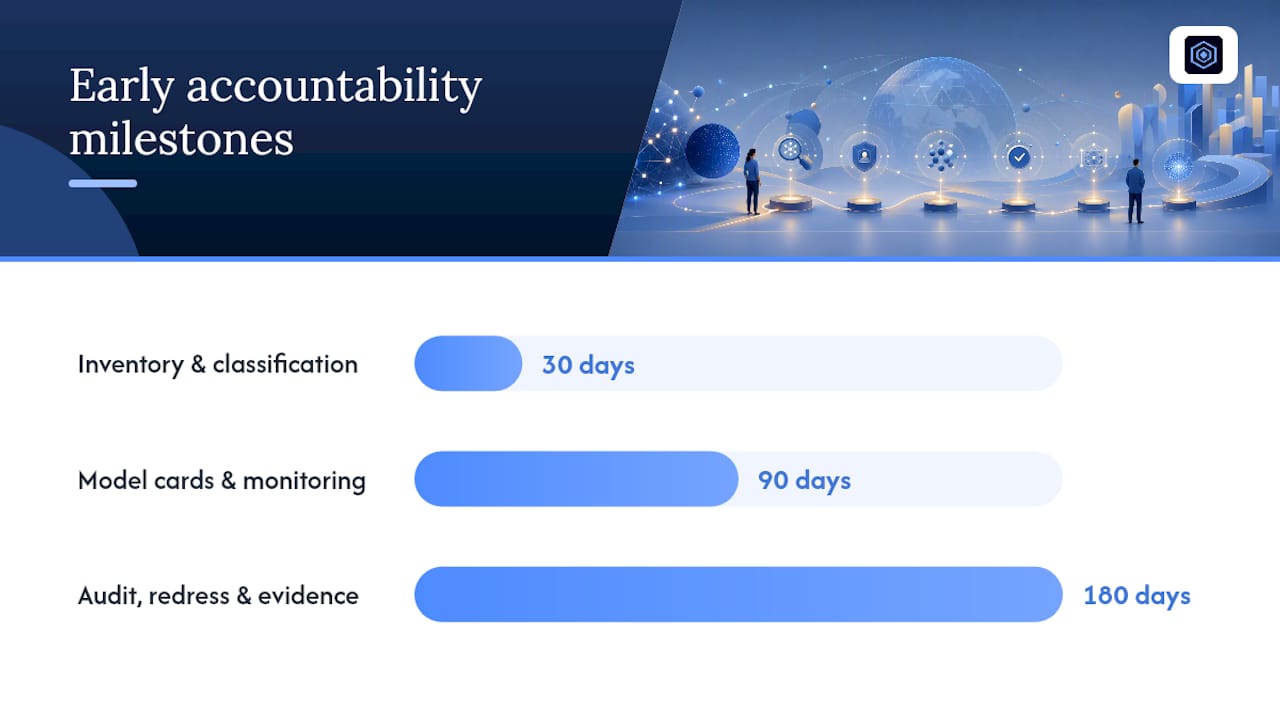
For sequencing, a practical 30/90/180-day plan looks like this: complete the system inventory and risk classification in the first 30 days; produce model cards and implement monitoring for Tier 1 systems by day 90; complete third-party audit scheduling, redress workflow documentation, and evidence pack assembly by day 180. Quick wins in the first 30 days — particularly the inventory — tend to surface governance gaps that would otherwise remain invisible until a regulatory inquiry forces them into view.
The AI governance operating model guide provides a detailed playbook for structuring these functions within regulated financial services firms.
Why governance infrastructure is the missing layer
The accountability gap in most organizations is not a shortage of policy intent. It is a shortage of evidence infrastructure. Governance policies exist; the tamper-evident, continuously generated records that make those policies verifiable to an external auditor often do not.
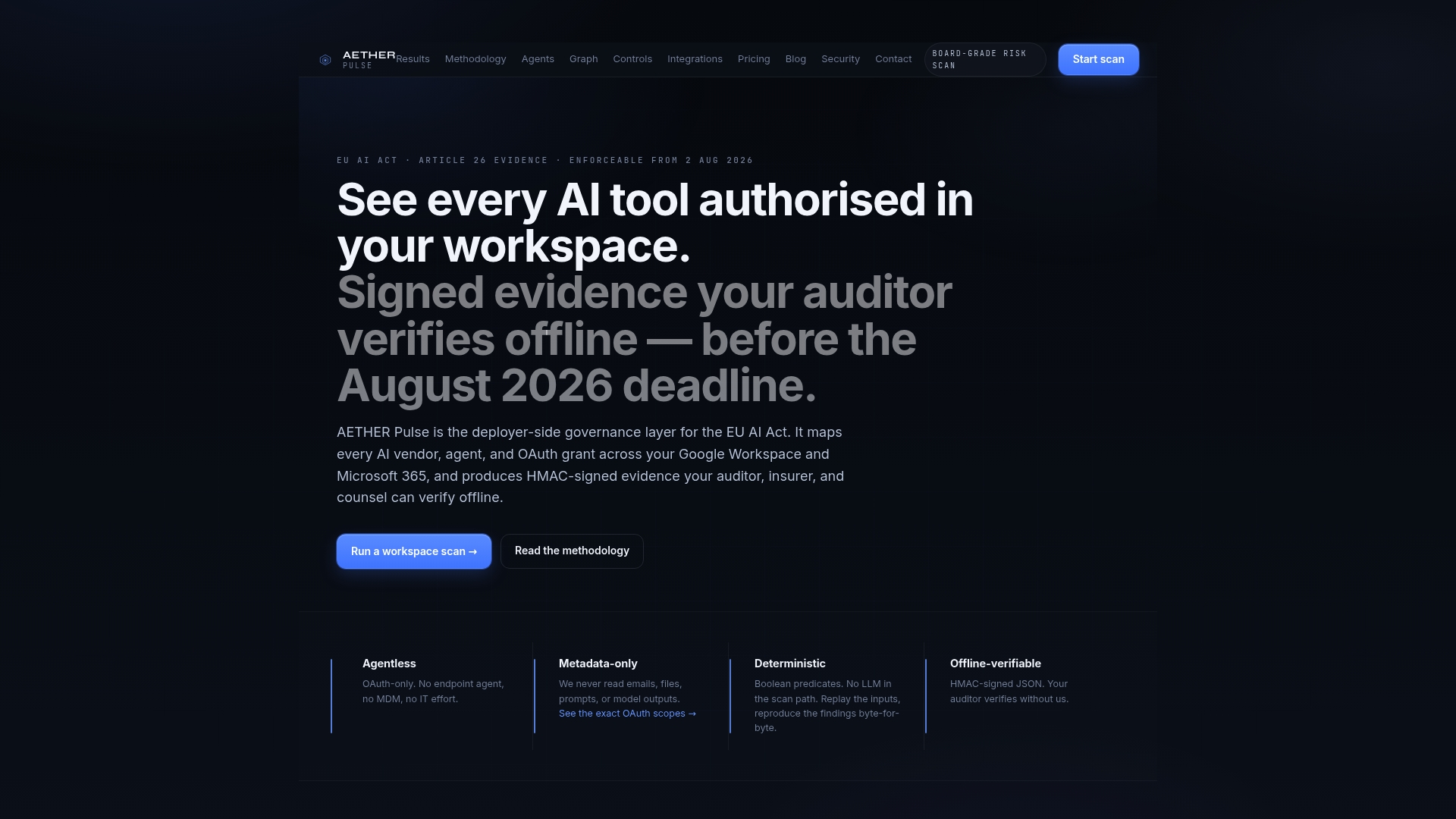
Aetherpulse was built to close that gap for regulated financial services firms. The platform connects through OAuth metadata only, touching no customer data, and builds a continuously updated inventory and identity graph of an organization's AI agents. It surfaces risk concentration — including financial blast-radius exposure — and generates cryptographically signed (HMAC-SHA256) evidence packs on demand. Those packs are the artifacts that auditors, regulators, and internal risk functions need to verify that governance obligations are being met, not just documented in policy.
The design principle is non-invasive by default: Aetherpulse does not insert itself into production systems or require agent-side instrumentation. This matters for regulated firms because governance tooling that accesses sensitive production data creates its own compliance exposure. The read-only, metadata-only architecture means firms can achieve audit-readiness without expanding their data-access perimeter.
For compliance and risk leaders who need to demonstrate algorithmic accountability to regulators today, not after the next audit cycle, Aetherpulse's evidence infrastructure provides the governance layer that turns policy commitments into verifiable, defensible records.
The accountability gap is a governance design problem, not a technical one
The most persistent misconception in this field is that algorithmic accountability will be solved by better algorithms. It will not. Fairness metrics, bias-detection tools, and explainability methods are necessary inputs to governance, but they do not create accountability. Accountability is created when a named human or organization holds formal responsibility for outcomes, has the authority to act on that responsibility, and faces consequences when they fail to do so.
What the field has learned over a decade of policy debate and enforcement action is that the technical layer and the governance layer must be designed together. A model card without a named owner who is responsible for keeping it current is a documentation artifact, not a governance control. An audit without mandatory remediation timelines is a report, not accountability. A redress pathway that requires affected individuals to prove harm without access to the model's documentation is not a pathway at all.
The EU AI Act's approach — placing explicit obligations on deployers of high-risk AI systems, requiring conformity assessments, and mandating human oversight mechanisms — reflects this governance-first logic. The U.S. is moving in the same direction through FTC enforcement, sectoral guidance, and state legislation, but the framework remains fragmented. Organizations that wait for comprehensive federal legislation before building accountability functions will find themselves behind both their regulators and their peers.
The practical implication for compliance and governance leaders: treat algorithmic accountability as a risk-control function, not a communications exercise. Build it into your model risk management framework, assign named owners, generate tamper-evident evidence continuously, and design redress pathways before you need them. That is what regulators will look for, and it is what affected individuals deserve.
Sources
The following resources provide primary documentation, practical templates, and authoritative analysis for organizations building or assessing algorithmic accountability programs.
- Algorithmic Accountability | Business & Information Systems Engineering | Springer Nature Link
- TS 104 224 - V1.1.1 - Securing Artificial Intelligence (SAI); Explicability and transparency of AI processing
- AI Now Institute — Algorithmic accountability
- Algorithmic Accountability Toolkit
- Ask the experts – What is algorithmic accountability?
- Wyden
Recommended
Working on Article 26 readiness, deployer-side governance evidence, or AI agent risk at a regulated firm? We'd value 15 minutes of your perspective.
Start a conversation